兰石重装

Search documents
兰石重装股价跌5.02%,南方基金旗下1只基金位居十大流通股东,持有596.83万股浮亏损失322.29万元
Xin Lang Cai Jing· 2025-11-12 05:35
Group 1 - The core point of the news is that Lanzhou Lanshi Heavy Equipment Co., Ltd. experienced a decline in stock price by 5.02%, with the current share price at 10.21 yuan and a total market capitalization of 13.337 billion yuan [1] - The company was established on October 22, 2001, and listed on October 9, 2014, with its main business involving traditional energy chemical equipment, new energy equipment, industrial intelligent equipment, and energy-saving environmental protection equipment [1] - The revenue composition of the company's main business includes traditional energy equipment (50.98%), metal new materials (16.65%), engineering general contracting (12.09%), energy-saving environmental protection equipment (8.59%), industrial intelligent equipment (6.49%), new energy equipment (4.13%), technical services (0.70%), and others (0.37%) [1] Group 2 - From the perspective of the top ten circulating shareholders, Southern Fund's Southern CSI 1000 ETF (512100) reduced its holdings by 73,000 shares in the third quarter, now holding 5.9683 million shares, which accounts for 0.46% of the circulating shares [2] - The estimated floating loss for the Southern CSI 1000 ETF today is approximately 3.2229 million yuan [2] - The Southern CSI 1000 ETF was established on September 29, 2016, with a latest scale of 76.63 billion yuan, and has achieved a year-to-date return of 28.07% [2]
从沉寂到复兴,煤制天然气为何迎来第二春?
Tianfeng Securities· 2025-11-11 09:16
Investment Rating - Industry Rating: Outperform the Market (Maintained Rating) [4] Core Viewpoints - The coal-to-gas industry is experiencing a revival due to improved market conditions, including a market-oriented pricing mechanism, fair access to national pipelines, and advancements in coal chemical technology [1][2][13] - There are currently 12 coal-to-gas projects planned in China, with a total capacity of 44 billion cubic meters per year, indicating a renewed interest in the sector [1][13] - The cost structure of coal-to-gas production shows that coal and depreciation account for approximately 73% of total costs, making coal prices and investment costs critical to competitiveness [2][31] Summary by Sections 1. Historical Context and Current Landscape - Prior to 2017, China planned 70 coal-to-gas projects, but only 4 were realized due to various constraints, including high coal prices and low gas prices [10] - As of 2025, only 4 companies are operational in the coal-to-gas sector, with a total capacity of about 7.5 billion cubic meters per year [10] 2. Catalysts for Industry Growth 2.1 Technological Advancements - Significant improvements in coal gasification technology have been made, enhancing the efficiency and economic viability of coal-to-gas projects [16][17] - The development of large-scale gasification equipment has reduced costs and improved operational efficiency [17] 2.2 Policy Changes - The introduction of a market-oriented pricing mechanism for coal-to-gas has improved profitability potential for projects [20] - The national pipeline reform has facilitated fair access for coal-to-gas companies, enhancing competition and operational viability [21][22] 2.3 Resource Availability - Xinjiang is identified as a major coal resource area, providing sufficient raw materials for coal-to-gas projects [24][25] - The region's coal production has increased significantly, supporting the growth of coal-to-gas initiatives [25] 2.4 Market Demand - The demand for natural gas in China is projected to grow significantly, providing a favorable market environment for coal-to-gas projects [28] - The expected annual increase in natural gas demand during the 14th Five-Year Plan period is estimated at 20.7 billion cubic meters [28] 3. Cost Competitiveness - The cost structure analysis indicates that coal prices significantly influence the profitability of coal-to-gas projects, with a stable low coal price being essential for economic viability [31][38] - A coal price of 200 RMB per ton allows for a production cost of approximately 1.46 RMB per cubic meter of gas, leading to a potential net profit of around 1.6 billion RMB for a 2 billion cubic meter project [2][36][38]
煤化工板块震荡走弱



Di Yi Cai Jing· 2025-11-11 05:56
Group 1 - The stock prices of several companies, including Lanstone Heavy Industry, Antai Group, and Hailu Heavy Industry, experienced significant declines, with drops of 5.25%, 4.92%, and 4.78% respectively [1] - Other companies such as Shaanxi Black Cat, China Coal Energy, and Yanzhou Coal Mining also saw declines exceeding 2% [1]
兰石重装股价跌5.34%,南方基金旗下1只基金位居十大流通股东,持有596.83万股浮亏损失364.07万元
Xin Lang Cai Jing· 2025-11-11 01:56
Group 1 - The core point of the article highlights the recent decline in the stock price of Lanzhou Lanshi Heavy Equipment Co., Ltd., which fell by 5.34% to 10.81 CNY per share, with a trading volume of 257 million CNY and a turnover rate of 1.79%, resulting in a total market capitalization of 14.121 billion CNY [1] - Lanzhou Lanshi Heavy Equipment Co., Ltd. was established on October 22, 2001, and listed on October 9, 2014. The company specializes in traditional energy chemical equipment, new energy equipment, industrial intelligent equipment, and energy-saving and environmental protection equipment [1] - The main business revenue composition of the company includes traditional energy equipment (50.98%), metal new materials (16.65%), engineering general contracting (12.09%), energy-saving and environmental protection equipment (8.59%), industrial intelligent equipment (6.49%), new energy equipment (4.13%), technical services (0.70%), and others (0.37%) [1] Group 2 - From the perspective of the top ten circulating shareholders of Lanzhou Lanshi Heavy Equipment, Southern Fund's Southern CSI 1000 ETF (512100) reduced its holdings by 73,000 shares in the third quarter, now holding 5.9683 million shares, accounting for 0.46% of circulating shares, with an estimated floating loss of approximately 3.6407 million CNY [2] - The Southern CSI 1000 ETF (512100) was established on September 29, 2016, with a latest scale of 76.63 billion CNY. Year-to-date returns are 28.45%, ranking 1974 out of 4216 in its category; the one-year return is 19.26%, ranking 2173 out of 3922; and since inception, the return is 13.67% [2]
煤化工板块震荡走弱 兰石重装跌5.25%
Mei Ri Jing Ji Xin Wen· 2025-11-11 01:50
Group 1 - The coal chemical sector is experiencing a downturn, with significant declines in stock prices for several companies [1] - Lansi Heavy Industry has dropped by 5.25%, Antai Group by 4.92%, and Hailu Heavy Industry by 4.78% [1] - Other companies such as Shaanxi Black Cat, China Coal Energy, and Yanzhou Coal Mining have also seen declines exceeding 2% [1]
涉嫌严重违纪违法,张金明被查
中国能源报· 2025-11-10 12:49
Group 1 - The former Party Secretary and Chairman of Lanzhou Lanshi Group Co., Ltd., Zhang Jinming, is under investigation for serious violations of discipline and law [1] - The investigation is being conducted by the Gansu Provincial Commission for Discipline Inspection and Supervision [1]


【10日资金路线图】食品饮料板块净流入约110亿元居首 龙虎榜机构抢筹多股
Zheng Quan Shi Bao· 2025-11-10 11:57
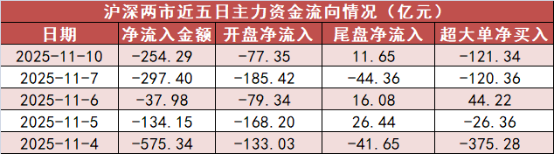
Market Overview - The A-share market showed mixed results on November 10, with the Shanghai Composite Index closing at 4018.6 points, up 0.53%, while the Shenzhen Component Index rose 0.18% to 13427.61 points. However, the ChiNext Index fell by 0.92% to 3178.83 points, and the North Star 50 Index decreased by 0.67% [1] - The total trading volume in the A-share market reached 21946.3 billion yuan, an increase of 1740.87 billion yuan compared to the previous trading day [1] Capital Flow - The main capital in the A-share market experienced a net outflow of 254.29 billion yuan, with an opening net outflow of 77.35 billion yuan and a closing net inflow of 11.65 billion yuan [2][3] - The CSI 300 index saw a net outflow of 87.96 billion yuan, while the ChiNext index had a net outflow of 147.56 billion yuan, and the Sci-Tech Innovation Board experienced a net outflow of 6.9 billion yuan [4][5] Sector Performance - Among the 13 sectors tracked, the food and beverage industry led with a net inflow of 109.94 billion yuan, reflecting a 3.49% increase [6][7] - Other sectors with significant net inflows included pharmaceuticals and biotechnology with 51.04 billion yuan, non-bank financials with 37.87 billion yuan, banks with 25.13 billion yuan, and agriculture, forestry, animal husbandry, and fishery with 24.72 billion yuan [7] - Conversely, the power equipment sector faced the largest net outflow of 211.06 billion yuan, followed by electronics with 154.94 billion yuan, and machinery with 76.27 billion yuan [7] Institutional Activity - Cambridge Technology recorded the highest net inflow of 7.58 billion yuan among individual stocks [8] - The top stocks with institutional net buying included Wanrun Technology and Tianji Shares, both showing a 10% increase [10][11] - Institutions showed interest in several stocks, with notable net buying in Prolo Pharmaceutical and Zhaoyan New Drug, indicating a positive outlook for these companies [13]
【10日资金路线图】食品饮料板块净流入约110亿元居首 龙虎榜机构抢筹多股
证券时报· 2025-11-10 11:48
Market Overview - The A-share market showed mixed performance with the Shanghai Composite Index closing at 4018.6 points, up 0.53%, while the Shenzhen Component Index rose 0.18% to 13427.61 points. The ChiNext Index fell by 0.92% to 3178.83 points, and the North Star 50 Index decreased by 0.67% [1] - Total trading volume in the A-share market reached 21946.3 billion yuan, an increase of 1740.87 billion yuan compared to the previous trading day [1] Capital Flow - The main capital in the A-share market experienced a net outflow of 254.29 billion yuan, with an opening net outflow of 77.35 billion yuan and a closing net inflow of 11.65 billion yuan [2][3] - The CSI 300 index saw a net outflow of 87.96 billion yuan, while the ChiNext and STAR Market experienced net outflows of 147.56 billion yuan and 6.9 billion yuan, respectively [4] Sector Performance - The food and beverage sector led with a net inflow of 109.94 billion yuan, showing a rise of 3.49%. Other sectors with significant inflows included biopharmaceuticals (51.04 billion yuan) and non-bank financials (37.87 billion yuan) [6][7] - Conversely, the power equipment sector faced the largest outflow of 211.06 billion yuan, followed by electronics with 154.94 billion yuan and machinery with 76.27 billion yuan [7] Stock Highlights - Cambridge Technology topped the list with a net inflow of 7.58 billion yuan [8] - Institutions actively participated in several stocks, with notable net purchases in Wanrun Technology (131.24 million yuan) and Tianji Technology (122.17 million yuan) [10][11] Analyst Ratings - Several companies received positive ratings from institutions, including Pro Pharmaceutical with a target price of 21.62 yuan, indicating a potential upside of 40.12% from its latest closing price [12]

机械设备行业资金流出榜:兰石重装等13股净流出资金超亿元
Zheng Quan Shi Bao Wang· 2025-11-10 10:36
Market Performance - The Shanghai Composite Index rose by 0.53% on November 10, with 23 out of the sectors experiencing gains, led by the beauty and personal care sector, which increased by 3.60%, and the food and beverage sector, which rose by 3.22% [1] - The sectors that saw declines included power equipment and machinery, with decreases of 1% each [1] Capital Flow - The main capital flow showed a net outflow of 31.427 billion yuan across the two markets, with 14 sectors experiencing net inflows [1] - The food and beverage sector had the largest net inflow, totaling 4.079 billion yuan, contributing to its 3.22% increase [1] - The electronic sector faced the largest net outflow, amounting to 9.600 billion yuan, followed by the power equipment sector with a net outflow of 9.087 billion yuan [1] Sector Analysis - In the machinery sector, there was a decline of 0.71%, with a net outflow of 4.024 billion yuan. Out of 531 stocks in this sector, 254 rose, 4 hit the daily limit up, while 272 fell, with 1 hitting the daily limit down [1]
指数大涨19%,为何四成股民亏损?
Sou Hu Cai Jing· 2025-11-10 08:21
Core Insights - The sudden surge in A-share nuclear energy stocks is attributed to the upcoming 2025 Fourth China Nuclear Energy High-Quality Development Conference, but deeper market dynamics are at play [1] - Among 179 nuclear power concept stocks, 164 have risen this year, representing 92% of the total, with an average increase of 51.73%, and 28 stocks have more than doubled in value [3] - Despite the overall market rally, many investors are experiencing a disconnect between index gains and individual stock performance, with only 40% of stocks outperforming the index since late October [3] Market Behavior - The perception that bull markets guarantee profits is misleading; the stock market is fundamentally a battleground where losses are possible [8] - Historical examples illustrate that stocks can experience misleading price movements, leading investors to make poor decisions based on short-term trends [11] - The difference in stock performance can often be traced back to institutional involvement, with successful stocks showing active participation from institutional investors during price adjustments [19] Investment Implications - The focus should be on nuclear stocks with prior institutional investment rather than those experiencing sudden price spikes [20] - The global increase in electricity demand and carbon neutrality goals present significant growth opportunities for the nuclear power industry, but understanding capital flow is crucial for capitalizing on these opportunities [20] - Recognizing the underlying trading behaviors and intentions is essential to avoid becoming a victim of market volatility [20]