Booking Holdings Inc.

Search documents
Should You Hold Booking Holdings (BKNG)?
Yahoo Finance· 2025-10-23 13:46
Core Insights - Wedgewood Partners' third-quarter 2025 investor letter indicates that AI stocks remain a prominent focus on Wall Street, with the Wedgewood Composite achieving a net return of 5.9%, underperforming compared to the S&P's 8.1% and the Russell 1000 Growth Index's 10.5% [1] Company Performance - Booking Holdings Inc. (NASDAQ:BKNG) reported a one-month return of -5.34% but has seen a 21.27% increase in share value over the past 52 weeks, closing at $5,230.59 with a market capitalization of $169.523 billion on October 22, 2025 [2] - The company experienced revenue growth of 16% and a 32% increase in earnings per share, driven by strong room night growth in its ex-U.S. markets [3] - Over 60% of Booking's bookings come from direct traffic to its booking.com app or website, allowing for reinvestment in advertising across various channels [3] Market Position and Strategy - Booking Holdings' strategy focuses on fragmented hotel suppliers in ex-U.S. markets, enabling it to achieve scale where competitors struggle [3] - The company's emphasis on generating attractive returns from advertising is a key driver of its success, which is expected to benefit shareholders regardless of the marketing channel [3] - Despite its potential, Booking Holdings is not among the top 30 most popular stocks among hedge funds, with a decrease in hedge fund portfolios holding the stock from 102 to 92 [4]

Apple Attacks EU Crackdown in Digital Law’s Biggest Court Test
Insurance Journal· 2025-10-22 15:51
Core Argument - Apple Inc. is challenging the European Union's Digital Markets Act (DMA), arguing that it imposes excessive burdens that conflict with its rights in the EU marketplace [1][2]. Group 1: Legal Challenge Details - Apple's lawyer claims the DMA imposes "onerous and intrusive burdens" that affect its operations in the EU [1]. - The company is contesting the law on three main fronts: interoperability obligations for rival hardware, the inclusion of its App Store under the DMA, and the investigation into iMessage [2][4][6]. - Apple argues that interoperability requirements could jeopardize user privacy, security, and intellectual property rights [4]. Group 2: Financial Implications - The App Store has faced a €500 million ($581 million) fine for alleged violations of the DMA, which Apple is challenging separately [5]. - Apple previously incurred a €1.8 billion penalty related to allowing developers to direct users to make purchases outside its store [8]. Group 3: Market Impact - The EU's actions against Big Tech have resulted in over €9.5 billion in fines against companies like Alphabet Inc. [9]. - Apple's control over the iPhone has allowed it to secure more than a third of European smartphone users, according to EU commission lawyer Paul-John Loewenthal [3].



Booking Holdings Inc. (BKNG): A Bull Case Theory
Yahoo Finance· 2025-10-22 00:14
Core Thesis - Booking Holdings Inc. is viewed positively due to its asset-light marketplace model, strong market position, and significant cash flow generation [1][5]. Business Model - Booking operates an asset-light marketplace connecting travelers and accommodation providers, earning 10-20% commissions per booking, which results in high margins and scalability across over 28 million listings in 220+ countries [2]. - The company benefits from powerful network effects, where increased hotel listings attract more travelers, creating a self-reinforcing competitive advantage [2]. Market Position - While Expedia leads in the U.S. market, Booking dominates Europe and Asia, being the global leader in room nights booked [3]. - Booking's diversification into vacation rentals enhances its competitive edge against Airbnb by providing a one-stop solution for homes, apartments, and hotels [3]. Financial Performance - The company enjoys strong operating margins exceeding 30% in favorable years, supported by a financial model characterized by negative working capital, where traveler payments are collected upfront [3][4]. - Booking reported a free cash flow of $7.8 billion, contributing to its stock price appreciation of approximately 19% since previous coverage [5]. Marketing and Risks - Booking's marketing scale, particularly as one of Google's largest advertisers, allows it to capture high-intent demand, although this creates a reliance on Google [4]. - Key risks include competition from Airbnb and Expedia, regulatory pressures, and potential encroachment by Google into the travel sector, but the company counters these with loyalty programs and adaptability [4].
当增长停滞,那些能“二次起飞”的公司做对了什么?
3 6 Ke· 2025-10-20 01:33
Core Insights - Companies can achieve "breakthrough growth" even during periods of stagnation by reshaping strategies, expanding core business, reallocating resources, innovating business models, or launching new products [1][3][4] Group 1: Breakthrough Growth Characteristics - Breakthrough growth is defined as achieving sales growth at least twice that of peers over five years, followed by sustained growth above industry averages [3] - In a study of 848 global companies experiencing stagnation, 99 companies successfully overcame challenges, achieving an average total shareholder return (TSR) of nearly 20% during the initial five years of breakthrough growth [3] - Companies achieving breakthrough growth did not sacrifice profitability, with an average profit margin increase of one percentage point during the initial growth phase [3] Group 2: Strategies for Achieving Breakthrough Growth - **Scale Expansion**: 45% of companies achieved breakthrough growth by increasing investment in core businesses, resulting in an average annual revenue growth of 16% and a TSR of 16% during the initial phase [5] - **Resource Reconfiguration**: 31% of companies shifted their business portfolios towards high-growth areas, achieving an average annual revenue growth of 20% and a TSR of 17% [7] - **Business Model Innovation**: 14% of companies changed their sales methods rather than the products themselves, leading to an average annual revenue growth of 20% and a TSR of 21% [9] Group 3: Examples of Successful Companies - United Rentals expanded its scale through a significant acquisition during the post-financial crisis, achieving a 68% TSR in the five years following the acquisition [6] - Constellation Brands shifted focus to the growing Mexican beer market, resulting in a twofold sales increase over ten years and a 45% TSR during the breakthrough growth phase [8] - Nintendo successfully innovated with the launch of the Switch console, achieving a 49% compound annual growth rate in revenue and a TSR exceeding 30% over five years [12] Group 4: Transformative Actions During Crisis - Companies often find opportunities for breakthrough growth during crises, with 36% of successful companies facing significant demand shifts [14] - External pressures, such as investor demands or market disruptions, can catalyze transformative actions, with two-thirds of breakthrough growth companies experiencing activist investor pressure prior to their growth phase [15] Group 5: Steps to Achieve Breakthrough Growth - **Choose the Right Strategy**: Companies must assess their current situation and select strategies that align with their strengths and market conditions [16] - **Focus Beyond Growth**: Successful companies adjust their cost structures and organizational processes to support growth initiatives [17] - **Capitalize on Crisis Opportunities**: Leaders should maintain focus on opportunities during crises to drive fundamental changes [18]

美股市场速览:“TACO”再现,市场呈现修复迹象
Guoxin Securities· 2025-10-19 11:20
Investment Rating - The report maintains a "Weaker than the market" investment rating for the U.S. stock market [1] Core Insights - The U.S. stock market shows initial signs of recovery, with the S&P 500 rising by 1.6% and the Nasdaq by 2.1% [3] - Among 22 sectors, 20 experienced capital inflows, with significant inflows into semiconductor products and equipment (+$46.6 billion) and automotive and automotive parts (+$22.5 billion) [4] - Earnings expectations for the S&P 500 constituents have been adjusted upward by 0.4%, with notable increases in banking (+1.7%) and semiconductor products and equipment (+1.0%) [5] Summary by Sections Price Trends - The S&P 500 increased by 1.6%, while the Nasdaq rose by 2.1% [3] - The automotive and automotive parts sector saw the highest increase at +6.1%, followed by media and entertainment (+4.0%) and food and staples retailing (+3.6%) [3] Capital Flows - Estimated capital inflow for S&P 500 constituents was +$91.7 billion this week, up from +$12.5 billion the previous week [4] - The semiconductor products and equipment sector led with a capital inflow of +$46.6 billion [4] Earnings Forecast - The earnings per share (EPS) forecast for the S&P 500 has been raised by 0.4% this week [5] - The banking sector saw the largest upward revision in earnings expectations at +1.7% [5]




Airbnb:2025 年第三季度业绩或不及预期
美股研究社· 2025-10-17 10:39
Core Viewpoint - Airbnb is facing challenges due to a slowdown in non-traditional accommodation demand and increased competition, which may lead to underperformance in its upcoming Q3 2025 earnings report [1][4][11]. Group 1: Financial Performance - In Q2 2025, Airbnb reported a Gross Booking Value (GBV) of $23.5 billion, a year-on-year increase of 10.8% [5]. - Revenue for Q2 2025 was $3.1 billion, reflecting a 12.7% year-on-year growth [5]. - Adjusted EBITDA for Q2 2025 reached $1 billion, up 11.8% year-on-year [5]. - The company’s earnings per share (EPS) was $0.98, a 19.5% increase compared to the previous year [5]. - The average daily rate (ADR) globally was $174, showing a 2.3% year-on-year increase [5]. Group 2: Market Conditions - The North American market, which accounts for 30% of Airbnb's total bookings, is experiencing weak demand, which could have led to stronger growth if excluded [6]. - The overall travel industry indicators are mixed, with hotel demand declining by 0.4% year-on-year, while short-term rental demand has seen some growth [9][10]. Group 3: Valuation Analysis - Airbnb's current forward EV/EBITDA ratio is 14.93, which is above the industry median of 10.36 [8][9]. - The forward P/E ratio is 27.95, significantly higher than the sector median of 16.99 [8][9]. - Despite a recent decline in stock price, Airbnb's valuation remains relatively high compared to its peers, such as Expedia and Booking [9]. Group 4: Future Outlook - The market consensus is lowering expectations for Airbnb's revenue and net profit growth rates, with projected CAGR for revenue at 9.7% and for net profit at 10.9% by FY 2027 [14][15]. - The company has a healthy balance sheet with a net cash position of $9.36 billion, supported by $4.27 billion in free cash flow over the last 12 months [15]. - Stock buybacks have been implemented, with 3.1% of shares repurchased in the last 12 months, totaling 8.4% since Q2 2022 [15]. Group 5: Potential Catalysts - Analysts may adjust ratings if Airbnb can achieve higher pricing for its non-traditional accommodations and value-added services, improve domestic travel trends in North America, expand its property supply, or launch more value-added services [18].

Citizens Reiterates Market Outperform Rating on Booking Holdings (BKNG), Maintains $6,500 PT
Yahoo Finance· 2025-10-16 20:19
Group 1 - Booking Holdings Inc. is identified as a stock to buy by Ray Dalio's Bridgewater Associates, with Citizens reiterating a "Market Outperform" rating and maintaining a price target of $6,500 [1][2] - Analysts highlighted Booking Holdings' competitive strengths, including broad diversification, a strong global brand, and extensive product offerings across hotels, flights, rental cars, and activities [1] - The company is well positioned to capitalize on resilient global travel demand, robust profit margins, and high-value customer retention through its Genius loyalty program [1] Group 2 - Booking Holdings is recognized as the world's leading provider of online travel and related services, operating well-known brands such as Booking.com, Priceline, Agoda, KAYAK, and OpenTable [3] - The company generates revenue primarily through commissions on hotel reservations, airline tickets, rental cars, and restaurant bookings made via its platforms [3] - Citizens named Booking Holdings as one of the first partners to launch travel apps within ChatGPT, enhancing interactive and personalized user experiences [2]
Law Tech Spotlight Examines Tax Exposure Claims Against LuxUrban Hotels Inc., Citing OTA Payment and Tax Collection Laws
Globenewswire· 2025-10-15 20:34
Core Insights - The analysis by Law Tech Spotlight concludes that claims against LuxUrban Hotels regarding large-scale tax liabilities in New York are likely inaccurate and legally precluded under state and city law [1][3]. Findings and Legal Basis - From 2020 to 2025, LuxUrban Hotels generated approximately $248 million in gross room revenue across 11 U.S. states and cities, with audited net room revenue totaling $149 million, of which only $56 million (22.6%) came from New York operations [2]. - Under New York State Tax Law, entities defined as "room remarketers" or "resellers," including OTAs, are responsible for collecting and remitting occupancy and sales taxes, not the hotel operators [3]. OTA Payment Structure - Between 2022 and 2025, 92–97% of LuxUrban's customers booked through OTAs, meaning LuxUrban did not handle customer payments or collect taxes, as OTAs charged guests and remitted taxes [4][5]. - The OTA payment structure defines the merchant-customer relationship and tax responsibility, indicating that LuxUrban did not control or process payments for the majority of its bookings [5][6]. Legal Implications - False claims regarding unpaid taxes may expose responsible parties to defamation and commercial disparagement under New York law, with potential recoverable damages for LuxUrban reaching tens of millions of dollars [7][8]. - The spokesperson for the LawTech Review emphasized that allegations against LuxUrban regarding tax remittance are unfounded and ignore statutory authority and the financial technology involved in hospitality commerce [9].


KAYAK INTRODUCES AI MODE: CONVERSATIONAL TRAVEL SEARCH, JUST IN TIME FOR HOLIDAY PLANNING
Prnewswire· 2025-10-15 14:02
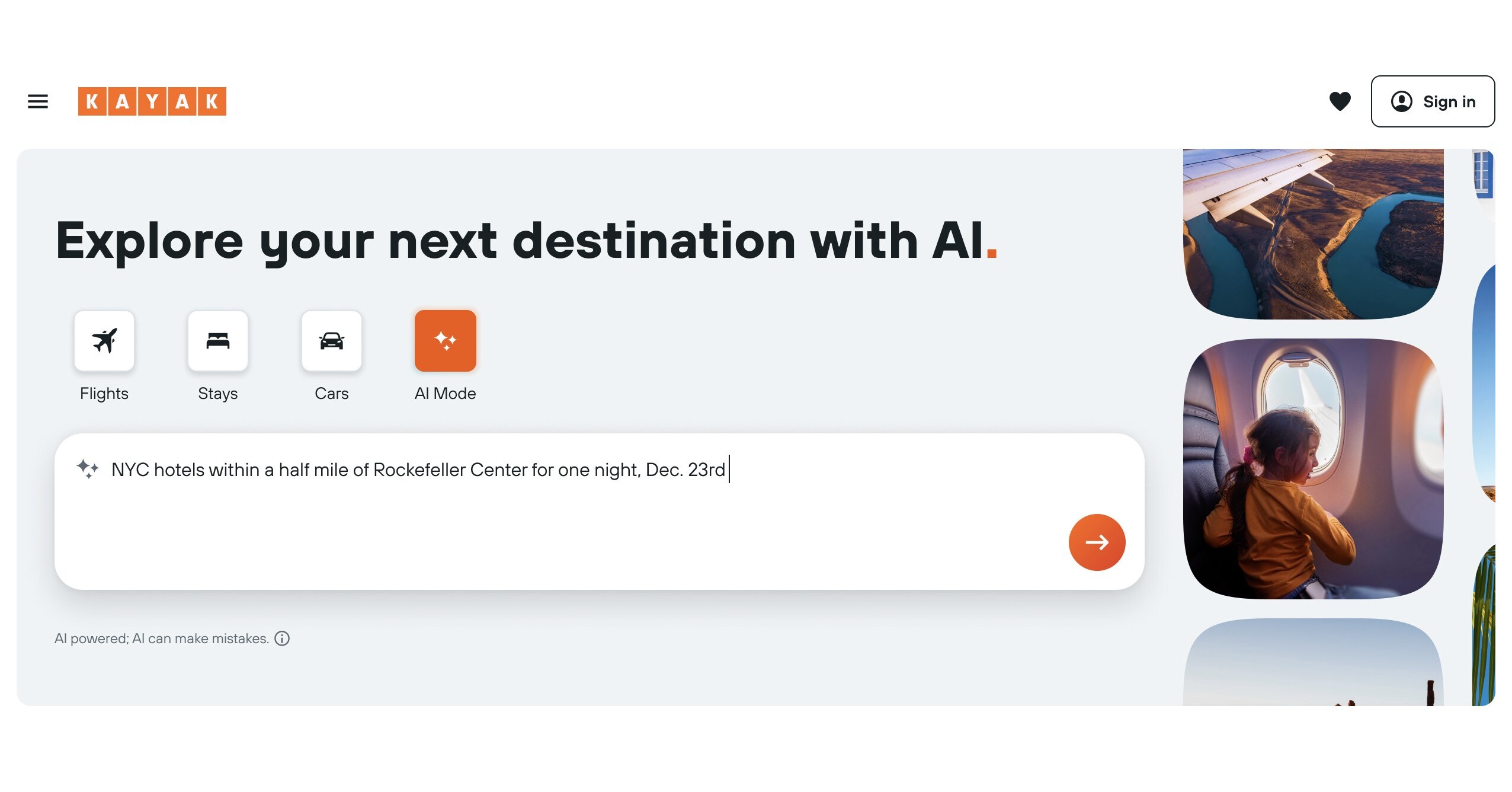
Core Insights - KAYAK has launched AI Mode, a natural-language search feature that integrates ChatGPT to enhance user experience on its homepage, allowing travelers to plan trips by typing questions in plain language [1][2][3] - The introduction of AI Mode coincides with the peak holiday travel planning period, as KAYAK data indicates that mid-October to early November is optimal for securing holiday travel deals [2][3] KAYAK AI Mode Features - AI Mode enables users to receive contextual travel information without being restricted to preset entry fields, making the search process more intuitive [2][3] - The feature is currently available in English on desktop and mobile browsers in the US, with plans for additional languages and platforms, including voice entry, to be rolled out soon [4] Holiday Travel Insights - KAYAK reports that holiday flight prices are trending lower than the previous year, with a 10% increase in search demand compared to 2024, suggesting travelers should book soon [3][8] - Notable travel insights include November 24 being the cheapest day to fly for Thanksgiving at an average price of $415, and Christmas Eve offering the best deals for both domestic and international trips [3][8] User Engagement - KAYAK encourages users to explore holiday-themed prompts in AI Mode to discover actionable trip ideas, enhancing user engagement and travel planning [3][6] - Examples of travel-related queries that can be made using AI Mode include specific hotel searches, car rentals, and unique travel experiences [7]
Brands adapting to market challenges drives the total value of 2025’s Best Global Brands by $150 billion
Retail Times· 2025-10-15 09:53
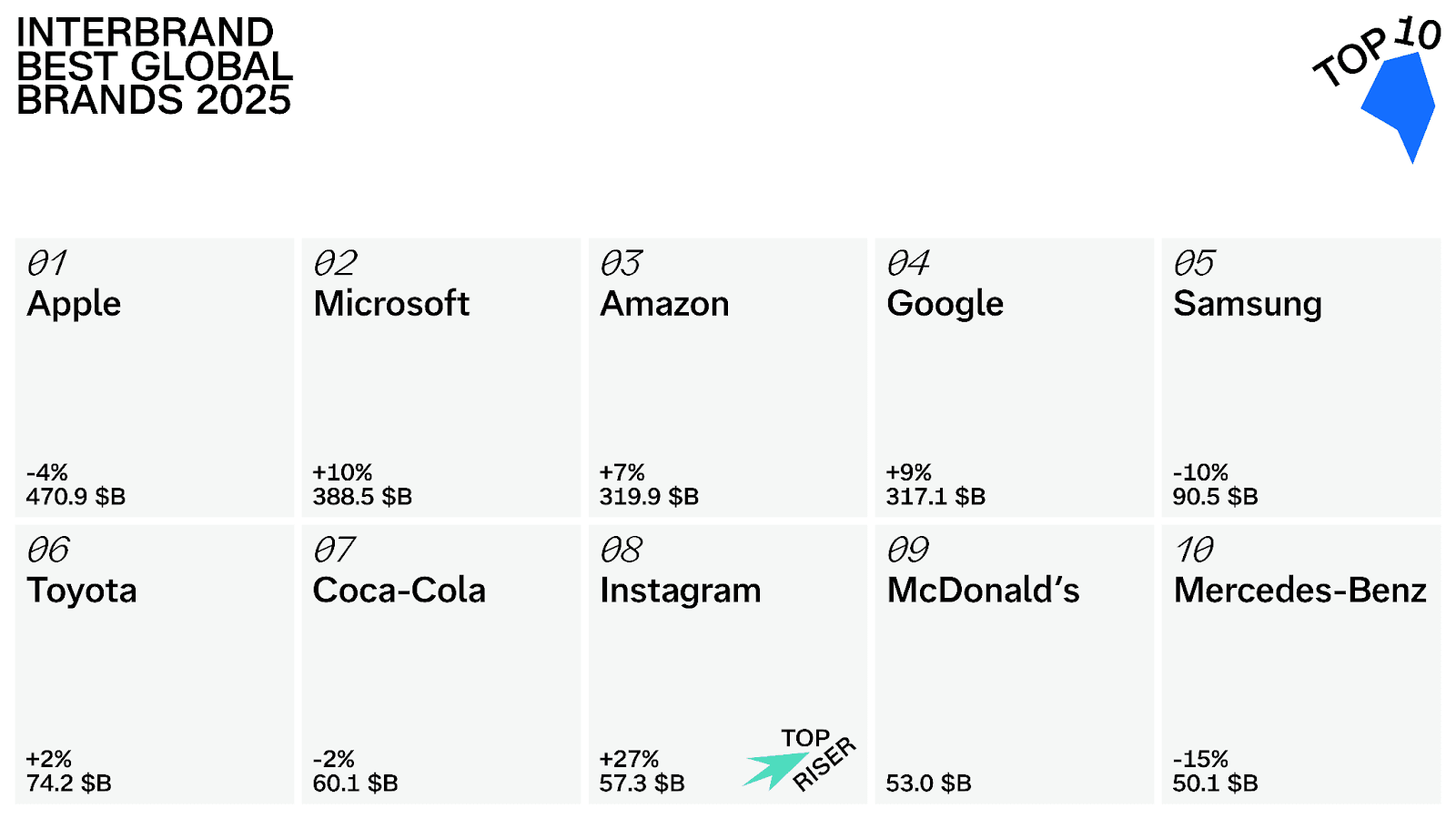
Core Insights - The total value of the Best Global Brands in 2025 is $3.6 trillion, reflecting a 4.4% increase from $3.4 trillion in 2024, with notable movements including 12 new entrants and significant declines for some brands [2][3] Brand Performance - Luxury brands show mixed results, with Hermès increasing by 18% to rank 21, while Louis Vuitton decreased by 5% to 12, and Gucci fell out of the top 50 with a 35% decline [3] - High-performing brands include Nvidia, which surged by 116% to $43.2 billion at 15, and YouTube, which grew by 61% to 13, while Netflix increased by 42% to 28 [4][5][11] - Uniqlo entered the rankings at 47 with a value of $17.7 billion, defying retail trends as most retailers faced declines [8] Sector Trends - The automotive sector is experiencing challenges with the shift to electric vehicles (EVs), with Toyota growing by 2% at 6, while Tesla saw a 35% decline to 25 [9] - Digital media and entertainment platforms are seeing significant brand value increases, with Instagram entering the Top 10 for the first time [5][6] New Entrants and Disruption - The report highlights the highest number of new entrants, including Blackrock (31), Booking.com (32), and Shopify (99), indicating a trend towards brands solving specific customer problems effectively [4][12] - Brands that view disruption as an opportunity, such as Instagram and Netflix, are successfully unlocking new revenue streams [13]