Anthropic

Search documents
Why Musk’s SpaceX mega-merger is a mega-bailout
Bloomberg Television· 2026-02-06 18:08
Elon has actually always hated running a public company. He hates quarterly earnings calls. A lot of disclosure like, yeah, this is really like a financial play more than anything else.xAI is losing, according to Bloomberg's reporting. And, you know, other other reporting backs up as well. A huge amount of money.I think we've said billion a month. Why are they losing so much money. Well, every air play is losing huge amounts of money because building these models requires you to build giant chips.And there' ...


Why Musk’s SpaceX mega-merger is a mega-bailout
Bloomberg Technology· 2026-02-06 18:07
Elon has actually always hated running a public company. He hates quarterly earnings calls. A lot of disclosure like, yeah, this is really like a financial play more than anything else.xAI is losing, according to Bloomberg's reporting. And, you know, other other reporting backs up as well. A huge amount of money.I think we've said billion a month. Why are they losing so much money. Well, every air play is losing huge amounts of money because building these models requires you to build giant chips.And there' ...

科技股回调之际 交易员追逐“抗AI”股票
Xin Lang Cai Jing· 2026-02-06 17:57
Group 1 - The core viewpoint of the article highlights a shift in investor sentiment towards companies that cannot be easily replicated by artificial intelligence (AI), as technology stocks face declines [1] - The S&P 500 index has dropped by 0.9% this week, primarily due to concerns over AI disrupting business models, particularly in the software sector [1] - In contrast, sectors such as residential construction, transportation, and heavy machinery manufacturing have seen strong gains, with the consumer staples sector rising by 5.2%, marking its best weekly performance since 2022 [1] Group 2 - The Dow Jones Industrial Average has outperformed both the S&P 500 and the tech-heavy Nasdaq 100, indicating a preference for traditional economic giants over tech stocks [1] - This trend contradicts the logic that has driven the U.S. stock market bull run over the past three years, where tech stocks were seen as the main market drivers due to expectations of economic transformation through AI [1] - Investors are rotating towards "anti-AI" sectors, which possess tangible, real-world attributes, as noted by JonesTrading's chief market strategist Michael O'Rourke, suggesting that dull industries may now hold unprecedented appeal [1]
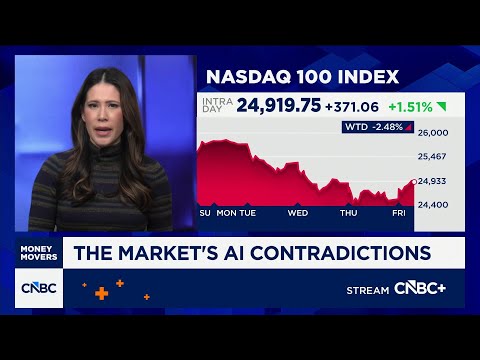
The market's AI contradictions
Youtube· 2026-02-06 17:39
Group 1 - Over a trillion dollars have been wiped out from big tech market caps in the last week, as major hyperscalers announced plans to spend over $600 billion in capital expenditures this year [1] - There is a contradiction in the AI trade, where software stocks are declining despite the significant investments being made by mega-cap companies to develop AI technologies [2][6] - Meta is highlighted as a key example, spending 50% of its revenue on AI infrastructure, while Amazon spends only half of that despite having a large cloud business [3] Group 2 - Meta's top-line growth has accelerated, but its capital expenditures relative to revenue are increasing at a faster rate, leading to a decline in operating margins from 48% to 41% year-over-year [3] - Free cash flow for Meta fell by 15% last year, and projected spending this year could reduce it by half or more [4] - OpenAI is preparing for a potential trillion-dollar IPO, and Anthropic is reportedly in early talks to go public, which will provide clearer financial metrics for the AI sector [5] Group 3 - Amazon's AWS is experiencing its fastest growth in three years, with a backlog growing at 38%, yet the company is facing stock price declines [6] - The current market environment is characterized by uncertainty, with macroeconomic factors potentially overshadowing company-specific developments [7] - The rapid advancements in AI technology are creating a challenging landscape for predicting which companies will thrive or be disrupted [8][9]



The market's AI contradictions
CNBC Television· 2026-02-06 17:39
More than a trillion dollars wiped out from big tech market caps in just the last week as those four large hyperscalers announced they expect to spend more than $600 billion in capex this year. Our DOSA has more on that in today's tech. Happy Friday Dean. >> Hey, happy Friday morning Carl.So this really gets at a contradiction right now at the heart of the AI trade. software stocks, they're in freef fall. And the logic here is that well, AI works so well, it's going to eat these companies alive.Yet, the oth ...
X @Elon Musk
Elon Musk· 2026-02-06 17:26
RT ₕₐₘₚₜₒₙ (@hamptonism)Anthropic CEO:Software engineering will be completely obsolete in 6-12 months… https://t.co/EwKq8l7HE7 ...
全线暴跌!凌晨超43万人爆仓,美股、黄金、白银、比特币、石油集体重挫
Sou Hu Cai Jing· 2026-02-06 16:33
Group 1: Cryptocurrency Market Collapse - The cryptocurrency market experienced a significant crash, with Bitcoin's price plummeting from over $70,000 to $63,860.8, marking a daily drop of 12.81% and a total decline of over 48% since its peak in October 2024 [3] - The total market capitalization of Bitcoin halved from its peak of $2.48 trillion to $1.27 trillion, with over 43,000 traders facing liquidation, resulting in total losses of approximately $2.069 billion [3] - Ethereum dropped by 13.1%, XRP fell over 22%, and other cryptocurrencies like SOL and Dogecoin also saw declines exceeding 14% [3] Group 2: Traditional Financial Markets Impact - The traditional financial markets were not spared, with major U.S. stock indices falling over 1%, and the Nasdaq index experiencing a 1.59% drop, marking its worst three-day decline since April of the previous year [4][5] - Major tech stocks such as Amazon and Microsoft saw declines exceeding 4%, while Nvidia dropped over 1%, reflecting a broader sell-off in the tech sector [5] - Concerns arose from the introduction of a new AI model by Anthropic, which led investors to worry about the potential disruption to traditional software and financial services companies [5] Group 3: Economic Indicators and Employment Data - The U.S. labor market showed signs of distress, with employers announcing 108,435 layoffs in January 2026, the highest number for that month since the global financial crisis [6] - Initial jobless claims increased beyond market expectations, and job vacancies fell to their lowest level since September 2020, indicating a cooling labor market [8] - The disconnect between job losses and GDP growth, which remained around 4%, raised concerns about the long-term implications for the economy [6] Group 4: Precious Metals and Commodities - Precious metals also faced significant declines, with silver prices dropping over 19% and gold prices falling more than 3%, following a historical sell-off [8] - The Chicago Mercantile Exchange raised margin requirements for gold and silver futures to control market volatility, which could force leveraged traders to liquidate positions [8] Group 5: Investor Sentiment and Market Fear - A "crisis of confidence" spread from the cryptocurrency sector to the broader financial market, with the CNN Fear and Greed Index plummeting to 10, indicating extreme fear among investors [11] - The proportion of individual investors expecting a market downturn surged to 68%, the highest level since December 2008, reflecting widespread pessimism across both institutional and retail investors [12]

The Super Bowl ad game: Top ads to look forward to this weekend
CNBC Television· 2026-02-06 15:20
The Super Bowl. We know this is more than a game. For many viewers, it's about the commercials that are costing up to $10 million for 30 seconds.Uh this year, there will be a faceoff between two AI names, OpenAI and Anthropic. Joining us now, Marcus Collins, marketing professor at the University of Michigan's Ross School of Business and author of For the Culture. We've come a long way, Marcus. Come a long way.Used to be Coke and Pepsi, didn't it. Used to be Coke and Pepsi. Uh, now now it's Isn't that incred ...

We're All Addicted To Claude Code
Y Combinator· 2026-02-06 15:01
I feel like when I'm using quad code, it's like, oh, I feel like I'm flying through the code. >> When it's in your CLI, this thing can debug nested delayed jobs like five levels in and figure out what the bug was and then write a test for it and it never happens again. This is insane. I think everyone who's experimenting with this stuff on like a hobbyist level or at like a very small startup, they're just pushing the coding agents as far as they can go because it's like you don't really have time to figure ...

两周搓出的Claude Cowork,让硅谷一夜蒸发2万亿,AI真要杀死软件?
虎嗅APP· 2026-02-06 14:10
Core Viewpoint - The article discusses a significant sell-off in the software sector, triggered by the introduction of AI capabilities by Anthropic, which threatens traditional software companies and their business models [4][6][19]. Group 1: Market Reaction - The global capital market has indiscriminately sold off software stocks, with major companies like Salesforce, Workday, and Intuit losing nearly $258 billion in market value in a single day [4]. - The North American software index experienced a 15% decline in January, marking the worst monthly performance since 2008 [4]. - The sell-off has spread to the Asia-Pacific market, leading to sharp declines in the stock prices of several industry leaders [4]. Group 2: AI's Impact on Software - Anthropic's AI application, Claude Cowork, has introduced capabilities that allow it to perform tasks traditionally done by humans, such as managing files and operating software [8][10]. - The release of specific plugins for various industries, including law and finance, indicates a shift where AI is not just a tool but a competitor to traditional software providers [11][13]. - Analysts predict that up to 50% of entry-level white-collar jobs may be impacted by AI within the next 1 to 5 years, posing a threat to companies that provide software tools for these roles [13]. Group 3: Software Industry Challenges - Software vendors are in a precarious position, needing to demonstrate revenue growth to alleviate concerns about AI's impact [15]. - Major companies are announcing layoffs, indicating a tightening of corporate budgets and a reluctance to invest in traditional software when AI can perform tasks at a lower cost [16]. - The trend of "downgrading" software is emerging, as companies reconsider the necessity of expensive SaaS solutions in light of AI capabilities [16]. Group 4: Future of Software Companies - The software industry is expected to split into two categories: "tool-based" software that will likely be eliminated and "system-based" software that must adapt to survive [24][25]. - Future software companies will need to shift from a per-user pricing model to a results-based pricing model, as AI agents reduce the need for human users [27]. - Gartner predicts that by the end of 2026, 40% of enterprise SaaS will incorporate outcome-based pricing elements, marking a significant shift in the industry [27].