
金融风暴

Search documents
全线暴跌!凌晨超43万人爆仓,美股、黄金、白银、比特币、石油集体重挫
Sou Hu Cai Jing· 2026-02-06 16:33
Group 1: Cryptocurrency Market Collapse - The cryptocurrency market experienced a significant crash, with Bitcoin's price plummeting from over $70,000 to $63,860.8, marking a daily drop of 12.81% and a total decline of over 48% since its peak in October 2024 [3] - The total market capitalization of Bitcoin halved from its peak of $2.48 trillion to $1.27 trillion, with over 43,000 traders facing liquidation, resulting in total losses of approximately $2.069 billion [3] - Ethereum dropped by 13.1%, XRP fell over 22%, and other cryptocurrencies like SOL and Dogecoin also saw declines exceeding 14% [3] Group 2: Traditional Financial Markets Impact - The traditional financial markets were not spared, with major U.S. stock indices falling over 1%, and the Nasdaq index experiencing a 1.59% drop, marking its worst three-day decline since April of the previous year [4][5] - Major tech stocks such as Amazon and Microsoft saw declines exceeding 4%, while Nvidia dropped over 1%, reflecting a broader sell-off in the tech sector [5] - Concerns arose from the introduction of a new AI model by Anthropic, which led investors to worry about the potential disruption to traditional software and financial services companies [5] Group 3: Economic Indicators and Employment Data - The U.S. labor market showed signs of distress, with employers announcing 108,435 layoffs in January 2026, the highest number for that month since the global financial crisis [6] - Initial jobless claims increased beyond market expectations, and job vacancies fell to their lowest level since September 2020, indicating a cooling labor market [8] - The disconnect between job losses and GDP growth, which remained around 4%, raised concerns about the long-term implications for the economy [6] Group 4: Precious Metals and Commodities - Precious metals also faced significant declines, with silver prices dropping over 19% and gold prices falling more than 3%, following a historical sell-off [8] - The Chicago Mercantile Exchange raised margin requirements for gold and silver futures to control market volatility, which could force leveraged traders to liquidate positions [8] Group 5: Investor Sentiment and Market Fear - A "crisis of confidence" spread from the cryptocurrency sector to the broader financial market, with the CNN Fear and Greed Index plummeting to 10, indicating extreme fear among investors [11] - The proportion of individual investors expecting a market downturn surged to 68%, the highest level since December 2008, reflecting widespread pessimism across both institutional and retail investors [12]

红星观察| 国债被“抛售”,债市遭暴击,日本恐面临3年前英国类似的金融风暴
Sou Hu Cai Jing· 2025-12-04 11:18
Group 1 - The yield on Japan's 10-year government bonds has surpassed 1.94%, indicating a significant decline in market prices for fixed-income securities [1][3] - Japan's GDP has contracted for the first time in six quarters, with a year-on-year decline of 1.8% in the third quarter of 2025, leading to substantial drops in the stock market [3] - The depreciation of the yen against the dollar is nearing the psychological threshold of 160, contributing to investor concerns [3] Group 2 - Japan's export-dependent economy has been severely impacted by high tariffs from the U.S., with a 1.2% decline in goods and services exports in the third quarter of 2025, and a 10.2% year-on-year drop in exports to the U.S. during the first half of the fiscal year [4] - The automotive sector has faced significant losses, with major companies reporting a combined net profit drop of 30%, exceeding 1.5 trillion yen [4] - The tourism industry has also suffered, with over 540,000 flight cancellations from Chinese tourists, leading to potential losses in the sector amounting to trillions of yen [4] Group 3 - A supplementary budget of 21.3 trillion yen for the fiscal year 2025 has been approved, significantly higher than the previous year's budget, raising concerns among bondholders [5] - The budget primarily focuses on direct financial aid, including subsidies for gas and electricity, and rice vouchers for local governments, which has drawn criticism for its lack of sustainable funding [5] Group 4 - The current fiscal strategy of tax cuts and subsidies has drawn parallels to the financial crisis in the UK in 2022, where similar measures led to a loss of market confidence and significant economic turmoil [7] - The UK experience serves as a cautionary tale for Japan, highlighting the potential risks associated with unbacked fiscal policies and the rapid rise in bond yields [7]

香港顶级豪宅“山顶道1号”发生命案,31岁菲佣在房内轻生,金庸曾住这里11年
第一财经· 2025-10-10 07:10
Core Viewpoint - The article discusses a tragic incident involving a Filipino domestic worker who committed suicide in a luxury residence located at 1 Peak Road, Hong Kong, which is now considered the most expensive haunted house in the city due to the incident [3]. Group 1: Incident Details - The incident occurred on October 8 at 7:35 AM, involving a 31-year-old Filipino domestic worker [3]. - The property is owned by Zhang Songqiao, known as the "Chongqing Li Ka-shing," who is a prominent real estate developer in Hong Kong [3][5]. Group 2: Property History - The property at 1 Peak Road was previously owned by the U.S. Consulate, which sold it during a market downturn between 1981 and 1983 for a total of HKD 120.5 million [6]. - In 1985, the property was purchased by the famous martial arts novelist Jin Yong (Louis Cha) and his wife for HKD 12 million, and they lived there for 11 years before selling it for HKD 196 million in 1996 [8].

就在上周五,“美元、美债双杀”之下,有人爆了!
Hua Er Jie Jian Wen· 2025-05-05 03:24
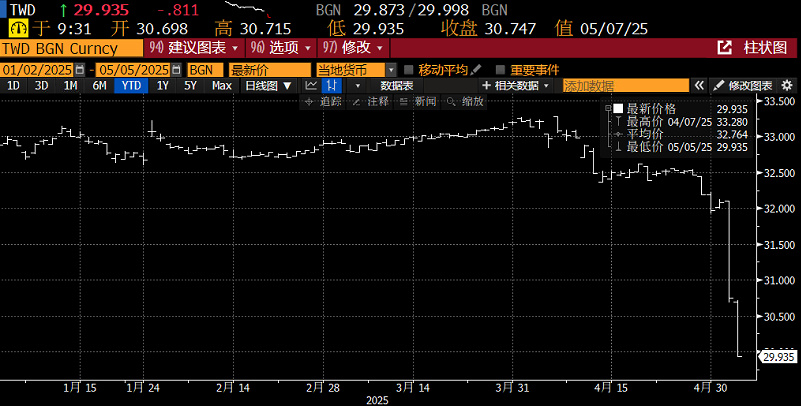
Core Viewpoint - The sudden surge of the New Taiwan Dollar (NTD) against the US dollar, reaching its highest level since February 2023 and marking the largest single-day increase in 40 years, is attributed to both external factors and internal financial dynamics, particularly the actions of Taiwan's life insurance companies [1][3]. Group 1: Currency Fluctuations - The NTD experienced a 3% increase last Friday and a further 4% rise on Monday, indicating significant volatility in the foreign exchange market [1]. - The surge in the NTD may be superficially linked to increased demand for Taiwanese semiconductors from the US tech sector, but it is primarily driven by life insurance companies hedging against dollar exposure [3]. Group 2: Structural Issues in the Insurance Sector - Taiwan's life insurance industry faces a substantial structural mismatch, with approximately $1 trillion in private hands, of which $700 billion is held in insurance investment portfolios [4]. - The insurance companies have relied on issuing policies in NTD while investing in USD assets, leading to a currency mismatch risk exceeding 40% of their investment portfolios, amounting to about $460 billion, which is over 60% of Taiwan's GDP [4]. Group 3: Risks and Challenges - The life insurance sector is exposed to three main risks: depreciation of the USD against the NTD, high currency hedging costs, and capital losses due to rising US bond yields [5]. - The financial stability of Taiwan is significantly threatened by the combination of a weak USD and high US interest rates, which could lead to substantial losses for the insurance companies [6]. Group 4: Hedging Strategies - Although Taiwan's life insurance companies have some hedging strategies in place, approximately $200 billion of USD assets remain unhedged, equating to a quarter of Taiwan's GDP [10]. - The hedging tools primarily involve foreign exchange forward contracts, which have become costly, especially during periods of aggressive interest rate hikes by the Federal Reserve [10]. Group 5: Future Outlook - If the USD continues to weaken and Taiwan cannot effectively intervene, the life insurance sector may be forced to further hedge its dollar exposure, potentially leading to a spiral effect of NTD appreciation [11]. - The ongoing situation may signal the beginning of a broader financial restructuring globally, particularly if the USD enters a prolonged depreciation phase [12].
美国石化业或迎寒冬
Zhong Guo Hua Gong Bao· 2025-04-14 02:19
Group 1 - The U.S. announced a "reciprocal tariff" policy on April 2, leading to significant turmoil in global financial markets, with a notable drop in stock markets and oil prices [1] - Following the announcement, global stock markets experienced a decline, with U.S. stocks falling over 10% and international oil prices dropping by more than $10 per barrel [1] - Major U.S. petrochemical companies saw substantial stock price declines, with ExxonMobil's share price falling from $118.39 to $99.93 and Chevron's from $167.40 to $134.98 between April 2 and April 10 [1] Group 2 - On April 7, U.S. Treasury bonds, typically viewed as safe-haven assets, faced heavy selling, resulting in a rise in yields, with the 30-year Treasury yield surging nearly 60 basis points to exceed 5% [2] - If the trend of rising yields continues, it could represent the most severe sell-off since 1981, surpassing events during the 2008 financial crisis and the initial Trump administration [2] - The outlook for the U.S. economy appears extremely pessimistic, which could severely impact demand in the U.S. petrochemical industry if the market does not recover [2]