
HONOR

Search documents
Canalys(现并入Omdia)数据快闪:2025年第二季度,全球智能手机重点市场厂商排名
Canalys· 2025-08-11 08:03
Core Viewpoint - The global smartphone shipment volume slightly decreased to 288.9 million units in Q2 2025, primarily due to moderate consumer demand, leading to restrained market growth [1] Global Smartphone Vendors Overview - Samsung maintained its position as the largest vendor with a shipment of 57.5 million units, a year-on-year increase of 7%, driven by the Galaxy A series targeting the mass market [1][3] - Apple ranked second with iPhone shipments of 44.8 million units, experiencing a 2% decline year-on-year, facing challenges from intense competition in China and inventory adjustments in the U.S. market [1][3] - Xiaomi held the third position with 42.4 million units shipped, showing strong performance in Latin America and Africa [1][3] - Vivo ranked fourth with a shipment of 26.4 million units, reflecting a 2% year-on-year growth, particularly strong in the Indian market [1][3] - Transsion ranked fifth with 24.6 million units shipped, marking a 3% decline year-on-year [1][3] Regional Market Insights Middle East & Africa - Transsion led with a 35% market share, growing by 6% year-on-year, followed by Samsung at 25% with a 19% increase [4] Latin America - Samsung captured 32% of the market with an 8% growth, while Xiaomi held 20% with the same growth rate [5] Europe - Samsung led with a 31% market share but saw a 10% decline, while Xiaomi grew by 11% to capture 23% [5] Mainland China - Huawei led with an 18% market share, growing by 15%, followed closely by Vivo at 17% with a 10% decline [8] India - Vivo dominated with a 21% market share, experiencing a significant 31% growth, while Xiaomi faced a 25% decline [8] United States - Apple led with a 49% market share but saw a 10% decline, while Samsung grew by 38% to capture 31% [9] Brazil - Samsung held 40% of the market, experiencing a 3% decline, while Lenovo captured 24% with an 8% decline [9] Mexico - Samsung led with a 23% market share, facing a 2% decline, while Xiaomi held 18% with a 13% decline [11] Canalys Smartphone Horizon Service - Canalys, now part of Omdia, offers a comprehensive view of global smartphone shipment estimates, including quarterly market share data and in-depth analysis of specifications such as storage, processors, and cameras [12]





Alibaba vs. JD.com: Which Chinese E-Commerce Stock Has Better Upside?
ZACKS· 2025-07-11 16:26
Core Insights - Alibaba and JD.com represent two distinct strategies in capturing the digital commerce market, with both companies expanding beyond traditional retail into cloud computing, logistics, AI, and global markets [2][3] - Recent strategic moves and financial performances of both companies highlight contrasting adaptation and growth potential in a competitive landscape [2][3] Alibaba's Position - Alibaba's transformation into an AI-powered technology platform marks a significant shift, enhancing its growth prospects [4] - The partnership with HONOR for integrating AI agents into consumer hardware opens new monetization pathways and expands Alibaba's influence [4][5] - A commitment to invest RMB 380 billion over three years in AI infrastructure reflects strong confidence in this strategic direction [5] - The Qwen3 language model's adoption across various platforms validates the commercial viability of Alibaba's AI strategy [5][6] - The cloud division is experiencing accelerating revenue growth due to rising AI demand, with over 300 million global downloads of Qwen [6] - Core e-commerce platforms show resilient user engagement and improved monetization efficiency through AI enhancements [7] - The Zacks Consensus Estimate for fiscal 2026 earnings is projected at $10.14 per share, indicating a 12.54% year-over-year increase [8] JD.com's Challenges - JD.com faces strategic misalignment, particularly in its aggressive food delivery expansion, leading to cash outflows and unsustainable profitability [11] - International logistics investments in Abu Dhabi and the UK are seen as poorly timed, straining resources amid domestic competition [12] - JD's historical logistics advantage is becoming commoditized, with partnerships lacking transformative impact [13] - The launch of JoyExpress in Saudi Arabia exemplifies JD's capital-intensive expansion approach, which may limit scalability [14] - The consensus estimate for 2025 earnings is pegged at $3.6 per share, indicating a 15.49% year-over-year decline [14] Valuation and Performance Comparison - Both companies trade at discounted valuations, with Alibaba's P/E ratio at 10.02x compared to JD's 7.66x, reflecting Alibaba's superior financial metrics and growth prospects [15] - Recent price performance shows Alibaba shares have increased by 25.8% year-to-date, while JD.com has declined by 10%, indicating investor confidence in Alibaba's strategy [18] Conclusion - Alibaba is positioned as the superior investment choice due to its transformative AI capabilities, diversified revenue streams, and strategic growth positioning [20] - JD's capital-intensive growth strategy and competitive challenges present significant headwinds, suggesting a potential reduction in exposure to JD [20]



Will Solid Momentum in Premium Handset Vertical Drive QCOM's Growth?
ZACKS· 2025-07-10 13:56
Core Insights - Qualcomm has been selected by Samsung to provide the Snapdragon 8 Elite Mobile Platform for its Galaxy Z Fold7 devices, enhancing performance and AI capabilities [1] - The Snapdragon 8 Elite chipsets are gaining traction in the premium smartphone market, with several manufacturers adopting them [2] - Qualcomm's QCT segment revenues increased to $9.47 billion in Q1 from $8.03 billion year-over-year, with expectations of $27.7 billion in handset revenue for 2025, reflecting an 11.3% year-over-year growth [3] Market Dynamics - Healthy demand in the premium smartphone segment is driving growth for Qualcomm, but competition from low-cost manufacturers like MediaTek and Rockchip is impacting profitability [4] - Apple is moving towards in-house chip development, which is affecting Qualcomm's revenue growth, as Apple has replaced Qualcomm's RF modem in its latest iPhone [4] - Broadcom is also a competitor, leveraging strong relationships with OEMs to gain insights into customer requirements [5] Financial Performance - Qualcomm shares have declined by 20.2% over the past year, contrasting with the industry's growth of 18.1% [6] - The company's shares trade at a price/earnings ratio of 13.51, significantly lower than the industry average of 33.07 [8] - Earnings estimates for 2025 have decreased by 0.17% to $11.71 per share, while 2026 estimates have declined by 2.23% to $11.82 [9]


奇富科技联合发起AI安全发展及人脸识别技术合规两大行业倡议
Zhong Jin Zai Xian· 2025-06-12 09:07
Core Insights - The 2025 China Cyber Civilization Conference was held in Hefei, focusing on digital technology security governance and the release of two key initiatives related to AI and facial recognition technology [1][2][3] - The initiatives aim to establish a digital security rule system, emphasizing the importance of safety, reliability, and controllability in AI development and the compliance of facial recognition technology applications [2][3] Group 1: Initiatives Overview - The "Industry Initiative for Promoting Safe, Reliable, and Controllable Development of Artificial Intelligence" focuses on multiple dimensions including law, technology, data, and ethics to promote the positive development of AI technology [2][3] - The "Facial Recognition Technology Application Compliance Initiative" addresses issues in facial recognition technology, proposing measures for personal information protection throughout the entire application process [2][3] Group 2: Company Commitment - QiFu Technology, as a primary initiator of the proposals, commits to implementing the initiatives in its operations and aims to collaborate with relevant departments to tackle complex issues arising from digital technology innovation and risk prevention [4] - The company has established a three-dimensional protection system in financial security and compliance, integrating compliance management, intelligent technology, and ecological collaboration [3][4] Group 3: Achievements and Innovations - Since its establishment, QiFu Technology has developed a comprehensive security protection system, including platforms like QFAC and Nova Cloud Shield, covering data, network, and business security [3] - In 2024, the company identified 13.84 million counterfeit information instances and issued 21.4 million fraud warnings, preventing losses amounting to 259 million yuan [3]
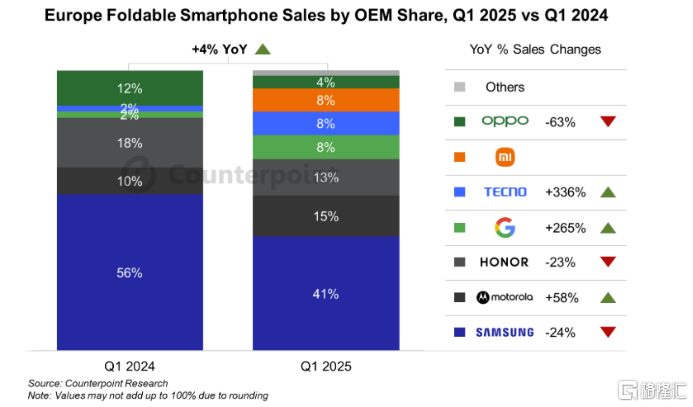
联想摩托罗拉超越HONOR成欧洲第二大折叠屏手机品牌
Ge Long Hui· 2025-06-12 07:38
此前,在CounterPoint发布的另一份报告显示,2024 年摩托罗拉智能手机出货量同比增长 23%,创下历 史新高,成功跻身全球第七大智能手机品牌。 报告称,尽管 2024 年全球智能手机市场出货量仍低于 2020 年水平,但摩托罗拉表现亮眼,出货量比 2020 年高出 75% ,年均复合增长率(CAGR)达 15%。 从区域市场来看,摩托罗拉在多个地区取得显著进展。拉丁美洲(LATAM)占据其全球出货量近一半, 巴西和墨西哥成为主要驱动力。在巴西,2024 年摩托罗拉智能手机市场份额同比增长至 31.0%,2020 - 2024 年复合年增长率(CAGR)为 7% ;墨西哥 2024 年市场份额虽有小幅下滑至 16.7%,但 CAGR 也有 2%。北美市场展现出强劲的复苏态势,美国市场 2024 年市场份额同比增长至 11.2% ,CAGR 达 20%。 而印度成为突破性市场,出货量同比增长高达 82%,2024 年占摩托罗拉全球出货量的 13%,市场份额 同比增长至 5.0% ,CAGR 更是高达 62%。此外,在哥伦比亚、智利、秘鲁、沙特阿拉伯、阿联酋等市 场,摩托罗拉的市场份额也有不同程度的增长 ...
中国高端手机影像趋势与用户洞察-知乎研究院
Sou Hu Cai Jing· 2025-05-26 10:40
今天分享的是:中国高端手机影像趋势与用户洞察-知乎研究院 报告共计:5页 《中国高端手机影像趋势与用户洞察-知乎研究院》显示,手机已成为影像爱好者的核心设备,77.2%用户以手机为主力拍摄工具,71.8%每日用手机记录生 活,27%会分享至社媒。用户摄影水平提升,61.3%常切换拍摄模式和参数,专业影像组更注重分享与创作,手机影像组则侧重个人记录。拍摄题材以风 光、人文、人像为主,手机用户常用24-26mm默认焦段,专业用户更偏好35mm焦段。后期处理中,50%用户在手机完成修图,但专业用户耗时更久,53% 对手机后期功能有更高期待。 用户认为手机影像在对焦速度、场景感光、运动抓拍等方面存在不足,43.1%认可高端影像手机可部分替代专业设备,但专业用户认为手机操作复杂。选购 高端手机时,影像能力是基础门槛,用户关注硬件配置(如潜望式长焦、多光谱传感器)、AI功能(自动修图、创意创作)及便携性,40%愿将高端影像手 机作为副机。 未来趋势上,AI深度融入影像全流程,用户期待AI在画质提升、拍摄辅助等方面突破,64.2%期望3D/AR影像交互,46.8%关注可变光圈。超半数用户认为 顶级影像赛事接纳手机作品将是行 ...


Counterpoint 2024 年 Q4 各地区智能手机市场数据报告
Counterpoint Research· 2025-03-14 05:18
Global Smartphone Market Overview - The global smartphone market remained flat in Q4 2024 but achieved a 4% growth for the year, driven by increases in the Latin America and European markets [4] - Apple led the global smartphone market with a 23% market share in Q4 2024, followed by Samsung at 16% [4] - Xiaomi ranked third with a 5% year-on-year increase in shipments, while Vivo saw a 13% increase, making it the fastest-growing brand among the top five [4] - OPPO experienced a 3% decline in shipments year-on-year but performed well in China, Latin America, and Western Europe [4] - In the 5G segment, Apple held a 32% market share, with Samsung at 16%, while Xiaomi was the fastest-growing brand in this category with a 33% year-on-year growth rate [4] India Smartphone Market - The Indian smartphone market achieved a record high revenue in 2024, with a 9% year-on-year growth [7] - Apple ranked first in market revenue for the second consecutive year and entered the top five in shipments for the first time in Q4 2024 [7] - Vivo became the leading brand in terms of shipments for the first time in the fiscal year 2024 [7] - Three-quarters of smartphones shipped in 2024 supported 5G technology, with the iPhone 15 being the top-selling model in Q4 2024 [7] China Smartphone Market - China's smartphone sales declined by 3.2% year-on-year in Q4 2024, marking the only quarter of year-on-year decline for the year [8] - Despite the decline, the overall smartphone sales in China grew by 1.5% year-on-year for the entire year, with Vivo maintaining the top market share at 17.8% [11] US Smartphone Market - The US smartphone sales decreased by 3% year-on-year in Q4 2024, primarily due to weak performance in the sub-$300 market [10][12] - High-end smartphones priced at $600 and above saw a 4% year-on-year increase in sales [12] - The iPhone 15 outperformed the iPhone 16 series in terms of sales growth since its release [12] European Smartphone Market - The European smartphone market experienced growth for four consecutive quarters, the first time since Q1 2017 [15][16] - Apple achieved year-on-year growth despite a slow start for the iPhone 16, while Realme and HONOR showed strong performance in Western Europe [16] Indonesia Smartphone Market - Indonesia's smartphone shipments grew by 7% year-on-year in 2024, driven by positive marketing during shopping seasons and the Eid festival [18] - Xiaomi's shipments increased by 24% due to a broader product range and expansion of offline channels [18] - The shipment of 5G smartphones in Indonesia rose by 36% year-on-year, reflecting the growing presence of mid-range 5G devices [18] Japan Smartphone Market - Japan's smartphone sales grew by 7% year-on-year in 2024, supported by economic recovery [20] - Apple continued to lead the high-end market, although its overall sales declined by 3% due to weak demand for older models [20]

Counterpoint 2024 年 Q4 各地区智能手机市场数据报告
Counterpoint Research· 2025-03-14 05:18
2024 年 Q4 全球智能手机市场总结 数据来源:Counterpoint Research 市场监测服务 全球智能手机市场份额 Q2 2023 - Q4 2024 尽管 2024 年 Q4 全球智能手机市场整体持平,但全年仍实现 4% 的增长,主要得益于加勒 比和拉美以及欧洲市场的增长。 苹果以 23% 的市场份额领先 2024 年 Q4 全球智能手机市场,三星以 16% 的份额位居第 二。 小米排名第三,出货量同比增长 5%,而 vivo 同比增长 13%,成为 2024 年 Q4 前五大品牌 中增长最快的品牌。 OPPO 在 2024 年 Q4 出货量同比下降 3%,但在中国、拉美和西欧市场表现良好。 在 5G 细分市场,苹果以 32% 的市场份额占据全球领先地位,三星以 16% 紧随其后。 在前五大品牌中,小米以 33% 的同比增长率成为 5G 领域增长最快的品牌,主要受中国、 印度和俄罗斯市场的强劲需求推动。 低成本 5G 机型的普及以及 GenAI 在中低价位段的渗透,将成为 2025 年需要关注的关键趋 势。 OPPO 自 Q3 2021 起包含 OnePlus 扫码跳转 阅读全文 Count ...
Canalys数据快闪:2024年,全球可穿戴腕带设备重点市场厂商排名
Canalys· 2025-03-07 03:10
Core Insights - The global wearable band device market is experiencing steady growth, with shipments reaching 193 million units in 2024, representing a 4% year-on-year increase. This marks two consecutive years of growth following a market adjustment in 2022, indicating a recovery trend driven primarily by strong demand in China and emerging markets, compensating for declines in mature markets like the US and India [1]. Regional Market Summaries Middle East - Xiaomi and Apple are tied for the top position with a 23% unit share each, with annual growth rates of 125% and 21% respectively. Huawei follows closely with a 19% share and a remarkable growth of 184% [2]. Central and Eastern Europe (CEE) - Xiaomi leads with a 33% unit share and a 34% annual growth rate. Huawei shows significant growth at 184%, while Apple has a 11% share but a decline of 15% [3]. Latin America - Xiaomi holds a 27% share with a 63% growth rate, indicating strong performance in this region [3]. Mainland China - Huawei dominates with a 37% unit share and a 42% growth rate, followed by Xiaomi at 24% with a 28% increase. Apple and HONOR have smaller shares of 6% and 2% respectively, with modest growth [5]. Spain - Xiaomi leads with a 39% share and a substantial growth of 117%, while Apple and Samsung follow with 19% and 8% shares, showing growth rates of 9% and 38% respectively [6]. Mexico - Xiaomi is the leader with a 24% share and a 15% growth rate, while Samsung and Apple follow with 20% and 9% shares, showing significant growth for Samsung at 162% [7]. Indonesia - Xiaomi leads with a 48% share and a remarkable growth of 129%, while Samsung also shows strong performance with a 19% share and a 213% growth rate [7]. Japan - Apple is the market leader with a 46% share and a 7% growth rate, followed by Google and Garmin, each with a 12% share and growth rates of 11% and 12% respectively [9].

中国智能手机市场份额:季度数据(2023 Q3 - 2024 Q4)
Counterpoint Research· 2025-02-19 09:46
数据来源:Counterpoint Research 市场监测服务自 2021 年 Q3 起,OPPO 包括 OnePlus 市场要点 中国智能手机出货量市场份额(%) 中国智能手机出货量市场份额( Q3 2023 - Q4 2024 ) 2024 年 Q4 中国智能手机出货量同比增长 5%,环比增长 9%,标志着连续四个季度实现同比增 长。 在 2024 年 Q4,vivo 以 18% 的市场份额稳居第一,主要得益于其性价比高的 Y 系列。其子品牌 iQOO 对这一增长也做出了重要贡献。 苹果以 16.8% 的市场份额位居第二,华为紧随其后,市场份额为 16.7%。除了 Pura 70 和 Mate 60 系列外,新推出的中端 Nova 13 系列也对这一增长做出了重要贡献。 小米以 16% 的市场份额位列第四,主要得益于旗舰 Mi 15 系列的热销。该品牌在今年的高端化方 面取得了显著进展。 2024 年,中国智能手机出货量同比增长 4%,而 2023 年则同比下降 4%。展望 2025 年,中国智能 手机市场预计将继续保持低个位数的增长。1 月宣布的全国智能手机补贴计划有望成为推动销量 增长的催化剂,特 ...