Niantic

Search documents
速递|沙特千亿AI棋局落子:Humain联手Luma AI,生成式内容重塑游戏与广告生产链
Z Potentials· 2025-06-20 03:50
Core Viewpoint - Saudi Arabia's newly established AI company Humain has launched a division called Humain Create, focusing on developing AI software for advertising, gaming, and film industries [1][2]. Group 1: Humain Create and Its Focus - Humain Create will collaborate with Luma AI to provide computational resources and deliver AI software capable of generating realistic images and videos for the media industry [1]. - The division aims to serve game developers, marketers, and other media professionals, promoting a limitless narrative approach [1]. Group 2: Strategic Investments and Goals - Humain, backed by Saudi Arabia's $925 billion Public Investment Fund, was established in May 2023 as a core part of the country's AI strategy, with plans to invest heavily in data centers, cloud computing, and large language models [1]. - The company announced a $10 billion venture capital fund to support its initiatives [1]. Group 3: Gaming Industry Focus - The gaming sector is a natural market for Humain, as the Saudi government has been acquiring stakes in foreign gaming companies to diversify its economy away from oil dependency [2]. - Recent acquisitions include Scopely Inc.'s agreement to spend $3.5 billion on acquiring the gaming business of Niantic, the developer of Pokémon Go [2]. - Saudi Arabia is set to host its first esports World Cup in 2024, aiming to establish Riyadh as a gaming industry hub [2].

游戏周报:阅文3.25亿收购艺画开天股权;欧盟要求苹果30天内支持三方支付
2 1 Shi Ji Jing Ji Bao Dao· 2025-06-09 00:35
Industry Developments - Chengdu government has introduced new policies to encourage the development of gaming and esports companies, indicating increasing local government support for the ACG industry [2][3] - The Chengdu government announced 15 policy measures aimed at enhancing game content creation, strengthening esports competitiveness, promoting industry integration, and improving development factors to elevate the gaming and esports industry [3] Company News - Yuewen Group announced a plan to acquire a 26.67% stake in Wuhan Yihua Kaitian Cultural Communication Co., Ltd. for 325 million yuan, increasing its ownership from 5.17% to approximately 31.48% [4] - After the acquisition, Tencent, the controlling shareholder of Yuewen, will hold a total of 61.82% of Yihua Kaitian, becoming the largest shareholder [4] - Xishanju's sci-fi mech battle game "Jiexianji" is set for global public testing on July 2, 2025, and will be available on PC, Steam, and Xbox Series X|S [5] - The highly anticipated domestic single-player game "Mingmo: Yuanshu Zhi Yu" has released a new trailer and is scheduled for official release on July 24 [6] Regulatory Updates - Following a U.S. ruling against Apple, the European Commission has mandated that Apple must open third-party payment options within 30 days in the EU market, with a potential fine of 500 million euros (approximately 4.096 billion yuan) for non-compliance [7] International Developments - Riot Games has announced its entry into the physical card game market with "Runeterra," based on the League of Legends IP, set to launch this year [8] - South Korean developer Shift Up has unveiled its flagship new game "Project Spirit," themed around "Eastern Fantasy," which is a cross-platform subculture project [9] - Niantic, the developer of "Pokémon GO," has confirmed the sale of its gaming business to Scopely for $3.5 billion, which includes titles like "Pokémon GO" and "Monster Hunter Now" [10]



5月全球手游收入Top20:国产独占6席,一新游爆火冲上前十
3 6 Ke· 2025-06-05 00:46
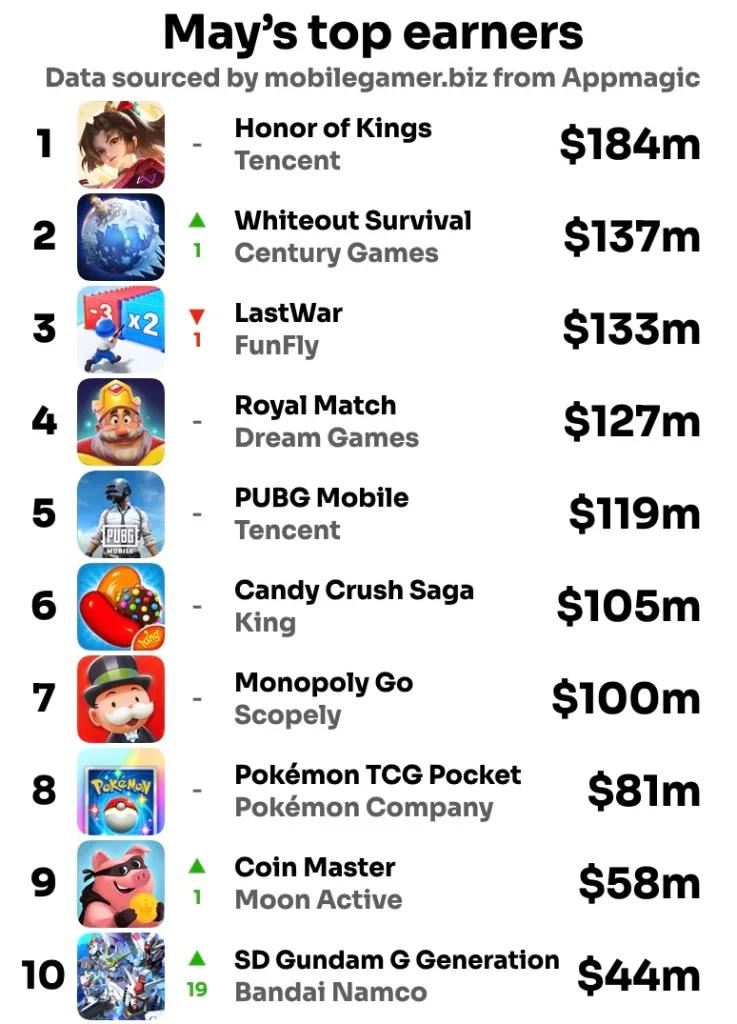
Core Insights - The global mobile game revenue rankings for May 2025 have been released, showing significant performance variations among top games [1][2]. Group 1: Top Performers - "Honor of Kings" by Tencent continues to lead the chart with a revenue of $184 million in May, maintaining its position after regaining the top spot in April [1][2]. - "Whiteout Survival" and "Last War: Survival" are in a close competition for the second position, with revenues of $137 million and $133 million respectively, marking their third consecutive month of rank changes [2][3]. - "PUBG Mobile" ranks fifth with a revenue of approximately $119 million, showing a slight month-over-month increase [3]. Group 2: Revenue Fluctuations - "Royal Match" experienced significant revenue fluctuations, earning about $127 million in May after peaking at nearly $145 million in March [2]. - "Candy Crush Saga" and "Monopoly Go" followed closely with revenues of $105 million and $100 million, both showing slight declines [3]. - "Pokémon TCG Pocket" saw its revenue rebound to over $80 million, heavily influenced by new card pack releases [3]. Group 3: Rankings 11-20 - The rankings from 11 to 20 include "Gossip Harbor" at $42.4 million, "Brawl Stars" at $38.9 million, and "Honkai: Star Rail" at $38.5 million, indicating a steady performance for these titles [4][5]. - "Gossip Harbor" has shown consistent growth since its launch in mid-2022, achieving a new high in May [5]. - "Fate/Grand Order" made a notable comeback to the top 20 with a revenue of $32.1 million [5].
硅谷最疯CEO:卖掉摇钱树《宝可梦GO》后,他做了什么?
创业邦· 2025-05-27 10:11
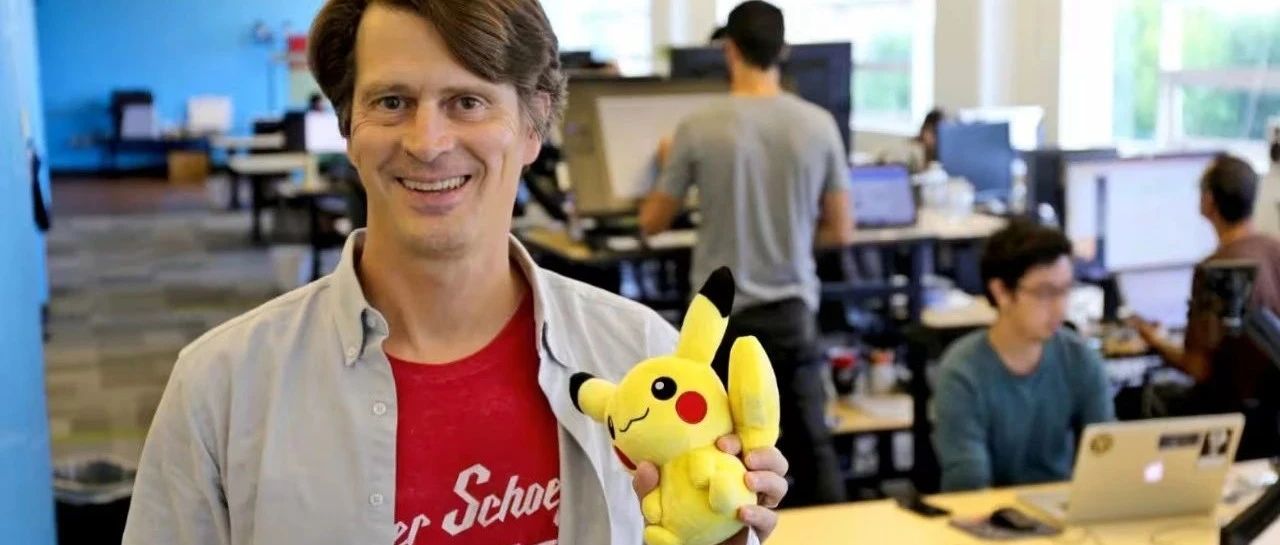
Core Insights - Niantic has announced a significant strategic shift by selling its gaming business for $3.5 billion to Scopely and rebranding itself as Niantic Spatial, focusing entirely on AI development for enterprise clients [4][5][7]. Company Strategy - The restructuring aims to allow both the gaming and AI divisions to pursue their respective futures more effectively, as stated by CEO John Hanke [5]. - Niantic is now concentrating on its newly launched Spatial platform, which provides AI mapping tools for businesses [5][15]. Market Opportunity - The spatial computing market is projected to grow from $110 billion in 2023 to $1.7 trillion by 2033, driven by major players like TomTom and Google [8]. - Niantic's transition highlights the impact of the generative AI trend in Silicon Valley, affecting even established companies [7]. Financial Aspects - Niantic raised $250 million from existing investors to fund its new direction, with the deal expected to close by the end of the month [9]. - The company reported $1 billion in revenue last year, with the majority coming from Pokémon GO, which has generated approximately $8 billion since its launch [10][12]. Competitive Landscape - Niantic faces strong competition in the spatial AI sector from companies like Nvidia and World Labs, which are developing advanced 3D modeling and simulation technologies [9]. - The gaming division's sale involved the transfer of around 400 employees to Scopely, while approximately 200 will remain with Niantic [9]. Data Utilization - Niantic has accumulated vast amounts of location data, totaling 30 billion miles walked by players, which will be leveraged for AI model development [5][22]. - The company will continue to provide AR mapping services to Scopely post-sale, maintaining access to the data used for AI model training [24]. Transition Challenges - The decision to exit the gaming business is not due to poor performance but rather a strategic focus on AI, as maintaining a successful game requires significant resources [13][21]. - Niantic's shift to enterprise solutions represents a serious transformation for a company known for its casual gaming culture [16].
硅谷最疯CEO:卖掉摇钱树《宝可梦GO》后,他做了什么?
3 6 Ke· 2025-05-26 10:34
Core Insights - Niantic, known for the popular mobile game Pokémon GO, has decided to sell its gaming business for $3.5 billion to Scopely and shift its focus to enterprise-level AI, rebranding itself as Niantic Spatial [3][4][11] - The company aims to leverage its extensive location data, accumulated from players walking over 30 billion miles, to develop AI models that analyze the real world and serve enterprise clients [4][6][19] Group 1: Strategic Shift - The CEO John Hanke emphasized that the restructuring allows both the gaming and AI divisions to pursue their respective futures more effectively [4][11] - Niantic's new platform, Spatial, offers AI mapping tools for businesses, enabling applications such as robot route planning and augmented reality glasses [4][6] - The decision to pivot to AI reflects the broader impact of generative AI trends in Silicon Valley, with the spatial computing market projected to grow from $110 billion in 2023 to $1.7 trillion by 2033 [6][7] Group 2: Financial Aspects - Niantic raised $250 million from existing investors to fund the new company, with the transaction expected to complete by the end of the month [7] - The gaming business, particularly Pokémon GO, has generated approximately $8 billion in revenue since its launch in 2016, with an estimated $770 million contribution to Niantic's projected $1 billion revenue in 2024 [8][11] - Despite the sale, Niantic will continue to provide augmented reality mapping services to Scopely, maintaining access to critical location data for AI model development [20][21] Group 3: Competitive Landscape - Niantic faces strong competition in the spatial AI sector from companies like Nvidia, which has launched the Omniverse platform for creating 3D digital twins [7] - The company has also encountered challenges in replicating the success of Pokémon GO, with previous titles like Harry Potter: Wizards Unite failing to achieve similar popularity [10][16] Group 4: Data Privacy and Ethical Considerations - The sale of the gaming business raised concerns regarding user data management, particularly due to Scopely's backing by the Saudi sovereign wealth fund [21] - Hanke reassured that data privacy regulations will be strictly followed, and user data will remain under the control of Niantic and Scopely [21] - Niantic has clarified that data collection for AI model training will only occur with user consent during specific actions, addressing player concerns about data usage [21]

特斯拉将Model Y降本20%,以捍卫在华份额;英特尔首次聘用华人CEO;宝可梦制造商将游戏部门卖给沙特公司 丨硅谷周报
创业邦· 2025-03-16 03:11
Core Insights - Intel appointed Lip-Bu Tan as its new CEO, marking a significant leadership change in the semiconductor industry with all four major chip companies now led by individuals of Chinese descent [3][4] - Tesla plans to reduce the production cost of its Model Y by at least 20% with a new lower-cost version aimed at maintaining its market share in China [9][10][11] - Meta is testing its first internally developed AI training chip to reduce reliance on external suppliers like Nvidia, with plans for large-scale deployment if testing is successful [7][8] - Alphabet's Waymo has expanded its autonomous vehicle service in Silicon Valley, covering a 27-square-mile area [12][13] - SoftBank-backed Wayve is preparing for its commercial debut, focusing on partnerships with global automakers for its driving assistance system [14][15] - Google plans to acquire AdHawk Microsystems for $115 million to enhance its smart glasses development with eye-tracking technology [17][19] - CoreWeave signed a $11.9 billion contract with OpenAI ahead of its IPO, providing AI infrastructure support [26][27] - Niantic Labs is selling its gaming division to Scopely for $3.5 billion, allowing it to focus on its geospatial AI business [28][29] - ServiceNow announced the acquisition of Moveworks for $2.85 billion to enhance its AI capabilities [30][31] - Bolt is expanding into the North American market, competing with Uber by recruiting drivers and launching a localized app [32][33] Company Developments - Intel's new CEO Lip-Bu Tan has a strong background in technology and leadership, previously leading Cadence Design Systems [3][4] - Meta's AI training chip, designed for energy efficiency and optimized for AI tasks, is part of a broader investment in AI infrastructure [7][8] - Tesla's new Model Y variant aims to counter declining market share in China, with a projected price around 210,000 yuan [9][10][11] - Waymo's expansion in Silicon Valley is a significant step in its autonomous driving strategy, with plans for further service area growth [12][13] - Wayve's innovative approach to autonomous driving, focusing on software sales to automakers, distinguishes it in the market [14][15] - Google's acquisition of AdHawk is a strategic move to enhance its capabilities in augmented reality and smart devices [17][19] - CoreWeave's contract with OpenAI is a major development in the AI infrastructure space, indicating strong demand for high-performance computing [26][27] - Niantic's sale to Scopely allows it to pivot towards geospatial technology, supported by significant funding for its new venture [28][29] - ServiceNow's acquisition of Moveworks is aimed at integrating advanced AI solutions into its enterprise platform [30][31] - Bolt's entry into North America reflects its ambition to capture market share in a competitive landscape [32][33] Investment and Financing - Chainguard is seeking new funding with a valuation of $3.5 billion, focusing on software supply chain security [42][43] - Flock Safety completed a $275 million funding round, aiming to enhance its AI-based security solutions [44][45] - Celestial AI raised $250 million to commercialize its photonic technology for AI chip connectivity [46][47] - Insilico Medicine is considering a Hong Kong IPO after raising $110 million, focusing on AI drug development [48][49] - Dexterity completed a $95 million funding round, with a valuation of $1.65 billion, to advance its AI robotics technology [50][51] - Zolve raised $251 million in its largest funding round to date, planning to expand its financial services [52][53] - Terabase Energy secured $130 million to enhance its solar technology deployment [54][55] - Supabase raised over $100 million, achieving a valuation of $2 billion, to expand its developer platform [56][57]