
农业银行

Search documents
中国农业银行申请事务处理方法专利,提升交易状态确认的准确性
Sou Hu Cai Jing· 2026-02-18 08:30
Core Viewpoint - China Agricultural Bank has applied for a patent related to a transaction processing method, device, storage medium, and electronic equipment, aimed at enhancing the accuracy of transaction status confirmation and efficiency of account reconciliation [1] Group 1: Patent Application Details - The patent, titled "A Transaction Processing Method, Device, Storage Medium, and Electronic Equipment," was published under CN121544411A and filed on November 2025 [1] - The invention focuses on distributed transaction processing technology, utilizing unique transaction elements to execute pre-business transactions and generate local transaction records [1] - After successful pre-transactions, the method retrieves auxiliary reconciliation information and executes auxiliary reconciliation transactions to produce results, ultimately synchronizing transaction statuses across systems [1] Group 2: Company Overview - China Agricultural Bank, established in 1986 and headquartered in Beijing, primarily engages in monetary financial services [1] - The company has a registered capital of approximately 34.998 billion RMB [1] - According to data analysis, the bank has invested in 16 enterprises, participated in 5,000 bidding projects, and holds 1,309 trademark records along with 5,000 patent records [1]

中国手机银行用户规模见顶,行业逻辑转向存量提升
Xin Lang Cai Jing· 2026-02-18 05:56
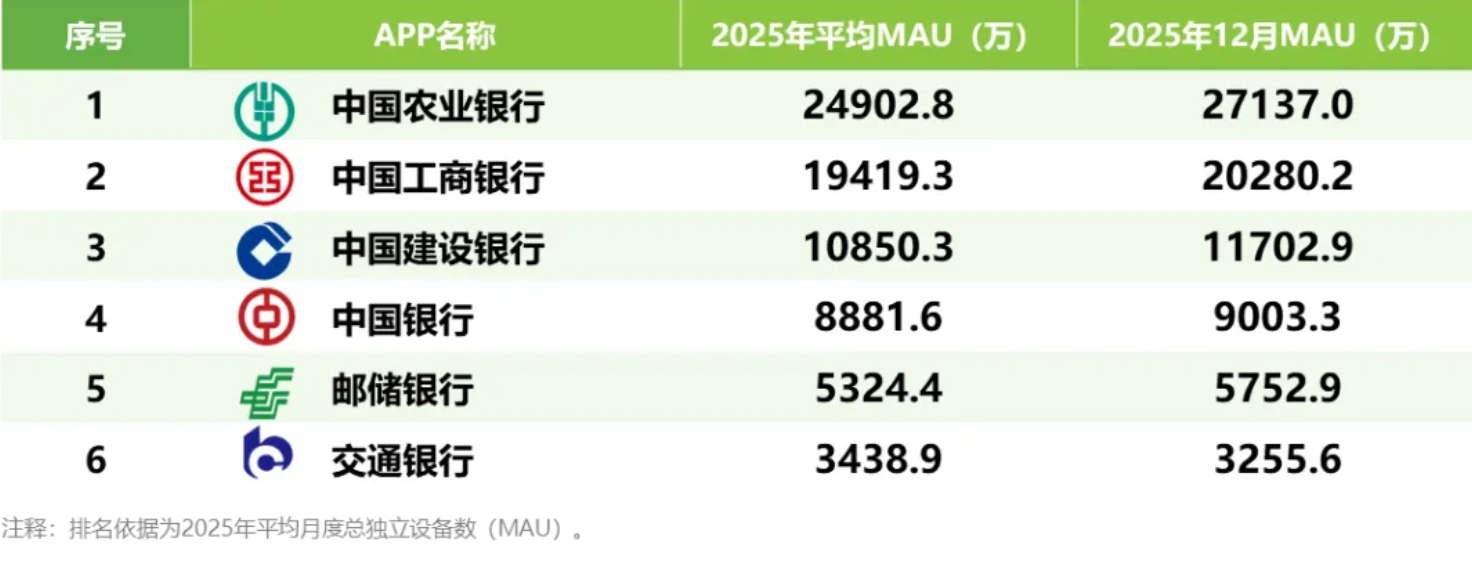
Core Insights - The report indicates that the average monthly active users (MAU) for major Chinese mobile banking apps in 2025 shows a significant user base, with the Agricultural Bank of China leading at approximately 24.9 million users [1]. Group 1: User Metrics - The average MAU for the top five mobile banking apps in 2025 are as follows: Agricultural Bank of China (24.9 million), Industrial and Commercial Bank of China (19.4 million), China Construction Bank (10.9 million), Bank of China (8.9 million), and Postal Savings Bank (5.3 million) [1]. - The total number of independent devices for mobile banking in China is projected to stabilize between 648 million and 739 million, indicating a plateau in user growth [1]. Group 2: Industry Trends - The report highlights a shift in industry dynamics from acquiring new users to enhancing existing user engagement, as the flow of new users has reached a ceiling [1]. - User behavior is changing structurally, with the effective daily usage time per device decreasing from 4.9 minutes in 2023 to around 2.7 minutes by mid-2025, stabilizing at approximately 3 minutes [1]. - The trend towards high-frequency, short-duration, and function-oriented usage is prompting financial institutions to streamline processes and focus on core transaction scenarios [1].





国有大行主导手机银行市场,生态嵌入构筑护城河
Jing Ji Guan Cha Wang· 2026-02-18 05:47
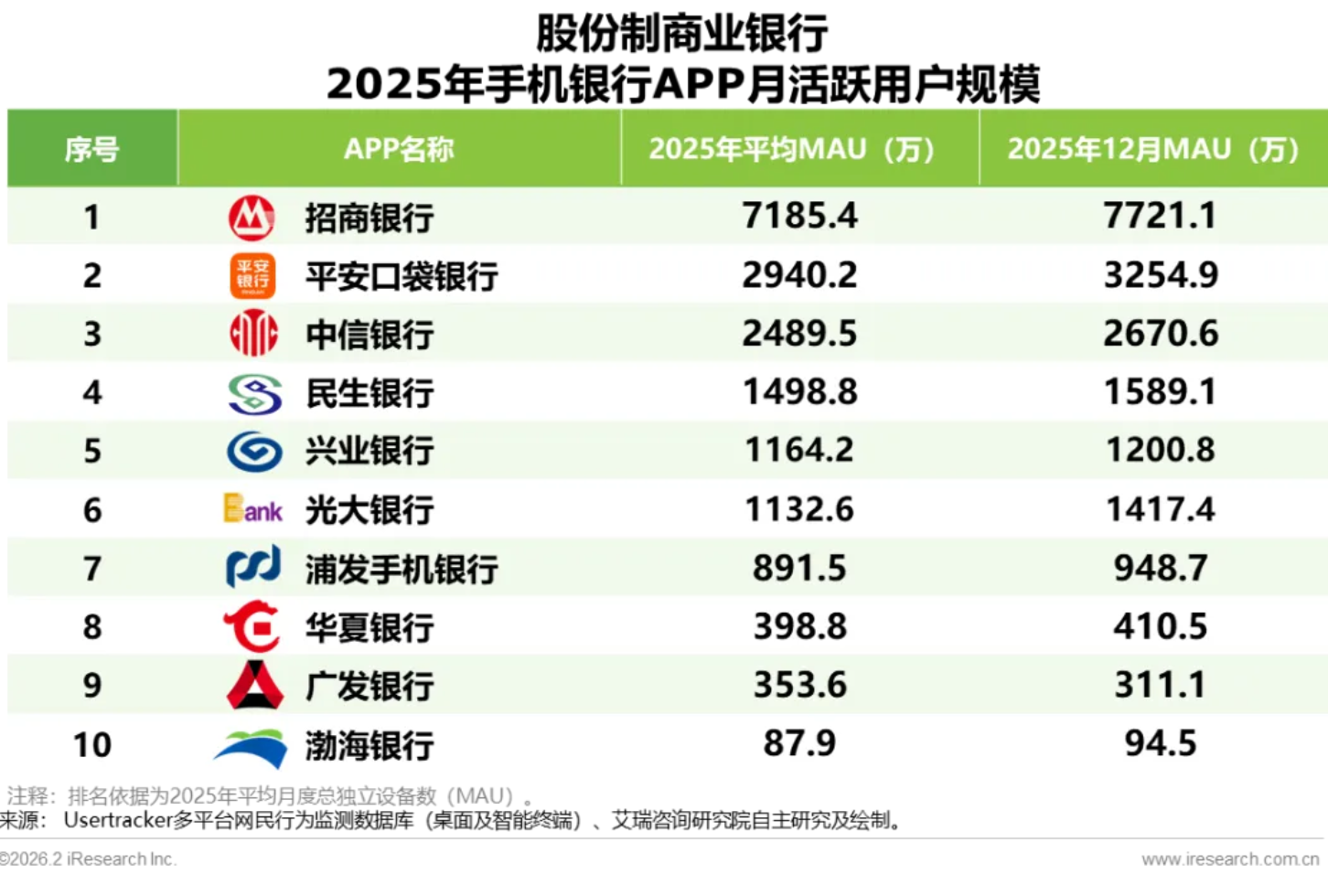
Core Insights - The Chinese mobile banking market is entering a stage of stock competition in 2025, with monthly active users (MAU) stabilizing between 648 million and 739 million [2] - State-owned commercial banks dominate the market due to their ecological embedding advantages, with Agricultural Bank of China leading at 249 million MAU, followed by Industrial and Commercial Bank of China (194 million) and China Construction Bank (109 million) [2] - Private banks are expected to collectively exit the top 50 MAU rankings in 2025 due to a lack of offline branch support and local living ecosystems [2] Group 1: Major Players - Agricultural Bank of China has the highest MAU at 249 million, followed by Industrial and Commercial Bank of China with 194 million and China Construction Bank with 109 million, forming the first tier of banks [2] - China Bank and Postal Savings Bank have MAUs exceeding 50 million, constituting the second tier [2] - China Merchants Bank leads the joint-stock banks with 71.85 million MAU, while Ping An Bank and CITIC Bank form the second tier, with other joint-stock banks generally below 20 million MAU [2] Group 2: Market Dynamics - The core advantage of state-owned banks lies in their "full-scenario integration" capabilities, embedding services deeply into high-frequency life scenarios such as government affairs, social security, healthcare, and education [2] - Agricultural Bank of China extends its services to rural areas through intelligent service matching and customer customization, while Industrial and Commercial Bank of China utilizes its "Gong Xiao Zhi" model for interactive service [2] - Regional banks like Jiangsu Bank, Beijing Bank, and Ningbo Bank show stable performance by focusing on local markets, with some rural commercial banks like Fujian Rural Credit exceeding 4.5 million MAU, indicating the sustainability of localized operations in the stock market [2]

手机银行TOP50再无民营 生态壁垒高筑草根绝迹
Jing Ji Guan Cha Wang· 2026-02-18 05:47
Core Insights - The monthly active users (MAU) of mobile banking apps in China have stabilized between 648 million and 739 million, indicating that user growth has reached a ceiling, marking the end of a decade-long traffic dividend period [2] - User behavior has shifted significantly, with average session duration decreasing from 4.9 minutes in 2023 to approximately 2.7 minutes by mid-2025, reflecting a preference for high-frequency, short-duration, and function-oriented usage [2] - Major state-owned banks have solidified their market dominance, with all six major state-owned banks ranking in the top ten for MAU, led by Agricultural Bank of China with 249 million MAU [2] Industry Dynamics - The core competitive advantage of state-owned banks lies in their "full-scenario integration" capabilities, providing financial services deeply embedded in public services such as government, social security, healthcare, and education [3] - Joint-stock banks are adopting specialized development strategies, with China Merchants Bank leading its peers with 71.85 million MAU, while Ping An Bank and Citic Bank are leveraging AI technology to enhance service processes and maintain user engagement [3] - Local banks are experiencing polarization, with some city commercial banks maintaining MAU above 3 million due to their deep understanding of local markets, while private banks like WeBank and MYbank have fallen out of the top 50 due to challenges in customer acquisition and retention [3] Future Trends - As the industry standard for single-session usage time becomes 3 minutes, banks must rethink their value creation strategies [4] - AI-driven service process optimization, real-time risk control systems, and multi-device collaboration within ecosystems are reshaping the competitive landscape [4] - Key factors for institutional success in the future will include precise user insights, prudent risk management, and robust ecosystem integration capabilities [4]


流量红利枯竭 存量博弈下银行APP被迫断臂求生
Jing Ji Guan Cha Wang· 2026-02-18 05:44
Core Insights - The Chinese mobile banking market is transitioning from "scale expansion" to "value cultivation," indicating a saturation of user growth and the end of the traffic dividend period [2] - Different types of banks are exhibiting varied development trends in this new landscape [2] State-Owned Commercial Banks - The six major state-owned banks dominate the mobile banking market, with Agricultural Bank of China leading with over 250 million monthly active users (MAUs) [2] - The top three banks, including Industrial and Commercial Bank of China and China Construction Bank, have MAUs of nearly 200 million and over 100 million, respectively [2] - All six major banks reported positive month-on-month growth in MAUs, with ICBC leading at a 6.1% growth rate [2] Joint-Stock Commercial Banks - Joint-stock banks are seeking to carve out a niche in the saturated market, with China Merchants Bank leading among them with over 70 million MAUs [3] - Some banks like Everbright Bank and CITIC Bank showed significant month-on-month growth rates of 11.0% and 9.2%, respectively [3] - The performance of joint-stock banks is mixed, with some experiencing negative growth [3] Urban Commercial Banks - Urban commercial banks are growing rapidly, with 17 banks making it to the top 50 list, led by Ningbo Bank with 3.644 million MAUs and a growth rate of 43.9% [3] - The growth is attributed to localized strategies that enhance customer engagement [3] Rural Commercial Banks and Credit Cooperatives - Rural commercial banks and credit cooperatives also performed well, with 17 banks in the top 50, led by Fujian Rural Credit with 781.6 thousand average MAUs [4] - 12 out of these 17 banks reported positive month-on-month growth [4] Private Banks - Private banks are facing significant challenges, with only WeBank making it to the top 50 list in the first half of 2025, experiencing a 27.3% decline in MAUs [4] - The competitive landscape has shifted, making it difficult for online-only private banks to maintain their initial advantages [4] Conclusion - State-owned banks leverage "ecosystem" advantages to solidify their market position, while joint-stock banks focus on "professional" opportunities [5] - Urban commercial banks establish a strong local presence, whereas private banks struggle to survive in the competitive environment [5] - The future of banking will require a focus on creating irreplaceable value for users through technology and insights into user behavior [5]

2.7分钟定生死 手机银行存量厮杀谁在“断臂”,谁在“吃肉”?
Jing Ji Guan Cha Wang· 2026-02-18 04:57
Core Insights - The report by iResearch indicates that the monthly active users (MAU) of mobile banking apps in China have stabilized after fluctuating between 648 million and 739 million, signaling a ceiling in user growth and a shift from acquiring new users to enhancing existing user engagement [2] - User behavior is undergoing a structural reversal, with the effective daily usage time per device dropping from 4.9 minutes in 2023 to around 2.7 minutes by mid-2025, leading to a focus on high-frequency, short-duration, and functional usage [2] - Financial institutions are compelled to streamline operations and focus resources on core transaction scenarios to survive in this competitive landscape, where efficiency and precision are paramount [2] Mobile Banking Market Overview - The top three banks in terms of MAU are Agricultural Bank of China (2.49 billion), Industrial and Commercial Bank of China (1.94 billion), and China Construction Bank (1.09 billion), with all six major state-owned banks ranking in the top ten [3][5][6] - Private banks, represented by WeBank and MYbank, have faced significant setbacks, with many dropping out of the top 50 MAU rankings by 2025 [4] Competitive Landscape - State-owned banks are solidifying their dominance through extensive customer bases and integrated ecosystems, leveraging services embedded in high-frequency life scenarios such as government services and healthcare [7] - Joint-stock commercial banks are adopting a "specialized and precise" survival strategy, with China Merchants Bank leading among them with 71.85 million MAU, focusing on wealth management and intelligent interaction [8][10] - Regional banks are thriving by deeply engaging with local markets, while private banks struggle due to high customer acquisition costs and lack of local ecosystem support [13][14] Future Outlook - The mobile banking market is transitioning from a phase of scale expansion to one of value cultivation, with state-owned banks building moats through ecosystems, joint-stock banks seeking niches through specialization, and regional banks solidifying their local roots [14] - The ability to create irreplaceable value in a limited user engagement environment will be crucial, with technology applications such as AI reshaping service processes and enhancing risk management [15][16]

农业银行取得数据同步方法专利
Sou Hu Cai Jing· 2026-02-17 13:16
Group 1 - The core point of the article is that Agricultural Bank of China has obtained a patent for a "data synchronization method, device, medium, and electronic equipment," with the authorization announcement number CN114443770B and an application date of January 2022 [1] Group 2 - Agricultural Bank of China was established in 1986 and is located in Beijing, primarily engaged in monetary financial services [1] - The registered capital of Agricultural Bank of China is approximately 34.998 billion RMB [1] - The bank has made investments in 16 companies, participated in 5,000 bidding projects, and has 1,309 trademark information entries and 5,000 patent information entries [1] - Additionally, the bank holds 119 administrative licenses [1]
中国农业银行取得交易查证方法及装置专利
Sou Hu Cai Jing· 2026-02-17 07:22
Group 1 - The core point of the article is that Agricultural Bank of China has obtained a patent for a method and device for transaction verification, indicating its focus on technological innovation in financial services [1] - The patent was granted with the announcement number CN114819956B, and the application date was March 2022 [1] - Agricultural Bank of China was established in 1986 and is headquartered in Beijing, primarily engaged in monetary financial services [1] Group 2 - The registered capital of Agricultural Bank of China is approximately 34.998 billion RMB [1] - The bank has made investments in 16 companies and participated in 5,000 bidding projects [1] - The bank holds 1,309 trademark registrations and 5,000 patent records, along with 119 administrative licenses [1]
金价真是大变天了!全国金店最新价出炉,现在入手还划算吗?
Sou Hu Cai Jing· 2026-02-17 06:36
Core Insights - The significant price disparity of 481 yuan per gram of gold on Chinese New Year's Eve highlights the complexities of the gold market, with prices varying widely between retail, investment, and recovery channels [1][3][6] Price Discrepancies - On February 16, 2026, the retail price of gold jewelry at Lao Feng Xiang was 1548 yuan per gram, while the price at Chow Tai Fook was 1529 yuan, contrasting sharply with the investment gold bar price from China Merchants Bank at 1121.60 yuan and recovery prices around 1067 yuan [1][3][5] - The price differences stem from various factors, including brand premiums, craftsmanship costs, and the nature of the products being sold, with retail prices incorporating significant additional costs beyond the base gold price [6][8] Market Dynamics - The Shanghai Gold Exchange was closed from February 14 to February 23, 2026, leading to a disconnect between retail prices and the international gold market, where prices remained active [3][14] - The international gold price was stable around 5023 to 5024 USD, while the domestic benchmark price was fixed at 1108.50 yuan per gram, illustrating the lack of synchronization between domestic and international markets during the holiday [3][14] Consumer Choices - For consumers purchasing gold for personal use, such as wedding jewelry, the price difference between retail and wholesale can be significant, with potential savings of up to 8800 yuan by opting for wholesale gold and self-processing [9][11] - For investment purposes, consumers are advised to focus on bank gold bars, which offer a closer alignment to the raw material price and lower associated costs compared to retail jewelry [11][12] Recovery Market - The gold recovery market presents its own challenges, with sellers facing potential exploitation through inaccurate weighing and purity claims, emphasizing the need for consumers to engage with reputable recovery services [15][16] - The recovery price reflects the intrinsic value of gold, devoid of any brand or craftsmanship premiums, highlighting the stark contrast between different market segments [8][16] Market Influences - Central banks globally, including China's, have been increasing their gold reserves, which supports the current high gold prices, alongside market expectations of potential interest rate cuts by the Federal Reserve [14] - The upcoming Chinese New Year traditionally boosts gold demand, although a significant portion of consumers express reluctance to purchase high-priced jewelry due to perceived excessive premiums [14]




中国农业银行取得报文发送方法和相关设备专利
Sou Hu Cai Jing· 2026-02-17 06:13
Group 1 - The core point of the article is that Agricultural Bank of China Limited has obtained a patent for a "message sending method and related equipment," with the authorization announcement number CN115866072B and an application date of November 2022 [1] - Agricultural Bank of China Limited was established in 1986 and is located in Beijing, primarily engaged in monetary financial services [1] - The registered capital of Agricultural Bank of China Limited is approximately 34.998 billion RMB [1] Group 2 - According to data analysis from Tianyancha, Agricultural Bank of China Limited has invested in 16 enterprises and participated in 5,000 bidding projects [1] - The company has 1,309 trademark information entries and 5,000 patent information entries, along with 119 administrative licenses [1]