
益丰药房

Search documents
医药生物行业双周报(2025、10、24-2025、11、6)-20251107
Dongguan Securities· 2025-11-07 09:22
Investment Rating - The report maintains a "Market Weight" rating for the pharmaceutical and biotechnology industry, indicating that the industry is expected to perform within ±10% of the market index over the next six months [3][29]. Core Insights - The SW pharmaceutical and biotechnology industry underperformed the CSI 300 index, declining by 0.61% from October 24 to November 6, 2025, which is approximately 2.50 percentage points lower than the index [10][23]. - Most sub-sectors within the industry recorded negative returns during the same period, with the vaccine and pharmaceutical distribution sectors showing the highest gains of 2.87% and 2.33%, respectively, while offline pharmacies and medical research outsourcing experienced declines of 3.95% and 3.11% [11][12]. - Approximately 57% of stocks in the industry recorded positive returns, with notable performers including Hezhong China, which saw a weekly increase of 115.96% [15][12]. Summary by Sections 1. Market Review - The SW pharmaceutical and biotechnology industry lagged behind the CSI 300 index, with a decline of 0.61% from October 24 to November 6, 2025 [10]. - Most sub-sectors recorded negative returns, with vaccines and pharmaceutical distribution leading in gains [11]. - About 57% of stocks in the industry had positive returns, with significant fluctuations among individual stocks [15]. 2. Industry News - The 11th batch of national drug centralized procurement results was announced, involving 55 varieties and 445 companies, with a selection rate of 57% [21]. - The new procurement rules emphasize clinical stability, quality assurance, and higher standards for bidding companies [21]. 3. Company Announcements - Yekang Pharmaceutical announced that its subsidiary received approval for clinical trials of YKYY013 injection for chronic hepatitis B treatment [22]. 4. Industry Outlook - The report suggests focusing on investment opportunities in innovative drugs and sectors with expected business development catalysts, including medical devices and traditional Chinese medicine [25]. - Key companies to watch include Mindray Medical, Yifeng Pharmacy, and Aier Eye Hospital, among others [26].
医药商业板块11月7日涨0.81%,合富中国领涨,主力资金净流出2.69亿元
Zheng Xing Xing Ye Ri Bao· 2025-11-07 08:37
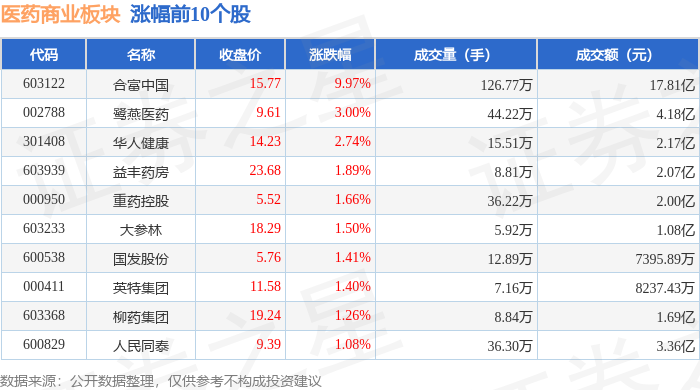
Market Overview - The pharmaceutical commercial sector increased by 0.81% on November 7, with HeFu China leading the gains [1] - The Shanghai Composite Index closed at 3997.56, down 0.25%, while the Shenzhen Component Index closed at 13404.06, down 0.36% [1] Top Performers - HeFu China (603122) closed at 15.77, up 9.97% with a trading volume of 1.2677 million shares and a transaction value of 1.781 billion [1] - LuYan Pharmaceutical (002788) closed at 9.61, up 3.00% with a trading volume of 442,200 shares and a transaction value of 418 million [1] - HuaRen Health (301408) closed at 14.23, up 2.74% with a trading volume of 155,100 shares and a transaction value of 217 million [1] Underperformers - JianFa ZhiXin (301584) closed at 31.22, down 4.23% with a trading volume of 110,900 shares and a transaction value of 348 million [2] - BaiYang Pharmaceutical (301015) closed at 24.25, down 1.78% with a trading volume of 51,000 shares and a transaction value of 124 million [2] - RunDa Medical (603108) closed at 15.90, down 1.55% with a trading volume of 171,300 shares and a transaction value of 272 million [2] Capital Flow - The pharmaceutical commercial sector experienced a net outflow of 269 million from institutional investors, while retail investors saw a net inflow of 256 million [2][3] - The net inflow from speculative funds was 13.51 million [2][3] Individual Stock Capital Flow - YiFeng Pharmacy (603939) had a net inflow of 28.4554 million from institutional investors, while it faced a net outflow of 2.9266 million from speculative funds and a net outflow of 25.5288 million from retail investors [3] - Shanghai Pharmaceutical (601607) saw a net inflow of 26.6640 million from institutional investors, with net outflows from both speculative and retail investors [3]




合计超200亿元 高商誉悬顶上市连锁药店
Bei Jing Shang Bao· 2025-11-06 16:26
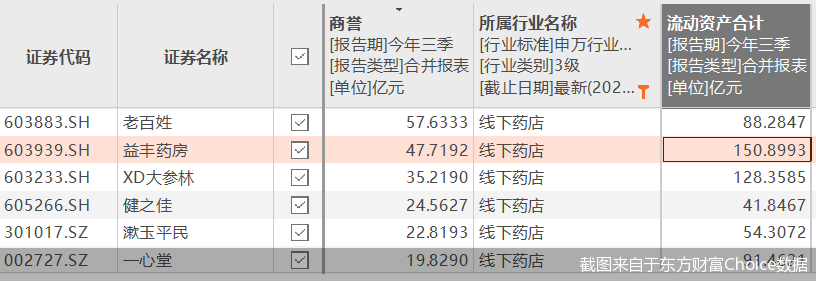
Core Viewpoint - The A-share chain pharmacy industry is experiencing a significant adjustment period, characterized by high goodwill levels due to previous aggressive expansion strategies through mergers and acquisitions. Companies are now facing challenges in balancing scale effects with operational quality [1][2]. Goodwill Accumulation - As of the end of Q3, the total goodwill of six A-share chain pharmacy companies reached 20.778 billion yuan, with an average of 3.463 billion yuan per company. The highest goodwill was recorded by Lao Bai Xing at 5.763 billion yuan, followed by Yi Feng Pharmacy at 4.772 billion yuan and Da San Lin at 3.522 billion yuan [2]. - Goodwill as a percentage of current assets is notably high, with Lao Bai Xing at 65.28% and Jian Zhi Jia exceeding 50% at 58.7%. This trend of high goodwill has persisted for several years, with Lao Bai Xing's goodwill exceeding 5 billion yuan in 2022 [2]. Performance Trends - The performance of A-share chain pharmacies has shown divergence in the first three quarters of this year. While Shuyu Pingmin has reported a revenue increase of 5.19% to 7.446 billion yuan and turned a profit of 109 million yuan, other companies like Lao Bai Xing have seen declines in net profit by 16.11% to 529 million yuan [4]. - Despite the overall decline in net profit for some companies, Lao Bai Xing showed signs of recovery in Q3 with a slight revenue increase of 0.07% [4]. Store Count Decline - Many chain pharmacy companies are experiencing a decline in the number of stores. Lao Bai Xing reported a net decrease of 240 direct stores this year, while Yi Feng Pharmacy closed 440 stores and opened only 137 [7]. - Jian Zhi Jia also closed more stores than it opened, with a net decrease of 38 stores. In contrast, Shuyu Pingmin increased its direct store count due to acquisitions, reflecting a shift in focus from quantity to quality in store management [7]. Industry Direction - As market saturation increases, the strategy of merely expanding store numbers is becoming less effective. The future direction for chain pharmacies should focus on high-quality service and enhancing customer experience to improve competitiveness [8].





合计超200亿!高商誉“悬顶”上市连锁药店企业 老百姓57.63亿居首
Bei Jing Shang Bao· 2025-11-06 14:12
Core Viewpoint - The A-share chain pharmacy industry is experiencing a significant adjustment period, marked by high goodwill levels due to previous aggressive expansion strategies through mergers and acquisitions. Companies are now facing declining store numbers and must balance scale effects with operational quality [2][5]. Goodwill Accumulation - As of the end of Q3, the total goodwill of six A-share chain pharmacy companies reached 20.778 billion yuan, with an average of 3.463 billion yuan per company [4]. - The company "老百姓" holds the highest goodwill at 5.763 billion yuan, followed by "益丰药房" at 4.772 billion yuan and "XD大参林" at 3.522 billion yuan [4][5]. - Goodwill as a percentage of current assets is notably high for "老百姓" at 65.28% and "健之佳" at 58.7%, indicating a heavy reliance on acquired goodwill [4]. Performance Trends - The performance of A-share chain pharmacies has shown divergence in the first three quarters of the year, with "漱玉平民" recovering from previous losses, achieving a revenue of 7.446 billion yuan, a year-on-year increase of 5.19% [7]. - "老百姓" reported a revenue decline of 1% to 16.07 billion yuan and a net profit drop of 16.11% to 529 million yuan [8]. - Other companies like "大参林" and "益丰药房" have also seen net profit growth, while "健之佳" and "一心堂" experienced declines [7][8]. Store Count Changes - Many chain pharmacy companies are witnessing a decline in store numbers, with "老百姓" reducing its direct stores by 240 this year [10]. - "益丰药房" closed 440 stores while opening only 137, resulting in a slight overall decrease in store count [10]. - In contrast, "漱玉平民" increased its direct store count due to new acquisitions, indicating a shift towards quality over quantity in store management [11]. Industry Direction - The industry is transitioning from a focus on expanding store numbers to enhancing service quality and operational efficiency, as market saturation makes previous growth strategies less effective [11].
重要调整!16只A股遭剔除
Shen Zhen Shang Bao· 2025-11-06 13:39
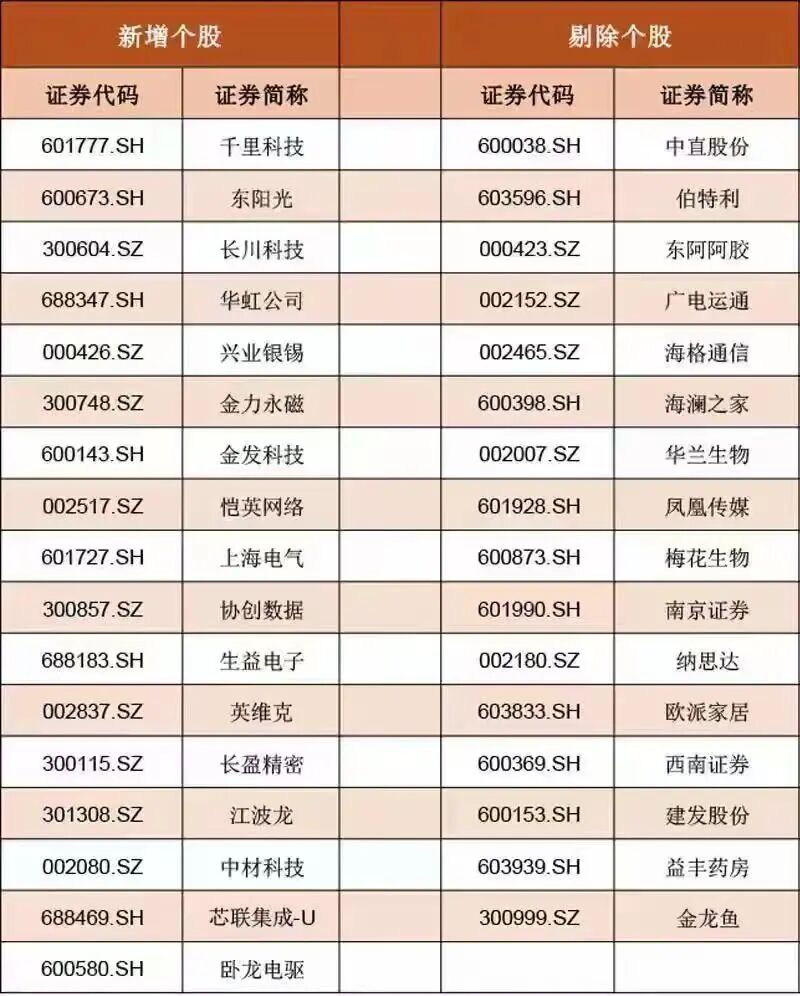
Group 1 - MSCI announced the results of its November index review, which includes the addition of 17 new A-shares and the removal of 16 A-shares [2][3] - The newly added A-shares include companies such as Qianli Technology, Dongyangguang, and Changchuan Technology, while the removed A-shares include companies like Zhongzhi Co., Bertley, and Dong'a Ejiao [1][3] - The adjustments will take effect after the market closes on November 24 [2] Group 2 - In addition to A-shares, MSCI also included 9 new Hong Kong stocks in its indices, such as Zijin Mining International and GF Securities, while removing 4 Hong Kong stocks [3][4] - The largest new additions to the MSCI Global Standard Index include companies like CoreWeave, Nebius Group, and Insmed, indicating a focus on sectors like cloud services and biopharmaceuticals [4] - MSCI conducts four routine adjustments to its indices each year, with the November review being one of the two major semi-annual assessments [5]


合计超200亿!高商誉“悬顶”上市连锁药店企业,老百姓57.63亿居首
Bei Jing Shang Bao· 2025-11-06 13:16
Core Viewpoint - The A-share chain pharmacy industry is experiencing a significant adjustment period, marked by high goodwill levels and a decline in the number of direct-operated stores, necessitating a balance between scale effects and operational quality [1][4]. Goodwill Accumulation - As of the end of Q3, the total goodwill of six A-share chain pharmacy companies reached 20.778 billion yuan, with the highest being 5.763 billion yuan for Lao Bai Xing [1][3]. - Goodwill accounts for over 50% of current assets for Lao Bai Xing and Jian Zhi Jia, indicating a heavy reliance on past acquisitions for growth [1][3]. Performance Trends - The performance of the six major A-share chain pharmacies has shown divergence in the first three quarters of the year, with some companies like Shu Yu Ping Min recovering from previous losses, achieving a revenue of 7.446 billion yuan, a year-on-year increase of 5.19% [5][6]. - Lao Bai Xing reported a revenue decline of 1% to 16.07 billion yuan and a net profit drop of 16.11% to 529 million yuan in the same period, although it showed signs of recovery in Q3 [6][8]. Store Count Changes - Many chain pharmacy companies have seen a decrease in the number of stores, with Lao Bai Xing reducing its direct-operated stores by 240 to 9,981 by the end of Q3 [8][9]. - Yi Feng Pharmacy and Jian Zhi Jia also reported net decreases in store counts, reflecting a shift from quantity to quality in store management [8][9]. Industry Outlook - The industry is transitioning from a focus on rapid expansion through store count to enhancing service quality and operational efficiency, as market saturation makes previous growth strategies less effective [9].
重要指数调整!新纳入17只A股标的
Shang Hai Zheng Quan Bao· 2025-11-06 06:19
Core Insights - MSCI announced the results of its November index review, which includes the addition of 17 new stocks to the MSCI China A-share index and the removal of 16 stocks. The changes will take effect after the market closes on November 24, 2025 [1][6]. Summary of Adjustments - **Newly Added Stocks**: The list includes stocks such as Qianli Technology (601777.SH), Dongyangguang (600673.SH), and Changchuan Technology (300604.SZ) among others [4]. - **Removed Stocks**: Stocks such as Zhongzhi Co., Ltd. (600038.SH), Bertli (603596.SH), and Dong'e Ejiao (000423.SZ) are among those being removed from the index [4]. - **Hong Kong Stocks**: In addition to A-share stocks, the MSCI China index also added nine Hong Kong stocks including Zijin Mining International and GF Securities, while removing four stocks such as Beijing Enterprises Water Group [4]. Global Index Adjustments - **Global Standard Index Changes**: MSCI's global standard index (ACWI) added 69 stocks and removed 64 stocks, with notable additions including CoreWeave, Nebius Group, and Insmed [5]. - **Emerging Markets Index**: The largest new additions to the MSCI Emerging Markets Index include Barito Renewables Energy from Indonesia, Zijin Mining International, and GF Securities [5]. Adjustment Frequency and Impact - MSCI conducts four routine adjustments annually, with the May and November adjustments typically being more significant. Adjustments are based on objective quantitative metrics such as market capitalization and liquidity [6].
最新变化!多只A股、港股被纳入
券商中国· 2025-11-06 06:09
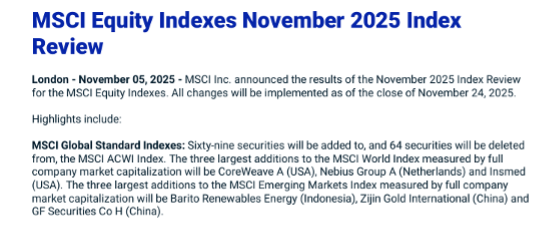
Core Viewpoint - MSCI announced the results of its index review for November 2025, with adjustments set to take effect after the market close on November 24, 2025 [1] Group 1: MSCI Global Index Adjustments - 69 new stocks will be added to the MSCI Global Standard Index, while 64 stocks will be removed [1] - The three largest securities added to the MSCI Global Index by total market capitalization are CoreWeave, Nebius Group, and Insmed [1] - The three largest securities added to the MSCI Emerging Markets Index are Barito Renewables Energy, Zijin Mining International, and GF Securities H-shares [1] Group 2: MSCI China Index Adjustments - The MSCI China Index will see the addition of 26 Chinese stocks and the removal of 20 stocks [2] - Newly added stocks include resource companies such as China Gold International and Zijin Mining International, as well as tech firms like Ganfeng Lithium and Huahong Semiconductor [2] - Stocks removed from the MSCI China Index include Haige Communications, Dong'e Ejiao, and Yihua Life [2][4] Group 3: MSCI China A-Shares Index Adjustments - The MSCI China A-Shares Index will add 17 stocks and remove 16 stocks [7] - Newly added companies include Qianli Technology, Dongyangguang, and Huahong Semiconductor [7] - The MSCI China A-Shares Onshore Index will add 18 stocks while removing 24 stocks, with notable additions like Baiwei Storage and Shengtun Mining [8] Group 4: Implications of Index Adjustments - The adjustments will lead to changes in related index funds, resulting in increased capital allocation to newly added companies and forced selling of removed companies [10] - Historical data suggests that passive funds tend to adjust their holdings on the last trading day to minimize tracking error, often leading to significant trading volume in affected stocks [10] Group 5: Market Sentiment and Foreign Investment - Several foreign institutions have expressed positive views on the Chinese market, with Fidelity Fund favoring emerging markets over developed ones [11] - Despite concerns over geopolitical risks and economic slowdown, some investors see significant growth potential in the Chinese equity market [11]

利好!多只A股、港股被纳入MSCI全球标准指数
Zheng Quan Shi Bao· 2025-11-06 05:04
Group 1 - MSCI announced the results of its index review for November 2025, with adjustments effective after market close on November 24 [1][2] - A total of 69 stocks were added to the MSCI Global Standard Index, while 64 stocks were removed, with CoreWeave, Nebius Group, and Insmed being the largest additions by market capitalization [1] - In the MSCI China Index, 26 Chinese stocks were added and 20 were removed, including significant resource and technology companies such as China Gold International and Huahong Semiconductor [2][3] Group 2 - The MSCI China A-share Index saw 17 new additions and 16 removals, with notable new entries like Qianli Technology and Huahong Semiconductor [2] - The MSCI China A-share onshore Index added 18 stocks while removing 24, with new additions including Baiwei Storage and Shengtun Mining [2] - The adjustments in MSCI indices are expected to lead to increased fund allocations to newly added companies, while those removed will face passive selling from index funds [3] Group 3 - Historical trends indicate that passive funds typically adjust their holdings on the last trading day to minimize tracking error, leading to significant trading volume changes for affected stocks [3] - Fidelity Investments expressed a preference for emerging markets over developed markets, anticipating more consumer stimulus measures in China to boost demand [3][4] - Despite mixed views on the Chinese stock market, there is recognition of its growth potential, with a call for a more rational perspective on investment opportunities in the second-largest economy [4]
利好!多只A股、港股被纳入
Zheng Quan Shi Bao· 2025-11-06 05:00
Group 1 - MSCI announced the results of its index review for November 2025, with adjustments effective after market close on November 24 [1] - A total of 69 stocks were added to the MSCI Global Standard Index, while 64 stocks were removed, with CoreWeave, Nebius Group, and Insmed being the largest additions by market capitalization [1] - In the MSCI Emerging Markets Index, Barito Renewables Energy, Zijin Mining International, and GF Securities H-shares were the largest new additions by market capitalization [1] Group 2 - The MSCI China Index saw the addition of 26 Chinese stocks and the removal of 20, including resource stocks and technology companies such as China Gold International and Huahong Semiconductor [2] - The MSCI China A-shares Index added 17 stocks and removed 16, with notable additions including Qianli Technology and Huahong Semiconductor [2] - The MSCI China A-shares Onshore Index added 18 stocks while removing 24, with new additions like Baiwei Storage and Shengtun Mining [2] Group 3 - The adjustments in MSCI indices will lead to rebalancing in related index funds, resulting in increased capital allocation to newly added companies and passive selling of removed companies [3] - Historical trends indicate that passive funds typically adjust their holdings on the last trading day to minimize tracking error, leading to significant trading volume changes in affected stocks [3] - Recent insights from foreign institutions, such as Fidelity, indicate a preference for emerging markets over developed markets, with expectations of more consumer stimulus measures in China [3] Group 4 - Despite mixed views on the Chinese stock market due to geopolitical risks and economic slowdown, some investors see significant growth potential in the Chinese equity market [4] - The ongoing strength of the Chinese stock market necessitates a rational assessment of attractive investment opportunities within the world's second-largest economy [4]