中国中车

Search documents
轨交设备板块1月14日跌1.35%,今创集团领跌,主力资金净流出4.99亿元
Zheng Xing Xing Ye Ri Bao· 2026-01-14 08:58
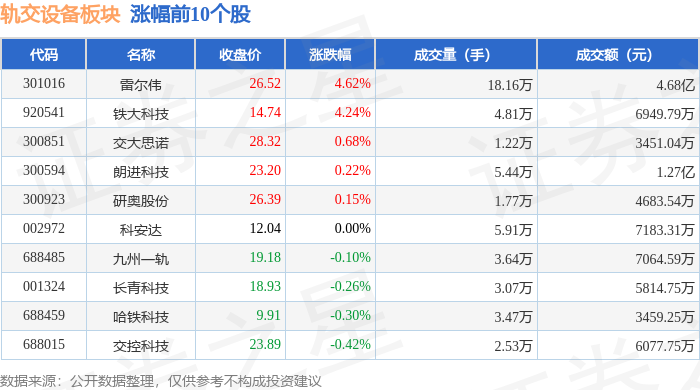
Market Overview - The rail transit equipment sector experienced a decline of 1.35% on January 14, with Jin Chuang Group leading the drop [1] - The Shanghai Composite Index closed at 4126.09, down 0.31%, while the Shenzhen Component Index closed at 14248.6, up 0.56% [1] Stock Performance - Notable gainers in the rail transit equipment sector included: - Railway Technology (301016) with a closing price of 26.52, up 4.62% on a trading volume of 181,600 shares and a transaction value of 468 million [1] - Tieda Technology (920541) closed at 14.74, up 4.24% with a trading volume of 48,100 shares and a transaction value of 69.5 million [1] - Conversely, Jin Chuang Group (603680) closed at 16.24, down 2.75% with a trading volume of 118,700 shares [2] Capital Flow - The rail transit equipment sector saw a net outflow of 499 million from institutional investors, while retail investors contributed a net inflow of 326 million [2] - The capital flow for key stocks included: - Railway Technology (301016) had a net inflow of 14.77 million from institutional investors, but a net outflow of 17.99 million from retail investors [3] - Tieda Technology (920541) experienced a net inflow of 4.54 million from institutional investors and a net inflow of 1.81 million from retail investors [3]


【职教实践进行时】技工教育从这里“远渡重洋”
Xin Lang Cai Jing· 2026-01-13 18:48
(来源:工人日报) 在中德合作领域,注重引进融合德国先进教育理念、教学模式和行业标准。平度市技师学院成立全省首 个"中德工匠学院",率先实现中德智能制造人才的国际化培养。青岛市技师学院成立了机电一体化中德 实验班,构建"工学一体化"与"德国双元制"融合课程体系,推进德国认证标准本土化转化,提升专业国 际竞争力,培养支撑制造业转型升级的高素质人才。 依托青岛区位优势,锚定建设"国际门户枢纽城市"目标,青岛以技工教育国际合作为突破口,构建技能 人才国际培养平台,推动与全球20多个国家和地区的教育机构开展合作,高质量推进"技能出海"。 "使用钳子剥除电线外皮,利用万用表检测线路通断,再通过电脑编程控制电器开关、调节设备运行速 度……"青岛市技师学院实训车间内,来自老挝琅勃拉邦职业技术学院电气专业的教师莫达·奔永正在反 复练习,额头汗珠滑落却丝毫不敢分心。几天后,他通过了中国电工三级(高级工)职业技能等级考试 并获取证书。这张证书不仅是对他技能的认可,更寄托着他回国后推动本土教学标准提升的期望。 莫达·奔永的国际求学经历,是青岛技工教育"请进来"与"走出去"相结合的生动写照。 近年来,青岛以技工教育为纽带,持续深化多 ...
轨交设备板块1月13日跌0.98%,今创集团领跌,主力资金净流出2.35亿元


Zheng Xing Xing Ye Ri Bao· 2026-01-13 09:06
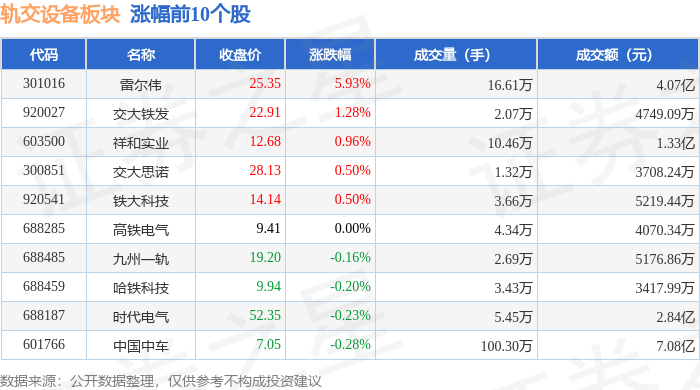
Market Overview - The rail transit equipment sector experienced a decline of 0.98% on January 13, with Jin Chuang Group leading the drop [1] - The Shanghai Composite Index closed at 4138.76, down 0.64%, while the Shenzhen Component Index closed at 14169.4, down 1.37% [1] Stock Performance - Notable gainers in the rail transit equipment sector included: - Railway Technology (301016) with a closing price of 25.35, up 5.93% on a trading volume of 166,100 shares and a transaction value of 407 million [1] - Jiaotong Iron and Steel (920027) closed at 22.91, up 1.28% with a trading volume of 20,700 shares [1] - Conversely, significant decliners included: - Jin Chuang Heavy Group (603680) which fell by 6.29% to a closing price of 16.70 [2] - Zhonghe Technology (000925) down 4.49% to 9.35 [2] Capital Flow - The rail transit equipment sector saw a net outflow of 235 million from institutional investors, while retail investors contributed a net inflow of 188 million [2] - The sector's capital flow details indicate: - China CNR (601766) had a net inflow of 36.78 million from institutional investors, but a net outflow of 42.75 million from retail investors [3] - Railway Technology (301016) also saw a net inflow of 35.21 million from institutional investors, with retail investors withdrawing 27.69 million [3]
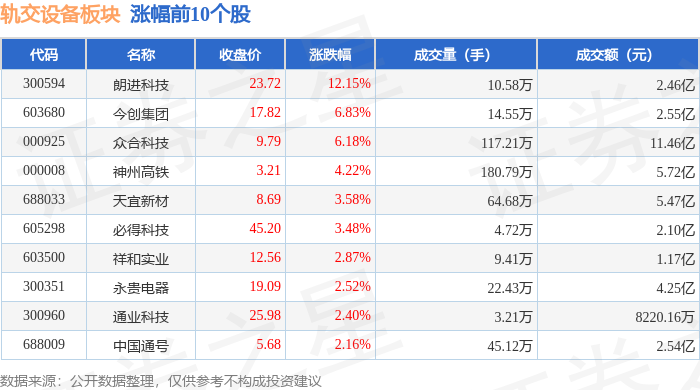
轨交设备板块1月12日涨1.57%,朗进科技领涨,主力资金净流入8502.4万元
Zheng Xing Xing Ye Ri Bao· 2026-01-12 09:10
Core Insights - The railway transportation equipment sector experienced a 1.57% increase on January 12, with Langjin Technology leading the gains [1] - The Shanghai Composite Index closed at 4165.29, up 1.09%, while the Shenzhen Component Index closed at 14366.91, up 1.75% [1] Sector Performance - Langjin Technology (300594) closed at 23.72, up 12.15% with a trading volume of 105,800 shares [1] - Jinchuan Group (603680) closed at 17.82, up 6.83% with a trading volume of 145,500 shares [1] - Zhonghe Technology (000925) closed at 9.79, up 6.18% with a trading volume of 1,172,100 shares [1] - Shenzhou High-speed Railway (000008) closed at 3.21, up 4.22% with a trading volume of 1,807,900 shares [1] - Tianzhizhi New Materials (688033) closed at 8.69, up 3.58% with a trading volume of 646,800 shares [1] - Bidetech (605298) closed at 45.20, up 3.48% with a trading volume of 47,200 shares [1] - Xianghe Industrial (603500) closed at 12.56, up 2.87% with a trading volume of 94,100 shares [1] - Yonghui Electric (300351) closed at 19.09, up 2.52% with a trading volume of 224,300 shares [1] - Tongye Technology (300960) closed at 25.98, up 2.40% with a trading volume of 32,100 shares [1] - China Railway Signal & Communication (688009) closed at 5.68, up 2.16% with a trading volume of 451,200 shares [1] Capital Flow - The railway transportation equipment sector saw a net inflow of 85.024 million yuan from institutional investors, while retail investors experienced a net outflow of 38.8308 million yuan [1] - Major stocks like China CRRC (601766) had a net inflow of 81.3475 million yuan, while Shenzhou High-speed Railway (000008) had a net inflow of 66.1107 million yuan [2] - Retail investors showed significant outflows in several stocks, including Shenzhou High-speed Railway with a net outflow of 6.43381 million yuan [2]


从延安通高铁感悟欣欣向荣的中国
Ren Min Ri Bao· 2026-01-12 04:03
当复兴号驶向宝塔山,西延高铁开通了,陕北革命老区从此迈入"高铁时代"。 随着陕西西安至延安高铁开通,中国高铁营业里程突破5万公里,领跑世界。 5万公里,织就全球最大、最先进的高铁网,营业里程超过全球其他国家总和两倍,人流、物流、信息 流、资金流相互交织,生机涌动。 建不建?怎么建?面对京沪高铁构想,我们曾激辩10余年。《中长期铁路网规划》的发布实施,让中国 高铁迈入跨越式发展新阶段。 习近平主席发表二〇二六年新年贺词时指出:"大家拼搏进取、耕耘奉献,铸就了欣欣向荣的中国。" 路,联通大江南北,串联历史与现实。从西延高铁开通看发展的确定性、创造性、机遇性,我们更能感 悟一个欣欣向荣的中国。 (一) 历史地看,从西延高铁开通,可以看到中国发展的确定性。 1991年12月26日,延安结束无铁路的历史,延安到西安需14小时;2012年,西安到延安开通动车,全程 2.5小时;2025年12月26日,开通后的西延高铁,设计时速达350公里。 当全长299公里的西延高铁融入全国高铁网,2004年发布的首版《中长期铁路网规划》更显"奠基石"的 意义。 循序渐进,步步为营。2008年、2016年,连续发布两版《中长期铁路网规划 ...
财信证券晨会纪要-20260112
Caixin Securities· 2026-01-11 23:30
Market Strategy - The report suggests a bullish market strategy with a focus on technology stocks, indicating that the A-share market is expected to enter a new round of upward momentum, particularly in the period from mid-December 2025 to early March 2026, which is seen as a favorable investment window [7][9]. Economic Insights - In December 2025, the industrial producer price index decreased by 1.9% year-on-year, with a narrowing decline compared to the previous month, while the month-on-month increase was 0.2% [16]. - The consumer price index rose by 0.8% year-on-year in December 2025, with urban prices increasing by 0.9% and rural prices by 0.6% [18]. - The U.S. non-farm payrolls increased by 50,000 in December 2025, with an unemployment rate of 4.4% [20]. Industry Dynamics - In 2025, China's engineering machinery sales were robust, with excavator sales reaching 235,257 units, a year-on-year increase of 17% [25]. - The report highlights that in December 2025, 12,236 loaders were sold, marking a 30% year-on-year increase [27]. Company Updates - Chongde Technology (301548.SZ) successfully delivered the first batch of three sets of "Hualong One" nuclear main pump bearings, marking a significant breakthrough in the localization of high-end nuclear power equipment [28]. - Chongde Technology also announced the bulk supply of core components to international leading gear manufacturers, indicating a strong position in the AI computing energy supply chain [31]. - Hisco (002653.SZ) signed an exclusive licensing agreement with AirNexis for the global development and commercialization of HSK39004, with an upfront payment of $108 million [33]. - Wens Foodstuffs Group (300498.SZ) expects a significant decline in net profit for 2025, projecting a year-on-year decrease of 40.73% to 46.12% [37]. - China CRRC (601766.SH) won a bid for 26 new train orders for the Malaysia Glarana Line, with the first set expected to be delivered in September 2028 [39].
欧盟FSR触发“过量申报”和业界不满,中企如何捍卫确定性
Di Yi Cai Jing· 2026-01-11 10:44
Core Insights - The EU's Foreign Subsidies Regulation (FSR) has led to over 200 transactions being reported to the European Commission by mid-October 2025, significantly exceeding the initial estimate of 30 transactions per year [1][4] - The FSR's broad applicability and complex reporting requirements have created substantial compliance burdens and uncertainties for both the EU and multinational transaction participants [1][5] Group 1: FSR Implementation and Impact - The FSR has triggered a large number of submissions, with nearly half (47%) of reported transactions involving EU investors, many of which have no clear connection to jurisdictions outside the EU [4] - Compliance procedures under the FSR are burdensome, requiring companies to detail all foreign financial support received over the past three years, often necessitating cross-departmental collaboration [5] - The European Commission has initiated an evaluation of the FSR, responding to feedback that the current review system is cumbersome and slows down transaction processes [5][6] Group 2: Future Developments and Regulatory Adjustments - Future enforcement of the FSR is expected to become more targeted, with potential simplification of review processes for low-risk transactions while maintaining vigilance for those in critical sectors [2] - A draft guideline from the European Commission aims to clarify the application of key FSR provisions, including the assessment of distortive effects and the initiation of pre-review for transactions below the reporting threshold [6] Group 3: Impact on Chinese Enterprises - Chinese enterprises have faced significant regulatory challenges under the FSR, with the Chinese Ministry of Commerce highlighting the adverse effects on their operations in Europe [7][8] - Reports indicate that Chinese companies' bids for public procurement projects are increasingly subjected to second-stage reviews by the European Commission, reflecting heightened scrutiny [8] - High-risk sectors for Chinese enterprises include automotive, pharmaceuticals, energy, battery, and chemicals, with state-owned enterprises being particularly vulnerable to investigations [8][9] Group 4: Strategic Recommendations for Enterprises - Despite regulatory obstacles, international expansion remains an irreversible trend, necessitating companies to identify viable investment opportunities within complex regulatory frameworks [9] - Companies are advised to conduct thorough risk assessments and develop effective response plans to navigate the regulatory landscape successfully [9]

2025年1-11月中国铁路机车产量为912辆 累计增长20.5%
Chan Ye Xin Xi Wang· 2026-01-11 01:37
Core Viewpoint - The report highlights the growth in China's railway locomotive production, indicating a positive trend in the industry with a projected increase in output and market potential from 2026 to 2032 [1] Group 1: Company Overview - Listed companies in the railway locomotive sector include China CNR Corporation (601766), China Railway Group (601390), China Railway Construction Corporation (601186), Jinxin Axle (600495), Taiyuan Heavy Industry (600169), Times New Material (600458), Shenzhou High-speed Railway (000008), Kanni Electromechanical (603111), Huizhong Technology (002296), and Jinyi Industrial (601002) [1] Group 2: Industry Statistics - According to the National Bureau of Statistics, the production of railway locomotives in China reached 150 units in November 2025, representing a year-on-year growth of 4.9% [1] - Cumulatively, from January to November 2025, the total production of railway locomotives was 912 units, showing a significant increase of 20.5% compared to the previous year [1] - A statistical chart detailing the production of railway locomotives from 2020 to November 2025 is provided, showcasing the growth trend in the industry [1]

轨交设备II:铁路十四五圆满收官,路网与效能双突破
Huafu Securities· 2026-01-10 08:24
Investment Rating - The industry rating is "Outperform the Market," indicating that the overall return of the industry is expected to exceed the market benchmark index by more than 5% in the next 6 months [6][13]. Core Insights - The "14th Five-Year Plan" for railways has been successfully completed, with the national railway operating mileage reaching 165,000 kilometers, a 12.8% increase from the previous five-year plan. High-speed rail has expanded to over 50,400 kilometers, marking a 32.98% growth, establishing the world's largest and most advanced high-speed rail network [3][4]. - During the "14th Five-Year" period, the railway transportation sector has seen significant improvements, with a total of 16.2 billion passengers and 19.6 billion tons of cargo transported, representing growth of 8.7% and 24.1% respectively compared to the previous five-year plan [4]. - The government has set ambitious targets for the future, aiming for a railway network of approximately 200,000 kilometers by 2035, including around 70,000 kilometers of high-speed rail. This long-term goal is expected to create vast market opportunities for the rail transit equipment industry [5]. Company Summaries - China CNR Corporation: A global leader in rail transit equipment, maintaining the top position in revenue within the industry [5]. - China Railway Signal & Communication Corporation: A leading provider of rail transit control systems, recognized for its technological expertise [5]. - Times Electric: A prominent supplier of traction and conversion systems, consistently leading the domestic market [5]. - Sifang Railway: A key supplier in the field of high-speed rail comprehensive monitoring, specializing in railway safety assurance [5]. - China High-Speed Railway Technology: A leading enterprise in intelligent operation and maintenance equipment for rail transit, serving a wide range of clients including national railways and urban rail systems [5]. - Huifeng Technology: Focused on providing operation and maintenance equipment and integrated solutions for rail transit, with extensive experience in technology development and project implementation [5].
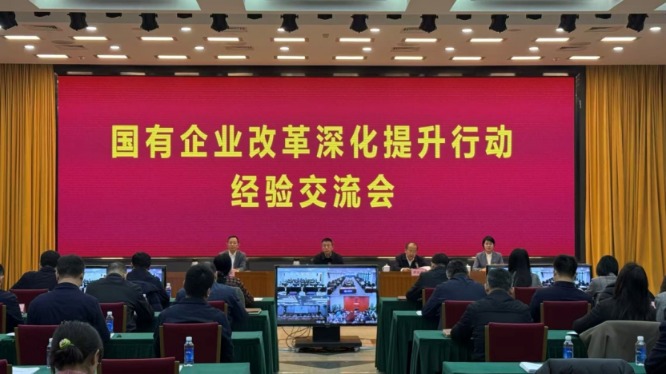
国务院国资委 最新部署!
Zheng Quan Shi Bao· 2026-01-10 00:53
Core Insights - The State-owned Assets Supervision and Administration Commission (SASAC) announced that the main tasks of the deepening reform action have been largely completed, but further reforms are still necessary to meet targets [1] - By November 2025, central enterprises' revenue in strategic emerging industries is expected to exceed 11 trillion yuan, indicating significant growth in this sector [6][7] Group 1: Reform Progress - The SASAC has facilitated the integration and restructuring of state-owned enterprises (SOEs) to enhance efficiency and focus on core competencies, with 116 strategic reorganizations involving 229 primary enterprises reported [3][2] - Local governments have initiated various restructuring efforts, such as the establishment of Hebei Water Development Group to improve water resource management and the integration of grain enterprises in Hebei [3] Group 2: Industry Transformation - Traditional industries are accelerating their transformation, with companies like Ansteel and China National Building Material increasing their share of high-end products and new materials [5] - The focus on digitalization, intelligence, and green transformation is being emphasized, with Guizhou increasing the weight of these factors in annual scientific and technological assessments [5] Group 3: Innovation and Investment - Central enterprises' R&D expenditure has seen an annual growth of 6.5%, with total spending exceeding 1 trillion yuan for three consecutive years from 2022 to 2024, and a 19% annual growth in basic research investment [7] - The government is promoting the integration of technological and industrial innovation, with a focus on key areas such as energy security and national defense [7] Group 4: Management and Performance - Performance evaluation is now closely linked to compensation and promotion within SOEs, with over 20,000 managerial personnel experiencing salary adjustments of more than 20% based on performance [9] - The implementation of flexible income distribution mechanisms and long-term incentive tools is becoming widespread, with various enterprises adopting innovative compensation strategies to motivate R&D teams [9]