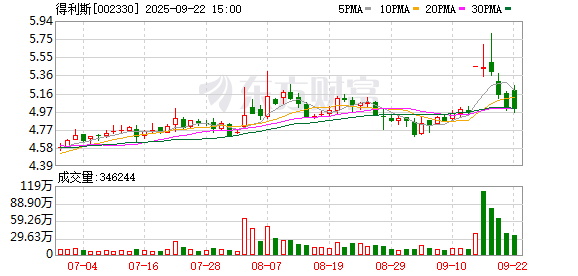
得利斯

Search documents
“宠物经济”发展驶入快车道 多地释放政策红利
Zhong Guo Zheng Quan Bao· 2025-09-24 23:17
Core Insights - The "pet economy" in China is experiencing rapid growth, with policies and activities being launched to support this sector, leading to increased interest in related stocks [1] - The market size of China's pet industry has grown significantly, from 97.8 billion yuan in 2015 to 592.8 billion yuan in 2023, with a compound annual growth rate (CAGR) of 25.4% [2] - By 2025, the market is expected to reach 811.4 billion yuan, and projections suggest it could reach 1.15 trillion yuan by 2028 [2] Industry Growth Dynamics - The pet market is driven by strong demand, with a variety of companies emerging to focus on pet-related products and services [2] - Key segments such as pet food, healthcare, and cleaning products are currently the largest and fastest-growing areas within the market [3] - There is still significant room for growth in the pet industry, with potential for market size to double in the coming years [3] Policy Support - Local governments are increasingly providing policy support to boost the pet economy, with initiatives aimed at encouraging traditional industries to engage in pet product development [3][4] - Specific regions, such as Wuxi and Anhui, are implementing measures to enhance the pet economy, including promoting technological innovation and e-commerce in the sector [3] Corporate Activities - Several listed companies are actively investing in the pet sector, with notable acquisitions and the establishment of subsidiaries focused on pet food and products [5][6] - Companies like Huang Shang Huang and Three Squirrels are making strategic investments to expand their presence in the pet food market [5] - Jinhe Biological has launched a pet-focused app, indicating a trend towards integrating technology with pet care services [6]



上市公司积极布局 “宠物经济”发展驶入快车道
Zhong Guo Zheng Quan Bao· 2025-09-24 23:17
Group 1 - The "pet economy" in China is experiencing rapid growth, with policies and activities being launched across multiple regions, leading to a surge in related stocks. The Wind Pet Economy Index has increased by over 37% year-to-date as of September 24 [1] - The market size of China's pet industry has grown from 97.8 billion yuan in 2015 to 592.8 billion yuan in 2023, with a compound annual growth rate (CAGR) of 25.4%. It is projected to reach 811.4 billion yuan by 2025, and could potentially hit 1.15 trillion yuan by 2028 [2] - The pet industry is seen as entering a golden decade of high-quality development, with significant growth potential remaining untapped. The market is expected to double in size [2][3] Group 2 - The penetration rate of pets in Chinese households is still lower compared to developed markets, indicating strong future growth potential for the pet economy. Key segments such as pet food, medical care, and cleaning products are currently the largest and fastest-growing areas [3] - Local governments are increasingly supporting the pet economy through various policies, such as promoting the development of pet-related products and encouraging technological innovation in the industry [3][4] - Several listed companies are actively investing in the pet sector, with notable acquisitions and the establishment of subsidiaries focused on pet food and related products. For instance, Huang Shang Huang has invested 494.7 million yuan to acquire a 51% stake in a freeze-dried food manufacturer [5][6]
政策支持力度加大 上市公司积极布局 “宠物经济”发展驶入快车道
Zhong Guo Zheng Quan Bao· 2025-09-24 21:48
Core Insights - The "pet economy" in China is experiencing rapid growth, with a market size projected to reach 5.928 trillion yuan in 2023, up from 97.8 billion yuan in 2015, reflecting a compound annual growth rate (CAGR) of 25.4% [1][2] - The pet economy index has increased by over 37% year-to-date as of September 24 [1] - The market is expected to reach 8.114 trillion yuan by 2025 and 11.5 trillion yuan by 2028, indicating significant growth potential [1][2] Industry Growth Dynamics - The pet industry is in a "golden decade" of high-quality development, with substantial room for growth as the current pet ownership penetration rate in China lags behind developed markets [2] - Key segments driving growth include pet staple food, medical care, and cleaning products, while emerging areas like pet insurance and elder pet care are seen as future growth opportunities [2] Policy Support - Local governments are increasingly supporting the pet economy through various policies, such as encouraging traditional industries to engage in pet product development and promoting technological innovation in the sector [3] - Specific initiatives include Wuxi's goal to exceed 3 billion yuan in pet-related industry scale by 2027 and Zhejiang's push for smart pet product manufacturing [3] Corporate Strategies - Several listed companies are actively investing in the pet sector, such as Huangshanghuang's acquisition of a 51% stake in a freeze-dried food manufacturer for 494.7 million yuan [4] - Three Squirrels has established two wholly-owned subsidiaries focused on pet food, with a registered capital of 5 million yuan for one of them [4] - Jinhe Biological has launched a pet emotional multi-modal model app, while Delisi has entered strategic partnerships for product development in the pet food sector [5]
“宠物经济”发展驶入快车道
Zhong Guo Zheng Quan Bao· 2025-09-24 20:18
Industry Overview - The "pet economy" in China has entered a rapid growth phase, with various policies and activities being launched to support this sector, leading to a surge in related stocks. The Wind Pet Economy Index has increased by over 37% year-to-date as of September 24 [1] - The pet market size in China has grown from 97.8 billion yuan in 2015 to 592.8 billion yuan in 2023, with a compound annual growth rate (CAGR) of 25.4%. It is expected to reach 811.4 billion yuan by 2025, and potentially 1.15 trillion yuan by 2028 [2][3] Market Demand and Growth Potential - The current pet penetration rate in Chinese households is still lower compared to developed markets, indicating strong future growth potential for the pet economy. Key segments such as pet food, medical care, and cleaning products are currently the largest and fastest-growing areas [3] - There is significant room for growth in the pet industry, with reports suggesting that the market size could double in the coming years [2] Policy Support and Local Government Initiatives - Local governments are increasingly providing policy support for the pet economy. For instance, Wuxi, Jiangsu, aims to exceed 3 billion yuan in pet-related industry scale by 2027, while Suzhou, Anhui, is focusing on technological innovation and e-commerce development in the pet sector [3] - Zhejiang province has proposed to develop smart pet products and encourage the use of advanced technologies in product innovation [3] Corporate Activities and Investments - Several listed companies are actively investing in the pet economy. For example, Huangshanghuang announced a 494.7 million yuan acquisition of a 51% stake in a freeze-dried food manufacturer, which will supply products for pet food brands [4] - Three squirrels have established two wholly-owned subsidiaries focused on pet food, with a registered capital of 5 million yuan for one of them [4] - Jinhai Biological has launched a pet care app utilizing a self-developed emotional multimodal model, indicating a trend towards technology integration in pet care [4] - Delisi has signed a strategic cooperation agreement with food companies to collaborate on product supply, market expansion, and freeze-dried pet food development [5]
得利斯集团再次入选“2025中国制造业企业500强”榜单
Quan Jing Wang· 2025-09-23 03:29
Core Viewpoint - The 2025 World Manufacturing Conference in Hefei highlighted the release of the "2025 China Manufacturing Enterprises Top 500" list, with Delisi Group once again making the list, showcasing its strong position in the industry [1][2]. Group 1: Industry Overview - The "2025 China Manufacturing Enterprises Top 500" list uses the 2024 revenue as the entry standard, reflecting the upward trend and enhanced capabilities of Chinese manufacturing enterprises [2]. - In 2024, despite global economic challenges, China's economy remains stable, with large manufacturing enterprises like the Top 500 demonstrating resilience through innovation and structural optimization [2]. - The food industry is a pillar of the national economy and plays a crucial role in ensuring public welfare, with Shandong Province prioritizing the food industry in its economic transformation initiatives [2]. Group 2: Company Performance - Delisi Group has established five production bases across China, including Shandong, Beijing, Shaanxi, Jilin, and Jiangxi, enhancing its regional layout advantage [3]. - The company has significant slaughtering capacity, with Shandong's base at 1 million heads/year and Jilin's at 2 million heads/year, while the under-construction Shaanxi base is planned for an additional 2 million heads/year [3]. - Delisi Group's pre-prepared food production capacity totals 180,000 tons, with specific capacities of 100,000 tons for pork and chicken, and 30,000 tons for beef in Shandong, and 50,000 tons in Shaanxi [3]. Group 3: Strategic Initiatives - The company is advancing smart transformation and digitalization, establishing smart production bases and implementing automated and information-driven production processes [4]. - Delisi Group is developing a digital supply chain system for comprehensive management from raw material procurement to product sales, alongside a quality traceability system for full-chain quality control [4]. - The recent inclusion in the Top 500 list is a recognition of Delisi Group's comprehensive strength and a commitment to high-quality development in the food manufacturing sector in Shandong [4].


得利斯:截至2025年9月20日公司股东人数为41242户
Zheng Quan Ri Bao· 2025-09-22 09:39
Core Insights - The company, Delisi, reported that as of September 20, 2025, the number of shareholders reached 41,242 [2] Company Summary - Delisi's shareholder count indicates a growing interest and potential investment in the company, reflecting its market position and investor confidence [2]
预制菜板块迎来大涨,企业上半年净利润却普遍下滑
Xi Niu Cai Jing· 2025-09-22 09:16
Industry Overview - The pre-prepared food sector is experiencing significant growth, with a market size projected to reach 485 billion yuan in 2024, reflecting a year-on-year increase of 33.8%, and expected to reach 749 billion yuan by 2026 [1] - The sector is facing challenges such as low entry barriers, product homogeneity, and consumer awareness issues, which could impact future growth [1] Company Performance - **Delisi**: Achieved revenue of 1.616 billion yuan in the first half of the year, up 17.04% year-on-year, but net profit decreased by 27.24% to 10.303 million yuan. Pre-prepared food contributed 643 million yuan to revenue, a growth of 35.77%, accounting for 39.77% of total revenue [1] - **Huifa Food**: Reported revenue of 735 million yuan, down 17.75% year-on-year, with a net loss of 29.993 million yuan, indicating worsening financial performance despite efforts to diversify product offerings [2] - **Longda Meishi**: Generated revenue of 4.975 billion yuan, a decrease of 1.38% year-on-year, with net profit down 39.52% to 35.169 million yuan. The pre-prepared food segment saw a revenue drop of 19.5% [2] - **Guolian Aquatic Products**: Recorded revenue of 1.651 billion yuan, down 18.36% year-on-year, and a net loss of 54 million yuan, indicating a significant decline in the main pre-prepared seafood business [2] - **Weizhi Xiang**: Achieved revenue of 343 million yuan, up 4.70% year-on-year, but net profit fell by 24.46% to 31.947 million yuan, marking two consecutive years of profit decline [3] - **Qianwei Central Kitchen**: Reported revenue of 886 million yuan, a slight decrease of 0.72%, with net profit down 39.67% to 35.789 million yuan. The fastest-growing segment was frozen prepared dishes, but overall revenue from main and snack categories declined [3] Market Dynamics - The pre-prepared food market is expanding due to improvements in cold chain technology and increased coverage, but companies must find growth points and establish competitive barriers to succeed [1][3]
食品加工板块9月22日跌1.03%,康比特领跌,主力资金净流出8672.07万元
Zheng Xing Xing Ye Ri Bao· 2025-09-22 08:46
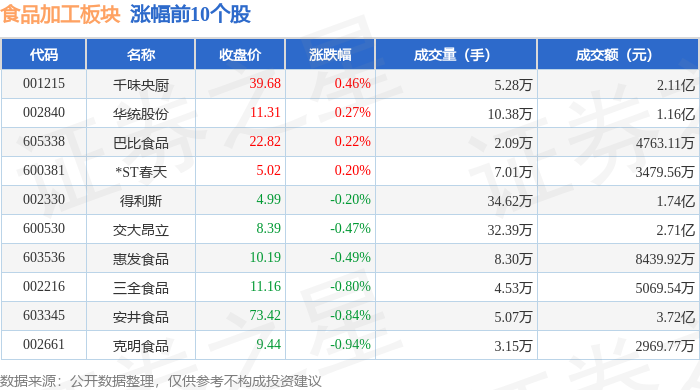
Market Overview - On September 22, the food processing sector declined by 1.03%, with Kangbiter leading the drop [1] - The Shanghai Composite Index closed at 3828.58, up 0.22%, while the Shenzhen Component Index closed at 13157.97, up 0.67% [1] Individual Stock Performance - Notable gainers included: - Qianwei Yangchu (001215) with a closing price of 39.68, up 0.46% [1] - Huaton Co., Ltd. (002840) with a closing price of 11.31, up 0.27% [1] - Significant decliners included: - Kangbiter (833429) with a closing price of 19.40, down 3.34% [2] - Xianle Health (300791) with a closing price of 24.37, down 2.52% [2] Trading Volume and Capital Flow - The food processing sector experienced a net outflow of 86.72 million yuan from institutional investors, while retail investors saw a net inflow of 23.94 million yuan [2] - The total trading volume for the food processing sector was significant, with individual stocks showing varied performance in terms of capital flow [3] Capital Flow Analysis - Major stocks with net inflows from institutional investors included: - Jiaoda Onl (600530) with a net inflow of 29.93 million yuan [3] - Deli Foods (002330) with a net inflow of 11.19 million yuan [3] - Stocks with net outflows included: - Huaton Co., Ltd. (002840) with a net outflow of 1.01 million yuan [3] - Kangbiter (833429) with a net outflow of 6.84 million yuan [3]
36氪精选:罗永浩大战贾国龙,预制菜闷声发大财
日经中文网· 2025-09-20 00:33
Core Viewpoint - The recent surge in stock prices of pre-prepared food companies in A-shares is attributed to the upcoming national food safety standards for pre-prepared dishes, which will provide a unified identity and safety baseline for the industry [12][13]. Industry Overview - The pre-prepared food industry in China has a history dating back to the 1990s, with significant developments occurring between 2000 and 2005 when many current leading companies were established [13]. - Regulatory frameworks for pre-prepared foods have only begun to take shape in recent years, with standards being introduced by various governmental bodies [13][14]. Market Dynamics - The stock prices of companies such as Deli Foods, Longda Food, and Huifa Foods have seen increases of over 5%, with Deli Foods hitting a 10.10% rise [7][11]. - The rise in stock prices is linked to the public's renewed interest in the pre-prepared food debate, sparked by recent comments from industry figures [12]. Consumer Perception - There is a disconnect between the regulatory definition of pre-prepared foods and consumer understanding, leading to concerns about food safety and transparency [14]. - Consumers express frustration over the lack of knowledge regarding the preparation of their meals, reflecting a deeper societal issue of time constraints and the desire for authentic dining experiences [14][17]. Operational Trends - The adoption of pre-prepared foods is becoming widespread among restaurants, as they are more cost-effective than hiring chefs and allow for a diverse menu without extensive culinary skills [16]. - The rise of central kitchens and cold chain logistics post-2008 has facilitated the expansion of pre-prepared foods, standardizing offerings across various dining establishments [16].



食品加工板块9月19日涨0.15%,交大昂立领涨,主力资金净流出3488.1万元
Zheng Xing Xing Ye Ri Bao· 2025-09-19 08:47
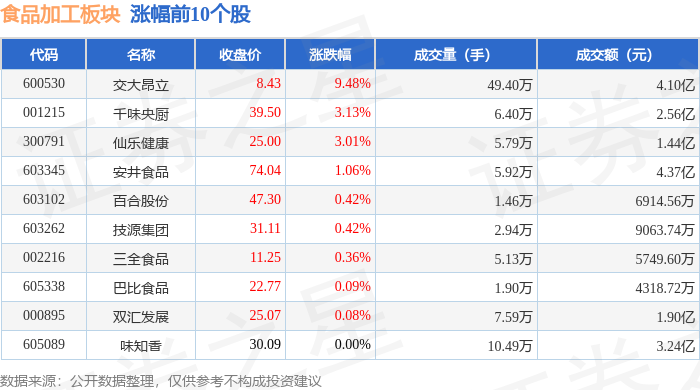
Market Overview - On September 19, the food processing sector rose by 0.15% compared to the previous trading day, with Jiaoda Onlly leading the gains [1] - The Shanghai Composite Index closed at 3820.09, down 0.3%, while the Shenzhen Component Index closed at 13070.86, down 0.04% [1] Top Performers - Jiaoda Onlly (600530) closed at 8.43, up 9.48%, with a trading volume of 494,000 shares and a turnover of 410 million yuan [1] - Qianwei Yangchu (001215) closed at 39.50, up 3.13%, with a trading volume of 64,000 shares and a turnover of 256 million yuan [1] - Xianle Health (300791) closed at 25.00, up 3.01%, with a trading volume of 57,900 shares and a turnover of 144 million yuan [1] Underperformers - Gais Food (836826) closed at 13.67, down 4.54%, with a trading volume of 91,200 shares and a turnover of 127 million yuan [2] - Deli Foods (002330) closed at 5.00, down 2.72%, with a trading volume of 377,600 shares and a turnover of 190 million yuan [2] - Xiwang Foods (000639) closed at 3.25, down 2.69%, with a trading volume of 364,800 shares and a turnover of 119 million yuan [2] Capital Flow - The food processing sector experienced a net outflow of 34.88 million yuan from institutional investors, while retail investors saw a net inflow of 68.44 million yuan [2] - The main capital flow data indicates that Jiaoda Onlly had a net inflow of 94.27 million yuan from institutional investors, while retail investors had a net outflow of 48.85 million yuan [3]