福瑞达

Search documents
今年,线下增长机会在哪?
Sou Hu Cai Jing· 2025-09-30 12:22
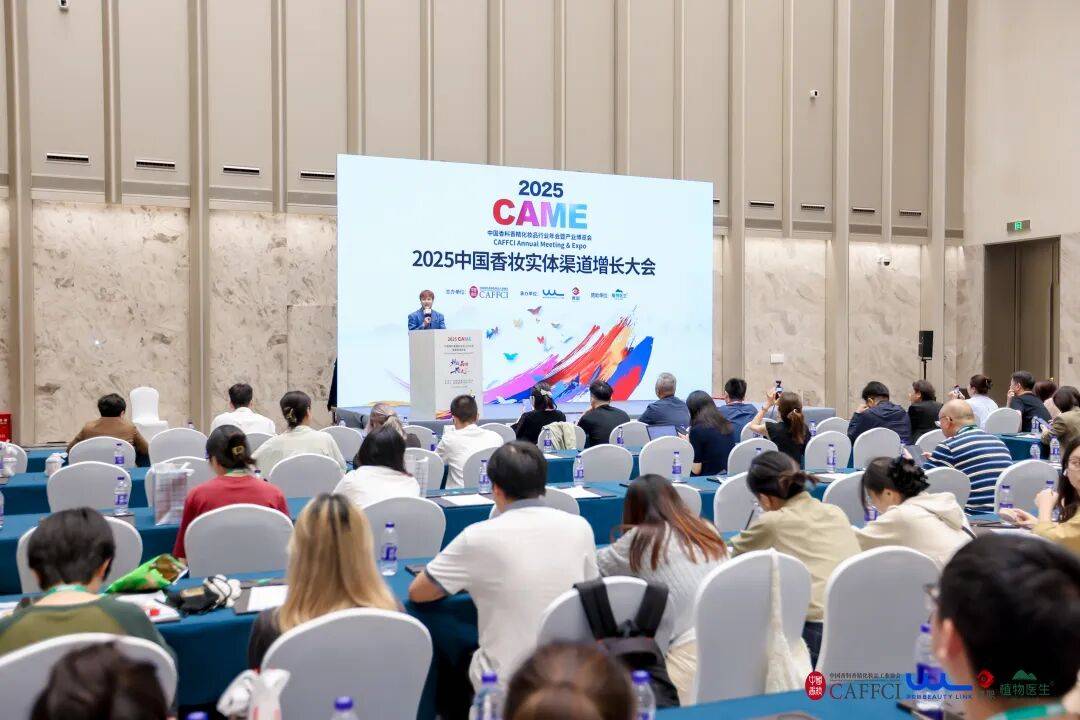
Core Insights - Despite the rise of online retail, offline retail remains a crucial channel for beauty brands to reach consumers and conduct brand marketing [1][3] - The "2025 China Fragrance and Cosmetics Physical Channel Growth Conference" highlighted the importance of offline channels in driving high-quality industry growth [3][5] Industry Overview - In the first half of this year, the Chinese cosmetics market reached a size of 496.27 billion yuan, with offline channels accounting for 228.44 billion yuan, representing 46% of the market [3] - The offline channel's resilience indicates its potential as a new growth point for beauty brands, despite challenges from digitalization [3] Key Strategies for Offline Growth - Brands are focusing on creating immersive shopping experiences and leveraging cultural elements to enhance consumer engagement [5][7] - The integration of online and offline marketing strategies is essential, with brands utilizing social media platforms to boost consumer trust and product appeal [7] Challenges in Offline Retail - The offline retail sector faces significant challenges, including reduced foot traffic, high operational costs, and changing consumer habits favoring online shopping [8][10] - Key issues include a lack of professional staff, product homogeneity, and outdated store environments [10][12] Future Trends - Instant retail is emerging as a new growth trend, allowing offline stores to connect with online channels and serve local customers effectively [13][18] - The market is witnessing a shift towards high-quality, affordable products, with a focus on consumer preferences for effective skincare solutions [12][16]

福瑞达:HA水光针(Ⅲ类)完成所有中心的临床试验启动,且已完成所有中心的病例入组
Mei Ri Jing Ji Xin Wen· 2025-09-30 09:55
每经AI快讯,有投资者在投资者互动平台提问:贵司两款三类医疗器械研发进度是否顺利,明年能否 按期取证? 福瑞达(600223.SH)9月30日在投资者互动平台表示,公司两款三类医疗器械按研发计划推进中,HA 水光针(Ⅲ类)完成所有中心的临床试验启动,且已完成所有中心的病例入组;胶原蛋白冻干纤维(Ⅲ 类)正在开展注册检验、生物学评价,进度符合研发计划,研发与临床团队全力推进中。 (文章来源:每日经济新闻) ...

珂谧KeyC突围记:“双标准”开路、在新华网直播间破1500万
FBeauty未来迹· 2025-09-29 11:51
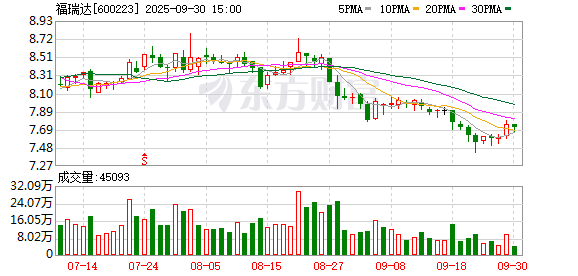
Core Viewpoint - The article discusses the integration of effective skincare and medical aesthetics, highlighting the shift in consumer demand from visible results to verifiable and reproducible outcomes. The emergence of recombinant collagen as a "super ingredient" is noted, with retail scale surpassing 28.6 billion yuan, while the industry faces challenges of unregulated efficacy claims and inconsistent perioperative care standards [2][13]. Summary by Sections Standards and Guidelines - The first domestic standard for recombinant collagen penetration, titled "Detection of Penetration, Degradation, and Promotion of Collagen by Raman Spectroscopy in Humans," was released on September 5, 2025, with Furuida Bio Co., Ltd. as the main drafter [5][14]. - This standard addresses the credibility of ingredient efficacy and clinical care standardization, providing a technical and procedural foundation for the integration of effective skincare and medical aesthetics [3][14]. - The "Medical Aesthetic (Perioperative) Skin Care Guidelines" was also published around the same time, outlining comprehensive skin care protocols from pre-operative to post-operative stages [10][12]. Market Dynamics - The recombinant collagen market has become a core component of effective skincare and medical aesthetics, with a retail scale projected to reach 28.6 billion yuan by 2024, significantly outpacing industry growth rates [13][14]. - The lack of unified standards for product efficacy claims and the inconsistency in perioperative care processes have created a chaotic market environment, indicating a transition from unregulated growth to a more refined approach [13][15]. Furuida Bio's Role - Furuida Bio Co., Ltd. has positioned itself as a leader in the industry by establishing these standards, filling the gap of "no evidence for testing and no benchmarks for evaluation" in the recombinant collagen sector [3][16]. - The company’s strategy involves embedding its products into standardized clinical processes through the "Care Guidelines," while also leveraging the "Detection Standard" to gain consumer trust [16][24]. Brand Development - The high-end medical aesthetic brand "Key C" under Furuida is rapidly gaining market traction, utilizing a "standard + technology + platform" strategy to penetrate the market [17][24]. - Key C has developed a unique "Recombinant Membrane Penetration Engine" that significantly enhances the skin penetration rate of collagen, addressing long-standing industry challenges [19][24]. - The brand's flagship product, "Membrane Penetrating Collagen Essence," has achieved remarkable sales, further solidifying its market presence and brand recognition [19][23]. Future Outlook - With the establishment of these standards and the successful launch of Key C products, Furuida aims to create a comprehensive care solution that spans medical aesthetics and health, positioning itself for significant growth in the global beauty market [24].
化妆品板块9月29日跌0.13%,青岛金王领跌,主力资金净流出1.04亿元
Zheng Xing Xing Ye Ri Bao· 2025-09-29 08:53
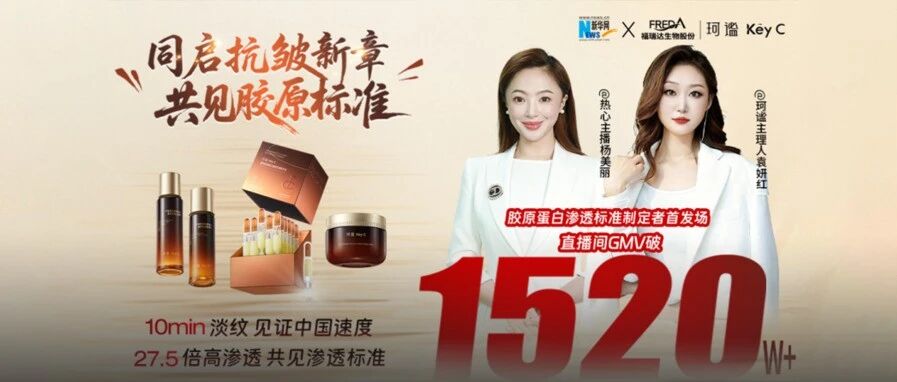
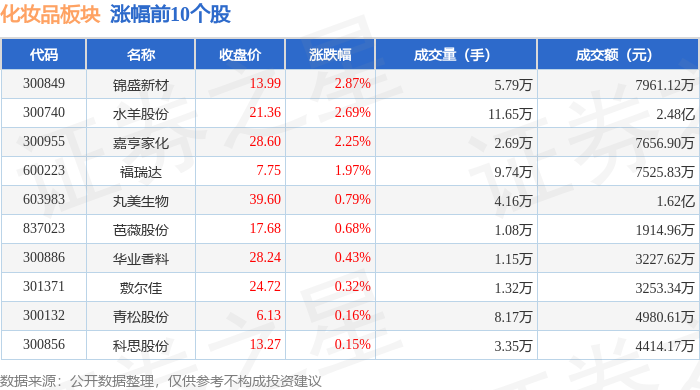
Core Insights - The cosmetics sector experienced a slight decline of 0.13% on September 29, with Qingdao Jinhao leading the drop [1] - The Shanghai Composite Index closed at 3862.53, up 0.9%, while the Shenzhen Component Index closed at 13479.43, up 2.05% [1] Group 1: Stock Performance - The top-performing stocks in the cosmetics sector included: - Jinsong New Material (300849) with a closing price of 13.99, up 2.87% and a trading volume of 57,900 shares [1] - Shuiyang Co. (300740) closed at 21.36, up 2.69% with a trading volume of 116,500 shares [1] - Jiahen Home Care (300955) closed at 28.60, up 2.25% with a trading volume of 26,900 shares [1] - Qingdao Jinhao (002094) was the biggest loser, closing at 7.77, down 2.88% with a trading volume of 287,600 shares [2] - Other notable declines included: - Lafang Home Care (603630) down 1.66% [2] - Beitaini (300957) down 1.37% [2] Group 2: Capital Flow - The cosmetics sector saw a net outflow of 104 million yuan from major funds, while retail funds experienced a net inflow of 58.59 million yuan [2] - The capital flow for specific stocks showed: - Furuida (600223) had a net inflow of 9.18 million yuan from major funds [3] - Jinsong New Material (300849) saw a net inflow of 2.32 million yuan from major funds [3] - Beitaini (300957) experienced a net outflow of 2.96 million yuan from major funds [3]


济南文旅集团:多赛道协同创新,让千年泉城“出圈”更“出彩”
Qi Lu Wan Bao Wang· 2025-09-29 00:33
Group 1 - The core viewpoint emphasizes the unprecedented development opportunities for the cultural tourism industry in the context of consumption structure upgrades and the continuous release of domestic demand, positioning it as a key engine for economic circulation [1] - Jinan Cultural Tourism Group is leveraging its rich cultural resources and innovative practices to integrate "culture, sports, tourism, and commerce," enhancing the city's cultural tourism appeal and depth [2][4] - The group is actively engaging in cultural empowerment of tourism through creative planning and immersive experiences, transforming static cultural symbols into interactive urban gifts [2][4] Group 2 - Various attractions under Jinan Cultural Tourism Group are enhancing cultural experiences and product offerings, such as the introduction of unique activities and personalized services to meet high-quality tourist demands [3][4] - The group is capitalizing on the "event economy" by hosting high-profile performances and sports events, which are driving consumer engagement and economic benefits [5][6] - The successful hosting of events like the Jay Chou concert attracted 300,000 visitors and generated 1 billion yuan in tourism revenue, showcasing the effectiveness of their strategy [6][7] Group 3 - Jinan Cultural Tourism Group is pursuing a multi-track approach to industry development, focusing on collaborative efforts across various sectors to create a new ecosystem for cultural tourism [8][9] - The group is advancing key projects, such as the Jinan Bucun Comprehensive Leisure Resort, aimed at integrating diverse experiences like ice and snow activities, performances, and wellness [8] - The group is also enhancing its competitive edge through successful youth training programs in football, contributing to the development of local talent and sports culture [9] Group 4 - The group recognizes the importance of high-quality service and experience in the competitive landscape of cultural tourism, implementing measures to ensure visitor satisfaction and safety during large events [11] - Jinan Cultural Tourism Group integrates party leadership into its operational framework, emphasizing social responsibility and community engagement as part of its development strategy [11][12] - The group aims to continue leveraging national strategies for expanding domestic demand and cultural tourism integration, striving to enhance Jinan's reputation as a modern cultural tourism city [12]
2025上半年美妆行业“变局”
3 6 Ke· 2025-09-28 11:48
Core Insights - The global beauty industry is projected to exceed $677 billion by 2025, indicating strong growth, while the Chinese cosmetics market is undergoing significant structural changes, moving away from reliance on single blockbuster products or marketing gimmicks to a focus on genuine brand strength [1][2]. Market Performance - The Chinese cosmetics retail market is expected to maintain moderate growth in the first half of 2025, with retail sales reaching 2.291 billion yuan, a year-on-year increase of 2.9%, although this is below the overall retail growth rate of 5.0% [2][4]. - International beauty giants are facing pressure in the Chinese market, with L'Oréal leading with sales of 186.19 billion yuan, a 3% increase year-on-year, while Estée Lauder reported a 10.88% decline in net sales, marking its lowest sales in five years [4][6]. Domestic Brand Performance - Domestic brands are showing resilience, with the retail scale of the Chinese cosmetics market reaching 1.0738 trillion yuan in 2024, and domestic brands capturing 55.2% of the market share [6][8]. - The top ten domestic beauty companies reported a total revenue growth of 11.72% in the first half of 2025, with Proya, Shiseido, and Shanghai Jahwa leading the rankings [7][8]. Consumer Trends - The beauty market is witnessing a shift towards rational consumption, with consumers increasingly sensitive to price and favoring cost-effective products. The sales of beauty and skincare products reached 235.23 billion yuan in the first half of 2025, a 10.1% increase year-on-year [12][13]. - The anti-aging market is experiencing significant growth, with total sales reaching 65.49 billion yuan, a 30.3% increase year-on-year, and the demand for anti-aging products is expanding to younger demographics [13][14]. Brand Strategies - Brands are increasingly adopting multi-brand strategies to address diverse consumer needs, moving from a single product focus to a more comprehensive brand matrix [14][19]. - Investment in research and development is on the rise among leading domestic brands, with a focus on building technological barriers and enhancing product efficacy [15][16]. Marketing and Distribution - Douyin (TikTok) has solidified its position as a growth engine for the beauty industry, with daily views of beauty videos exceeding 2.5 billion, reflecting a shift towards more refined and systematic marketing strategies [17][18]. - The competition is evolving from a focus on single-channel strategies to an integrated approach that balances online and offline resources, emphasizing the importance of brand experience and customer loyalty [18][19].


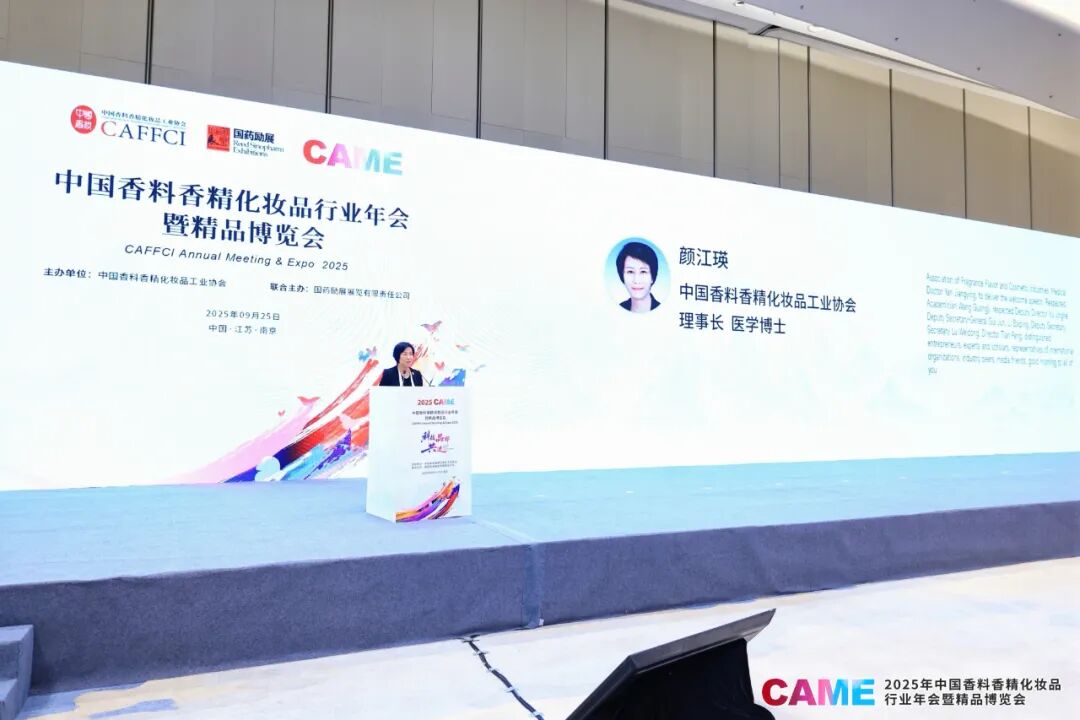
现场直击香妆产业“超级会展”: 品牌比拼科技,药企跨界美妆
Di Yi Cai Jing· 2025-09-27 09:25
Core Insights - The Chinese fragrance and cosmetics industry is entering a golden era, characterized by high-quality development and the necessity for collaboration to address global challenges and opportunities [1][8]. Industry Trends - The 2025CAME conference focused on "Technology, Brand, and Collaboration," showcasing cutting-edge technology projects from various companies, highlighting the trend of technology empowering fragrance and cosmetics brands [3][4]. - Major companies like Shanghai Jahwa and Shiseido presented innovative technologies, such as non-invasive skin glycation level analysis and advanced skin analysis techniques, indicating a shift towards scientific validation in product development [3][4]. Regulatory Environment - The regulatory landscape for the cosmetics industry in China is becoming increasingly stringent, with the implementation of comprehensive regulations aimed at promoting standardization and scientific development [8]. - New industry standards are being established, requiring companies to validate product efficacy scientifically, which is pushing the industry towards a more research-driven approach [8]. Consumer Demand - There is a notable shift in consumer demand towards products that emphasize safety, efficacy, and scientific backing, moving beyond basic cosmetic functions [8][9]. - Consumers are increasingly favoring products with medical endorsements and high technological content, driving the industry to align more closely with pharmaceutical and medical device sectors [9]. Cross-Industry Collaboration - Pharmaceutical companies are entering the cosmetics space, leveraging their established research and quality control systems to innovate in the beauty sector [9][10]. - While pharmaceutical firms have advantages in R&D and safety validation, they face challenges in brand establishment and market competition due to the saturated nature of the cosmetics industry [10].
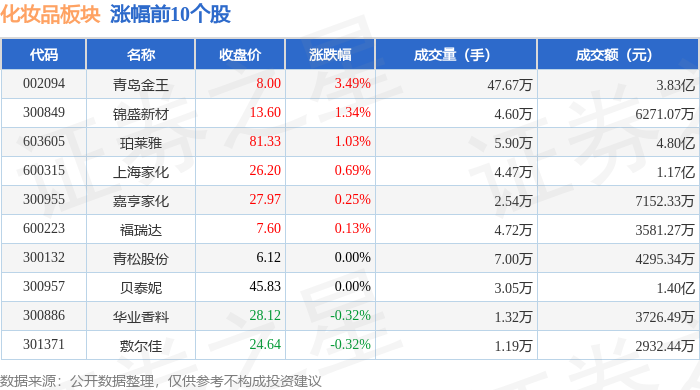
化妆品板块9月26日涨0.1%,青岛金王领涨,主力资金净流入5580.27万元
Zheng Xing Xing Ye Ri Bao· 2025-09-26 08:48
Group 1 - The cosmetics sector experienced a slight increase of 0.1% on September 26, with Qingdao King leading the gains [1] - The Shanghai Composite Index closed at 3828.11, down 0.65%, while the Shenzhen Component Index closed at 13209.0, down 1.76% [1] - Key stocks in the cosmetics sector showed varied performance, with Qingdao King rising by 3.49% to a closing price of 8.00 [1] Group 2 - The cosmetics sector saw a net inflow of 55.80 million yuan from main funds, while retail investors experienced a net outflow of 30.36 million yuan [2] - Major stocks like Qingdao King and Shanghai Jahwa had significant net inflows from main funds, indicating investor interest [3] - The overall trading volume and turnover in the cosmetics sector reflected active market participation, with Qingdao King achieving a turnover of 3.83 billion yuan [1][2]


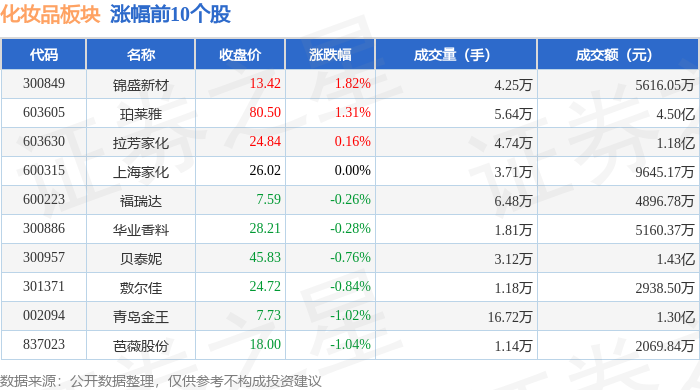
化妆品板块9月25日跌0.34%,嘉亨家化领跌,主力资金净流出4989.87万元
Zheng Xing Xing Ye Ri Bao· 2025-09-25 08:44
Market Overview - On September 25, the cosmetics sector declined by 0.34%, with Jiaheng Jiahua leading the drop [1] - The Shanghai Composite Index closed at 3853.3, down 0.01%, while the Shenzhen Component Index closed at 13445.9, up 0.67% [1] Individual Stock Performance - Notable gainers included: - Jinsheng New Material (300849) with a closing price of 13.42, up 1.82% [1] - Tiancaiya (603605) with a closing price of 80.50, up 1.31% [1] - Major decliners included: - Jiaheng Jiahua (300955) with a closing price of 27.90, down 2.04% [2] - Wanmei Biological (603983) with a closing price of 39.81, down 1.87% [2] Trading Volume and Capital Flow - The cosmetics sector experienced a net outflow of 49.89 million yuan from main funds, while retail investors saw a net inflow of 29.38 million yuan [2] - The trading volume for key stocks included: - Shanghai Jahwa (600315) with a trading volume of 37,100 shares and a turnover of approximately 96.45 million yuan [1] - Qingdao Kingway (002094) with a trading volume of 167,200 shares and a turnover of approximately 130 million yuan [2] Fund Flow Analysis - Main fund inflows and outflows for selected stocks: - Shanghai Jahwa had a main fund net inflow of 3.17 million yuan, while retail investors contributed a net inflow of 3.43 million yuan [3] - Jiaheng Jiahua saw a main fund net outflow of 393,800 yuan, with retail investors contributing a net outflow of 387,720 yuan [3]
美容护理行业今日跌1.36%,主力资金净流出2.23亿元
Zheng Quan Shi Bao Wang· 2025-09-22 10:24
Market Overview - The Shanghai Composite Index rose by 0.22% on September 22, with 11 sectors experiencing gains, led by the electronics and computer sectors, which increased by 3.71% and 1.70% respectively [1] - The total net outflow of capital from the two markets was 18.892 billion yuan, with only four sectors seeing net inflows [1] Sector Performance - The electronics sector had the highest net inflow of capital, amounting to 9.357 billion yuan, coinciding with its 3.71% increase [1] - The computer sector followed with a net inflow of 2.081 billion yuan and a daily increase of 1.70% [1] - The power equipment sector experienced the largest net outflow, totaling 4.662 billion yuan, while the pharmaceutical and biological sector saw a net outflow of 3.371 billion yuan [1] Beauty and Personal Care Industry - The beauty and personal care sector declined by 1.36%, with a net outflow of 223 million yuan [2] - Out of 29 stocks in this sector, 8 rose while 21 fell [2] - The top three stocks with the highest net outflow included Aimeike, Pola, and Qingdao King, with outflows of 73.5801 million yuan, 27.1153 million yuan, and 24.1188 million yuan respectively [2] Capital Flow in Beauty and Personal Care - The top stock with net inflow in the beauty sector was Shuiyang Co., with an inflow of 13.0672 million yuan [3] - Other notable inflows were from Runben Co. and Jinsong New Materials, with inflows of 4.8789 million yuan and 2.4414 million yuan respectively [3] - The overall capital flow data indicates a challenging environment for the beauty and personal care sector, with significant outflows from major companies [2][3]