
南方电网

Search documents
治理假冒央国企乱象须系统施策
Xin Lang Cai Jing· 2025-12-23 20:12
□ 侯建斌 近日,南方电网、中国石油旗下公司相继发布《关于不法分子冒用我公司名义进行虚假招聘 的严正声明》《关于不法企业冒用我公司名义的严正声明》,打假相关假冒企业。不久前,中国保利集 团有限公司亦发布声明称,"有不法分子通过伪造印章、注册材料,将企业注册为保利集团的下属公 司,并假冒保利集团名义开展经营及宣传活动"。 近年来,假冒央国企事件时有发生,引起有关部门高 度重视。去年,公安机关开展了打击整治冒充部委国企央企违法犯罪专项行动,取得良好成效;国务院 国资委曾多次发布假冒中央企业名单,并在其官方网站上线"假冒国企"举报平台,专门受理公众对假冒 国企问题线索的举报……在多个部门的持续努力下,一大批假冒企业被查处,对假冒央国企行为"人人 喊打"的舆论氛围正在加速形成。 不过也要清醒认识到,当前假冒央企国企的乱象并未禁绝,一些企业 或个人仍在以身试法、铤而走险。分析其原因,无外乎央国企的品牌光环。不法分子或企图通过假冒央 企国企,在承揽工程等方面获取非法利益;或利用公众对央企国企的信任,进行诈骗、非法融资等活 动。这类冒充央国企"搭便车"的违法行为,不仅损害了央企国企的声誉、侵害了社会各方的合法利益, 而且扰 ...
中国充电联盟:截至11月底我国电动汽车充电基础设施(枪)总数达到1932.2万个 同比增长52.0%
智通财经网· 2025-12-23 09:19
Core Insights - As of November 2025, China's electric vehicle charging infrastructure has reached a total of 19.322 million charging guns, marking a year-on-year increase of 52.0% [1][2] - Public charging facilities account for 4.625 million guns, with a year-on-year growth of 36.0%, while private charging facilities have reached 14.697 million guns, growing by 57.8% [1][2] - The total charging power of public charging facilities is approximately 210 million kilowatts, with an average power of about 45.34 kilowatts [1] Charging Infrastructure Overview - The top 10 regions for public charging facility construction, including Guangdong, Zhejiang, and Jiangsu, contribute to 66.0% of the total [1] - The total charging electricity nationwide is approximately 8.44 billion kWh, which is a year-on-year increase of 62.5% and a month-on-month increase of 4.3% [1] - The number of charging piles operated by the top 15 charging operators accounts for 83.3% of the total, with the leading operator, Telai Electric, managing 871,000 charging piles [2] Growth Comparison with Electric Vehicles - From January to November 2025, the increase in charging infrastructure was 6.504 million, while domestic sales of new energy vehicles reached 12.466 million [3] - The ratio of charging infrastructure growth to new energy vehicle sales is 1:1.9, indicating that the development of charging infrastructure is keeping pace with the rapid growth of new energy vehicles [3]
广东普惠金融“创新仔”亮相!这30个案例何以脱颖而出?
Nan Fang Du Shi Bao· 2025-12-23 08:28
Core Viewpoint - The "China Inclusive Finance Action" conference in Guangdong showcased 30 exemplary cases of innovative practices in inclusive finance, highlighting the achievements and demonstration value of the banking sector in this field [2][9]. Group 1: Digital Transformation in Inclusive Finance - Ten outstanding cases of digital transformation in inclusive finance were recognized, involving major banks such as Agricultural Bank of China and China Construction Bank, showcasing a shift from manual to intelligent review processes for more precise and efficient services [4][5]. - These institutions utilized big data and artificial intelligence to convert enterprise credit data into credit assets, significantly enhancing service efficiency [5]. Group 2: Supply Chain Finance - Five exemplary cases of inclusive supply chain finance were presented, focusing on the integration of financial resources to support small and micro enterprises through core enterprises [5][6]. - Innovations included fixed asset supply chain financing and guarantee financing services tailored to agricultural enterprises, effectively addressing financing challenges within the supply chain [6]. Group 3: Regional Characteristics in Inclusive Finance - Fifteen cases of regional characteristic inclusive finance were highlighted, with institutions developing specialized credit products to support local industries and small businesses [8][9]. - Notable innovations included a loan linked to industrial wastewater treatment metrics, which dynamically adjusted credit limits and interest rates based on environmental performance, exemplifying a model for financial empowerment in environmental management [9]. Group 4: Future Directions - The conference organizers plan to promote these benchmark cases to guide more financial resources into the inclusive finance sector, aiming to enhance the quality of inclusive finance in Guangdong [9].


万里银线 强国脊梁——我国建成世界上规模最大、最复杂的输变电工程
Zhong Guo Dian Li Bao· 2025-12-23 08:21
Core Insights - China's electricity consumption is expected to exceed 10 trillion kilowatt-hours for the first time by 2025, surpassing the total consumption of the EU, Russia, India, and Japan combined for 2024 [1] - The country has built the world's largest and most advanced power transmission network, with a reliability rate of 99.924% [1] Group 1: Development of High Voltage Transmission - The capacity of China's ultra-high voltage (UHV) transmission has increased from 270 million kilowatts at the end of the 13th Five-Year Plan to 340 million kilowatts, a growth of over 25% [2] - The total length of UHV direct current lines has surpassed 40,000 kilometers, marking a 43% increase from the previous period [2] - The UHV alternating current network has expanded significantly, with the length increasing from 12,000 kilometers to over 20,000 kilometers, a growth of over 67% [2] Group 2: Clean Energy Transition - The proportion of clean energy transmitted through UHV direct current channels has risen from less than 40% at the end of the 13th Five-Year Plan to nearly 60% in 2024, with annual clean energy transmission reaching 420 billion kilowatt-hours, a 70% increase [6] - The construction of UHV transmission channels has accelerated, with projects like the first "wind-solar-fire-storage integrated" UHV project and the "desert energy" transmission channel successfully operational [7][8] Group 3: Technological Innovations - China's UHV technology has achieved breakthroughs in various fields, establishing a self-controlled technical standard system [11] - Key technologies have overcome significant challenges, such as high-altitude construction and integrating large hydropower stations [12] - The integration of digital technology has enhanced the efficiency and reliability of the UHV network, with significant improvements in operational decision-making and equipment assessment [12] Group 4: Global Leadership and Export - China has established itself as a global leader in UHV technology, with the unique ±1100 kV UHV direct current transmission technology setting international standards [13] - Successful projects like the Belo Monte UHV project in Brazil demonstrate China's capability to export high-end equipment and technology [13]
中老电力联网工程建设上演“高空芭蕾”
Xin Hua Wang· 2025-12-23 07:46
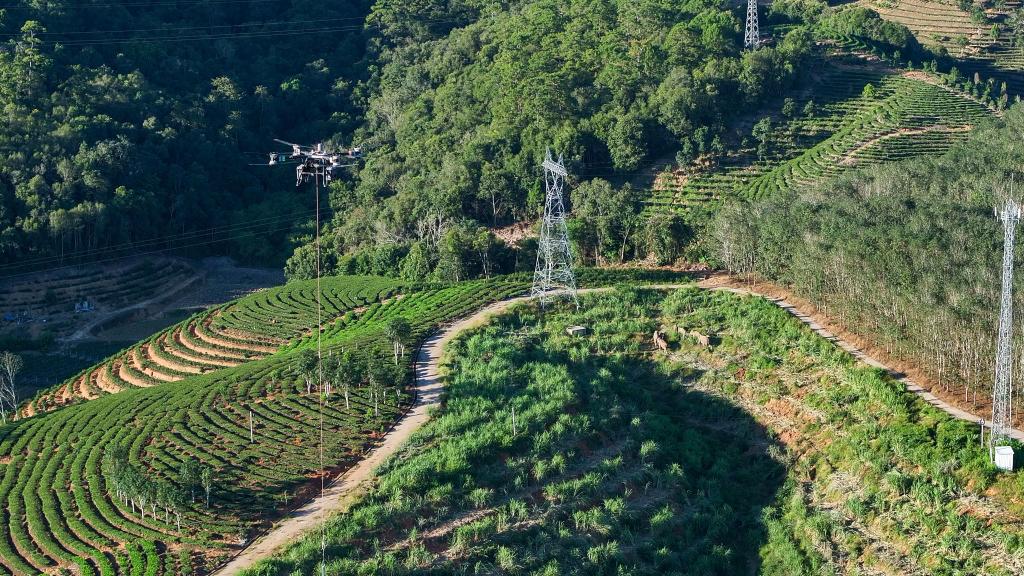
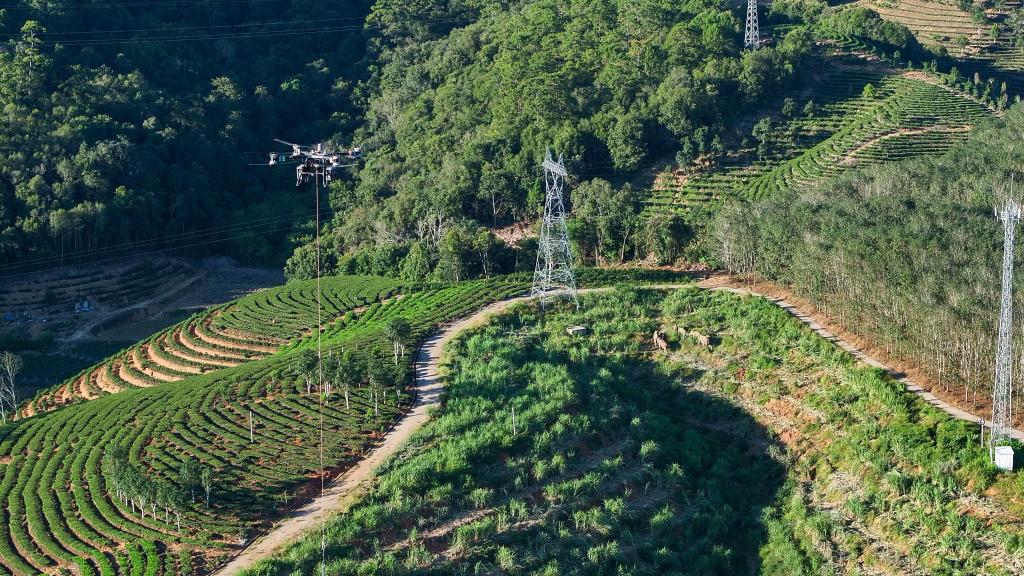
Core Viewpoint - The China-Laos 500 kV interconnection project is a significant infrastructure initiative aimed at enhancing bilateral cooperation and promoting the Belt and Road Initiative, with a focus on minimizing environmental impact during construction [4][7]. Group 1: Project Overview - The project commenced construction on June 30, 2025, and is expected to be completed by 2026, facilitating a bi-directional power exchange of 1.5 million kilowatts and delivering approximately 30 billion kilowatt-hours of clean electricity annually [4]. - The construction faces challenges as it traverses extensive tropical rainforests and protected areas, which are critical habitats for Asian elephants and home to rare plant species [4][7]. Group 2: Environmental Considerations - The initial construction plan would have required over 30 kilometers of access roads and the felling of more than 30,000 trees, permanently occupying 103 acres of forest land [4][6]. - To protect the rainforest ecosystem, the project team decided to increase costs by approximately 10 million yuan to preserve the original rainforest area [6][7]. Group 3: Innovative Construction Techniques - The project employs an aerial transportation model, utilizing two Mi-171 helicopters and over 30 heavy-lift drones to transport materials, significantly reducing the need for ground access [9][10]. - The "four-machine joint lift" technology was developed to handle heavy loads, achieving a record of transporting over 500 kilograms and covering a vertical distance of 220 meters in a single day [9][11]. Group 4: Wildlife Protection Measures - Construction activities are carefully monitored to minimize disturbances to wildlife, with teams adjusting flight paths and speeds to avoid disrupting elephant herds [12][13]. - The project has successfully reduced construction disturbances by over 90%, with 88% of the work areas achieving "zero road access" [11].
电网老旧分裂,就连稳定供电都做不到,美国AI产业还怎么赢中国?
Sou Hu Cai Jing· 2025-12-23 00:36
Core Viewpoint - The competition between China and the US in the AI industry is heavily influenced by their respective power supply capabilities, with China leveraging its stable electricity grid to support AI development while US tech giants struggle with outdated infrastructure and high costs [1][3]. Group 1: Power Supply and AI Development - AI requires significant electricity, with training a model like ChatGPT consuming energy equivalent to 30,000 Tesla vehicles running 200,000 kilometers, or enough to power 40,000 households for a day [7]. - By 2030, global data centers' electricity consumption is expected to double, surpassing Japan's total electricity usage, making power supply a critical factor for AI survival [9][11]. - China's AI labs benefit from a stable power supply through high-voltage transmission lines, ensuring consistent electricity from renewable sources like hydropower, while the US faces challenges with its aging power grid [11][30]. Group 2: US Power Grid Challenges - The US power grid is plagued by aging infrastructure, with 70% of transmission lines and transformers over 25 years old, leading to inefficiencies and vulnerability to extreme weather [15][21]. - During the 2021 Texas winter storm, over 4 million users lost power, resulting in significant economic losses exceeding $100 billion, highlighting the grid's unreliability [18][21]. - The fragmented nature of the US power grid, divided into independent regional networks, limits its ability to respond effectively to crises, as seen in the Texas power outages [23][30]. Group 3: China's Power Grid Advantages - China's power grid operates as a unified system, allowing for efficient energy distribution across vast distances, which supports AI development in urban centers [30][35]. - The country has mastered high-voltage transmission technology, enabling low-loss electricity delivery over long distances, which is crucial for integrating renewable energy sources [32][35]. - China's electricity costs are significantly lower than those in the US, providing a competitive advantage for AI companies in terms of operational expenses [38][42]. Group 4: Future Implications - As AI technology advances, electricity demand will continue to rise, potentially widening the gap between China's and the US's power grid capabilities [44]. - China's robust power infrastructure is expected to sustain its AI industry's growth and foster related sectors, while the US risks falling behind if it cannot address its power grid issues [44].

不修路少砍树,百亩雨林保住了——中老电力联网工程建设上演“高空芭蕾”
Xin Hua Wang· 2025-12-22 12:46
新华社昆明12月22日电 题:不修路少砍树,百亩雨林保住了——中老电力联网工程建设上演"高空芭蕾" 新华社记者赵珮然 中老500千伏联网工程(国内段)建设正稳步推进。这样的画面几乎每天都会在雨林出现——塔材从空中"飞"来,象群从林间穿行。 多花约1000万元 少破坏103亩雨林 中老500千伏联网工程是中国和老挝继中老铁路之后,深化务实合作、共建"一带一路"的又一标志性工程,其国内段于2025年6月30日正式开 工建设。作为纳入中老命运共同体行动计划的重大工程,项目计划于2026年竣工,可实现150万千瓦双向电力互济,每年输送约30亿千瓦时清洁电 力。 工程启动之初,建设者们就遇到了难题。线路需穿越大面积热带雨林,途经西双版纳国家级自然保护区、罗梭江鱼类州级自然保护区等生物 多样性富集区域,这里不仅是亚洲象的重要栖息地,还分布着望天树等珍稀植物。 "如果采用传统施工方案,需要修建超过30公里施工道路,架设15条运输索道。"南方电网云南电网建设分公司中老联网工程项目部副经理付 卫斌指着施工图纸说,初步估算将永久占用林地103亩,临时占地超过8万平方米,需砍伐树木3万余棵。 当团队把这组数据摆在桌面上时,现场一度 ...
“四个革命、一个合作”的生动实践——从南方电网的三个数据看能源高质量发展
Ren Min Ri Bao· 2025-12-22 08:55
Core Viewpoint - The article highlights the advancements and achievements of the Southern Power Grid in promoting a high-quality energy development model, emphasizing the integration of renewable energy sources and the establishment of a new power system in China. Group 1: Energy Development Strategy - In 2014, the Chinese government proposed a new energy security strategy focusing on "four revolutions and one cooperation," which outlines the direction for energy development in the country [3] - The Southern Power Grid is actively implementing this strategy to enhance energy quality and sustainability [4] Group 2: Renewable Energy Integration - Non-fossil energy sources account for 55% of the power generation mix, showcasing a significant shift towards renewable energy [5][6] - The Southern Power Grid's operational area has over 66% of installed capacity from non-fossil energy sources, with a power generation share of 55% [12] Group 3: Technological Innovations - A digital forecasting platform has been established, achieving accuracy rates of 89.0% for wind and 93.7% for solar energy predictions [14] - The company is developing new power transmission channels, such as the upcoming Cangyue DC transmission project, to facilitate the transfer of clean energy to major load centers [11] Group 4: Reliability and Efficiency - The reliability of power supply in the Southern Power Grid's operational area reached 99.99%, even during extreme weather events [19][20] - Significant investments have been made in rural power grid upgrades, achieving a reliability rate of 99.9% for rural electricity supply [25] Group 5: Cross-Border Electricity Cooperation - The Southern Power Grid has facilitated over 800 billion kilowatt-hours of electricity exchange with neighboring countries, enhancing regional energy cooperation [30] - The company has also supported electrification projects in Peru, improving the average outage time to the lowest level in the country [33] Group 6: International Expansion - During the 14th Five-Year Plan period, the Southern Power Grid's international business has driven over $7 billion in Chinese technology, capital, equipment, and services to go global [39]
人工智能重构全球能源秩序底层逻辑
Zhong Guo Dian Li Bao· 2025-12-22 06:28
Core Insights - The rapid evolution of artificial intelligence (AI) is reshaping the global energy landscape, transitioning from a resource-based order to one centered on data, algorithms, and computing power [2][4] - AI's capabilities are significantly enhancing operational efficiency in the energy sector, with examples such as improved forecasting accuracy and reduced exploration times [2][4] Group 1: AI's Impact on Energy - AI's iteration cycle has accelerated, with parameter scales increasing tenfold every nine months, leading to cognitive abilities that surpass human capabilities in certain areas [1] - AI is enabling real-time predictions for renewable energy sources, drastically reducing operational inefficiencies, such as lowering wind power curtailment rates to below 3% [2] - Major energy companies are developing large-scale AI models to enhance system efficiency and transform operational paradigms [2] Group 2: Economic Implications of Computing Power - Computing power is becoming synonymous with economic output, with a return of 3 to 4 times for every unit invested in computing power [3] - The competition in the energy sector is shifting from asset-heavy investments to a focus on algorithmic efficiency and density [3] Group 3: Global Power Dynamics - The control of AI algorithms is concentrated, with the U.S. holding 85% of global AI frameworks, while Europe and China dominate in specific energy technologies and manufacturing capacities [4] - The future energy order will be defined by those who can integrate energy and computing power effectively, potentially relegating traditional energy producers to mere "energy subcontractors" [4] Group 4: Challenges in AI Adoption - The energy sector faces significant challenges in harnessing AI, including high computing power demands leading to increased energy consumption and carbon emissions [4] - Data silos hinder the training and effectiveness of AI models, with less than 30% data sharing across the energy system [5] - Supply chain security is a concern, particularly regarding reliance on foreign technology for AI hardware and software [6] Group 5: Strategic Pathways for Advancement - To overcome existing challenges, the industry must focus on creating a unified data and computing ecosystem, enhancing collaboration between computing resources and renewable energy [7] - Establishing a secure and trustworthy energy data-sharing environment is crucial, necessitating standardized data protocols and advanced technologies for data privacy [8] - Strengthening domestic capabilities in AI technology and reducing dependency on foreign systems is essential for long-term sustainability [8]
北部湾跨海联网工程开始敷设海缆
Xin Hua She· 2025-12-22 02:56
Core Viewpoint - The commencement of the South Power Grid's 220 kV undersea interconnection project marks a significant advancement in the power supply capabilities of Weizhou Island, transitioning from isolated operation to a connected grid system [1] Investment and Financial Summary - The total investment for the undersea interconnection project is approximately 858 million yuan [1] - The project involves the installation of 44.8 kilometers of undersea cable, which is the most complex and critical part of the operation [1] Technical and Operational Details - This project is notable for being the first in China to use domestically produced insulation materials for 220 kV undersea cables [1] - Upon completion, the power supply capacity on Weizhou Island is expected to increase from 35,000 kW to 161,000 kW [1] - The cable laying operation is scheduled to last for 15 days, with the project expected to undergo acceptance testing and commence operation by mid-January 2026 [1]