
宝武镁业

Search documents
金属矿企入局低空经济:一场不能输的“空中材料战争”
Jing Ji Guan Cha Wang· 2025-10-19 02:19
Core Insights - The article highlights a significant shift in the metal mining industry driven by the emerging "low-altitude economy," which is expected to create substantial demand for aviation-grade aluminum and other materials [3][4][8]. Industry Trends - The low-altitude economy is projected to see aluminum consumption exceed 1.25 million tons by 2025, with a market size reaching 32 billion yuan, reflecting a compound annual growth rate of over 36% [3][6]. - Companies are experiencing a surge in orders for aviation-grade aluminum, with one manufacturer reporting a 23% increase in prices to 24,200 yuan per ton compared to the previous year [6][10]. Strategic Shifts - Metal mining companies are compelled to transition towards producing aviation materials, with some firms planning to double their production capacity for 7-series aluminum alloys to meet the growing demand from eVTOL and logistics drone manufacturers [9][10][14]. - A central enterprise has decided to invest 52 billion yuan to enhance its aviation aluminum production capacity to 40% of total output, indicating a strategic pivot away from traditional markets [14][15]. Competitive Landscape - Companies are adopting collaborative approaches, such as forming partnerships to create lightweight materials and participating in product design phases to secure long-term contracts with drone manufacturers [20][21]. - The competition is intensifying as firms engage in price negotiations and technical standard discussions, with some companies leveraging their material properties to differentiate themselves in the market [20][21]. Technological Innovations - The development of advanced aluminum alloys, such as the 7B50 alloy, is enabling significant weight reductions in drone manufacturing, which is critical for performance [18][24]. - Companies are investing in R&D to enhance material properties, such as strength and thermal resistance, to meet the stringent requirements of low-altitude vehicles [24][26]. Challenges and Barriers - The transition to aviation materials faces hurdles, including lengthy certification processes that can take up to 24 months and the high costs associated with them [28][30]. - There is a notable shortage of skilled talent in the aerospace materials sector, with a projected gap of 47,500 professionals by 2025, complicating the industry's ability to meet demand [29][30]. Future Outlook - The article suggests that the ongoing material revolution will reshape the supply chain dynamics, with companies exploring new business models that extend beyond traditional material sales to include technical services and operational partnerships [34][35]. - The global market for low-altitude economy materials is expanding, with companies aiming to position themselves as key suppliers in this emerging sector [35].


全市有色金属产业迈入千亿级新时代
Qi Lu Wan Bao· 2025-10-15 11:30
Core Viewpoint - The city of Liaocheng is focusing on the development of the non-ferrous metal and deep processing industry chain, emphasizing green, low-carbon, and high-quality growth while enhancing the industrial structure and competitiveness [1][2]. Group 1: Industry Development - Liaocheng has established a dual-chain development pattern centered on copper and aluminum, attracting leading companies such as Yunhai Metal and Hailiang Co., Ltd. [1] - By 2024, the city is expected to have 68 large-scale enterprises in this industry, achieving a revenue of 119.51 billion yuan [1]. - The non-ferrous metal and deep processing industry is recognized as a traditional advantageous industry in Liaocheng, with a focus on high-end, intelligent, and green development [2]. Group 2: Competitive Advantages - The establishment of a national quality inspection center for copper and aluminum products and the formation of a research institute for non-ferrous metals have strengthened the industry [1]. - The market share of several products from companies like Xinfeng Group and Yunxin Technology ranks among the top in the country [1]. Group 3: Green and Low-Carbon Initiatives - Liaocheng has cultivated 4 national and 9 provincial green factories, with Xiangguang Copper Industry recognized as a national "energy efficiency leader" [2]. - Xinfeng Group has completed carbon quota transactions totaling 35.73 million tons, with a transaction value of 2.322 billion yuan, accounting for about 5% of the national total [2]. - The city is actively promoting the peak carbon emissions in the non-ferrous metal industry and increasing the proportion of recycled non-ferrous metals [2]. Group 4: Digital Transformation - The integration of industrial internet and big data technologies is being promoted to enhance the intelligent manufacturing level of non-ferrous metal enterprises [3]. - The development of a digital platform for green functional aluminum aims to improve the digitalization of the industry chain and resource allocation efficiency [3].


小金属板块10月15日跌1.67%,北方稀土领跌,主力资金净流出20.92亿元
Zheng Xing Xing Ye Ri Bao· 2025-10-15 08:27
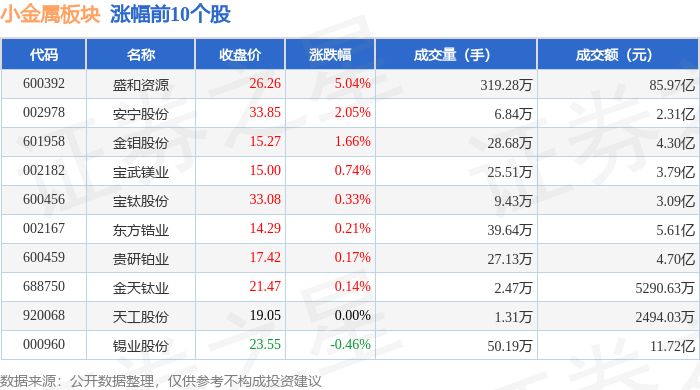
Market Overview - The small metal sector experienced a decline of 1.67% on October 15, with Northern Rare Earth leading the drop [1] - The Shanghai Composite Index closed at 3912.21, up 1.22%, while the Shenzhen Component Index closed at 13118.75, up 1.73% [1] Individual Stock Performance - Shenghe Resources (600392) saw a closing price of 26.26, with an increase of 5.04% and a trading volume of 3.19 million shares, amounting to a transaction value of 8.597 billion [1] - Anning Co. (002978) closed at 33.85, up 2.05%, with a trading volume of 68,400 shares and a transaction value of 231 million [1] - Northern Rare Earth (600111) closed at 54.50, down 4.05%, with a trading volume of 3.03 million shares and a transaction value of 1.6617 billion [2] Capital Flow Analysis - The small metal sector experienced a net outflow of 2.092 billion from main funds, while retail investors saw a net inflow of 2.265 billion [2] - The main funds showed a significant outflow in several stocks, including Baotai Co. (600456) with a net outflow of 27.17 million [3] - Retail investors contributed positively to stocks like Shenghe Resources (600392) with a net inflow of 65.96 million [3]




“一带一路”俄罗斯汽车零件镁压铸件市场发展环境及投资建议评估预测报告(2025版)
Sou Hu Cai Jing· 2025-10-14 02:20
报告发布方:中金企信国际咨询 项目可行性报告&商业计划书专业权威编制服务机构(符合发改委印发项目可行性研究报告编制要求)-中金企信国际咨询:集13年项目编制服务经验为各 类项目立项、投融资、商业合作、贷款、批地、并购&合作、投资决策、产业规划、境外投资、战略规划、风险评估等提供项目可行性报告&商业计划书编 制、设计、规划、咨询等一站式解决方案。助力项目实施落地、提升项目单位申报项目的通过效率。 汽车零件镁压铸件是指通过压铸工艺使用镁合金生产的汽车零部件。镁合金以其重量轻、强度高和良好的导热性而闻名,适合用于制造对轻量化和性能有高 要求的汽车部件。通过压铸工艺,镁合金能够被精确成型,生产出复杂形状且具有较高表面质量的零件,如方向盘骨架、仪表盘支架和发动机部件等。镁压 铸件有助于减轻汽车的整体重量,提升燃油效率和车辆的操控性能。根据中金企信数据显示,2024年全球汽车零件镁压铸件市场规模1939.16百万美元,年 复合增长率CAGR为10.56%。 第四节 汽车零件镁压铸件市场供给/需求分析及预测 第二章 中国及俄罗斯"一带一路"政策环境分析 生产:万丰奥威、GeorgFischer、宝武镁业、DGSDruckg ...

2025年1-8月全国有色金属冶炼和压延加工业出口货值为1711.8亿元,累计增长15.7%
Chan Ye Xin Xi Wang· 2025-10-12 02:48
上市公司:焦作万方(000612),铜陵有色(000630),合金投资(000633),中钨高新(000657), 国城矿业(000688),北方铜业(000737),常铝股份(002160),东方锆业(002167),楚江新材 (002171),宝武镁业(002182),融捷股份(002192),海亮股份(002203) 2019年-2025年1-8月全国有色金属冶炼和压延加工业出口货值统计图 数据来源:国家统计局,智研咨询整理 知前沿,问智研。智研咨询是中国一流产业咨询机构,十数年持续深耕产业研究领域,提供深度产业研 究报告、商业计划书、可行性研究报告及定制服务等一站式产业咨询服务。专业的角度、品质化的服 务、敏锐的市场洞察力,专注于提供完善的产业解决方案,为您的投资决策赋能。 相关报告:智研咨询发布的《2026-2032年中国有色金属行业市场发展现状及竞争格局预测报告》 根据国家统计局数据可知:2025年8月全国有色金属冶炼和压延加工业出口货值为221.9亿元,同比增长 30.3%;2025年1-8月全国有色金属冶炼和压延加工业累计出口货值为1711.8亿元,累计同比增长 15.7%。 ...

宝武镁业:赛力斯的问界镁合金产品均为公司提供
Zheng Quan Ri Bao· 2025-10-09 10:12
Core Insights - Baowu Magnesium Industry announced on October 9 that it supplies all magnesium alloy products for Seres' AITO Wenjie vehicles, with current usage exceeding 20 kg per vehicle [2] - Future projections indicate that with the integration of larger magnesium die-cast components such as electric drive housings, rear floors, and inner door panels, the magnesium usage per vehicle could reach between 50 kg to 100 kg [2]

宝武镁业:镁基轻合金与镁合金本质上属于包含关系
Zheng Quan Ri Bao· 2025-10-09 10:10
Core Viewpoint - Baowu Magnesium Industry clarified the relationship between magnesium-based light alloys and magnesium alloys, stating that magnesium alloys are a subset of magnesium-based light alloys [2] Group 1 - Magnesium-based light alloys encompass all lightweight alloy materials with magnesium as the base [2] - Magnesium alloys are the most common type of magnesium-based light alloys [2]
宝武镁业:赛力斯的问界镁合金产品均为公司提供,单车用量目前已达20Kg以上
Mei Ri Jing Ji Xin Wen· 2025-10-09 03:44
Group 1 - The company has confirmed its collaboration with Chongqing 601127 Sairus, providing magnesium alloy products for Sairus's vehicles [1] - The current usage of magnesium per vehicle has exceeded 20 kg, with potential to reach 50-100 kg as larger magnesium die-cast components are integrated into vehicles [1]
周期论剑|降息周期,周期股展望!
2025-10-09 02:00
Summary of Key Points from Conference Call Records Industry Overview - The conference call discusses the outlook for the Chinese stock market in 2025, highlighting a positive trend with the Shanghai Composite Index expected to rise to 3,880 points, and various indices such as the ChiNext Index, Hang Seng Tech Index, and STAR 50 Index reaching new highs within the year [1][3][4]. Core Insights and Arguments - **Market Sentiment Shift**: The market sentiment is changing due to factors like the decline in risk-free returns, optimization of economic policies, and asset reforms, which have altered investor attitudes towards Chinese assets [1][5]. - **Technological Advancements**: Significant technological progress is improving economic expectations, with the real estate sector stabilizing and innovation boosting profit forecasts, thereby reducing uncertainty in long-term outlooks [1][6]. - **Investment Direction**: Continued optimism is expressed for technology, cyclical, and financial sectors, with technology stocks expected to reach new highs and cyclical stocks undergoing recovery [1][4][13]. - **Reform Initiatives**: October is anticipated to see the implementation of several reform measures, including changes to the STAR Market and the introduction of new listing standards, which are expected to drive further market improvements [1][12]. Additional Important Content - **Impact of Risk-Free Return Decline**: The decline in risk-free returns is leading to a shift in investment from fixed income products to equities, as investors seek higher returns [1][7][9]. - **Core Assets and New Energy Bubble**: The bubble in core assets and new energy sectors is attributed to deteriorating micro-trading structures rather than fundamental changes [1][8]. - **Consumer Sentiment and Spending**: The consumer sentiment is expected to improve in 2026, leading to increased demand for various consumer goods as financial markets stabilize [1][18]. - **Sector-Specific Opportunities**: Specific sectors such as technology, upstream cyclical products, and financial services are highlighted as having strong investment opportunities due to their alignment with current market trends and policies [1][17][19]. Conclusion - The overall sentiment for the Chinese market in 2025 is optimistic, driven by technological advancements, policy reforms, and a shift in investment strategies. Key sectors to watch include technology, cyclical industries, and financial services, with a focus on the upcoming reforms and their potential impact on market dynamics [1][11][13].
趋势2025!中国储氢合金行业基本原理、技术路线、产业链全景、技术创新及未来发展前景分析:资源优势巩固行业地位,创新引领打开市场空间[图]
Chan Ye Xin Xi Wang· 2025-10-02 03:40
Core Insights - Hydrogen storage alloys are critical materials in the hydrogen energy industry due to their high safety, volumetric hydrogen density, and long-cycle stability [1][2] - China has established a complete hydrogen storage alloy industry chain driven by rare earth resources and strong policies, featuring upstream resource monopolization, midstream technological iteration, and downstream diverse applications [1][8] - The global hydrogen storage alloy market is dominated by rare earth-based alloys, with rapid iterations of magnesium-based, titanium-based, and solid-state materials [1][9] Industry Overview - Hydrogen storage alloys (HSA) are special functional materials capable of reversible absorption and release of hydrogen under normal conditions, forming metal hydrides for safe and efficient hydrogen storage [2][3] - The main hydrogen storage methods include high-pressure gas storage, low-temperature liquid storage, and solid-state storage using hydrogen alloys, each with its advantages and disadvantages [5][6] Technological Development - Current mainstream hydrogen storage methods are compared, highlighting solid-state hydrogen storage alloys as the leading technology due to their safety and volumetric density [5][6] - The preparation methods for hydrogen storage alloys significantly influence their microstructure and hydrogen absorption performance, with various techniques available [7] China's Industry Background - Hydrogen is a key carrier for building a new energy system and achieving carbon neutrality, with hydrogen storage alloys being essential materials supported by national strategies and policies [8] - The Chinese government has implemented comprehensive policies to promote the hydrogen energy industry, including standards for solid-state hydrogen storage alloys [8] Industry Chain Structure - The Chinese hydrogen storage alloy industry chain features upstream resource monopolization, midstream technological advancements, and diverse downstream applications, with companies like Xiamen Tungsten and China Rare Earth Group leading the midstream [8][9] - The industry is characterized by close cooperation among upstream, midstream, and downstream enterprises, forming a collaborative innovation model [8] Global and Domestic Market Analysis - The global hydrogen storage alloy industry is at a critical juncture of technological breakthroughs and large-scale applications, with a projected market size of $440 million by 2030 [9] - China's hydrogen storage alloy sector has seen significant advancements in technology and enterprise layout, focusing on high capacity, low working temperature, and long cycle life [9][10] Future Trends - The future of China's hydrogen storage alloy industry will focus on technological innovation, industry integration, and international competition [11][12][14] - Technological innovation will lead to performance upgrades, with a focus on developing new multi-component alloy systems and optimizing kinetic performance [11] - Industry integration will involve increased mergers and acquisitions, creating industry leaders and enhancing overall competitiveness [12] - In international competition, Chinese enterprises will leverage their scale and resource advantages while addressing high-end technology gaps through increased R&D investment [14]


