农业银行

Search documents
最新21家系统重要性银行名单公布
Jing Ji Ri Bao· 2026-02-14 04:21
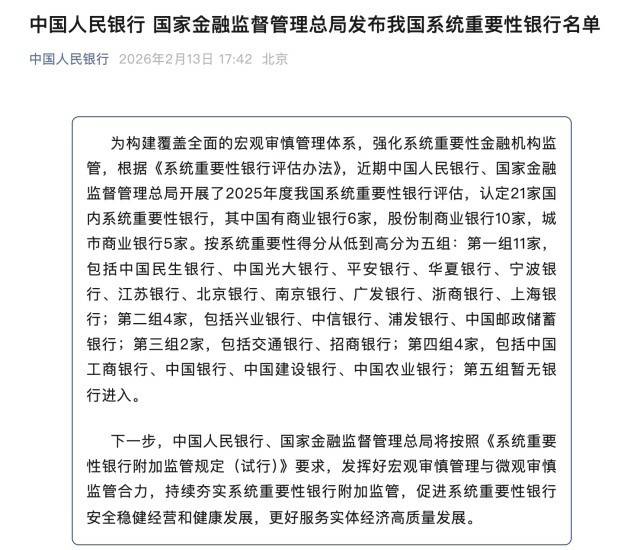
Group 1 - The People's Bank of China and the National Financial Regulatory Administration have conducted an assessment for the 2025 systemically important banks, identifying 21 domestic banks as systemically important, including 6 state-owned commercial banks, 10 joint-stock commercial banks, and 5 city commercial banks [1][3] - The list aims to establish a comprehensive macro-prudential management system and strengthen the regulation of systemically important financial institutions [2] Group 2 - Systemically important banks in China are categorized into five groups based on their importance scores, with the first group consisting of 11 banks, the second group having 4 banks, the third group with 2 banks, the fourth group containing 4 banks, and no banks in the fifth group [3] - The People's Bank of China plans to enhance the combined effect of macro-prudential management and micro-prudential regulation, continuing to solidify additional supervision for systemically important banks to promote their safe and sound operation and better serve the high-quality development of the real economy [3]




银行1月信贷社融点评:温和开门红
ZHESHANG SECURITIES· 2026-02-14 03:24
Investment Rating - The industry investment rating is "Positive" (maintained) [4] Core Insights - The report highlights a "strong deposit, weak loan" characteristic in the opening month of the year [4] - In January 2026, new social financing increased by 7.2 trillion yuan, a year-on-year increase of 166.2 billion yuan, with a balance growth of 8.2% [4][5] - New RMB loans in January 2026 amounted to 4.7 trillion yuan, a year-on-year decrease of 420 billion yuan, with a balance growth of 6.1% [4][5] - The report indicates that consumer demand has shown some recovery, particularly in short-term loans, but overall consumer credit demand may remain pessimistic throughout the year [1][2] Summary by Sections Credit Overview - Entity credit remained stable, with a significant reduction in bill financing [1] - Retail loans added 456.5 billion yuan in January, a year-on-year increase of 12.7 billion yuan [1] - Corporate loans added 4.5 trillion yuan, a year-on-year decrease of 330 billion yuan, primarily due to a reduction in bill financing [2] Social Financing - Government bonds contributed significantly to social financing, with new issuance of 976.4 billion yuan, a year-on-year increase of 283.1 billion yuan [5] - The report notes a trend of "deposit migration," with non-bank deposits reaching 36 trillion yuan, accounting for 10.7% of total deposits [5] Investment Recommendations - The report recommends a "New Momentum Portfolio" including banks such as Nanjing Bank, Shanghai Bank, and Industrial and Commercial Bank of China, highlighting their potential for value recovery [3][5] - It emphasizes the importance of high-dividend bank stocks as having allocation value amid steady declines in credit growth [5]




国有大行首次“上岗”这一职位,由行长兼任!中小银行早已跟进,有何影响?
券商中国· 2026-02-14 03:12
Core Viewpoint - The establishment of Chief Compliance Officers (CCOs) in major state-owned banks marks a significant shift in compliance management, emphasizing the importance of compliance at the highest management level [1][2][6]. Group 1: Establishment of Chief Compliance Officers - On February 13, Agricultural Bank of China and Bank of China announced the appointment of their respective CCOs, with the positions held by the banks' presidents [1][2]. - This move signifies the formal establishment of CCOs in major state-owned banks, replacing the previous supervisory board system that has been in place for over 20 years [2]. - The appointment of CCOs by bank presidents is seen as a way to elevate compliance responsibilities to the highest management level, fostering a culture of compliance within the organization [2][8]. Group 2: Regulatory Background - The "Compliance Management Measures" issued by the Financial Regulatory Authority came into effect on March 1, 2025, with a one-year transition period that is nearing its end [4][5]. - As of February 13, 21 out of 42 A-share listed banks have appointed CCOs, while half of the banks have yet to finalize their appointments [7]. Group 3: Industry Trends and Practices - Many listed banks are following suit in appointing CCOs, with recent announcements from Qilu Bank, Shanghai Bank, and Everbright Bank regarding their CCO appointments [3]. - Approximately half of the banks have adopted a model where senior executives, particularly bank presidents, serve as CCOs, which is prevalent among state-owned banks and some city commercial banks [7][8]. - The practice of having senior executives serve as CCOs is recommended to enhance the importance of compliance management and reduce operational costs associated with appointing separate compliance officers [8].




国内系统重要性银行名单发布 21家银行入选
Cai Jing Wang· 2026-02-14 02:03
Core Viewpoint - The People's Bank of China has conducted an assessment of systemically important banks for 2025, identifying 21 domestic banks categorized into five groups based on their systemic importance scores [1] Group 1: Assessment Overview - The assessment is part of a broader effort to establish a comprehensive macro-prudential management system and strengthen the regulation of systemically important financial institutions [1] - The evaluation was carried out in collaboration with the National Financial Regulatory Administration [1] Group 2: Classification of Banks - A total of 21 banks were recognized as systemically important, including 6 state-owned commercial banks, 10 joint-stock commercial banks, and 5 city commercial banks [1] - The banks are divided into five groups based on their systemic importance scores: - Group 1: 11 banks including China Minsheng Bank, China Everbright Bank, Ping An Bank, Huaxia Bank, Ningbo Bank, Jiangsu Bank, Beijing Bank, Nanjing Bank, Guangfa Bank, Zheshang Bank, and Shanghai Bank [1] - Group 2: 4 banks including Industrial Bank, China CITIC Bank, Shanghai Pudong Development Bank, and China Postal Savings Bank [1] - Group 3: 2 banks including Bank of Communications and China Merchants Bank [1] - Group 4: 4 banks including Industrial and Commercial Bank of China, Bank of China, China Construction Bank, and Agricultural Bank of China [1] - Group 5: No banks were classified in this group [1]

央行重要发布!名单公布
Sou Hu Cai Jing· 2026-02-14 01:14
Core Viewpoint - The People's Bank of China and the National Financial Regulatory Administration have conducted an assessment of systemically important banks for 2025, identifying 21 domestic banks categorized into five groups based on their systemic importance scores [1]. Group 1: Assessment of Systemically Important Banks - A total of 21 banks have been recognized as systemically important, including 6 state-owned commercial banks, 10 joint-stock commercial banks, and 5 city commercial banks [1]. - The banks are divided into five groups based on their systemic importance scores, with the first group containing 11 banks, the second group 4 banks, the third group 2 banks, the fourth group 4 banks, and the fifth group having no banks [1]. Group 2: Breakdown of Banks by Group - **First Group (11 banks)**: Includes China Minsheng Bank, China Everbright Bank, Ping An Bank, Huaxia Bank, Ningbo Bank, Jiangsu Bank, Beijing Bank, Nanjing Bank, Guangfa Bank, Zheshang Bank, and Shanghai Bank [1]. - **Second Group (4 banks)**: Includes Industrial Bank, China CITIC Bank, Shanghai Pudong Development Bank, and China Postal Savings Bank [1]. - **Third Group (2 banks)**: Includes Bank of Communications and China Merchants Bank [1]. - **Fourth Group (4 banks)**: Includes Industrial and Commercial Bank of China, Bank of China, China Construction Bank, and Agricultural Bank of China [1]. - **Fifth Group**: No banks are included in this group [1]. Group 3: Future Regulatory Actions - The People's Bank of China and the National Financial Regulatory Administration will implement additional regulatory measures for systemically important banks according to the "Regulations on Additional Supervision of Systemically Important Banks (Trial)" [1]. - The aim is to enhance the synergy between macro-prudential management and micro-prudential supervision, ensuring the safe and sound operation of systemically important banks and better supporting the high-quality development of the real economy [1].
我国系统重要性银行名单公布
新华网财经· 2026-02-14 01:10
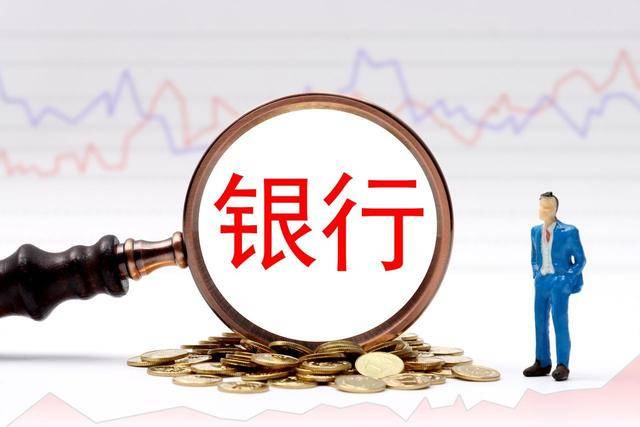
Group 1 - The People's Bank of China and the National Financial Regulatory Administration have conducted an assessment for the 2025 systemically important banks, identifying 21 domestic banks, including 6 state-owned commercial banks, 10 joint-stock commercial banks, and 5 city commercial banks [3][4]. - The list aims to establish a comprehensive macro-prudential management system and strengthen the regulation of systemically important financial institutions [4]. - Systemically important banks are categorized into five groups based on their importance scores, with the first group including 11 banks such as China Minsheng Bank and China Everbright Bank, and the fourth group including major banks like Industrial and Commercial Bank of China and Bank of China [5]. Group 2 - The People's Bank of China and the National Financial Regulatory Administration will enhance the combined efforts of macro-prudential management and micro-prudential regulation to solidify additional supervision of systemically important banks, promoting their safe and sound operation to better serve the high-quality development of the real economy [5].

系统重要性银行名单公布 新增浙商银行
Zhong Guo Zheng Quan Bao· 2026-02-14 00:32
Core Insights - The People's Bank of China and the National Financial Regulatory Administration have conducted an assessment for the 2025 systemically important banks, identifying 21 domestic banks as systemically important [1] Group 1: Systemically Important Banks - The assessment categorized the 21 banks into five groups based on their systemic importance scores, with the first group consisting of 11 banks including China Minsheng Bank, China Everbright Bank, Ping An Bank, and others [1] - The second group includes 4 banks: Industrial Bank, China CITIC Bank, Shanghai Pudong Development Bank, and China Postal Savings Bank [1] - The third group has 2 banks: Bank of Communications and China Merchants Bank [1] - The fourth group consists of 4 major banks: Industrial and Commercial Bank of China, Bank of China, China Construction Bank, and Agricultural Bank of China [1] - No banks were placed in the fifth group [1] Group 2: Changes and Future Directions - Compared to the 2023 list of systemically important banks, Zhejiang Commercial Bank is a new addition [1] - The People's Bank of China and the National Financial Regulatory Administration plan to enhance macro-prudential management and micro-prudential supervision to ensure the safe and sound operation of systemically important banks [1] - The goal is to better support the high-quality development of the real economy [1]

港股市场 重要调整
Zhong Guo Zheng Quan Bao· 2026-02-14 00:23
Financial Data - As of the end of January, the social financing scale increased by 8.2% year-on-year, while the broad money supply (M2) grew by 9.0%, significantly exceeding the nominal GDP growth rate, creating a favorable monetary environment for economic recovery [1][1]. Stock Market Adjustments - The Hang Seng Index will increase its constituent stocks from 88 to 90, with the inclusion of CATL, Luoyang Molybdenum, and Laopu Gold, while Zhongsheng Holdings will be removed. These changes will take effect after the market closes on March 6 and will be effective from March 9 [1][1]. Regulatory Actions - The China Securities Regulatory Commission (CSRC) has issued an administrative penalty and market ban notice to Tianfeng Securities for allegedly providing financing and violating information disclosure regulations related to Wuhan Contemporary Technology Industry Group [2][2]. Company News - Southwest Securities plans to issue A-shares to specific investors, raising up to 6 billion yuan, which will be used to supplement the company's capital for various business operations [4][4]. - SAIC Motor's subsidiary, SAIC Jin Kong, will co-invest in a private equity fund with a total initial subscription of 2.5 billion yuan, focusing on solid-state batteries and other advanced technologies [5][5]. - KOTAI Power has decided to terminate its H-share issuance preparations, stating that the decision will not significantly impact its operations or shareholder interests [5][5]. - Yinchip has received a notice from the CSRC regarding an investigation for suspected information disclosure violations, while its business operations continue normally [5][5]. - Meituan has issued a profit warning, expecting a loss of 23.3 billion to 24.3 billion yuan for 2025, primarily due to a shift from profit to loss in its core local business segment and increased investment in overseas operations [6][6]. - Zongshen Power plans to swap motorcycle engine-related assets with Longxin General's assets to resolve competition issues and promote clearer business development [6][6]. Industry Insights - Huatai Securities believes that the advancement of a unified national electricity market will benefit the construction of a new power system from multiple dimensions, including profit mechanisms and structural growth in renewable energy demand [7][7].
刘小涛会见中国农业银行行长王志恒
Xin Hua Ri Bao· 2026-02-14 00:20
Core Viewpoint - The meeting between Jiangsu Province Governor Liu Xiaotao and Agricultural Bank of China President Wang Zhiheng emphasizes the importance of financial support for Jiangsu's high-quality development and modernization efforts, highlighting the collaboration between the bank and the province in various sectors [1]. Group 1: Economic Development - Liu Xiaotao introduced Jiangsu's economic and social development, focusing on implementing Xi Jinping's important speeches and provincial meeting directives to build a modern industrial system [1]. - The province aims to accelerate the development of new productive forces and maintain leadership in high-quality development [1]. Group 2: Financial Support and Collaboration - The Agricultural Bank of China has a strong foundation and broad cooperation space in Jiangsu, actively supporting rural revitalization and the real economy [1]. - Liu Xiaotao encouraged the bank to enhance its role as a financial "national team," increasing support for transportation, energy, water conservancy, and municipal sectors, while focusing on providing credit resources to real enterprises [1]. - Wang Zhiheng expressed gratitude for Jiangsu's support and committed to improving service quality for the real economy and agriculture, contributing to the province's development goals [1].
共计21家!我国系统重要性银行名单发布
Sou Hu Cai Jing· 2026-02-13 23:52
Core Viewpoint - The People's Bank of China and the National Financial Regulatory Administration have conducted an assessment of systemically important banks for 2025, identifying 21 domestic banks and aiming to enhance macro-prudential management and supervision of these institutions [1] Group 1: Identification of Systemically Important Banks - A total of 21 domestic systemically important banks have been recognized, including 6 state-owned commercial banks, 10 joint-stock commercial banks, and 5 city commercial banks [1] - The banks are categorized into five groups based on their systemic importance scores, with the first group consisting of 11 banks, the second group having 4 banks, the third group with 2 banks, the fourth group containing 4 banks, and no banks in the fifth group [1] Group 2: Breakdown of Banks by Group - **First Group (11 banks)**: China Minsheng Bank, China Everbright Bank, Ping An Bank, Huaxia Bank, Ningbo Bank, Jiangsu Bank, Beijing Bank, Nanjing Bank, Guangfa Bank, Zheshang Bank, Shanghai Bank [1] - **Second Group (4 banks)**: Industrial Bank, China CITIC Bank, Shanghai Pudong Development Bank, China Postal Savings Bank [1] - **Third Group (2 banks)**: Bank of Communications, China Merchants Bank [1] - **Fourth Group (4 banks)**: Industrial and Commercial Bank of China, Bank of China, China Construction Bank, Agricultural Bank of China [1] - **Fifth Group**: No banks are included [1] Group 3: Future Regulatory Actions - The People's Bank of China and the National Financial Regulatory Administration will implement additional regulatory measures as per the "Regulations on Additional Supervision of Systemically Important Banks (Trial)" to ensure the safe and sound operation of these banks [1] - The aim is to strengthen the collaboration between macro-prudential management and micro-prudential supervision, thereby supporting the high-quality development of the real economy [1]