晶科能源

Search documents
事关“太空光伏” 天合光能、协鑫集成回应
2 1 Shi Ji Jing Ji Bao Dao· 2026-02-05 15:41
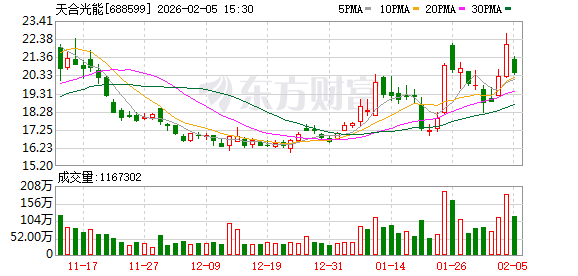
Core Viewpoint - The recent visit of SpaceX to several Chinese photovoltaic companies led to a surge in the space photovoltaic concept stocks on February 4, but the momentum could not be sustained, resulting in a significant decline in the space photovoltaic index on February 5 [2][3]. Group 1: Market Performance - On February 5, the space photovoltaic index (8841929) dropped by 4.86%, closing at 3837.43, with notable declines in stocks such as JunDa Co., JinCheng Co., and Shuangliang Energy, which hit the daily limit down [2][3]. - Other companies like GaoCe Co., JieJia WeiChuang, MaiWei Co., JingSheng JiDian, and HaiYou New Materials saw declines exceeding 9%, while Trina Solar fell over 7% and JinkoSolar dropped over 6% [2][4]. Group 2: Company Announcements - Trina Solar announced that it has not engaged in any cooperation with SpaceX and has no related orders in the "space photovoltaic" sector, clarifying that its main products are focused on ground photovoltaic applications [5][6]. - GCL-Poly Energy stated that it has not received any orders in the "space photovoltaic" field and emphasized that the technology is still in the exploratory phase, with uncertain commercial prospects [8]. - JinkoSolar confirmed it has not collaborated with SpaceX and highlighted that the "space photovoltaic" concept remains in the early exploration stage [10]. - Other companies like Guosheng Technology, Shuangliang Energy, and JingSheng JiDian also reported no involvement in "space photovoltaic" business, reiterating the uncertainty surrounding the commercialization of this technology [11][12][13]. Group 3: Financial Forecasts - Trina Solar projected a net loss of between 6.5 billion to 7.5 billion yuan for the year 2025 [7]. - GCL-Poly Energy expects a net loss of between 890 million to 1.29 billion yuan for the same year [8].





马斯克给了“做多”光伏的理由
虎嗅APP· 2026-02-05 14:27
出品 | 妙投APP 作者 | 董必政 编辑 | 丁萍 一、非"光"不可 过去两年,光伏行业经历了惨烈的周期下行。产能过剩、价格内卷,让大量企业深陷亏损泥潭,股价 更是跌得只剩零头。 此时,"太空光伏"概念的横空出世,尤其是马斯克的亲自站台,无疑给绝望中的资本市场递上了一根 救命稻草。市场充满了美好的联想:如果能搭上SpaceX和特斯拉的快车,中国光伏企业或许能通过 技术输出或代工,再度迎来春天。 头图 | AI制图 2月4日,沉寂许久的A股光伏板块被一股神秘力量猛然点燃。 盘面上,泽润新能、中来股份等瞬间掀起"20CM"涨停潮,TCL中环巨量封板,光伏设备龙头晶盛机 电大涨近13%,东方日升也紧随其后涨近7%。 资金的嗅觉总是最灵敏的,谜底很快被揭晓。 据多方消息证实,马斯克旗下团队正低调秘访中国多家光伏龙头企业,从设备到硅料、硅片、从异质 结(HJT)到钙钛矿,把光伏产业链全面摸底一遍。 这可不是随便看看。 1月22日,马斯克在达沃斯世界经济论坛宣布,SpaceX与特斯拉将在三年内(2026-2028年)于美国 本土分别建设100GW光伏产能,合计200GW。该产能主要用于地面数据中心与太空AI卫星供能。 ...

马斯克给了“做多”光伏的理由
Hu Xiu· 2026-02-05 13:18
Core Viewpoint - The recent interest from Elon Musk's team in China's photovoltaic industry has sparked significant market activity, suggesting a potential turning point for the sector after a prolonged downturn [1][2]. Group 1: Market Reaction - On February 4, the A-share photovoltaic sector saw a surge, with companies like Zairun New Energy and TCL Zhonghuan hitting the "20CM" limit-up, while leading equipment manufacturer Jing Sheng Machinery rose nearly 13% [1]. - Following the initial excitement, the market experienced a sharp reversal, with the photovoltaic ETF dropping 5.45% and companies like Jun Da and Gao Ce falling significantly [5]. Group 2: Industry Context - The photovoltaic industry has faced severe challenges over the past two years, including overcapacity and price competition, leading many companies into losses [2]. - Musk's announcement of plans to build 200GW of photovoltaic capacity in the U.S. by 2028 has raised hopes for a revival in the Chinese photovoltaic sector [2]. Group 3: Strategic Implications - Musk's interest in the photovoltaic sector is seen as a strategic necessity, given the energy demands in North America, where a projected power shortfall of 88GW is expected between 2025 and 2028 [7]. - The potential for space-based solar power, which can achieve significantly higher efficiency due to constant sunlight in geosynchronous orbit, presents a compelling opportunity for innovation [8][9]. Group 4: Opportunities for Chinese Companies - The entry of Musk's team into the photovoltaic space is likely to lead to a revaluation of certain companies, particularly those involved in core materials and equipment manufacturing [12]. - Companies like GCL-Poly, which possess advanced technology in granular silicon, may benefit from potential collaborations with Musk's team [14][16]. - Equipment manufacturers are expected to be the first beneficiaries, as establishing production facilities in the U.S. will require purchasing equipment from Chinese suppliers [18][20]. Group 5: Long-term Outlook - The development of space solar power technology, particularly using gallium arsenide (GaAs) and perovskite solar cells, could revolutionize the industry, with Musk's involvement potentially accelerating commercialization [21][22]. - The collaboration between Musk's companies and Chinese photovoltaic firms could lead to breakthroughs in technology that are currently in the experimental stage, enhancing the overall value of the sector [23].

硅业分会:单晶硅需求疲软成交清淡 硅片价格承压下行
智通财经网· 2026-02-05 13:14
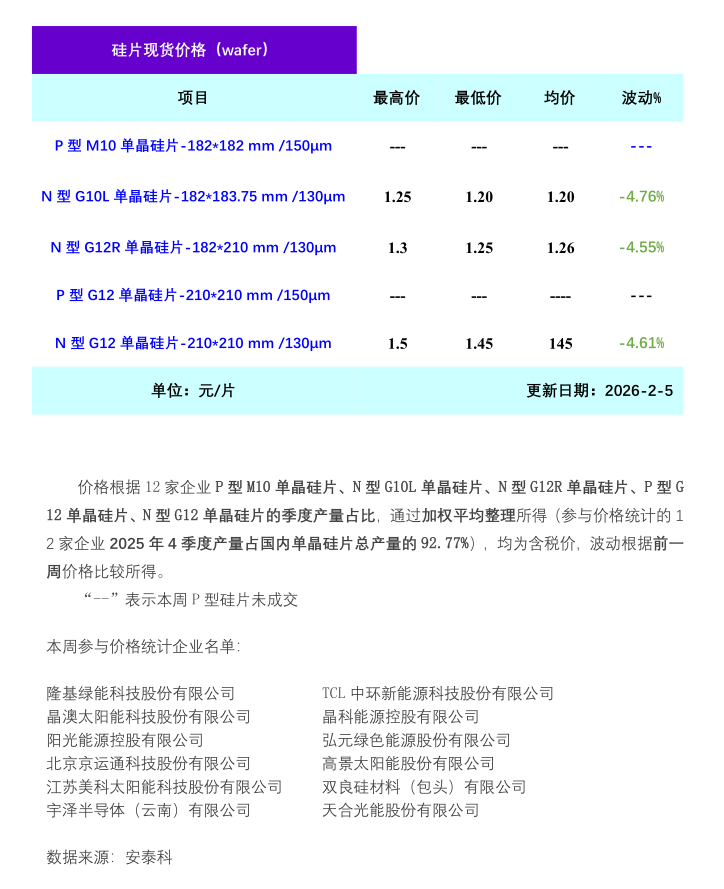
Core Insights - The silicon wafer prices are under pressure, with significant declines observed in various types of wafers, indicating a weak market demand [1][2] - The overall operating rates in the industry have slightly decreased, reflecting reduced production levels among major companies [1][2] Price Trends - N-type G10L monocrystalline silicon wafers (182*183.75mm/130μm) have an average transaction price of 1.20 yuan per piece, down 4.76% week-on-week [1][3] - N-type G12R monocrystalline silicon wafers (182*210mm/130μm) have an average price of 1.26 yuan per piece, down 4.55% week-on-week [1][3] - N-type G12 monocrystalline silicon wafers (210*210mm/130μm) have an average price of 1.45 yuan per piece, down 4.61% week-on-week [1][3] Market Conditions - The downstream demand remains weak, leading to a significant reduction in silicon wafer procurement [1][2] - The overall industry operating rate has been slightly adjusted, with major companies operating at rates of 50% and 46%, while integrated companies maintain rates between 50%-68% [1][2] Future Outlook - Short-term demand for silicon wafers is expected to remain weak, with a projected monthly production decrease of about 5% due to reduced battery cell production [2] - Post-holiday, as rigid orders from downstream gradually release, the supply-demand relationship for silicon wafers may gradually improve, potentially providing some market support [2]



太空光伏概念热度退潮 多家上市公司紧急澄清业务现状
Xin Hua Cai Jing· 2026-02-05 13:10
Core Viewpoint - The A-share space photovoltaic concept stocks experienced a collective decline following a previous surge due to rumors of an investigation by Elon Musk's team, prompting several companies to clarify their involvement in space photovoltaic business [1][2]. Group 1: Company Responses - JinkoSolar stated that space photovoltaic technology is still in the preliminary exploration stage, with industrialization affected by various factors, and that its main business remains focused on ground photovoltaic, with no revenue from space photovoltaic [1]. - Jinglong Technology indicated that the application scenarios for space photovoltaic are still exploratory, and the industrialization process faces uncertainties, with its main business being the research, production, and sales of photovoltaic equipment and materials [1]. - Shuangliang Eco-Energy announced that the application scenarios for space photovoltaic are still in exploration, with significant uncertainties in industrialization, and that it has not engaged in space photovoltaic business, which has no substantial impact on current performance [1]. - Guosheng Technology clarified that its heterojunction (HJT) battery products are primarily used in centralized and distributed power stations, with no involvement in space photovoltaic business [2]. Group 2: Industry Outlook - The photovoltaic industry is undergoing a deep adjustment period, with significant challenges in supply-demand mismatches, and addressing "involution" in the industry is a key focus for regulatory authorities this year [2]. - Despite the recent pullback in concept stocks, some brokerages remain optimistic about the long-term prospects of space photovoltaic, with CITIC Securities indicating that it is on the verge of large-scale deployment [2]. - CITIC Securities projects that the number of satellite launches will increase from 5,000 to 50,000 between 2025 and 2040, with gallium arsenide batteries currently holding an 80% market share, but the penetration of P-type HJT and perovskite/silicon tandem batteries is expected to rise as costs decrease and technology advances [2]. - The future market space for photovoltaic cells in the satellite sector is estimated to reach 328.8 billion yuan, representing a potential growth of over 30 times compared to the current market [3].
【安泰科】单晶硅片周评-需求疲软成交清淡 硅片价格承压下行(2026年2月5日)
中国有色金属工业协会硅业分会· 2026-02-05 12:44
Core Viewpoint - The silicon wafer market is experiencing downward pressure on prices due to weak downstream demand and high costs for battery manufacturers, leading to a significant reduction in procurement demand and production rates [1][2]. Price Trends - The average transaction prices for various types of silicon wafers have decreased: - N-type G10L (182*183.75mm/130μm) at 1.20 CNY/piece, down 4.76% week-on-week - N-type G12R (182*210mm/130μm) at 1.26 CNY/piece, down 4.55% - N-type G12 (210*210mm/130μm) at 1.45 CNY/piece, down 4.61% [1][3]. - The prices for downstream battery cells remain stable, with mainstream prices at 0.41-0.45 CNY/W and module prices at 0.71-0.75 CNY/W [1]. Market Dynamics - The market is characterized by weak demand, with terminal installation demand remaining soft and rising silver prices increasing cost pressures on battery companies, leading to a pessimistic industry sentiment and significant production cuts [1][2]. - The overall operating rate in the industry has slightly decreased, with leading companies operating at 50% and 46%, while integrated companies maintain rates between 50%-68% and other companies between 50%-70% [1]. Future Outlook - In the short term, silicon wafer demand is expected to remain weak, with a forecast of narrow fluctuations in the market due to adjustments in battery cell production and expectations of declining silicon material prices [2]. - Post-holiday, as rigid orders from downstream gradually release, the supply-demand relationship for silicon wafers is anticipated to improve, potentially providing some market support [2].
光伏设备板块震荡调整 钧达股份、金辰股份跌停
Shang Hai Zheng Quan Bao· 2026-02-05 12:38
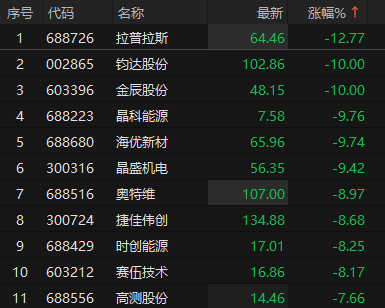
Core Viewpoint - The photovoltaic equipment sector is experiencing significant fluctuations, with several companies facing sharp declines in stock prices as of February 5th. Group 1: Market Performance - As of 9:32 AM on February 5th, companies such as JunDa Co., Ltd. and JinChen Co., Ltd. hit the daily limit down, while Laplace saw a drop of over 10% [1] - The following companies reported notable declines: - Laplace: down 12.77% - JunDa Co., Ltd.: down 10.00% - JinChen Co., Ltd.: down 10.00% - JinkoSolar: down 9.76% - Haiyou New Materials: down 9.74% - JingSheng Electromechanical: down 9.42% - Aotwei: down 8.97% - Jiejia Weichuang: down 8.68% - Shichuang Xinyuan: down 8.25% - Saisang Technology: down 8.17% - Gaoce Co., Ltd.: down 7.66% [2]

光伏设备板块回调
Di Yi Cai Jing· 2026-02-05 12:28
奥特维跌超10%,钧达股份、金辰股份双双跌超9%,迈为股份、拉普拉斯、东方日升、晶盛机电、晶 科能源等个股跟跌。 (本文来自第一财经) ...




A股太空光伏概念股坐上“过山车”
Jin Rong Shi Bao· 2026-02-05 12:00
Group 1 - The A-share photovoltaic sector experienced a sharp decline, with several popular concept stocks dropping approximately 5% as the market shifted from a heated phase to a "cooling period" [1] - The rapid market reversal was primarily driven by two factors: the release of announcements by multiple listed companies clarifying business uncertainties and a statement from the China Photovoltaic Industry Association indicating that space photovoltaic technology is still in the early stages of exploration and verification [1][2] - On February 4, around seven related concept stocks issued announcements regarding abnormal trading fluctuations or risk warnings [2] Group 2 - Guosheng Technology clarified that it does not engage in space photovoltaic business, despite recent stock price fluctuations, and warned investors about market risks [3] - Jinjing Technology reported a projected net loss of approximately 560 million yuan for 2025 and indicated that its TCO glass revenue is currently a small portion of its total income [4] - Shuangliang Energy stated that it has not confirmed any revenue related to commercial space projects and emphasized the uncertainties surrounding the commercialization of space photovoltaic technology [5] Group 3 - Jingsheng Mechanical and JinkoSolar both noted that space photovoltaic technology is still in the initial exploration phase, with significant uncertainties in the industrialization process [6][7] - Tian Tong Co. announced that it does not produce light module products and warned investors about the risks associated with market speculation [8] - The market buzz around space photovoltaic concepts was fueled by rumors of SpaceX's team visiting several Chinese photovoltaic companies, which led to stock price surges [9] Group 4 - The China Photovoltaic Industry Association emphasized the importance of mature and replicable manufacturing capabilities for the successful commercialization of new technologies [10] - The association encouraged Chinese photovoltaic companies to leverage their advantages in manufacturing to seek partnerships with leading global commercial space enterprises [11][12]


太空光伏板块,多只概念股跌停
Di Yi Cai Jing Zi Xun· 2026-02-05 11:58
Group 1 - The photovoltaic sector experienced a significant decline, with a drop of 6.67%, and space photovoltaic concept stocks also fell by 4.86% [2] - Notable individual stock declines included JunDa Co., Ltd. and JinCheng Co., Ltd., which hit the daily limit down, while Jiejia Weichuang and JingSheng Machinery fell by 12.39% and 9.85%, respectively [2] - Recent speculation arose from Elon Musk's team visiting several Chinese photovoltaic companies, which sparked renewed interest in space photovoltaic collaborations [3][4] Group 2 - Despite the initial excitement, most companies reported no knowledge of any collaboration with Musk's team, with many issuing clarifications stating no agreements or orders were in place [3][4][6] - Companies like JinkoSolar and GaoCe Co., Ltd. confirmed they had not engaged in any space photovoltaic-related business or partnerships [4][6] - The market's reaction to the rumors led to some companies, such as GCL Group, experiencing stock price increases, while others clarified their lack of involvement with Musk's team [6] Group 3 - The global satellite manufacturing and launch industry is rapidly developing, with projections indicating over 100,000 satellites in orbit by 2030, making space photovoltaic a potentially lucrative market [7] - The market for space photovoltaic could reach hundreds of billions by 2030, but significant technological breakthroughs are still required for commercialization [7][8] - Current space photovoltaic technologies are still in the exploratory phase, with no clear path to large-scale implementation, leading to uncertainty in the industry [8][9] Group 4 - A stark contrast exists between the hype surrounding space photovoltaic concepts and the actual financial performance of photovoltaic companies, with many forecasting substantial losses for 2025 [10] - Of the 64 companies that issued earnings forecasts, 39 expect losses, indicating a 61% loss rate within the sector, with major players like Tongwei Co., Ltd. predicting losses of up to 100 billion [10][11] - The overall financial outlook for the photovoltaic industry remains bleak, with only a small percentage of companies expecting profit increases [11]