爱美客

Search documents
医疗美容板块12月11日跌1.21%,爱美客领跌,主力资金净流出5889.08万元
Zheng Xing Xing Ye Ri Bao· 2025-12-11 09:17
Group 1 - The medical beauty sector experienced a decline of 1.21% on December 11, with Ai Meike leading the drop [1] - The Shanghai Composite Index closed at 3873.32, down 0.7%, while the Shenzhen Component Index closed at 13147.39, down 1.27% [1] - A table detailing the individual stock performance within the medical beauty sector was provided [1] Group 2 - In terms of capital flow, the medical beauty sector saw a net outflow of 58.89 million yuan from main funds, while retail funds had a net inflow of 34.55 million yuan [2] - Speculative funds recorded a net inflow of 24.35 million yuan [2] - A table showing the capital flow for individual stocks in the medical beauty sector was included [2]


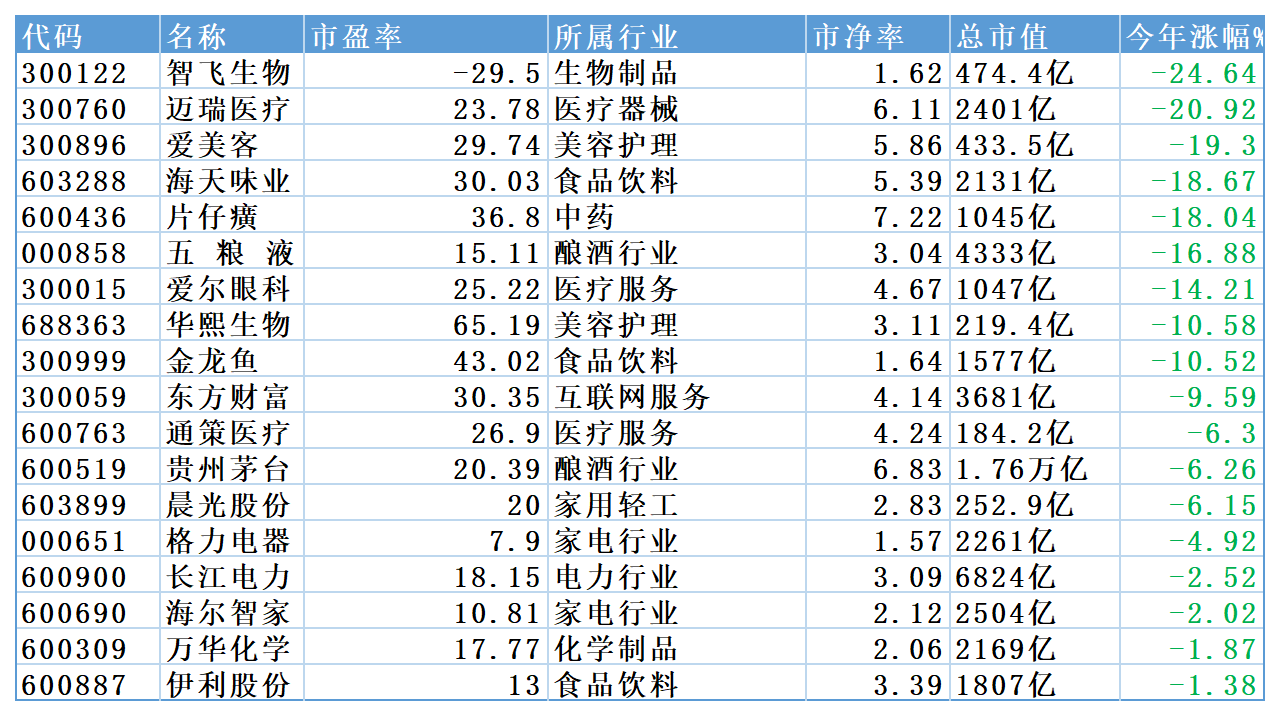
股市面面观丨2025,“茅”股的失意之年?
Xin Hua Cai Jing· 2025-12-11 02:35
Group 1: Guizhou Moutai Performance - Guizhou Moutai's stock price has been declining, dropping below 1400 CNY per share on December 10, but managed to close at this key level [1] - The decline in Moutai's stock is attributed to the falling prices of Moutai liquor, with the wholesale reference price for 2025 53-degree 500ml Moutai dropping to 1500 CNY per bottle, a decrease of 15 CNY from the previous day, marking a historical low [1] - Year-to-date, Guizhou Moutai's stock has fallen by 6.26%, underperforming the CSI 300 index by nearly 23 percentage points [1] Group 2: Other "Mao" Stocks Performance - The top three "Mao" stocks with the largest declines this year are Zhifei Biological, Mindray Medical, and Aimeike, with respective stock price drops of 24.64%, 20.92%, and 19.3% [2] - A total of 18 "Mao" stocks have declined this year, with 9 of them experiencing drops exceeding 10% [1][4] Group 3: Zhifei Biological Analysis - Zhifei Biological's significant decline is closely related to a substantial drop in performance, reporting a loss of 1.206 billion CNY in the third quarter, resulting in a negative price-to-earnings ratio [4] - The company faces increased competition and pricing pressure in the HPV vaccine market, with a gross margin dropping to 23.77% and a net margin of -15.99% [4] - The company is attempting to diversify away from reliance on HPV vaccines, with 34 self-developed projects in various stages of clinical trials [5] Group 4: Mindray Medical and Aimeike Performance - Mindray Medical's net profit fell by 28.83% year-on-year in the first three quarters, marking the first negative growth in net profit since its listing [6] - Aimeike reported a 31.05% decline in net profit and a 21.49% drop in revenue, both representing the first instances of simultaneous negative growth since its listing [6][7] - Analysts suggest that both companies may see a turnaround in 2026, with Mindray's domestic business expected to achieve positive revenue growth [7][8] Group 5: Market Sentiment and Future Outlook - Despite the overall poor performance of "Mao" stocks in 2025, some technology stocks have significantly outperformed the CSI 300 index, indicating potential new "Mao" stocks emerging from innovative sectors [9] - Notable investors express optimism about Guizhou Moutai, suggesting it remains a better investment than keeping cash in the bank [9]

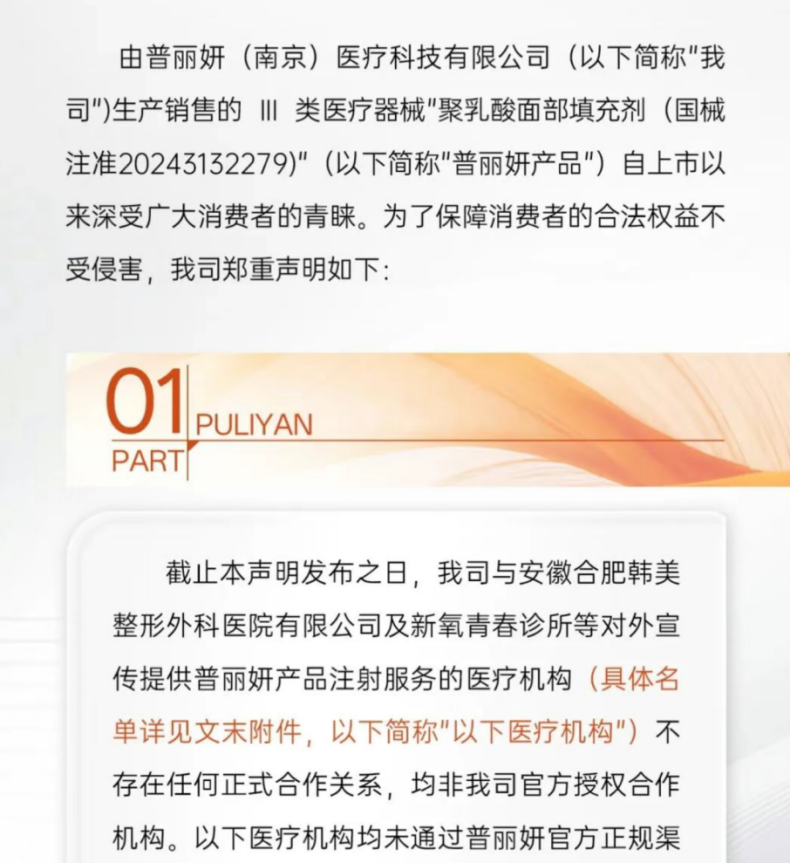
新氧与普丽妍对峙升级 谁的童颜针定价权?
Bei Jing Shang Bao· 2025-12-11 01:30
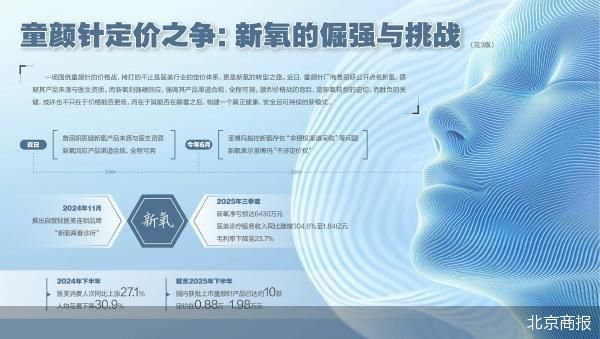
Core Viewpoint - The price war surrounding "童颜针" (youthful needle) is not only challenging the pricing system of the medical beauty industry but also testing the transformation path of the company, 新氧 (Xinyang) [1] Group 1: Price War and Market Dynamics - 新氧 has significantly reduced the price of "童颜针" from tens of thousands to 2999 yuan, aiming to gain pricing autonomy through its "奇迹童颜" series and the new "塑缇妍" product [1][8] - The conflict escalated as the manufacturer, 普丽妍, publicly named 新氧's clinics as "non-official partners," questioning their product sources and doctor qualifications [3][4] - The price reduction strategy has raised concerns about the sustainability of the medical beauty industry's profit distribution and the traditional agency model [4][5] Group 2: Transformation Challenges - 新氧's transition from a platform to a direct participant in the industry has led to conflicts with previously partnered medical institutions, resulting in a significant decline in its platform service revenue [11][12] - The company's aggressive expansion into self-operated clinics has resulted in increased costs and operational challenges, with a reported net loss of 64.3 million yuan in the third quarter [12][13] - Despite the challenges, the self-operated business is seen as a key driver for future growth, with a 304.6% year-on-year increase in medical treatment service revenue [12] Group 3: Pricing Strategy and Cost Structure - The drastic price reduction of 70% for "童颜针" is not solely based on cost but is a strategic market move to disrupt the high-price perception in the industry [5][6] - 新氧's lower pricing is attributed to its ability to bypass traditional distribution layers and its strategy of low-margin, high-volume sales [6][7] - The company claims that its pricing reflects a trend towards "value return" in medical beauty consumption, with a 27.1% increase in consumer visits but a 30.9% decrease in average spending [7] Group 4: Regulatory and Compliance Issues - 新氧 has faced multiple regulatory challenges, including fines for non-compliance with national standards and advertising laws [13][14] - The company acknowledges the importance of addressing consumer complaints and emphasizes that its low-cost model does not compromise regulatory compliance [14]

新氧对峙普丽妍 谁的童颜针定价权
Bei Jing Shang Bao· 2025-12-10 15:44
Core Viewpoint - The price war surrounding the "youthful needle" is not only challenging the pricing system of the medical beauty industry but also testing the transformation path of the company, New Oxygen [1] Group 1: Price War and Market Dynamics - New Oxygen has significantly reduced the price of the "youthful needle" from tens of thousands to 2999 yuan, aiming to gain pricing autonomy through differentiation and collaboration with West Hong Biological [1][7] - The conflict escalated when the manufacturer, Puli Yan, publicly named New Oxygen's clinics as "non-official partners," questioning the legitimacy of their product sources and medical qualifications [2] - The price war reflects a challenge to the long-standing profit distribution system in the medical beauty industry, as New Oxygen's pricing strategy disrupts traditional agency rules [3] Group 2: Transformation Challenges - New Oxygen is transitioning from a platform-based model to a direct participant in the industry, facing backlash from previously cooperative medical institutions that now view it as a competitor [10] - The company's core platform revenue has been declining, with a 19.3% year-on-year drop in information and appointment service revenue in 2024 [10] - Despite the challenges, New Oxygen's offline medical beauty service revenue surged by 304.6% year-on-year, becoming its largest income source [11] Group 3: Cost Structure and Profitability - New Oxygen's low pricing strategy is attributed to its scale advantages and a thin profit margin approach, with a reported gross margin of only 23.7% in the third quarter [5][11] - The company is focusing on cost optimization through various strategies, including supply chain integration and digital tools, to improve operational efficiency [11] - The medical beauty industry has high gross margins, often around 90%, indicating that New Oxygen's pricing strategy may be unsustainable in the long term [5] Group 4: Regulatory and Compliance Issues - New Oxygen has faced multiple regulatory challenges, including fines for non-compliance with national standards and advertising laws [12] - The company acknowledges the importance of addressing customer complaints and regulatory feedback as part of its service optimization strategy [12] - The sustainability of New Oxygen's low-price model hinges on building a robust framework based on medical safety and compliance trust [12]
定价权之争再升级!万元级“童颜针”卖到2999元!新氧46家诊所上厂商黑名单
Bei Jing Shang Bao· 2025-12-10 15:25
Core Viewpoint - The ongoing price war surrounding "童颜针" (youthful needle) is not only challenging the pricing system of the medical beauty industry but also represents a critical transformation path for the company, 新氧 (So-Young) [2][14]. Group 1: Price War and Market Dynamics - 新氧 has significantly reduced the price of "童颜针" from over 10,000 RMB to 2,999 RMB, aiming to gain control over pricing autonomy [2][10]. - The company faces accusations from suppliers like 普丽妍, which has labeled many of 新氧's clinics as "non-official partners," questioning the legitimacy of their product sources and medical qualifications [3][4]. - The price reduction strategy is seen as a challenge to the traditional profit distribution model in the medical beauty industry, where high prices were previously justified by perceived quality [6][7]. Group 2: Transformation Challenges - 新氧 is transitioning from a platform-based model to a direct participant in the medical beauty industry by establishing its own clinics, which has led to conflicts with previously partnered medical institutions [14][15]. - The company's revenue from information and reservation services has declined significantly, with a 34.5% year-on-year drop in the third quarter [14]. - Despite the aggressive expansion into self-operated clinics, 新氧 has reported continuous losses, with a net loss of 64.8 million RMB in the third quarter of 2025 [15][16]. Group 3: Financial Performance and Cost Structure - 新氧's aesthetic treatment services revenue surged by 304.6% year-on-year to 1.84 billion RMB in the third quarter, becoming the largest revenue source [17]. - The gross profit margin for 新氧's medical aesthetic services was reported at only 24.25% in the second quarter of 2025, indicating a significant deviation from industry standards [8][9]. - The company is focusing on cost optimization through strategies like scale procurement and supply chain integration to improve profitability [17]. Group 4: Regulatory and Compliance Issues - 新氧 has faced multiple complaints regarding service quality and compliance, with 876 complaints recorded on consumer platforms, including issues related to false advertising and operational violations [17][19]. - The company has been penalized for non-compliance with national standards, highlighting the regulatory risks associated with its rapid expansion [17][18]. - 新氧 emphasizes that its low pricing strategy does not compromise regulatory compliance and is committed to addressing consumer feedback seriously [19].
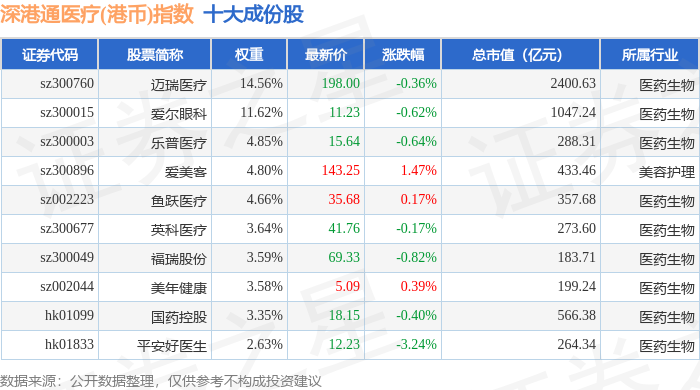
12月10日深港通医疗(港币)(983036)指数跌0.28%,成份股先健科技(01302)领跌
Sou Hu Cai Jing· 2025-12-10 11:19
Core Points - The Shenzhen-Hong Kong Stock Connect Medical Index (983036) closed at 4327.65 points, down 0.28%, with a trading volume of HKD 7.682 billion and a turnover rate of 0.9% [1] - Among the index constituents, 21 stocks rose while 36 stocks fell, with Kewei Medical leading the gainers at a 4.14% increase and Xianjian Technology leading the decliners at a 9.14% decrease [1] Index Constituents Summary - The top ten constituents of the Shenzhen-Hong Kong Stock Connect Medical Index include: - Mindray Medical (sz300760) with a weight of 14.56%, latest price at HKD 198.00, and a market cap of HKD 240.063 billion, down 0.36% [1] - Yier Eye Hospital (sz300015) with a weight of 11.62%, latest price at HKD 11.23, and a market cap of HKD 104.724 billion, down 0.62% [1] - Lejin Medical (sz300003) with a weight of 4.85%, latest price at HKD 15.64, and a market cap of HKD 28.831 billion, down 0.64% [1] - Aimeike (sz300896) with a weight of 4.80%, latest price at HKD 143.25, and a market cap of HKD 43.346 billion, up 1.47% [1] - Yuyue Medical (sz002223) with a weight of 4.66%, latest price at HKD 35.68, and a market cap of HKD 35.768 billion, up 0.17% [1] - Yingke Medical (sz300677) with a weight of 3.64%, latest price at HKD 41.76, and a market cap of HKD 27.360 billion, down 0.17% [1] - Furuijia (sz300049) with a weight of 3.59%, latest price at HKD 69.33, and a market cap of HKD 18.371 billion, down 0.82% [1] - Meinian Health (sz002044) with a weight of 3.58%, latest price at HKD 5.09, and a market cap of HKD 19.924 billion, up 0.39% [1] - Sinopharm Holdings (hk01099) with a weight of 3.35%, latest price at HKD 18.15, and a market cap of HKD 56.638 billion, down 0.40% [1] - Ping An Good Doctor (hk01833) with a weight of 2.63%, latest price at HKD 12.23, and a market cap of HKD 26.434 billion, down 3.24% [1] Capital Flow Analysis - The index constituents experienced a net outflow of HKD 382 million from institutional investors, while retail investors saw a net inflow of HKD 329 million [1] - Notable individual stock capital flows include: - Meinian Health (sz002044) with a net inflow of HKD 23.6308 million from institutional investors [2] - Aimeike (sz300896) with a net inflow of HKD 5.8353 million from institutional investors [2] - Yier Eye Hospital (sz300015) with a net outflow of HKD 20.7620 million from retail investors [2]



欧莱雅再增持高德美股权至20%,释放出哪些信号?
Xin Lang Cai Jing· 2025-12-10 02:19
Core Viewpoint - L'Oréal Group has acquired an additional 10% stake in Galderma from EQT-led consortium, increasing its ownership to 20%, marking a significant move in the medical aesthetics and skin health sector [1][5] Group 1: Acquisition Details - The acquisition allows L'Oréal to nominate two non-independent board members from its group starting from the 2026 annual shareholders' meeting, replacing representatives from EQT [1] - L'Oréal's historical connection with Galderma dates back to 1981 when it co-owned the company with Nestlé, which later sold its stake to EQT and Abu Dhabi Investment Authority in 2019 [3] Group 2: Financial Performance - Galderma's sales increased from $34.17 billion in 2021 to $44.1 billion in 2024, with a notable growth rate of 9.3% in 2024 and 15% in the first three quarters of 2025, significantly outpacing L'Oréal's growth [4][5] - The company has successfully restructured its business focus on aesthetic injectables, skin care, and dermatological treatments under EQT's leadership [4] Group 3: Strategic Importance - Galderma is viewed as a "strategic puzzle" by L'Oréal, which aims to leverage its expertise in medical aesthetics rather than treating it as a short-term investment [5] - The collaboration is expected to enhance R&D alignment between L'Oréal and Galderma, particularly in developing innovative products that combine medical aesthetics and skincare [12][14] Group 4: Market Positioning - Galderma has established a strong presence in over 100 countries, with significant achievements in the Chinese market, which is projected to exceed 300 billion yuan in the medical aesthetics sector by 2025 [14] - The partnership allows L'Oréal to utilize Galderma's existing capabilities and distribution channels to capture market share in the injectable aesthetics segment [14] Group 5: Industry Challenges - The medical aesthetics industry is entering a phase of compliance and competition, with various brands launching new products and services [15] - L'Oréal faces challenges in balancing its mass marketing approach with the specialized services required in the medical aesthetics field, necessitating a focus on localized product development [17][18] Group 6: Long-term Strategy - The success of the collaboration between L'Oréal and Galderma hinges on a commitment to long-term investment in R&D and the development of innovative products that meet consumer needs [18] - The evolving consumer demand from basic skincare to advanced aesthetic solutions indicates a trend towards deeper integration between beauty and medical sectors [18]

爱美客:价值创造和可持续发展是上市公司市值管理的基石
Zheng Quan Ri Bao Wang· 2025-12-08 13:41
证券日报网讯12月8日,爱美客(300896)在互动平台回答投资者提问时表示,价值创造和可持续发展 是上市公司市值管理的基石,规范透明的信披环境和良好的投资者关系是价值实现的途径。公司通过聚 焦主业,以客户需求为导向,不断技术创新、实现产品与服务升级等方式提升公司内在价值,同时也通 过国际化战略布局,优化资产配置,提升核心竞争力,推动市值的长期稳定和提升。 ...
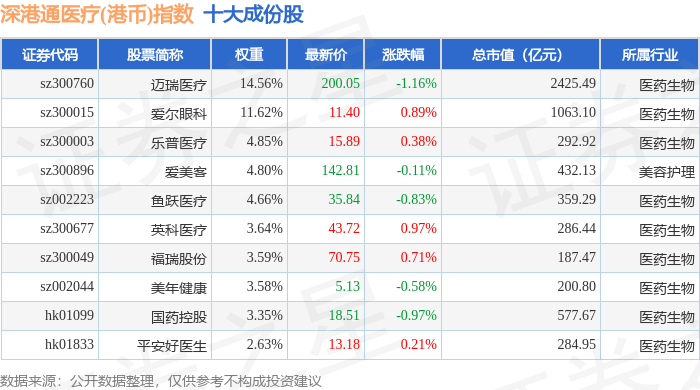
12月8日深港通医疗(港币)(983036)指数跌0.24%,成份股锦欣生殖(01951)领跌
Sou Hu Cai Jing· 2025-12-08 11:22
Core Insights - The Shenzhen-Hong Kong Stock Connect Medical Index (983036) closed at 4406.89 points, down 0.24%, with a trading volume of HKD 7.939 billion and a turnover rate of 0.88% [1] - Among the index constituents, 23 stocks rose while 34 stocks fell, with Yiyang Sunshine leading the gainers at 3.98% and Jinxin Fertility leading the decliners at 3.89% [1] Index Constituents Summary - The top ten constituents of the Shenzhen-Hong Kong Stock Connect Medical Index are as follows: - Mindray Medical (sz300760) holds a weight of 14.56%, latest price at HKD 200.05, down 1.16%, with a market cap of HKD 242.549 billion [1] - Aier Eye Hospital (sz300015) has a weight of 11.62%, latest price at HKD 11.40, up 0.89%, with a market cap of HKD 106.31 billion [1] - Lepu Medical (sz300003) has a weight of 4.85%, latest price at HKD 15.89, up 0.38%, with a market cap of HKD 29.292 billion [1] - Aimeike (sz300896) has a weight of 4.80%, latest price at HKD 142.81, down 0.11%, with a market cap of HKD 43.213 billion [1] - Yuyue Medical (sz002223) has a weight of 4.66%, latest price at HKD 35.84, down 0.83%, with a market cap of HKD 35.929 billion [1] - Yingke Medical (sz300677) has a weight of 3.64%, latest price at HKD 43.72, up 0.97%, with a market cap of HKD 28.644 billion [1] - Furuide (sz300049) has a weight of 3.59%, latest price at HKD 70.75, up 0.71%, with a market cap of HKD 18.747 billion [1] - Meinian Onehealth (sz002044) has a weight of 3.58%, latest price at HKD 5.13, down 0.58%, with a market cap of HKD 20.08 billion [1] - Sinopharm (hk01099) has a weight of 3.35%, latest price at HKD 18.51, down 0.97%, with a market cap of HKD 57.767 billion [1] - Ping An Good Doctor (hk01833) has a weight of 2.63%, latest price at HKD 13.18, up 0.21%, with a market cap of HKD 28.495 billion [1] Capital Flow Analysis - The index constituents experienced a net outflow of main funds totaling HKD 230 million, while retail investors saw a net inflow of HKD 268 million [1] - Detailed capital flow for specific stocks shows: - Furuide (sz300049) had a main fund net inflow of HKD 8.7323 million, with retail outflows of HKD 3.3726 million [2] - Aier Eye Hospital (sz300015) had a main fund net inflow of HKD 6.6536 million, with retail outflows of HKD 1.8752 million [2] - Lepu Medical (sz300003) had a main fund net inflow of HKD 3.7716 million, with retail outflows of HKD 0.7273 million [2]

媛颂集团组建高标产业联盟,以供应链升级推动产业价值竞争
Jing Ji Wang· 2025-12-08 10:08
Core Viewpoint - The medical aesthetics industry is transitioning from scale expansion to quality enhancement, with compliance and standardization becoming critical paths for companies to break through [2][3]. Group 1: Current Status of Compliance in the Medical Aesthetics Industry - The medical aesthetics industry is at a critical juncture characterized by tightening regulations and ecological restructuring, with the market size reaching a trillion yuan [3]. - Issues such as "black institutions" and "black injectables" continue to hinder the healthy development of the industry, making compliance a necessity for survival rather than an option [3]. - Companies are collaborating to establish high-standard, transparent industry alliances, promoting initiatives like "tenfold compensation for counterfeit products" to enhance consumer trust [3]. Group 2: Role of Compliance in Industry Trust - Compliance is viewed not as a cost burden but as the best trust agent for the industry [4]. - The company, established in 2015, has built a direct sales system in 20 first-tier and new first-tier cities, focusing on technological upgrades and standard outputs to shift the industry from "marketing-driven" to "technology-driven" [4].