纳芯微

Search documents
纳芯微:部分行使超额配售权,额外募资约1.15亿港元
Xin Lang Cai Jing· 2026-01-04 08:17
纳芯微公告称,2026年1月2日公司部分行使超额配售权,涉及102.66万股H股,占行使前全球发售股份 约5.38%,超额配售股份预计1月7日上市。公司因部分行使超额配售权获额外募资净额约1.15亿港元。 本次发行有关全球发售的稳定价格期已结束,稳定价格经办人在稳定价格期内有超额配售、市场买入等 行动。整体协调人部分行使超额配售权后,未行使部分于1月2日失效,公司将继续遵守公众持股量规 定。 ...
密集赴港上市,港股“含A量”提高
Zhong Guo Zheng Quan Bao· 2026-01-04 04:21
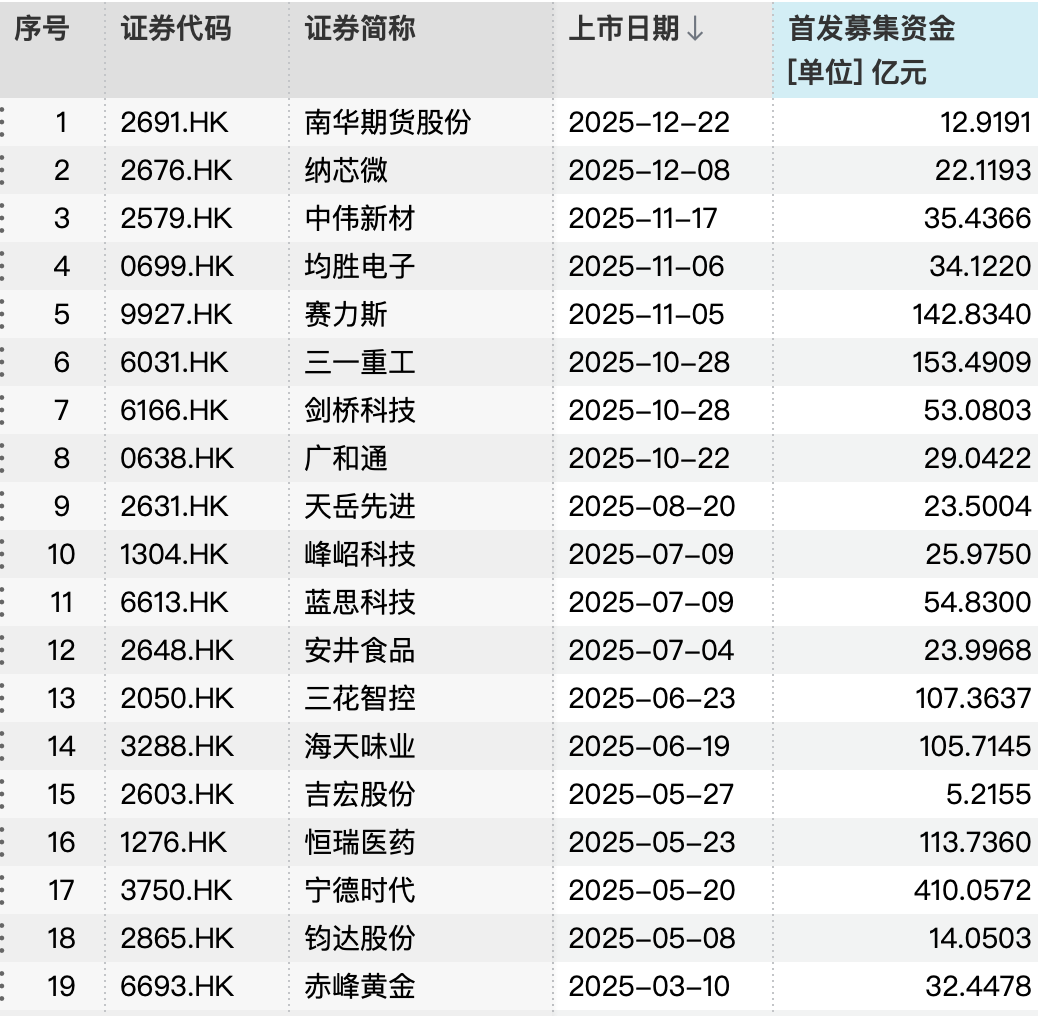
A股公司赴港上市热潮持续。 制度红利持续释放 2025年港股IPO募资总额登顶全球,也是一大看点。市场认为,港股IPO市场升温,离不开制度红利持续释放。 据中国证券报记者不完全统计,2025年12月,包括聚辰股份、拓斯达(300607)、中文在线(300364)、天孚通信(300394)等在内的超20家A股 上市公司,披露(包含更新披露)赴港上市相关公告。 机构认为,港股"含A量"提高,释放出两地市场协同发力的积极信号,"A+H"模式预计将持续火热。 港股"含A量"提高 2025年,"A+H"股上市数量创下历史新高。 数据显示,2025年,共有19家A股上市公司登陆港股,合计募资1399.93亿港元,占港股全年IPO总额近半。 2025年上市公司"A+H"上市情况 | | | 证券代码 | 训 崇简称 | 上市日期 ↓ | 首发募集资金 | | --- | --- | --- | --- | --- | --- | | | | | | | [单位] 亿元 | | | 1 : | 2691.HK | 南华期货股份 | 2025-12-22 | 12.9191 | | | 2 | 2676.HK | 纳芯微 | ...

“国际金融中心遗址论”不攻自破 港股逆袭,问鼎全球IPO募资额
Sou Hu Cai Jing· 2026-01-03 23:42
羊城晚报全媒体记者 莫谨榕 2024年,国际资本市场仍弥漫着对香港国际金融中心地位的疑虑,其时刚刚上任的香港交易所集团行政 总裁陈翊庭驳斥所谓"香港是国际金融中心遗址"的论调过于片面。如今,香港资本市场已经完成了逆 袭,数据显示,香港交易所2025年有114家企业完成IPO,合计募资约2863亿港元,不仅超过2023年与 2024年两年募资总和,更强势登上全球交易所IPO募资额榜首。 "遗址论"不攻自破!在陈翊庭看来,香港拥有"与内地资本市场独特的互联互通机制,高度国际开放、 流动性充裕且多元化的市场,还有持续创新的决心",正积极拥抱"成为全球金融市场核心的巨大机 遇"。 香港IPO市场的回暖得益于龙头企业的相继奔赴。2025年港股迎来8只融资破百亿港元的超大型新股上 市,占总融资额约五成。排在首位的宁德时代募资约410亿港元,不仅是2025年内全球第二大IPO纪 录,也创下近4年港股最大IPO纪录,其国际配售认购倍数达15.2倍,散户认购倍数高达151.2倍,全球 资金纷纷抛出橄榄枝。 港交所敲锣声不断,正成为全球资金的蓄水池。本轮港股IPO浪潮中,大量外资机构成为了基石投资 者。记者统计发现,2025年以 ...

2026年中国MEMS微纳米制造零部件行业产业链、市场规模、竞争格局及发展趋势研判:随着MEMS技术在多个领域加速渗透,市场规模有望达到77亿元[图]
Chan Ye Xin Xi Wang· 2026-01-03 02:50
Core Insights - The MEMS micro-nano manufacturing components industry is experiencing rapid growth due to increased penetration in consumer electronics, automotive electronics, industrial automation, and healthcare sectors, with the global market expected to reach 7.3 billion yuan by 2025 and 7.7 billion yuan by 2026 [1][5][10] Industry Definition and Classification - MEMS (Micro-Electro-Mechanical Systems) combines electronic and mechanical technologies to create devices at micro or nano scales, enabling smart and integrated systems [2][3] - Key components include sensors, acoustic modules, optical modules, pressure sensors, and inertial sensors, characterized by miniaturization, integration, and mass production [3][4] Current Industry Status - The MEMS micro-nano manufacturing components market is expanding, driven by technological advancements and increasing demand for miniaturized and intelligent devices [4][5] - The largest segment within this market is sensors, followed by acoustic modules, with significant growth projected in various subcategories [5] Industry Chain - The upstream of the MEMS industry includes high-grade metals, silicon-based materials, polymers, and precision equipment, with high technical barriers and reliance on imports for some high-end materials [6] - The midstream focuses on the production of MEMS components, characterized by high technology barriers and added value [6] - The downstream applications span aerospace, automotive, biomedical, and consumer electronics sectors [6] Competitive Landscape - The MEMS micro-nano manufacturing components market in China is primarily dominated by foreign companies, with domestic firms accelerating their efforts to replace imports and enhance core technologies [7] - Key players include AAC Technologies, Huazhong University of Science and Technology, Goertek, and others, with ongoing advancements in various segments [7][8] Development Trends - The MEMS industry is evolving towards micro-nano precision manufacturing of integrated functional components, emphasizing miniaturization, integration, and mass production [9][10] - Future growth is anticipated as technological advancements lower production costs and expand applications across various sectors, including IoT, consumer electronics, and automotive industries [10]


纳芯微:部分行使超额配股权、稳定价格行动及稳定价格期结束
Zhi Tong Cai Jing· 2026-01-02 14:08
Core Viewpoint - Naxin Micro (02676) has partially exercised the over-allotment option as of January 2, 2026, involving a total of 1.0266 million H-shares, which represents approximately 5.38% of the total shares available for subscription before the exercise of the over-allotment option [1][1]. Group 1 - The over-allotment shares will be issued at a price of HKD 116.00 per H-share, which is the same as the offering price for the global sale [1][1]. - The stabilization period for the global offering ended on January 2, 2026, which is 30 days after the deadline for submitting applications for the Hong Kong public offering [1][1].
纳芯微(02676):部分行使超额配股权、稳定价格行动及稳定价格期结束

智通财经网· 2026-01-02 13:45
纳芯微(02676)发布公告,整体协调人(为其本身及代表国际承销商)已于2026年1月2日部分行使招股章程 所述的超额配股权,涉及合共102.66万股H股,相当于任何超额配股权获行使前全球发售项下初步可供 认购发售股份总数约5.38%。超额分配股份将由本公司按每股H股116.00港元(即全球发售项下每股H股 的发售价)发行及配发。此外,有关全球发售的稳定价格期已于2026年1月2日(即递交香港公开发售申请 的截止日期后第30日)结束。 ...
纳芯微(02676.HK)部分行使超额配股权、稳定价格行动及稳定价格期结束
Ge Long Hui· 2026-01-02 13:41
超额分配股份将由公司按每股H股116.00港元(不包括1.0%经纪佣金、0.0027%证监会交易徵费、 0.00015%会财局交易徵费及0.00565%联交所交易费)(即全球发售项下每股H股的发售价)发行及配发。 格隆汇1月2日丨纳芯微(02676.HK)宣布,整体协调人(为其本身及代表国际承销商)已于2026年1月2日(星 期五)部分行使招股章程所述的超额配股权,涉及合共1,026,600股H股(「超额分配股份」),相当于任何 超额配股权获行使前全球发售项下初步可供认购发售股份总数约5.38%。 根据香港法例第571W章证券及期货(稳定价格)规则第9(2)条,公司宣布,有关全球发售的稳定价格期已 于2026年1月2日(星期五)(即递交香港公开发售申请的截止日期后第30日)结束。有关稳定价格操作人中 国国际金融香港证券有限公司或代其行事的任何人士于稳定价格期内采取的稳定价格行动的进一步资料 载于本公告内。 ...
纳芯微(02676) - 部分行使超额配股权、稳定价格行动及稳定价格期结束
2026-01-02 13:32
香 港 交 易 及 結 算 所 有 限 公 司、香 港 聯 合 交 易 所 有 限 公 司(「聯交所」)及 香 港 中 央 結算有限公司對本公告的內容概不負責,對其準確性或完整性亦不發表任何聲明, 並 明 確 表 示,概 不 就 因 本 公 告 全 部 或 任 何 部 分 內 容 所 產 生 或 因 依 賴 該 等 內 容 而 引致的任何損失承擔任何責任。 本 公 告 不 得 直 接 或 間 接 於 或 向 美 國(包 括 其 領 土 及 屬 地、美 國 任 何 州 份 以 及 哥 倫 比 亞 特 區)發 佈、刊 發 或 派 發。本 公 告 並 不 亦 不 擬 構 成 或 屬 於 在 美 國 境 內 或 於 任 何 其 他 司 法 權 區 購 買 或 認 購 證 券 的 任 何 要 約 或 招 攬 的 一 部 分。本 公 告 所 述 證 券 並無亦不會根據1933年 美 國 證 券 法(經 不 時 修 訂)(「美國證券法」)或 美 國 任 何 州 份 或其他司法權區的證券法登記。證券不會於美國境內提呈發售、出售、質押或以 其 他 方 式 轉 讓,惟 根 據 美 國 證 券 法 的 登 記 規 定 獲 豁 免 ...
44家公司港股通新贵即将喜迎“北水”流入
Zhi Tong Cai Jing· 2025-12-31 16:29
Core Insights - The adjustment of Hong Kong Stock Connect (港股通) for the first batch of 2026 has been finalized, indicating a structural change in the Hong Kong stock market, with southbound funds playing a significant role in influencing stock liquidity and valuations [1] Group 1: Inclusion and Exclusion Criteria - The current inclusion threshold for Hong Kong Stock Connect has risen to 9.317 billion, while the exclusion threshold stands at 6.05 billion [2] - A total of 44 companies meet the inclusion criteria, while 24 companies face the risk of exclusion due to insufficient market capitalization [2][7] - Market capitalization and liquidity are the core indicators determining inclusion or exclusion [2] Group 2: Companies Meeting Inclusion Criteria - Among the 44 companies eligible for inclusion, the average market capitalization is 14.377 billion, with a median of 12.613 billion, indicating overall high quality [2] - The types of inclusion include 40 companies for standard inclusion, 2 for A+H inclusion, and 2 for dual-class share inclusion [2] Group 3: Companies Facing Exclusion Risk - The 24 companies at risk of exclusion have an average market capitalization of only 5.094 billion, all below the 6.05 billion threshold [7] - Notable companies facing exclusion include Youbao Online and Haotian International Construction [7] Group 4: Market Dynamics and Adjustment Mechanism - The adjustment of Hong Kong Stock Connect is based on a complex system that considers market capitalization, liquidity, and market structure [7] - The market capitalization threshold is dynamically adjusted based on the market capitalization distribution of the Hang Seng Composite Index [8] - The liquidity requirement is assessed through the trading volume turnover ratio, which varies based on the listing duration of the companies [10] Group 5: Adjustment Frequency and Fast Inclusion Mechanism - Adjustments to Hong Kong Stock Connect occur four times a year, with two major adjustments in March and September, and two minor adjustments in June and December [11] - New stocks can be included through a fast-track mechanism, with specific criteria for quarterly and special fast inclusion [12]


2025中国汽车行业十大年度热点 | 精进2025——汽车行业10个十大年度盘点
Jing Ji Guan Cha Wang· 2025-12-31 07:20
Core Insights - The automotive industry in China has made significant progress in 2025, with a focus on stability and quality improvement, driven by a series of proactive policies and a shift towards value and innovation in competition [2][3] Group 1: Industry Performance - New energy vehicle (NEV) production and sales are expected to exceed 15 million units in 2025, with domestic sales accounting for over 50% of total automotive sales [3][4] - The total automotive production and sales reached approximately 31.2 million units in 2025, with NEVs making up 50.3% of domestic sales [3] - Automotive exports are projected to reach a record 7 million units in 2025, with NEV exports doubling year-on-year [5][7] Group 2: Regulatory Environment - The Chinese government has implemented unprecedented measures to address "involution" in the automotive industry, including new regulations and guidelines to maintain fair competition [8][9] - A comprehensive "Stability Growth Work Plan" was introduced to support the automotive industry, aiming for a 3% increase in total automotive sales and a 20% increase in NEV sales in 2025 [10][11] Group 3: Corporate Developments - The establishment of China Changan Automobile Group marks the formation of a new structure in the state-owned automotive sector, alongside other major state-owned enterprises [12][13] - Numerous automotive companies have listed or applied for listing on the Hong Kong Stock Exchange, reflecting the industry's robust growth and the need for strategic investment [20][21] Group 4: Technological Advancements - The release of two major technical roadmaps for intelligent connected vehicles and energy-saving NEVs outlines the development goals and timelines for the next 5 to 15 years [14][15][16] - The first L3-level autonomous driving vehicles have received approval for road use, marking a significant milestone in the commercialization of autonomous driving technology [17][18] Group 5: Market Expansion - The implementation of export licensing for pure electric passenger vehicles is expected to promote healthy development in NEV trade and enhance regulatory oversight [19] - The automotive industry is positioned as a key driver of the new technological revolution and industrial transformation, contributing significantly to the national economy [22][23]