Perplexity

Search documents
The AI race after Google's antitrust win
CNBC Television· 2025-09-03 17:35
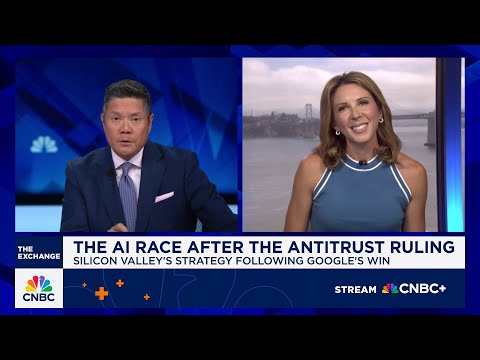
We're going to keep it right here with technology, staying with Alphabet and the antitrust victory. The ruling has major implications for the generative AI space as well. Mackenzie Sagalos digs into what this means for Google and the AI startup landscape.Mac, hey. So, going into the ruling DOM, there was fear it would send shock waves through Silicon Valley. And instead, it is being read as good news, not just for Google, but for the handful of well- capitalized players dominating the AI market.An ex Google ...


Analysts are calling Google's antitrust decision 'broadly favorable' and 'benign'
Business Insider· 2025-09-03 05:47
Core Viewpoint - The recent ruling in Google's antitrust lawsuit is seen as largely favorable for the company, allowing it to maintain its key businesses while imposing some restrictions on exclusive contracts and data sharing [1][2][8]. Summary by Sections Legal Ruling - A district judge ruled that Google will not have to divest its Chrome or YouTube businesses, which was a significant concern for investors [1]. - Google is prohibited from entering exclusive contracts with partners like Apple that prioritize its search engine and must share some data with competitors [2]. Market Reaction - Following the ruling, Google's stock increased by 6.7% in after-hours trading, indicating positive investor sentiment [2]. - Analysts described the ruling as "benign," suggesting it alleviated a major overhang on Google's stock [2]. Analyst Insights - RBC Capital analysts noted that the ruling focused on opening Google's search technology to competitors rather than disrupting its distribution framework, which they viewed as a lesser risk [3]. - RBC raised its price target for Google from $220 to $260, citing clearer paths for earnings growth and multiple expansion [3]. Competitive Landscape - Wedbush analysts expressed a favorable view of the ruling, stating it mitigated the worst-case scenarios for Google [8]. - They identified three bullish factors: removal of lingering risks, diminishing impact from generative AI competitors, and Google's repositioning as a leader in the AI space with strong demand trends and accelerating Cloud growth [9]. - Wedbush raised its stock price target from $225 to $245 following the ruling [9]. Stock Performance - Year-to-date, Google's stock has risen by 11.3%, reflecting positive market sentiment and investor confidence [10].

谷歌Chrome不必卖,一纸判决背后缔造了哪些赢家和输家?
Feng Huang Wang· 2025-09-03 00:54
Core Viewpoint - The U.S. Department of Justice's antitrust ruling against Google has clarified the winners and losers in the case, allowing Google to continue paying for default search engine status while prohibiting exclusive contracts with partners like Apple [1][2]. Group 1: Winners - Google benefits significantly from the ruling as it does not have to divest its Chrome browser, which is crucial for directing users to its search engine [1][2]. - Apple stands to gain as it can continue receiving approximately $20 billion from Google for being the default search engine on iPhones, which constitutes about 20% of Apple's annual services revenue [3]. - AI competitors such as OpenAI and Perplexity may benefit from the ruling, as Apple can now promote their services without violating agreements with Google, and they may gain access to shared search data from Google [5]. Group 2: Losers - Competitors to Google's Chrome browser, such as Microsoft's Edge and Apple's Safari, are at a disadvantage since the ruling allows Google to maintain its significant distribution channel with over 3 billion active users [6]. - The inability to force Google to divest Chrome means that the competitive landscape for browsers remains unchanged, making it difficult for rivals to gain market share [6].

Google's AI stumbles, ChatGPT's emergence 'changed the course' of antitrust case
CNBC· 2025-09-03 00:14
Core Viewpoint - The recent federal judge ruling allows Google to retain its Chrome browser and limits the severity of antitrust consequences, reflecting the competitive dynamics of the generative AI market that has emerged rapidly since 2022 [2][3][4]. Group 1: Antitrust Case Outcome - A federal judge ruled against the harshest penalties proposed by the U.S. Department of Justice, allowing Google to keep its Chrome browser and imposing restrictions on exclusive contracts and search data sharing [2][3]. - The ruling acknowledges that while Google remains dominant in search, the rise of generative AI technologies could alter competitive dynamics in the market [3][4]. Group 2: Generative AI Market Dynamics - The judge emphasized that the generative AI market is highly competitive, with numerous new entrants and significant capital investment, differentiating it from the search market [4][5]. - Google cannot apply the same anticompetitive strategies in the generative AI space as it did in search, indicating a shift in regulatory focus [5][6]. Group 3: Industry Impact and Competitors - The ruling highlights the importance of generative AI, with references to companies like OpenAI, Anthropic, and Perplexity, which have emerged as significant players in the space [7][8]. - The decision aims to promote competition among general search engines and prevent Google's dominance in search from extending into generative AI technologies [9].

The biggest winner from the Google antitrust decision? Its AI rivals.
Business Insider· 2025-09-02 23:12
Core Viewpoint - The Department of Justice's ruling against Google clarifies the landscape of competition in the search engine market, allowing Google to maintain some partnerships while restricting exclusive contracts [1][2][9]. Winners - Google benefits from the ruling as it is not required to sell off its Chrome browser, which is crucial for directing users to Google Search [4][8]. - Apple continues to receive significant payments from Google, approximately $20 billion in 2022, to remain the default search engine on iPhones, which constitutes about 20% of Apple's annual services revenue [11][12]. - The ruling may facilitate further collaboration between Apple and Google in AI, particularly regarding the Gemini AI partnership [13]. Losers - Competitors of Google's Chrome browser, such as Microsoft's Edge and Apple's Safari, face challenges as Chrome remains a dominant player with over 3 billion monthly active users, supported by Google's resources [16][17]. - The inability to displace Chrome means that rivals will struggle to gain market share in the browser space, as demonstrated by Perplexity's failed bid to acquire Chrome [17]. - AI startups like OpenAI and Perplexity may benefit from Google's requirement to share search data, enhancing their competitive offerings [15].

Google antitrust ruling is also positive for Meta, says Deepwater's Gene Munster
CNBC Television· 2025-09-02 22:13
Regulatory & Legal Landscape - A federal judge's ruling that Google won't be forced to separate from its Chrome browser is positive for Google, Apple, and Meta [1][2] - The adtech case represents approximately 9% of Google's business, with a potential impact of around 5% due to lower profitability [6] AI & Search Technology - Google is making progress in AI overviews and AI mode across its search interfaces [2] - Click-through rates with AI overviews and AI mode are nearing the levels of traditional search from a couple of years ago [12] - Apple could potentially benefit from AI by developing its own AI search product, with Perplexity being a possible acquisition target [7][8] Market Dynamics & Competition - Microsoft's Bing has struggled to significantly increase its search share despite substantial investment over 15 years, remaining at 4% [5] - Google's search share remains above 90% [6] - The market believes Google's valuation had a significant gap compared to other major tech companies (Mag 7), partly due to regulatory concerns and search progress [10][11] Apple-Google Search Deal - Apple currently receives $20 billion annually from the Google search deal, which is renegotiated yearly [6] - The Google search deal accounts for about 15% of Apple's operating income [4]

Google can't have exclusive search deals — but won't have to divest Chrome or Android, judge rules in antitrust case
Business Insider· 2025-09-02 20:23
Core Viewpoint - A federal judge has ruled that Google operates a monopoly in the online search market and has imposed restrictions on its business practices, while not requiring divestiture of key assets like Chrome and Android [1][2][8]. Summary by Sections Legal Ruling - US District Judge Amit Mehta issued a 230-page ruling that prohibits Google from having exclusive contracts for its search and related products [1]. - The ruling concluded that Google must share search data with competitors, but it did not mandate the sale of Chrome or Android, which the Justice Department had sought [2][9]. Market Impact - Following the ruling, Alphabet shares increased by over 6% in after-hours trading, indicating a positive market reaction to the decision [2]. - The judge acknowledged the evolving landscape of online search due to advancements in general artificial intelligence, which influenced the remedies proposed [3][7]. Government's Position - The Justice Department had requested more stringent measures, including the divestiture of Chrome and the termination of exclusive agreements with major companies to make Google the default search engine [9][10]. - The DOJ argued that without eliminating Google's substantial payments, the company would continue to dominate search distribution opportunities [14]. Future Considerations - Google plans to appeal the ruling, which could prolong the legal process for years [14][15]. - The company faces additional antitrust challenges, including a ruling regarding its monopoly in online advertising technology markets [16].
想成为一名合格的 AI PM,先抛弃过去那些让你成功的经验
Founder Park· 2025-09-02 12:26
Core Insights - The role of AI product managers (PMs) has evolved from merely adding features to designing systems that can learn and optimize over time, creating a compounding value system [2][4][12] - A well-defined and actionable AI product strategy is crucial for PMs to succeed in the current landscape [3][5] - Understanding the unique economic principles and product design philosophies brought by AI is essential for PMs to lead their companies towards sustainable success [12][13] Group 1: AI Product Strategy - Mastering AI product strategy is the primary skill required for PMs today, as highlighted by OpenAI's product lead Miqdad Jaffer [5] - AI product strategy involves insights into how AI can change unit economics, building feedback loops that compound value, and resisting homogenization [13][18] - The strategy must begin with selecting the right moat, as AI models are temporary while moats are enduring [19][21] Group 2: Unique Moats in AI - There are three primary moats in AI: data moat, distribution moat, and trust moat [32][36] - A data moat is built by generating unique, structured, high-quality data with each user interaction, which can be used to train better models and provide insights that competitors cannot access [25][26] - A distribution moat is critical for scaling AI products, as having a large user base allows for immediate adoption of new features [29][30] Group 3: Differentiation in AI Products - Differentiation is essential in a landscape where many products can access the same AI models; it focuses on user experience, workflow integration, and creating systems that accumulate value over time [42][45] - Successful AI products often integrate seamlessly into existing workflows, making them feel like invisible assistants rather than standalone tools [48][49] - The most effective differentiation strategies include building trust through transparency, governance, and community engagement [46][55] Group 4: Designing AI Products - Designing AI products requires a shift in mindset, recognizing that AI products are fundamentally different from traditional SaaS products due to their cost structures and user interactions [62][63] - Key design principles include considering cost implications, choosing the right workflow integration points for AI, and embedding safeguards from the outset [64][75] - The choice of product model (Copilot, Agent, Augmentation) significantly impacts user experience and cost management [72][78] Group 5: Deployment and Scaling - Deploying AI products involves balancing user growth with cost control, as each user interaction incurs costs that can escalate quickly [82][83] - Effective scaling strategies include starting small, controlling adoption curves, and building feedback loops that enhance product value [85][91] - Organizations must ensure that their internal capabilities grow in tandem with user growth to avoid operational failures [95] Group 6: Leadership in AI Integration - Leadership in AI requires PMs to view AI as a system that evolves and compounds value over time, rather than a set of features [96][103] - Establishing a structured experimental culture is vital for navigating the rapid changes in AI technology [105][110] - Clear communication of AI strategy and its business impact is essential for gaining support from stakeholders [104][109]


广告,救不了AI 搜索
Hu Xiu· 2025-09-01 11:14
Core Viewpoint - Perplexity, an AI search startup, faces significant challenges despite its high valuation of $18 billion, including struggles in monetizing its advertising business and legal issues with content copyright [2][4][12]. Group 1: Company Overview - Perplexity was founded three years ago and has rapidly increased its valuation to $18 billion while expanding into advertising and shopping [2]. - The company recently made headlines with a proposal to acquire Google Chrome for $34.5 billion, aiming to gain a substantial user base [32][33]. - Perplexity's advertising revenue for Q4 of the previous year was only $20,000, highlighting the difficulties in generating income from this segment [3][10]. Group 2: Advertising Challenges - The departure of Taz Patel, the head of advertising, after just nine months, raises concerns about the company's ability to effectively develop its advertising strategy [7][11]. - Perplexity's advertising efforts are still in the experimental phase, with no clear successor to lead the advertising business following Patel's exit [11]. - The company has incurred millions in legal expenses due to copyright lawsuits from major publishers, further complicating its financial situation [12][14]. Group 3: Industry Context - Perplexity is not alone in facing challenges in the advertising space; major players like Microsoft and Google are also exploring AI-driven advertising but have encountered their own difficulties [15][18]. - Microsoft has integrated OpenAI's technology into Bing and is attempting to embed ads within conversational responses, but its daily active users still lag behind Google [16][17]. - Google is also experimenting with AI search ads but has faced issues with the quality of its AI-generated responses, which could deter advertisers [19][29]. Group 4: Future Prospects - The AI search advertising market is still in its infancy, with projected spending of only $1 billion in 2024, indicating that companies like Perplexity may struggle to recover costs through advertising alone [38]. - Despite the challenges, there is potential for higher conversion rates in AI-driven advertising compared to traditional search, as evidenced by Microsoft's data showing increased user interaction and conversion rates [40]. - The future of AI search may shift from traditional advertising models to a focus on delivering results, raising questions about the reliability of AI recommendations and the evolving nature of advertising in this space [44].