
Jefferies

Search documents
JEF SECURITIES NEWS: Jefferies Financial Group Inc. Faces a Securities Fraud Investigation after Stock Drops 8% -- Contact BFA Law if You Suffered Losses
Globenewswire· 2025-10-20 12:36
Core Viewpoint - Jefferies Financial Group Inc. and its trade finance arm Point Bonita Capital are under investigation for potential violations of federal securities laws following their significant exposure to the bankrupt First Brands Group, LLC [1][2][4]. Group 1: Investigation Details - Bleichmar Fonti & Auld LLP is investigating whether Jefferies and Point Bonita made materially false and misleading statements to investors regarding their exposure to First Brands [4]. - Jefferies and Point Bonita had approximately $715 million in exposure to First Brands' receivables, which constitutes about 25% of Point Bonita's trade finance portfolio [3]. Group 2: Market Reaction - Following the announcement of their exposure, Jefferies' stock price dropped by $4.66 per share, or approximately 8%, from $59.10 on October 7, 2025, to $54.44 on October 8, 2025 [3]. - Investors are reportedly seeking redemptions from Point Bonita in light of the situation [3]. Group 3: Company Background - Jefferies is an investment banking and capital markets firm, while Point Bonita Capital serves as its trade finance arm [2]. - Both firms were closely associated with First Brands Group, an auto parts supplier that filed for bankruptcy in September 2025 [2].

六问美国地区性银行信贷危机事件:——海外周报第110期-20251020
Huachuang Securities· 2025-10-20 06:41
Group 1: Recent Events and Market Reactions - The S&P Regional Banking Select Industry Index fell by 6.3% on October 16, marking its largest drop since April, triggered by loan fraud disclosures from Zions Bancorp and Western Alliance Bancorp[3] - Following the fraud disclosures, the market's risk sentiment was negatively impacted, leading to a decline in regional bank stocks and a widening of credit spreads[5] - The market showed signs of stabilization on October 17, with a rebound of 1.7% in the S&P Regional Banking Index, indicating a potential recovery in market sentiment[21] Group 2: Assessment of Crisis Potential - The recent events are viewed as isolated incidents related to specific borrowers rather than a systemic credit crisis, with the overall impact considered manageable[4] - The financial exposure from the Tricolor bankruptcy is estimated to result in losses of several hundred million dollars for JPMorgan and Fifth Third Bancorp, while First Brands' debt reached approximately $11.6 billion[4] - Zions Bancorp and Western Alliance Bancorp are pursuing approximately $160 million in loans related to the fraud incidents, which is relatively small compared to previous crises[20] Group 3: Comparison with Previous Crises - Unlike the Silicon Valley Bank crisis, which involved total assets of $211.8 billion and significant unrealized losses, the current incidents involve much smaller scales, estimated at around $1 billion[30] - The nature of the current issues is primarily credit risk related to commercial loans, contrasting with the liquidity crisis seen in the Silicon Valley Bank case[31] - Current macroeconomic conditions differ, with the Federal Reserve in a rate-cutting cycle and a lower recession probability of 33%, compared to a 65% probability during the Silicon Valley Bank crisis[31] Group 4: Analyst Perspectives and Future Monitoring - Analysts generally view the recent defaults as isolated events, with some caution expressed by JPMorgan's CEO regarding potential losses in the credit market[9] - Key indicators to monitor include the stock prices of affected banks, credit spreads, liquidity conditions, and the U.S. Financial Conditions Index, which may lag in reflecting economic fundamentals[10] - The financial conditions index has shown signs of improvement after an initial deterioration, indicating a potential easing of financial stress in the market[60]
JP Morgan CEO issues blunt warning on auto industry bankruptcies
Yahoo Finance· 2025-10-19 17:17
Core Insights - Jamie Dimon, CEO of JPMorgan, has issued warnings regarding the state of corporate lending, particularly in light of two recent auto-industry bankruptcies that have raised concerns about the stability of companies in this sector [1][2][6] Group 1: Bank Exposure and Losses - JPMorgan incurred a charge-off of $170 million due to loans made to Tricolor, a subprime car lender that filed for bankruptcy [1][3] - Other financial institutions also reported significant exposure, with Jefferies indicating that companies that purchased First Brands inventory owe $175 million, and UBS noting approximately $500 million in exposure [8] - Fifth Third Bank disclosed $200 million in impairments linked to fraudulent activity by a borrower, which was Tricolor [8] Group 2: Industry Concerns - Dimon expressed that the recent bankruptcies could signal a broader industry issue, suggesting that these events may be just the beginning of a larger problem [2][6] - The bankruptcies have raised alarms about the amount of money private banks have lent to companies that may not be as stable as they appear [5] - Dimon used a metaphor about seeing "one cockroach" to illustrate the potential for more companies to be in precarious financial situations, indicating a fear of further collapses if economic conditions worsen [9]

美国区域银行再陷危机,高盛直呼“太疯狂”
华尔街见闻· 2025-10-18 10:47
Core Viewpoint - The recent sharp decline in U.S. regional bank stocks is attributed to Zions Bancorporation's disclosure of significant loan losses, raising concerns about potential fraud cases and the overall health of the banking sector [1][3][9]. Group 1: Market Reaction - U.S. regional banks collectively fell by 7%, with Zions' stock plummeting by 13% following the news of loan defaults [3][7]. - Investor anxiety has spread from private credit markets to regional banks, leading to a sell-off in financial stocks [3][5]. - Goldman Sachs noted that the market's reaction to a single borrower's disclosure seems excessive, but the emergence of multiple fraud cases has heightened concerns [5][9]. Group 2: Key Issues Raised by Investors - Investors are questioning how these loans passed through the approval process, targeting both regional and larger banks [9]. - The occurrence of three unrelated fraud cases within a month and a half raises significant concerns among investors [9]. - There is apprehension that smaller banks may have relaxed underwriting standards to stimulate loan growth, which aligns with fears of a deteriorating credit environment [9][10]. Group 3: NDFI Loan Exposure - NDFI (Non-Deposit Financial Institution) loans, which account for approximately 15% of regional banks' total loans, have become a focal point for investor scrutiny [9][10]. - The quality of NDFI underwriting varies significantly among banks, with large banks outperforming smaller and regional banks by about 300 basis points [10]. - The market is currently in a "discovery phase," with investors uncertain about the extent of the issues at hand, particularly regarding private credit exposures [10][11]. Group 4: Upcoming Earnings Season - The upcoming earnings season is expected to reveal more risks, as many regional banks have yet to report their financial results [11][12]. - Goldman Sachs anticipates that NDFI loan exposure will be a key topic during earnings calls and disclosures [11].



Jefferies Financial Group Inc. (NYSE:JEF) Investors may be Entitled to Recover Losses – Contact BFA Law about its Securities Fraud Investigation
Globenewswire· 2025-10-18 10:16
Core Viewpoint - Bleichmar Fonti & Auld LLP is investigating Jefferies Financial Group Inc. and Point Bonita Capital for potential violations of federal securities laws related to their significant exposure to First Brands Group, which recently filed for bankruptcy [1][4]. Group 1: Company Overview - Jefferies Financial Group Inc. is an investment banking and capital markets firm, with its trade finance arm being Point Bonita Capital [2]. - Point Bonita Capital and Jefferies were closely associated with First Brands Group, an auto parts supplier that declared bankruptcy in September 2025 [2]. Group 2: Financial Exposure - On October 8, 2025, Jefferies disclosed that it and Point Bonita had approximately $715 million in exposure to First Brands' receivables, which constitutes about 25% of Point Bonita's trade finance portfolio [3]. - Following this announcement, Jefferies' stock price dropped by $4.66 per share, or approximately 8%, from $59.10 on October 7, 2025, to $54.44 on October 8, 2025 [3]. Group 3: Legal Investigation - The investigation by Bleichmar Fonti & Auld LLP aims to determine if Jefferies and/or Point Bonita made materially false and misleading statements to investors regarding their exposure to First Brands [4].
美国区域银行再陷危机,高盛直呼“太疯狂”,这是客户最关心的三个问题!
美股IPO· 2025-10-18 02:08
Core Viewpoint - The market is closely monitoring the recent loan approval processes and the emergence of three unrelated suspected fraud cases within a month, raising concerns about whether small banks have relaxed underwriting standards to stimulate loan growth [1][3][7] Group 1: Market Reactions - U.S. regional bank stocks experienced a significant drop, marking the second worst trading day since the collapse of Silicon Valley Bank in March 2023, with regional banks collectively down 7% and Zions Bancorporation's stock plummeting 13% [3][6] - Investor anxiety has spread from private credit to regional banks, leading to a sell-off in financial stocks, with Jefferies down 10.6% and Capital One down 6% due to credit exposure concerns [3][6] Group 2: Key Concerns - Investors are focused on three main issues: the approval process of the loans, the occurrence of three unrelated suspected fraud cases in a short time frame, and whether small banks have loosened underwriting standards to boost loan growth [7][8] - The recent disclosures from Zions Bancorporation regarding loan defaults and significant write-offs have heightened scrutiny on the NDFI (non-deposit financial institution) loan exposure among regional banks [5][6] Group 3: NDFI Loan Focus - NDFI loans account for approximately 15% of total loans in regional banks, with significant variations in underwriting quality among different banks, leading to concerns about the overall credit environment [8][9] - The market is particularly focused on private credit exposure within NDFI loans, indicating a shift in investor sentiment towards a more cautious outlook [8][9] Group 4: Upcoming Earnings Season - The upcoming earnings season is expected to reveal more risks related to NDFI loan exposures, as many regional banks have yet to disclose their financial results [10]

The Weakness in US Regional Banking Now May Be Another Silicon Valley Bank Opportunity
Investment Moats· 2025-10-17 23:02
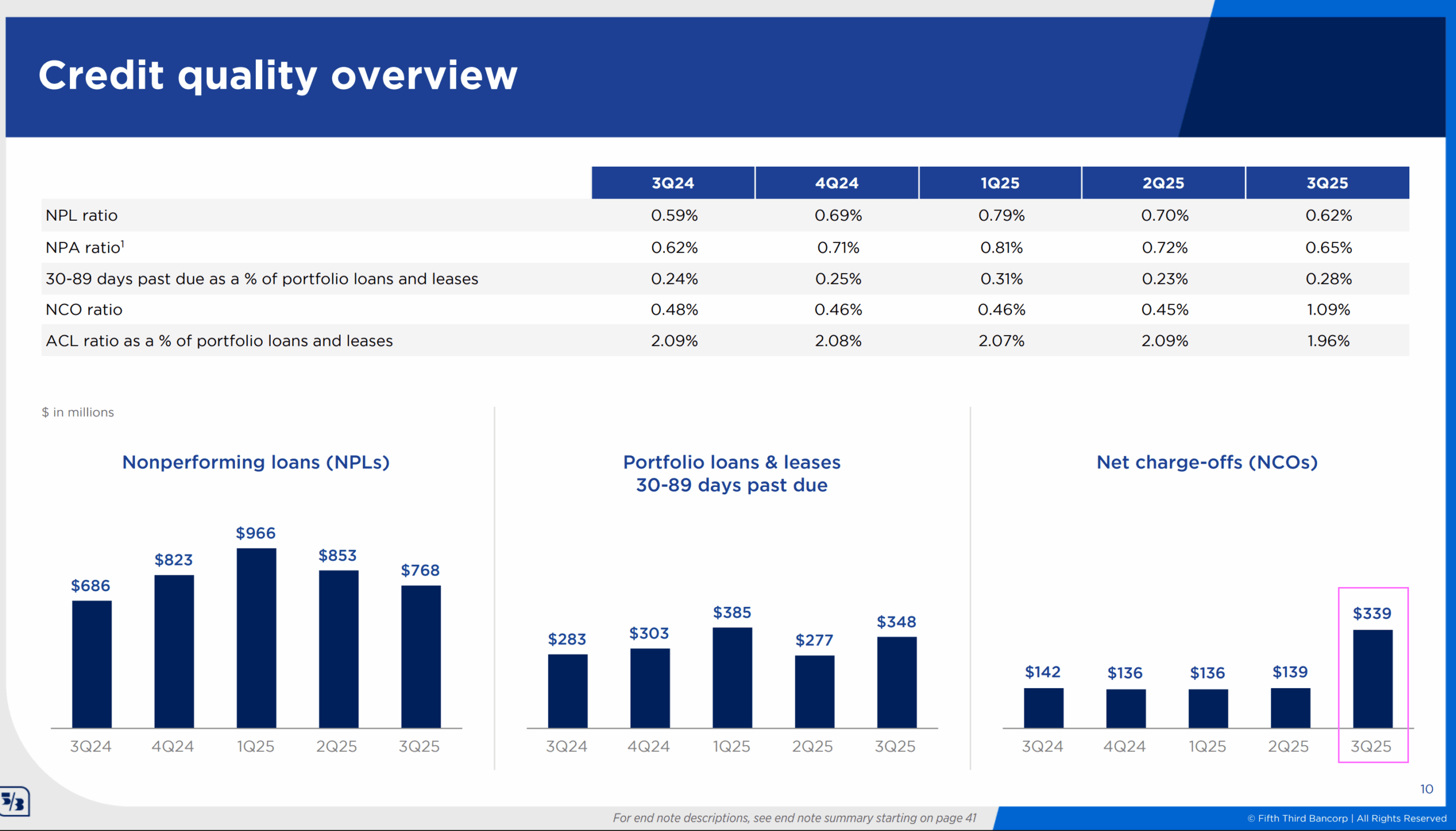
Group 1: Portfolio Performance - The portfolio did not benefit from the small-cap run due to a lack of companies with earnings, particularly in sectors like uranium and quantum computing, and was negatively impacted by the bankruptcies of First Brands and Tricolor [1][2] - The portfolio experienced a positive shift when Fed Chair Jerome Powell indicated a likely path towards lower interest rates [1] Group 2: Bankruptcy Impact - First Brands, an auto-parts company, filed for bankruptcy protection, while Tricolor opted for Chapter 7 liquidation, revealing issues with collateral that may have been fraudulently double-pledged [2] - The bankruptcies have adversely affected the banking sector, especially small regional banks, as the weak economy has led consumers to be more selective in their spending, impacting the auto sector [2] Group 3: Financial Sector Analysis - Fifth Third Bancorp had to write off 100% of a $200 million asset-backed loan to Tricolor, yet reported strong third-quarter results despite this write-off [5] - Concerns exist regarding potential systemic issues in the banking sector, with fears of fraud and lax underwriting standards being highlighted [6][18] Group 4: Credit Cycle and Economic Outlook - The current situation is not expected to lead to a financial crisis similar to 2008, as the banking system is fundamentally sound, and the issues are seen as isolated rather than systemic [10][13] - The performance of major banks has been strong, with robust investment banking and trading results, indicating a potential M&A boom [12] Group 5: Fiscal Stability and Interest Rates - Recent data suggests an improvement in U.S. government finances, with a budget surplus of $198 billion in September 2025, indicating a more sustainable financial path [19] - This fiscal improvement is expected to exert downward pressure on U.S. Treasury rates, potentially lowering the 10-year Treasury rate to around 3.5% by the end of 2026 [19]

美股反弹,市场忧虑缓解
Wind万得· 2025-10-17 22:46
Market Overview - US stock market rebounded on Friday after a significant drop in regional bank stocks, with major indices showing recovery as investor sentiment improved following official signals of easing [1][3] - The Dow Jones Industrial Average rose by 238.37 points, or 0.52%, closing at 46,190.61 points; the S&P 500 increased by 0.53% to 6,664.01 points; and the Nasdaq Composite gained 0.52%, reaching 22,679.98 points [1][2] Regional Bank Sector - Regional bank stocks experienced a sharp decline on Thursday due to disclosures of credit losses, with Zions Bancorp and Western Alliance reporting significant bad loans, leading to a drop of 13% and 11% in their stock prices respectively [3] - The SPDR S&P Regional Banking ETF (KRE) fell over 6% in a single day, marking a four-week streak of declines, but rebounded by 1.6% on Friday, although it still recorded a weekly drop of 1.9% [3] - Analysts noted that current credit issues are isolated cases rather than indicative of systemic risk, with Zions Bancorp's stock rebounding nearly 6% after a rating upgrade from Baird [3] Investor Sentiment and Economic Outlook - Market optimism was bolstered by government officials' comments suggesting that recent trade tensions may be resolved through negotiations rather than leading to large-scale sell-offs [4] - The VIX index, which measures market volatility, decreased significantly as stock prices rebounded, indicating a stabilization of investor sentiment [4] - Analysts believe that the recent market adjustment reflects an overreaction to localized credit events rather than a broader financial crisis, with ongoing monitoring of credit risk by regulatory bodies [4] Broader Market Implications - Concerns over credit quality in the banking sector have led to increased volatility and questions about the stability of the financial system, with some investors fearing a repeat of past crises [6] - However, analysts from Guotai Junan International suggest that the impact of potential government shutdowns on the market is likely to be limited, and that the Federal Reserve's easing policies will provide support for US stocks [6] - The report highlights that the banking sector's performance is crucial for overall market sentiment, with a focus on credit default rates and consumer spending to assess the US economy's resilience in a high-interest rate environment [4][6]
Rattled Wall Street on alert after trillion-dollar risk runup
Fortune· 2025-10-17 21:05
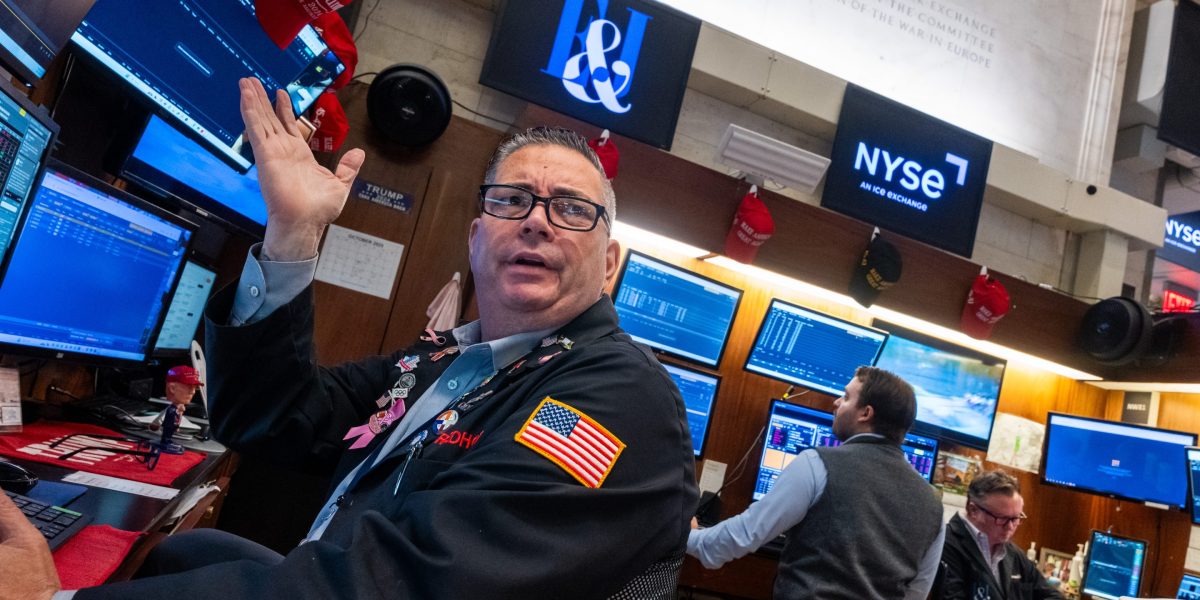
Core Viewpoint - Wall Street is experiencing renewed anxiety over credit risks following significant market events, including the collapse of First Brands Group and Tricolor Holdings, which have raised concerns about hidden credit losses and broader lending stress [1][3]. Market Sentiment and Positioning - Investors had previously been optimistic, largely ignoring risks such as government shutdowns and high valuations, with allocations to risky assets reaching 67% of tracked portfolios by the end of August [2]. - Despite a bull market adding $28 trillion in value, recent volatility indicates a shift in sentiment, with over $3 billion exiting high-yield bond funds in a week [3][8]. Credit Risk and Investment Strategies - Strategies that mitigate credit risk are gaining popularity, with a focus on shorting higher-leveraged firms while supporting low-debt counterparts [4]. - The tone among large money managers is shifting towards discipline, with concerns about lax credit standards and speculative flows disconnected from fundamentals [5]. Risk Reduction Actions - Legal & General, managing $1.5 trillion, has reduced risk exposure due to a mismatch between investor positioning and fundamentals, moving to short equities [6]. - Berenberg's head of multi-asset strategy has trimmed equity exposure by approximately 10 percentage points and added equity hedges, indicating a cautious approach [7]. Market Performance and Indicators - The S&P 500 rose by 1.7% despite credit concerns, while the S&P Regional Banks Select Industry Index fell nearly 2% [8]. - High-yield corporate bond spreads widened by 0.25 percentage points to 2.92 percentage points this month, and the VVIX reached its highest level since April, indicating increased investor anxiety [8]. Active Management Challenges - The proportion of long-only actively managed funds beating benchmarks is at a low of 22% for 2025, intensifying the pressure on managers to chase performance despite deteriorating fundamentals [9]. Crypto Market Dynamics - The crypto market has not rebounded after a $150 billion loss, with a notable absence of retail buying interest, suggesting a shift towards risk control rather than speculative behavior [10].

Top investment bank CEO says he was ‘defrauded’ by the bankruptcy that’s rattling Wall Street. Famous short-seller sees an Enron moment
Yahoo Finance· 2025-10-17 19:43
Core Insights - A leading Wall Street investment bank's CEO claims to have been "defrauded" in the bankruptcy of First Brands Group, which poses risks to global credit markets [1] - Jefferies disclosed a significant reduction in its exposure to First Brands' debt, from an initial estimate of $715 million to approximately $45 million, which is deemed manageable [2] - The CEO does not view the First Brands bankruptcy as indicative of a broader economic downturn, asserting that the overall business environment remains strong [3] Company Specifics - Jefferies' share price has dropped over 20% since the bankruptcy news broke, despite the bank's assertion that its financial health is not at risk [2] - First Brands Group's collapse involved over $2 billion reportedly missing from its accounts and more than $10 billion owed to creditors, including major Wall Street firms [4] - Jefferies executives denied any involvement in undisclosed fees and stated they were unaware of fraudulent activities at First Brands until public disclosure [5] Industry Context - The CEO highlighted a conflict between banks and direct lenders, each blaming the other for the situation, while maintaining that the economy does not appear to be on the brink of a default cycle [3] - The current environment is contrasted with the pre-2007 financial crisis, suggesting that the financial sector is not showing signs of imminent collapse [3] - Jefferies anticipates that the negative impact on its equity market value and credit perception will correct as more facts emerge [5]