福瑞达

Search documents
福瑞达跨界融合破局 “工业旅游+直播研学”打造美妆产业新生态
Zhong Guo Zheng Quan Bao· 2026-01-24 04:36
Core Insights - The article highlights the innovative integration of "industrial tourism" and "live streaming education" by Furuida, positioning it as a model for digital transformation in the beauty industry [1][5] Group 1: Industrial Tourism Development - Furuida has transformed traditional manufacturing sites into interactive and educational tourist attractions, breaking the stereotype of factories being inaccessible [2] - The company has developed a diverse experience system tailored to different customer groups, including families, students, and investors, enhancing the appeal of its facilities [2] - In the summer of 2025, Furuida's World Beauty Technology Museum received over 150 groups and nearly 5,000 visitors, showcasing its success in attracting a wide audience [2] Group 2: Live Streaming and Digital Transformation - Furuida has extended its service chain by combining industrial tourism with digital transformation needs, offering practical training for entrepreneurs in live streaming [3] - The company emphasizes the importance of product quality as the foundation for growth in live streaming, sharing insights on effective content creation and marketing strategies [3] - Participants in the training program reported gaining a clear path for traditional enterprises to transition into the digital space through comprehensive live streaming strategies [3] Group 3: Future Layout and Technological Empowerment - Furuida aims to solidify its position as "China's first beauty technology hub" by enhancing the visitor experience and deepening collaborations with educational institutions [4] - The company is actively developing an "online virtual factory" and integrating emotional recognition technology to provide personalized recommendations, merging technology with consumer experience [4] - Furuida plans to optimize its marketing loop by combining product traceability, brand communication, and experiential sales, thereby enhancing its brand and product strength [4] Group 4: Industry Impact and Future Prospects - Industry experts note that Furuida's cross-industry innovation is breaking down barriers between industrial production, cultural tourism, and enterprise services, creating a multifaceted ecosystem [5] - The ongoing implementation of Furuida's strategies is expected to further unlock its value in industrial integration, contributing to high-quality development in the beauty and manufacturing sectors [5]

福瑞达跨界融合破局 “工业旅游+直播研学” 打造美妆产业新生态
Zhong Guo Zheng Quan Bao· 2026-01-23 23:16
Core Insights - The company is transforming traditional manufacturing perceptions by integrating industrial tourism with educational experiences, creating a multifaceted ecosystem that appeals to diverse audiences [1][3][6] Group 1: Industrial Tourism Development - The company has redefined factory visits by combining smart factories, beauty technology exhibitions, and educational programs, making factories attractive tourist destinations [1] - In the summer of 2025, the company’s beauty technology museum received over 150 groups and nearly 5,000 visitors, showcasing its successful engagement with families, students, and corporate clients [1] - The service team is trained to ensure high-quality experiences, balancing roles in guiding, reception, sales, and facility maintenance, which has garnered market recognition [1] Group 2: Digital Transformation and E-commerce - The company is extending its service chain by merging industrial tourism with digital transformation needs, exemplified by a recent entrepreneurial training event that focused on live-streaming growth strategies [2][3] - Participants learned about the company's 30 years of industry experience and its skincare technology system, emphasizing the importance of product quality in driving live-streaming success [2] - The training included practical sessions on live-streaming setup and marketing strategies, providing actionable insights for traditional businesses [4] Group 3: Future Strategies and Innovations - The company aims to solidify its position as "China's first beauty technology hub" by enhancing visitor experiences and deepening collaborations with educational institutions [5] - Plans include developing virtual factories and personalized product recommendations using emotional recognition technology, merging technology with consumer engagement [5] - The company is committed to optimizing its marketing strategies to create a closed-loop system that enhances brand and product strength, offering replicable models for traditional manufacturing upgrades [5][6]

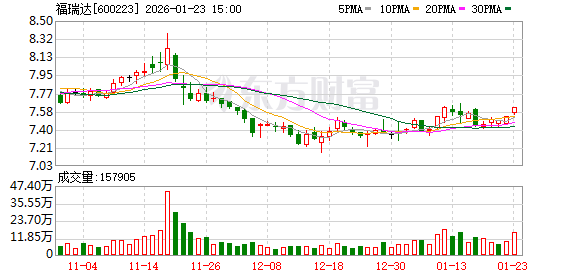
福瑞达跨界融合破局
Zhong Guo Zheng Quan Bao· 2026-01-23 20:54
Core Insights - Furuida has established a dual-engine development model combining "industrial tourism + live-streaming education," transforming traditional manufacturing sites into new cultural and educational spaces, thereby facilitating digital transformation in the beauty industry [1][4] Group 1: Industrial Tourism - Furuida has redefined the traditional factory experience by integrating smart factories and beauty technology museums with educational courses, creating an engaging industrial tourism ecosystem [2] - The company has successfully attracted diverse visitor groups, including families, students, and corporate clients, with nearly 5,000 visitors recorded in the summer of 2025 [2] - The service team is trained to ensure high-quality experiences, balancing roles in guiding, reception, sales, and facility maintenance, which has garnered widespread market recognition [2] Group 2: Live-Streaming Education - Furuida has extended its service chain by combining industrial tourism with digital transformation needs, hosting events that teach entrepreneurs about the full live-streaming growth logic [3] - Participants gain insights into Furuida's 30 years of industry experience and learn practical skills related to live-streaming, including setup and content creation strategies [3] - The company emphasizes the importance of quality content in driving natural traffic and provides strategies for effective brand storytelling and conversion [3] Group 3: Future Layout - Furuida aims to solidify its position as "China's first beauty technology hub" by enhancing the visitor experience at its technology museum and factory [4] - The company is committed to deepening industry-academia collaboration, developing educational materials, and promoting the integration of educational and industrial chains [4] - Digital upgrades are a key focus, with plans for a virtual factory and personalized product recommendations using emotion recognition technology [5] Group 4: Industry Impact - Furuida's innovative cross-industry exploration breaks down barriers between industrial production, cultural tourism, and enterprise services, creating a diverse ecosystem of "technology + beauty + culture + live-streaming" [5] - The company's dual empowerment through industrial tourism and live-streaming education enhances both brand and product strength, providing replicable practices for traditional manufacturing transformation [5] - As Furuida's initiatives take effect, the value of its industry integration is expected to further unfold, contributing to high-quality development in the beauty and manufacturing sectors [5]
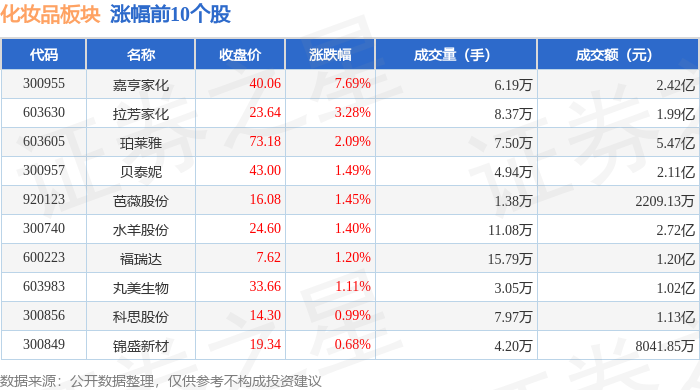
化妆品板块1月23日涨1.34%,嘉亨家化领涨,主力资金净流出3535.3万元
Zheng Xing Xing Ye Ri Bao· 2026-01-23 09:07
Group 1 - The cosmetics sector experienced a rise of 1.34% on January 23, with Jiaheng Jiahua leading the gains [1] - The Shanghai Composite Index closed at 4136.16, up 0.33%, while the Shenzhen Component Index closed at 14439.66, up 0.79% [1] - Jiaheng Jiahua's stock price increased by 7.69% to 40.06, with a trading volume of 61,900 shares and a transaction value of 242 million yuan [1] Group 2 - The cosmetics sector saw a net outflow of 35.35 million yuan from institutional investors, while retail investors had a net inflow of 31.72 million yuan [2] - Key stocks in the sector included Qingdao Jinwang, which had a net inflow of 13.85 million yuan from institutional investors, but a net outflow of 21.21 million yuan from speculative funds [3] - Jiaheng Jiahua had a net inflow of 11.11 million yuan from institutional investors, but also saw a net outflow of 1.77 million yuan from speculative funds [3]




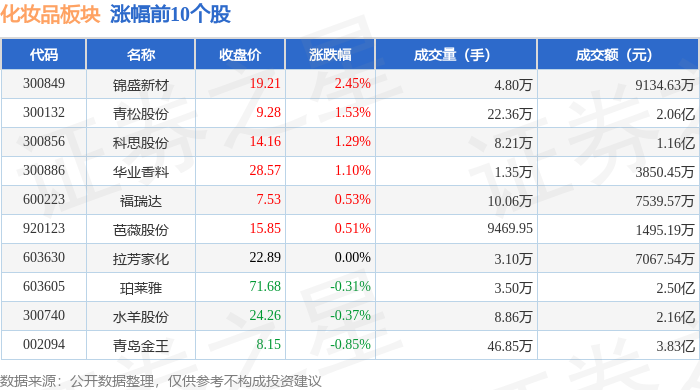
化妆品板块1月22日跌0.44%,贝泰妮领跌,主力资金净流出5488.34万元
Zheng Xing Xing Ye Ri Bao· 2026-01-22 09:02
Market Overview - The cosmetics sector experienced a decline of 0.44% on January 22, with Betaini leading the drop [1] - The Shanghai Composite Index closed at 4122.58, up 0.14%, while the Shenzhen Component Index closed at 14327.05, up 0.5% [1] Individual Stock Performance - Notable gainers included: - Jingsheng New Materials (300849) with a closing price of 19.21, up 2.45% on a trading volume of 48,000 shares and a turnover of 91.35 million yuan [1] - Qingsong Co. (300132) closed at 9.28, up 1.53% with a trading volume of 223,600 shares and a turnover of 206 million yuan [1] - Kesheng Co. (300856) closed at 14.16, up 1.29% with a trading volume of 82,100 shares and a turnover of 116 million yuan [1] - Decliners included: - Betaini (300957) closed at 42.37, down 1.42% with a trading volume of 71,400 shares [2] - Jiahen Home (300955) closed at 37.20, down 1.30% with a trading volume of 19,000 shares and a turnover of 71.10 million yuan [2] - Shanghai Jahwa (600315) closed at 23.41, down 1.22% with a trading volume of 89,200 shares [2] Capital Flow Analysis - The cosmetics sector saw a net outflow of 54.88 million yuan from institutional investors, while retail investors experienced a net inflow of 82.39 million yuan [2] - Key stocks with significant capital flow include: - Kesheng Co. (300856) with a net inflow of 12.48 million yuan from institutional investors [3] - Qingsong Co. (300132) with a net inflow of 9.15 million yuan from institutional investors [3] - Shanghai Jahwa (600315) had a net inflow of 4.16 million yuan from institutional investors [3]
1.1万亿之上的竞逐:从“水涨船高”到“结构分化”
FBeauty未来迹· 2026-01-21 14:25
Core Insights - The Chinese cosmetics market has surpassed 1.1 trillion yuan, maintaining its position as the largest cosmetics consumer market globally [2][3] - The market share of domestic cosmetics has increased to 57.37%, solidifying its leading position [3][25] - Approximately 27,000 brands were eliminated in the past year, while over 60% of the top 500 brands achieved positive growth, indicating a shift from a broad growth phase to a deep transformation focused on structural optimization [3][19] Market Size and Growth - In 2025, the total transaction value of the Chinese cosmetics market is projected to be 1,104.25 billion yuan, with a year-on-year growth of 2.83%, indicating a stable development phase [8] - The growth rates for the years 2023, 2024, and 2025 are 3.61%, 2.80%, and 2.83% respectively, reflecting a new normal of single-digit growth [8] - The retail sales of cosmetics in 2025 are expected to reach 465.3 billion yuan, with a growth rate of 5.1%, outpacing the overall retail sales growth [11] Market Dynamics - The data from the China Cosmetics Association and the National Bureau of Statistics complement each other, presenting a comprehensive view of the market landscape [14] - The divergence in data is attributed to different statistical scopes, with the National Bureau focusing on larger enterprises while the Association includes a broader range of market players [14] - The market is experiencing a significant internal structural change, with resources concentrating on larger, compliant, and research-capable enterprises, while smaller firms face increasing survival pressures [15] Brand Performance - Over 60% of the top 500 brands achieved positive growth, while the number of brands with over 100 million yuan in sales increased from 746 in 2023 to 839 in 2025 [16] - The elimination of approximately 27,000 brands in 2025 signifies the end of competition based on traffic and homogenized products, marking an acceleration of the survival of the fittest [19] Channel Competition - Online channel transaction value grew by 4.45% in 2025, while offline channels remained stable, indicating the end of reliance on a single growth channel [22] - The shift towards comprehensive channel operations is becoming the new foundation for brand development [22] Rise of Domestic Brands - Domestic brands' market share has risen to 57.37%, marking a fundamental shift in market dynamics [25] - Successful domestic brands focus on niche markets, technological barriers, and unique brand cultures rather than just price competitiveness [28] - The victory of domestic brands reflects a new development model that emphasizes long-term value and systemic capabilities [31] Regulatory and Competitive Landscape - The modernization of the regulatory system during the 14th Five-Year Plan has clarified the direction for high-quality development [34] - The shift from marketing wars to technology and brand wars is reshaping competitive dynamics within the industry [35] - Continuous investment in R&D is evident, with the average R&D expense ratio for Chinese cosmetics companies increasing from 2.36% in 2020 to 3.24% in 2025 [35] Consumer Behavior and Market Trends - The market is witnessing a dual pursuit among consumers for both high-value basic products under 300 yuan and luxury products over 1,000 yuan, while mid-range products are declining [38] - Brands must clearly position their value propositions to succeed in this evolving market landscape [38] Global Market Expansion - Expanding into global markets is becoming essential for leading brands, with some achieving significant breakthroughs in mature markets [39] - The dual drivers of strong policy and active market dynamics are propelling the Chinese cosmetics industry towards a new era of high-quality development [40]

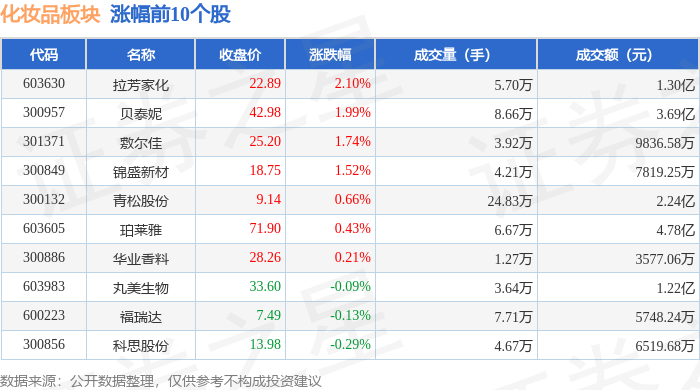
化妆品板块1月21日涨0.25%,拉芳家化领涨,主力资金净流出5552.25万元
Zheng Xing Xing Ye Ri Bao· 2026-01-21 09:08
Group 1 - The cosmetics sector experienced a slight increase of 0.25% on January 21, with Lafang Jiahua leading the gains [1] - The Shanghai Composite Index closed at 4116.94, up 0.08%, while the Shenzhen Component Index closed at 14255.12, up 0.7% [1] - Lafang Jiahua's closing price was 22.89, reflecting a rise of 2.10%, with a trading volume of 57,000 shares and a transaction value of 130 million yuan [1] Group 2 - The cosmetics sector saw a net outflow of 55.52 million yuan from institutional investors, while retail investors had a net inflow of 30.86 million yuan [2] - The trading data for various companies showed mixed performance, with some companies like Betaini and Lafang Jiahua experiencing net outflows from institutional investors [3] - Betaini had a net outflow of 14.09 million yuan from institutional investors, while Lafang Jiahua saw a net inflow of 13.43 million yuan [3]


化妆品板块1月20日涨1.11%,上海家化领涨,主力资金净流入3030.2万元
Zheng Xing Xing Ye Ri Bao· 2026-01-20 08:59
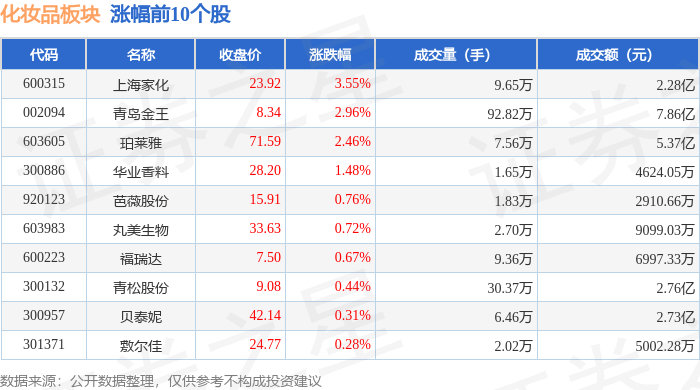
Group 1 - The cosmetics sector experienced a rise of 1.11% on January 20, with Shanghai Jahwa leading the gains [1] - The Shanghai Composite Index closed at 4113.65, down 0.01%, while the Shenzhen Component Index closed at 14155.63, down 0.97% [1] - Key stocks in the cosmetics sector showed varied performance, with Shanghai Jahwa closing at 23.92, up 3.55%, and Qingdao Kingking at 8.34, up 2.96% [1] Group 2 - The cosmetics sector saw a net inflow of 30.3 million yuan from institutional investors, while retail investors experienced a net outflow of 54.5 million yuan [2] - Notable individual stock performances included Shanghai Jahwa with a net inflow of 20.5 million yuan from institutional investors, and Qingdao Kingking with a net inflow of 23.3 million yuan [3] - The overall market sentiment reflected a mixed response, with some stocks like Banlaya experiencing significant net outflows from both institutional and retail investors [3]

深度 | 美妆科学传播的下一个浪潮是什么?
FBeauty未来迹· 2026-01-19 12:34
Core Insights - The beauty science communication has shifted from a "one-way output of scientific strength" to a "temperature dialogue with consumers" over the past 25 years, focusing on social emotional insights rather than just scientific data [2][4] - The NUTE model (Need-Unique-Technology-Evidence) is introduced as a methodology for scientific communication, emphasizing the importance of translating hard science into relatable solutions for consumers [3][5] Evolution of Beauty Science Communication - The initial phase focused on creating market buzz through ingredient efficacy and scientific concepts [4] - The explosion of scientific content saw many beauty companies entering the field, but it lacked consumer focus [4] - The communication evolved to a consumer-centric approach, aiming for empathy and understanding [4] - The current phase emphasizes co-creation of brand trust, where consumers focus less on scientific data and more on brand reliability [4] Case Studies in Effective Communication - Natural Hall's "anti-fatigue" marketing effectively resonated with consumers by translating abstract concepts into relatable experiences, such as "post-overtime fatigue" [6] - Zhanmiya utilized cinematic storytelling to connect with the emotional expectations of consumers regarding "China's technological rise," showcasing the journey of artificial skin [8] - Brands like Zhenyan addressed information gaps in post-surgery care by prioritizing knowledge dissemination over direct product promotion [10] The Role of Social Emotion - Social emotion acts as a "translator" in scientific communication, transforming deep research into consumer-friendly language and practical solutions [12] - The understanding of consumer needs is crucial, as effective communication is not about what brands research but what consumers need to know [12] Unique Research Frameworks - Establishing a unique research framework is essential for brands to create an irreplaceable competitive edge, allowing them to transition from "ingredient followers" to "category definers" [13] - Brands must avoid merely showcasing single-point technologies and instead build comprehensive frameworks or focus on specialized breakthroughs [13][14] Challenges in Consumer Acceptance - Concepts like ECM (extracellular matrix) are difficult for consumers to grasp; thus, brands must create relatable scenarios to make advanced theories accessible [16][18] - Shiseido's innovative approach to anti-aging through "memory T cells" represents a reverse strategy in a market focused on collagen supplementation [19][22] Evidence-Based Communication - The beauty industry is adopting a structured evidence chain similar to that in clinical research, categorizing evidence into various levels to enhance credibility [34][36] - Brands like HBN are leading the way in establishing standardized guidelines for efficacy evidence, promoting transparency and scientific rigor [41] Visualizing Scientific Evidence - OLAY's use of 3D technology to visualize the effects of their products represents a shift towards making scientific evidence more comprehensible and relatable to consumers [42][44] - The focus is on reducing the complexity of scientific data to enhance consumer trust and understanding [45] Future Directions - The industry is moving towards a model where storytelling is used to explain science, fostering a two-way relationship between brands and consumers [47] - The expectation is for brands to create relatable narratives that connect scientific advancements with everyday consumer experiences, enhancing trust and engagement [47]
济南将争取国家“人工智能+工业软件”中试基地项目落地建设
Qi Lu Wan Bao· 2026-01-19 02:14
Core Viewpoint - Jinan aims to implement an industrial strong city strategy by 2026, focusing on building a modern industrial system Group 1: Strengthening Advantageous Industries - The city will focus on electronic information, automotive, high-end software, and modern medicine industries, aiming to enhance scale, extend chains, and grow enterprises [2] - In the electronic information sector, Jinan plans to achieve an industry scale of 240 billion yuan by accelerating the construction of semiconductor and micro-display projects [2] - The automotive industry aims for a scale of 180 billion yuan, supporting companies like BYD and Geely in introducing high-end models and promoting collaborative development [2] - The high-end software sector targets a scale of 130 billion yuan, emphasizing the development of industrial software and AI applications [2] - The modern medicine industry, relying on key enterprises, aims for a scale of 52 billion yuan by enhancing various pharmaceutical sectors [2] Group 2: Cultivating Characteristic Industries - Jinan will focus on high-end CNC machine tools, robotics, specialized equipment, steel, advanced materials, and food and bio-manufacturing, aiming to create competitive industrial clusters [4] - The high-end CNC machine tools and robotics sector targets a scale of 55 billion yuan, with key projects like the industrial mother machine park [4] - The specialized equipment industry aims for a scale of 115 billion yuan, with support for leading companies and project expansions [4] - The steel industry will focus on green low-carbon transformation, targeting a scale of 165 billion yuan by developing high-value products [4] - The advanced materials sector aims for a scale of 35 billion yuan, promoting innovation and expansion in chemical and metal materials [4] - The food and bio-manufacturing industry targets a scale of 77.5 billion yuan, supporting innovative development of key enterprises [4]