
鼎际得

Search documents
东海证券晨会纪要-20251231
Donghai Securities· 2025-12-31 06:39
Group 1: AI-Driven Chemical Industry - The integration of AI in the chemical industry is expected to create investment opportunities across four key areas: research, production, operations, and supply chain management, leading to a data-driven and optimized system [5][6] - The demand for new chemical materials is driven by the energy consumption of AI data centers, with a projected compound annual growth rate of 44.8% in IT energy consumption from 2022 to 2027 [6] - The renewable energy generation in China is currently about 35%, with a future target of nearly 90%, emphasizing the need for green energy materials [7] - The new energy storage plan aims for a scale of 180 million kilowatts by 2027, with significant investments expected in lithium battery storage [8] - The manufacturing sector is poised for growth, particularly in high-end electronic resins and specialty engineering plastics, as domestic companies catch up with international standards [9] - The cooling materials market is projected to exceed $7 billion by 2034, with a compound annual growth rate of over 10% from 2024 to 2034, driven by the demand for AI-related cooling solutions [11] Group 2: Refrigeration Equipment Industry - The refrigeration and air conditioning industry in China is at a critical turning point, transitioning from a growth phase to a stable development phase dominated by replacement demand [12] - Strategic acquisitions in the HVAC sector are becoming common as companies seek to establish local distribution networks and adapt to market differences [13] - The commercial refrigeration sector, particularly in data center cooling, is highlighted as a growth area due to increasing demand for energy-efficient solutions [14] - Investment recommendations include focusing on leading companies in household refrigeration, specialized cooling solutions, and upstream components benefiting from data center demands [14]
AI智变化工:双向赋能下化工新材料产业升级与投资机遇(附66页PPT)
材料汇· 2025-12-30 14:50
Macro Foundation: Strong Policy Guidance - Major countries view AI as a strategic core technology, with China promoting deep integration of AI with the real economy through its "New Generation Artificial Intelligence Development Plan" and the U.S. ensuring its leadership in AI through the "National Artificial Intelligence Initiative" [3][4] - Various countries have introduced policies to actively layout artificial intelligence, including the U.S. proposing a unified federal standard for AI regulations, China setting clear goals for AI integration by 2030, and the EU establishing a comprehensive AI regulatory framework [5][6] Chemical Industry Policy - The Ministry of Industry and Information Technology in China has issued a "Stabilizing Growth Work Plan for the Petrochemical Industry (2025-2026)", focusing on innovation, efficiency, demand expansion, and collaboration, with AI becoming a key driver for industry transformation [6][7] New Materials Policy - Governments worldwide are implementing targeted policies for new materials, aiming to break through critical bottlenecks and secure future technological advantages [9][10] - China has established a "New Materials Big Data Center" plan, aiming to create a comprehensive data-driven innovation paradigm in the materials sector by 2035 [12][13] AI and Chemical Industry Integration - AI is expected to deeply integrate into the entire lifecycle of the chemical industry, creating a data-driven, intelligent decision-making, and continuously optimizing system [15][16] - Major chemical companies are increasingly adopting AI technologies to enhance production efficiency and product quality, with examples including collaborations with tech firms for smart factory initiatives [17][18] Demand and Application of AI - The demand for AI is driving significant growth in the AI server market, with projections indicating a rise from $125.1 billion in 2024 to $222.7 billion by 2028 [37][38] - The energy consumption of AI data centers is expected to double by 2025, highlighting the increasing energy demands associated with AI advancements [45][46] Renewable Energy and AI - The share of renewable energy in China's total power generation is projected to reach 88% by 2050, with significant growth in wind and solar energy contributing to the energy needs of AI [51][52] - The development of a new power system centered on renewable energy is crucial for reducing the carbon footprint of AI computing [51][52] Market Trends in Chemical Materials - The chemical materials sector is evolving towards "smart material systems" that integrate multiple functionalities, driven by the demands of embodied intelligence products [35][36] - The market for embodied intelligence products is expected to reach 400 billion yuan by 2030, with significant growth anticipated in the robotics and drone sectors [30][31]

基础化工可转债双周报:凯盛转债、利民转债赎回-20251225
GUOTAI HAITONG SECURITIES· 2025-12-25 09:17
Investment Rating - The report assigns an "Overweight" rating for the basic chemical industry [1]. Core Insights - The report highlights the focus on convertible bonds in the basic chemical sector, specifically mentioning several bonds such as Qilin Convertible Bond, Zhoubang Convertible Bond, Yangfeng Convertible Bond, Miwei Convertible Bond, Huakang Convertible Bond, and Hebang Convertible Bond as key investment opportunities [3][4]. - The report notes that the prices of storage chip DRAM are continuously rising, which benefits the upstream semiconductor materials [4]. - The report provides a summary of the performance of various convertible bonds in the basic chemical sector, indicating significant price increases for some bonds, such as Songlin Convertible Bond, which rose by 19.20%, and Su Li Convertible Bond, which increased by 7.42% [5][8]. Summary by Sections Convertible Bond Performance - The report details the performance of issued convertible bonds in the basic chemical sector, with notable increases in prices for bonds like Songlin Convertible Bond (up 19.20%), Su Li Convertible Bond (up 7.42%), and Shuiyang Convertible Bond (up 5.18%) [5][8]. - Conversely, some bonds such as Xin Hua Convertible Bond, Yong 22 Convertible Bond, and Fu Xin Convertible Bond experienced declines of 1.72%, 3.33%, and 3.37% respectively [5][8]. Upcoming Convertible Bonds - As of December 23, 2025, several companies, including Jiangshan Co., Shuangle Co., and Bailong Chuangyuan, have received shareholder approval for their convertible bond proposals [9]. - The report lists companies with pending convertible bond proposals, indicating ongoing developments in the sector [9][12].
四大助剂龙头,宣布涨价
DT新材料· 2025-12-21 16:05
Core Viewpoint - The antioxidant product prices are being adjusted upwards by approximately 10% across the board by major companies in the industry, indicating a shift in pricing strategy after a period of intense competition and declining margins [1]. Group 1: Price Adjustments - Dingjide announced a price increase of about 10% for all its antioxidant products effective immediately [1]. - This marks the fourth price increase among leading antioxidant companies within a month, following similar announcements from Lianlong, Suqian Liansheng, and Fengguang [1]. Group 2: Industry Competition - The antioxidant industry has faced fierce competition in 2023, leading to irrational price competition due to slowing downstream demand and fluctuating raw material prices [1]. - Companies like Lianlong, Suqian Liansheng, Fengguang, and Dingjide have experienced price declines in their products during this period [1]. Group 3: Financial Performance - Fengguang's gross margin for its antioxidant products dropped from 16.58% in 2023 to 3.02% in 2024, with a slight recovery to 3.26% in the first half of 2025 [1]. - Financial reports indicate that Fengguang incurred a net loss of 40 million yuan in the first three quarters of 2025, while Dingjide's net profit decreased by 15.49% to 9.0911 million yuan, reflecting a trend of increasing revenue without corresponding profit growth [1].


抗氧剂行业突变,多家上市公司集体涨价
2 1 Shi Ji Jing Ji Bao Dao· 2025-12-20 23:36
Core Viewpoint - The domestic antioxidant industry is experiencing a wave of price increases, with major companies raising prices by approximately 10% across the board, indicating a collective response to market conditions and demand [1][4]. Group 1: Price Adjustments - Dingjide (603255.SH) announced a price increase of about 10% for all its antioxidant products effective immediately [1]. - Other leading companies, including Lianlong (300596.SZ), Suqian Liansheng (603065.SH), and Fengguang Co. (301100.SZ), have also implemented similar price hikes within a short timeframe [4]. - The price adjustments are attributed to strong demand and a need to improve profit margins, as stated by Fengguang's representative [4]. Group 2: Industry Context - The antioxidant industry has faced intense competition in 2023, leading to irrational price competition due to slowing downstream demand and fluctuations in raw material prices [5]. - For instance, Fengguang's single antioxidant product saw its gross margin drop from 16.58% in 2023 to 3.02% in 2024, reflecting the industry's challenges [6]. - Despite revenue growth, companies like Fengguang and Dingjide reported net losses, highlighting the phenomenon of increasing revenue without corresponding profit [6]. Group 3: Market Reaction - The market response to the price increases has been muted, with slight gains for some companies and a decline for Fengguang as of December 19 [7]. - Analysts are optimistic that the price hikes could positively impact the industry by helping to stabilize and improve market conditions [6].
抗氧剂行业突变,多家上市公司集体涨价
21世纪经济报道· 2025-12-20 23:27
Core Viewpoint - The domestic antioxidant industry is experiencing a wave of price increases, with major companies adjusting prices by approximately 10% across their product lines, indicating a collective response to market conditions and demand [1][4]. Group 1: Price Adjustments - Dingjide (603255.SH) announced a price increase of about 10% for all its antioxidant products effective immediately [1]. - This follows similar announcements from leading companies such as Lianlong (300596.SZ), Suqian Liansheng (603065.SH), and Fengguang Co. (301100.SZ), all implementing a 10% price hike within a short span of two weeks [4]. - The price adjustments are attributed to strong demand and a need to improve profit margins, as stated by Fengguang's representative [4]. Group 2: Industry Context - The antioxidant industry has faced intense competition in 2023, leading to irrational price competition among major players like Lianlong, Suqian Liansheng, Fengguang, and Dingjide, resulting in declining product prices [5]. - For instance, Fengguang's single antioxidant product saw its gross margin drop from 16.58% in 2023 to 3.02% in 2024, with a slight recovery to 3.26% in the first half of 2025 [5]. - Financial reports indicate that despite revenue growth, companies like Fengguang and Dingjide are experiencing net losses, highlighting the industry's challenges [5]. Group 3: Market Reactions - Analysts are optimistic about the potential positive impact of the price increases on the industry, suggesting that it may help restore industry conditions and improve market dynamics [5]. - However, the stock market's reaction has been muted, with only slight increases in some companies' stock prices and a decline in Fengguang's stock as of December 19 [5].

抗氧剂龙头集体涨价修复盈利
Huan Qiu Wang· 2025-12-19 10:09
Core Viewpoint - The domestic antioxidant industry is experiencing a significant price increase, with leading companies raising prices by approximately 10% to combat irrational competition and restore profitability [1][3]. Group 1: Price Increase Details - Four major companies, including Li'anlong, Suqian Liansheng, Fengguang Co., and Dingjide, have announced a collective price increase of around 10% within a short span of two weeks [1][4]. - The price adjustments are seen as a response to a prolonged period of low profitability and intense competition in the antioxidant sector [3][4]. Group 2: Industry Context - The antioxidant industry has faced a "cold winter" for two years, characterized by fierce price competition, declining downstream demand, and fluctuating raw material prices [3][4]. - Financial data from companies like Fengguang Co. illustrate the impact of the price war, with its gross margin for core antioxidant products plummeting from 16.58% in 2023 to 3.02% in 2024 [3]. Group 3: Future Outlook - Analysts suggest that the collective price increase may help improve industry conditions and optimize market structure, provided that the price hikes can be effectively passed on to downstream customers [4]. - The success of this price adjustment will depend on whether companies can genuinely enhance their profitability and avoid a scenario where price increases lead to loss of market share [4].

抗氧剂行业突变!多家上市公司集体涨价,龙头企业回应:调节利润
2 1 Shi Ji Jing Ji Bao Dao· 2025-12-19 07:03
Core Viewpoint - The antioxidant industry in China is experiencing a collective price increase among leading companies, with a general adjustment of around 10% across various products, aimed at profit regulation amidst strong demand and competitive pressures [1][2]. Group 1: Price Adjustments - Dingjide (603255.SH) announced a price increase of approximately 10% for all its antioxidant products effective immediately [1]. - Other leading companies, including Lianlong (300596.SZ), Suqian Liansheng (603065.SH), and Fengguang Co. (301100.SZ), have also implemented similar price hikes within a short timeframe [1]. - The price adjustments are seen as a response to the current market conditions and are intended to stabilize profit margins [1][2]. Group 2: Industry Context - Antioxidants are essential additives in polymer materials, significantly impacting the production and quality of downstream products despite their small usage proportions [2]. - The industry has faced intense competition in 2023, leading to irrational price competition due to slowing downstream demand and fluctuations in raw material prices [2]. - Financial reports indicate that while revenue for companies like Fengguang Co. and Dingjide has increased, net profits have declined, highlighting a trend of rising revenue without corresponding profit growth [2]. Group 3: Market Reactions - Institutions are optimistic about the potential positive impact of the price increases on the industry, suggesting that it may help improve the industry's overall conditions and market structure [3]. - However, the stock market's reaction has been muted, with only Suqian Liansheng seeing a slight increase, while other companies experienced minor declines [3].
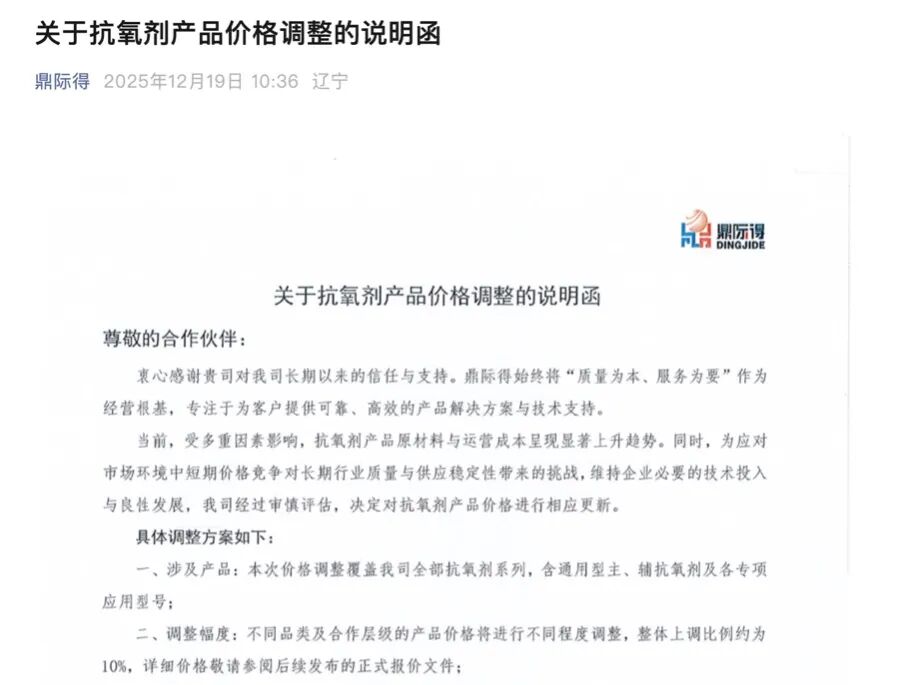
鼎际得:上调抗氧剂产品价格
Zheng Quan Shi Bao Wang· 2025-12-19 03:04
Core Viewpoint - The company Dingjide (603255) announced a price adjustment for its antioxidant products due to significant increases in raw material and operational costs, with an overall price increase of approximately 10% across all antioxidant series [1] Group 1: Price Adjustment Details - The price adjustment will affect the entire range of antioxidant products, including general-purpose main and auxiliary antioxidants as well as specialized application models [1] - Different categories and cooperation levels of products will see varying degrees of price adjustments [1] - The new prices will be officially implemented from the date of announcement [1]
鼎际得POE产品累计发货突破5000吨
Zheng Quan Ri Bao· 2025-12-17 15:48
Core Viewpoint - The successful operation of the first production line of the POE high-end new materials project by Liaoning Dingjide Petrochemical Co., Ltd. marks a significant advancement in domestic production capabilities, achieving over 5,000 tons of product delivery and meeting international standards for quality [1][2]. Group 1: Company Overview - Liaoning Dingjide was established in 2004 and specializes in the production of polyolefin catalysts and additives, positioning itself as a high-tech enterprise [1]. - In September 2023, the company signed an investment agreement to establish Liaoning Dingjide Petrochemical Technology Co., Ltd., focusing on the development of a new petrochemical materials project in Dalian Changxing Island [1]. Group 2: Project Details - The first phase of the POE project includes a planned capacity of 200,000 tons/year for POE and 300,000 tons/year for ethylene to alpha-olefins, along with supporting infrastructure [1]. - The project commenced construction in March 2024 and achieved pilot production in June 2024, with successful initial feed in October 2024 [1]. Group 3: Market Implications - POE materials, known for their flexibility and weather resistance, are essential in various industries, including photovoltaic films, automotive interiors, and medical consumables [2]. - The successful operation of the first production line validates the stability of Dingjide's technology and product quality, which has historically relied on imports [2]. - The upcoming completion of the second production line, expected to be operational by mid-January 2026, will enhance Dingjide's production capacity and contribute to a more robust market supply [2].