Humane

Search documents
那些昙花一现的AI硬件做错了什么?Nest创始人指出根本原因
Huan Qiu Wang· 2025-10-24 03:42
Core Insights - Recent high-profile AI hardware products have failed, prompting deep reflection within the industry, with the fundamental issue being that they are built on hype rather than functionality [1][3] Group 1: Critique of Current AI Hardware - The current AI hardware has three major failures: Humane's AI Pin lacks integration of core smartphone functions and has user-unfriendly operation; Rabbit's R1 was launched without a clear use case; and the new Friend necklace device fails to answer the question of its utility [3] - The focus on packaging, industrial design, and marketing has led to a significant disconnect from actual user needs [3] Group 2: Comparison with Successful Products - The success of the original iPhone was attributed to addressing daily user pain points, such as cumbersome keyboards and poor mobile browsing experiences, aligning with Larry Page's "toothbrush test" which emphasizes solving high-frequency user needs [3] - None of the current AI hardware products have passed this "toothbrush test" [3] Group 3: Future of AI Technology - Despite a cooling market, there is a belief that the future of AI technology is still tied to hardware, with a notable investment of $6.4 billion by OpenAI into Jony Ive's startup seen as a potential turning point for AI integration into daily life [3] - The key to success lies in shifting focus to the smartphone sector, where hardware must meet daily needs more effectively [3] Group 4: Challenges Ahead - Two major challenges are highlighted: the urgent need for high-end software talent in Ive's team and the necessity to navigate the realities of using Google's Android system [3] - While Ive's Apple background may pose competitive challenges with OpenAI and Google, leveraging the open-source nature of Android could provide the fastest path to return on investment [3] Group 5: Conclusion on AI Integration - Manufacturing AI smartphones is deemed the most challenging task in the tech industry since 2007, with the assertion that for AI to truly integrate into billions of lives, it must be compatible with the existing world [4] - OpenAI is urged to develop the next generation of smartphone iterations rather than spending months on products that do not complement or compete with existing smartphones [4]

OpenAI从云端走向终端
Bei Jing Shang Bao· 2025-09-24 15:26
Core Insights - OpenAI is intensifying its efforts in the AI hardware market, collaborating with major supply chain companies like Luxshare Precision and GoerTek to create a closed-loop system of "model + hardware" [1][2] - The stock prices of Luxshare Precision surged following reports of OpenAI's strategic partnership, with the company's market capitalization exceeding 500 billion yuan for the first time [2] - OpenAI plans to develop consumer-grade AI devices, including smart glasses and digital voice recorders, with initial products expected to launch by late 2026 or early 2027 [2][3] Group 1: OpenAI's Hardware Strategy - OpenAI has shifted from investing in AI hardware to a self-designed and deeply integrated approach, aiming to create a competitive ecosystem of "algorithm + hardware + data" [4] - The company has recruited at least 25 hardware and product professionals from Apple, offering over $1 million in stock options to attract talent [4] - OpenAI's collaboration with Luxshare Precision leverages Asia's efficient supply chain to establish technological barriers [4][5] Group 2: Market Context and Challenges - The AI hardware industry is currently facing challenges, with many products receiving mixed market responses, such as Meta's smart glasses encountering technical issues during a launch event [6] - IDC's research director highlights smart glasses and robots as the most promising AI-enabled consumer hardware categories, emphasizing the need for effective user experience and energy efficiency [7] - Previous failures in AI hardware products are attributed to poor demand positioning, user experience issues, and energy consumption limitations [7]
OpenAI做硬件的伙伴,为何锚定“果链双雄”?
2 1 Shi Ji Jing Ji Bao Dao· 2025-09-23 09:15
Group 1 - OpenAI is collaborating with Luxshare Precision and GoerTek to enter the AI hardware market, with a focus on consumer-grade AI devices [2][3] - Luxshare Precision's stock price surged by 51.6% over the past month, reaching a record high of 65.12 yuan on September 23, influenced by OpenAI's hardware ambitions and strong iPhone 17 sales [2] - OpenAI plans to develop AI hardware such as smart glasses, digital voice recorders, and wearable badges, with initial products expected to launch by late 2026 or early 2027 [2][4] Group 2 - GoerTek is also in discussions with OpenAI, likely supplying components like MEMS microphones for the AI hardware [3][4] - Following the news of OpenAI's hardware initiatives, GoerTek's stock rose by 7.73% on September 22, but fell by 2.82% the next day [4] - Analysts suggest that OpenAI's move into hardware could benefit various Chinese hardware companies in Apple's supply chain, including Luxshare Precision and GoerTek [4] Group 3 - OpenAI's hardware strategy is seen as a response to the growing trend of "physical AI," with significant recruitment from Apple to bolster its hardware team [4][5] - The collaboration with Jony Ive's company, io Products, aims to produce a new form of AI hardware, potentially assembled in Vietnam and resembling the iPod Shuffle [5] - The AI hardware market is expected to grow, with predictions of over 200 million wearable devices shipped globally by 2025, indicating a shift towards service-oriented products [10][11] Group 4 - The competitive landscape for smart glasses includes various players, with each type of manufacturer having distinct advantages [11] - Chinese companies are rapidly gaining market share in AI hardware, leveraging their supply chain capabilities and cost control [11][12] - Luxshare Precision has recently partnered with a U.S. AI chip company to develop next-generation wearable products, focusing on low power consumption and compact design [12]


OpenAI从苹果挖了20多人搞硬件,知情人士:苹果创新缓慢、官僚主义令人厌倦
Xin Lang Cai Jing· 2025-09-21 03:24
Core Insights - OpenAI is actively recruiting hardware, design, and supply chain talent from Apple to accelerate its hardware development efforts [1][4][12] - The collaboration between OpenAI and Apple's supply chain network aims to facilitate the production of various hardware products, including a smart speaker without a display, smart glasses, digital voice recorders, and wearable pins, with a target launch by late 2026 or early 2027 [4][12] - OpenAI has established partnerships with major Apple suppliers, including Luxshare Precision, to assemble at least one of its devices [4][17] Talent Acquisition - OpenAI has hired over 20 employees from Apple this year, focusing on consumer hardware expertise, including engineers and designers specializing in user interfaces, wearables, cameras, and audio engineering [4][12] - Notable hires include Cyrus Daniel Irani, Matt Theobald, and Erik de Jong, who have extensive experience in Apple's hardware design and manufacturing [5][12] Employee Sentiment - Many Apple employees are attracted to OpenAI due to the promise of a better work environment with less bureaucracy and more collaboration, alongside lucrative compensation packages potentially exceeding $1 million in stock options [12][15] - Discontent among Apple employees stems from dissatisfaction with incremental product improvements and the company's bureaucratic culture, exacerbated by poor stock performance over the past year [12][17] Strategic Implications - OpenAI's aggressive talent acquisition strategy may complicate its ongoing collaboration with Apple, particularly regarding the integration of OpenAI's models into Apple's Siri voice assistant [17] - Apple's management has expressed concern over employee turnover, leading to the cancellation of an annual meeting for its manufacturing and supply chain teams in China to prevent further departures [17] Competitive Landscape - OpenAI's ambitions in hardware face challenges, as many companies have historically failed to compete with Apple's dominance in this sector [17][18] - The potential for AI to become a core feature in future devices could provide OpenAI with a competitive edge over Apple, which derives over 70% of its revenue from device sales [18]

OpenAI联手立讯精密开发AI硬件,此前疯狂挖角苹果骨干
Tai Mei Ti A P P· 2025-09-20 04:37
Core Viewpoint - OpenAI is venturing into hardware development by collaborating with Luxshare Precision to create a revolutionary AI device aimed at consumers, which could disrupt the smartphone market and challenge established players like Apple [2][5]. Group 1: Strategic Partnerships - OpenAI has formed a strategic partnership with Luxshare Precision, a leading Chinese manufacturer, to co-develop a consumer-oriented AI device [2]. - OpenAI is also reportedly in discussions with GoerTek, another key player in the supply chain for Apple products, to support its hardware ambitions [5]. Group 2: Talent Acquisition - OpenAI has been actively recruiting talent from Apple, having hired over twenty hardware engineers in 2025, doubling the number from the previous year [3][4]. - The recruitment strategy includes offering substantial incentives, such as stock options worth over $1 million upon joining, to attract top talent from Apple [4]. Group 3: Hardware Development - OpenAI's first AI device is still in the prototype stage, designed to be pocket-sized with advanced contextual awareness and deep integration of ChatGPT's language model for natural human-computer interaction [2][5]. - The company has considered various forms for its AI device, including screenless smart speakers and AI glasses, with the first products expected to launch by late 2026 or early 2027 [5][12]. Group 4: Market Context and Challenges - The entry of OpenAI into the hardware space is seen as a significant move, especially as the consumer electronics market has been stagnant, potentially shaking up the dominance of companies like Apple and Samsung [11]. - However, the success of OpenAI's hardware initiative is uncertain, as previous attempts by other companies to innovate in this space have faced challenges, indicating that hardware innovation is complex and not guaranteed [6][11].

OpenAI与立讯精密达成硬件制造协议,计划在2026年末或2027年初推出首款设备
Hua Er Jie Jian Wen· 2025-09-19 13:44
Core Insights - OpenAI is aggressively entering the AI hardware market and attempting to attract talent from Apple, having recruited over 20 employees from Apple's consumer hardware division this year, significantly more than the approximately 10 hired last year [1][5][6] - OpenAI has established hardware manufacturing agreements with Apple's assembly partners, including Luxshare Precision and GoerTek, to produce components for its upcoming products [1][3] - The company plans to launch its first devices, which may include smart speakers without displays, glasses, digital voice recorders, and wearable pins, by late 2026 or early 2027 [1][3] Talent Acquisition - OpenAI's recruitment of Apple talent has accelerated following its $6.5 billion acquisition of io Products, a hardware startup co-founded by former Apple design chief Jony Ive [5] - New hires include experienced professionals from Apple, such as Cyrus Daniel Irani, who previously led the human interface design team [5][6] - OpenAI is reportedly offering significantly higher compensation packages to attract Apple employees, with stock grants potentially exceeding $1 million [6] Collaboration and Competition - OpenAI's talent acquisition efforts may complicate its collaborative relationship with Apple, as both companies are currently discussing deeper integration of OpenAI's models into Apple's Siri [2] - OpenAI is leveraging Apple's established supply chain network in China to support its hardware manufacturing plans [3] - Despite its ambitions, OpenAI faces challenges in the hardware market, as previous attempts by other companies to compete with Apple's dominance in devices like the iPhone and iPad have struggled [4]
From Scarcity to Abundance: How AI Can Build a Fairer World | Eng.Tariq Amin | TEDxRiyadh
TEDx Talks· 2025-09-11 15:28
Vision and Strategy - The focus has shifted from commodity-based economies to knowledge-based economies, with innovation as the driving force across sectors [2] - Saudi Arabia aims to leverage its abundance of power, energy, land, and connectivity to build a large digital infrastructure for itself and the world [11][13] - The goal is to democratize infrastructure and make connectivity a human right, addressing the digital divide [12][14] - The vision is to establish a new Silicon Valley in Riyadh, unlocking innovation through AI infrastructure [15][16] AI Development and Application - AI should be inclusive, accessible, and designed to understand local culture, values, and religion [7][8] - Saudi Arabia has developed Alam, the first Arabic large language model with Arabic-first preference, embedding local values [8][9][10] - AI is seen as a digital companion to enable sector transformation, company growth, and GDP growth [7] - The company "Humane" is redefining how society benefits from AI, emphasizing coexistence between AI and humans [18][19] Global Impact and Reach - Saudi Arabia aims to impact 44% (4.4 billion) of the world's population by providing access and advantages through its offerings [11][19] - The company is building a platform called "Humane Create" for creators in Saudi Arabia and worldwide [18] - The company emphasizes the importance of building AI to serve humanity and create abundance, especially for those without access to essential services [17]

华人做出利润率堪比 iPhone 的智能硬件
3 6 Ke· 2025-09-08 00:53
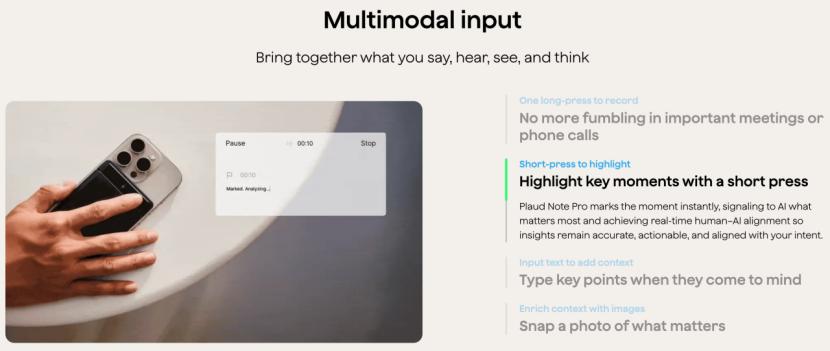
Core Insights - The article discusses the resurgence of AI smart devices, particularly focusing on the startup Plaud, which has successfully carved a niche in the AI recording device market [2][17]. - Plaud has achieved significant milestones, including a global shipment of 1 million units and an annualized revenue of $250 million, demonstrating a successful business model that leverages both Chinese manufacturing and American software development [5][15]. Company Overview - Plaud was founded by Xu Gao, who has a background in entrepreneurship and investment, and has previously experienced failures in his startup ventures [7][10]. - The company was established in 2021 and quickly became profitable, launching its first successful product, Izyrec, before introducing the Plaud Note, an AI recording device that gained traction through crowdfunding [10][11]. Product Development - The Plaud Note, launched in 2023, is a card-sized AI recording device that integrates multiple AI models and supports real-time transcription in 60 languages, appealing to busy professionals [11][13]. - The company has since released additional products, including the Plaud Note Pro, which features enhanced capabilities such as improved microphone technology and multi-modal input [15][16]. Market Position - Plaud has positioned itself in a market that was previously overlooked by larger companies, focusing on professional users rather than the general consumer market [13][25]. - The company has achieved rapid growth, with annual revenue reaching $100 million and a tenfold increase over two consecutive years [15]. Competitive Landscape - The article highlights the challenges faced by AI hardware startups, referencing the failures of other companies like Humane and Rabbit, which struggled to maintain user satisfaction and market relevance [19][24]. - Despite its success, Plaud faces potential threats from larger tech companies entering the AI recording space, as well as emerging startups offering similar products [25][26].
1 亿美元 ARR、不设 AI 硬件产品经理,Plaud 如何拿下全球百万用户?
AI前线· 2025-08-25 06:24
Core Viewpoint - The article discusses the current state of AI hardware, highlighting that while last year was considered the "year of AI hardware," this year has seen a decline in excitement and consumer interest in new AI hardware products [2][3]. Group 1: AI Hardware Market Trends - Humane's AI Pin, a highly anticipated wearable device, ended in disappointment and was acquired by HP for $116 million [2]. - Rabbit R1, which sold 50,000 units in a week, saw a drastic drop in daily active users to only 5,000 after a scandal [2]. - Overall, many AI hardware products have failed to demonstrate significant consumer interest or utility [2]. Group 2: Plaud AI's Success - Plaud AI launched the Plaud Note, an AI recording card, which achieved 300,000 units delivered and $100 million ARR within a year [3]. - By July, Plaud's global shipment reached 1 million units, with users saving an average of 260 hours annually, translating to a potential value of approximately $8,845 per user per year [3]. - The product's design focuses on user context, aiming to provide features that users may not initially think of but find useful once experienced [4][24]. Group 3: Product Development Philosophy - Plaud's CEO emphasized that the company does not have direct competitors, as it focuses on creating usable products rather than just hardware [4][28]. - The design philosophy has shifted from merely addressing user scenarios to actively exploring the boundaries of intelligence and providing unexpected yet useful functionalities [4][42]. - The integration of hardware and software is crucial, with hardware serving as a gateway to gather user context for enhanced AI interactions [23][24]. Group 4: Challenges and Future Directions - The article highlights ongoing technical challenges in AI hardware, including battery life, communication, and noise reduction algorithms [47]. - The company aims to expand its market by leveraging the unique advantages of combining human and machine intelligence, focusing on user context to enhance productivity [48][54]. - The future of AI hardware is seen as having significant potential, with the expectation that the current phase is just the beginning of a transformative era [54].

WAIC 2025落幕,AI硬件终于找到突破口
量子位· 2025-07-31 06:51
Core Viewpoint - The article emphasizes the potential of AI hardware, particularly AI headphones, in addressing specific user needs in vertical markets, such as office meetings, and highlights the importance of focusing on core hardware functionality while integrating AI capabilities [6][10][40]. Group 1: AI Hardware Market Trends - The AI hardware market is crowded with various products, but many lack unique value propositions, leading to a short-lived consumer interest [7][9]. - Companies often pursue a "big and comprehensive" approach, resulting in mediocre functionality across many features, which fails to create real value for consumers [9][10]. Group 2: Focus on Vertical Markets - Office meetings are identified as a high-frequency need where AI hardware can significantly enhance user experience by automating tasks like note-taking and summarizing [12][15]. - AI headphones are positioned as ideal tools for this vertical, allowing users to engage in discussions without the distraction of manual note-taking [16][19]. Group 3: Technological Foundations - Future Intelligent's AI headphones are built on a self-developed architecture called "viaim brain," which is optimized for the specific needs of headphone applications [22][30]. - The design of AI headphones requires a shift in traditional hardware and algorithm considerations to accommodate AI interactions effectively [24][27]. Group 4: Product Development Strategy - The company adopts a "5+X" principle, ensuring that core hardware attributes like sound quality, noise cancellation, battery life, comfort, and design are prioritized before adding AI functionalities [42][43]. - Future Intelligent aims to evolve from basic AI headphone capabilities to a comprehensive AI office assistant that integrates seamlessly into users' workflows [31][35]. Group 5: Future Outlook - The company envisions a future where AI hardware can evolve into a universal computing platform, integrating various sensory devices to create a cohesive user experience [47][48]. - Mastery of user intent will be crucial for companies to lead in the future AI landscape, as it will enable proactive engagement and service delivery [49][50].