RELX

Search documents
RELX(RELX) - 2025 Q4 - Earnings Call Transcript
2026-02-12 09:30
Financial Data and Key Metrics Changes - The company reported an underlying revenue growth of 7% and an underlying adjusted operating profit growth of 9% at constant currency, with adjusted earnings per share growth of 10% [1][8] - The adjusted operating margin improved by just under one percentage point to 34.8%, with cash conversion remaining strong at 99% [8][12] - Net profit increased by 8% at constant currency, reaching over GBP 2.3 billion, with adjusted earnings per share up 10% at constant currency [12][13] Business Line Data and Key Metrics Changes - In the Risk segment, underlying revenue growth was 8%, and underlying adjusted operating profit growth was 10% [1][2] - Business Services, representing over 40% of divisional revenue, saw strong growth driven by financial crime compliance and digital fraud solutions [2] - In the STM segment, underlying revenue growth was 5%, with underlying adjusted operating profit growth of 7% [3] - The Legal segment experienced a 9% growth in underlying revenue and a 12% growth in underlying adjusted operating profit, driven by the adoption of AI-enabled legal platforms [4][5] - Exhibitions delivered an 8% underlying revenue growth, with adjusted operating profit growth of 9% [5] Market Data and Key Metrics Changes - The number of articles submitted grew by over 20% in 2025, and the number of articles published increased by 10% [4] - The company continues to see strong demand for primary research publishing, with a global increase in scientific researchers [27] Company Strategy and Development Direction - The company aims to sustain strong long-term growth across all business areas, with a focus on higher growth analytics and decision tools [6][8] - The strategic direction remains unchanged, emphasizing continuous product innovation and managing cost growth below revenue growth [6][8] - The company is committed to organic development while remaining open to strategic acquisitions that align with its goals [13][54] Management's Comments on Operating Environment and Future Outlook - Management expressed confidence in continued strong underlying revenue growth, with adjusted operating profit growth expected to exceed revenue growth [1][16] - The company is well-positioned to leverage advancements in AI to enhance product offerings and customer value [6][24] - Management acknowledged potential competition in the legal segment but emphasized the unique value of their comprehensive content and analytics [18][22] Other Important Information - The company completed GBP 270 million in acquisitions and a GBP 1.5 billion share buyback, with net debt at GBP 7.2 billion [12][13] - The company proposed a 7% increase in the full-year dividend to 67.5 pence per share [8] Q&A Session Summary Question: Concerns about competition in the legal segment - Management noted that the adoption of AI tools has doubled the customer base for Lexis+ AI, indicating strong demand and value addition [21][22] Question: Outlook for STM and potential growth considerations - Management highlighted continued strong demand for primary research publishing, with no signs of slowdown in submissions or publications [27] Question: Differentiation of Protégé AI workflows from competitors - Management emphasized that their offerings are content-enabled, leveraging unique and curated data sets, which differentiates them from other workflow tools [33][34] Question: Impact of autonomous driving on auto insurance - Management indicated that the evolving auto insurance market presents opportunities for sophisticated risk analysis, with the value at stake increasing [38][39] Question: New sales impact on future growth - Management confirmed that while new sales contribute modestly to current revenues, they signal strong momentum for long-term growth [40]

RELX(RELX) - 2025 Q4 - Earnings Call Presentation
2026-02-12 08:30
Results 2025 Erik Engstrom, CEO, and Nick Luff, CFO 12 February 2026 2 Erik Engstrom, CEO 3 RELX 2025 4 DISCLAIMER REGARDING FORWARD-LOOKING STATEMENTS This presentation contains forward-looking statements within the meaning of Section 27A of the US Securities Act of 1933, as amended, and Section 21E of the US Securities Exchange Act of 1934, as amended. These statements are subject to risks and uncertainties that could cause actual results or outcomes of RELX PLC (together with its subsidiaries, "RELX", "w ...
美国银行家称:软件股暴跌正扰乱部分并购与IPO交易
Xin Lang Cai Jing· 2026-02-11 11:46
Core Viewpoint - The significant sell-off in software stocks is causing a slowdown in M&A and IPO activities, with market volatility making valuations unreliable and potential buyers becoming more cautious [1][2][10]. Group 1: Market Conditions - Software stocks have experienced a substantial decline, with the S&P 500 Software and Services Index recording its worst three-month performance since May 2002 [1][2]. - Despite some recovery, the software sector is down approximately 25% from its historical peak on October 28, 2025, while the S&P 500 index has increased by 1% during the same period [1][2]. Group 2: Reasons for Slowdown - The sharp drop in software stocks has led to rapid fluctuations in valuation benchmarks, making it difficult for both buyers and sellers to agree on prices [2][10]. - Buyers are concerned about overpaying for assets that may depreciate further, while sellers are reluctant to sell at low prices [2][10]. Group 3: Impact on Transactions - The volatility has resulted in a challenging negotiation environment, with many transactions likely to be canceled or repriced in the coming weeks [11][12]. - Financial technology company Brex was valued at over $12 billion during a funding round in October but was acquired for approximately $5.15 billion, highlighting the impact of valuation reassessment [2][11]. Group 4: Broader Market Effects - The downturn in software stocks has extended to Europe, with companies like RELX and Wolters Kluwer seeing stock price declines of around 20% [12]. - The IPO market is particularly affected, with companies like Liftoff Mobile postponing their listing plans due to the current market environment [12]. Group 5: Emotional vs. Fundamental Drivers - Market volatility is perceived to be driven more by emotional responses and uncertainty rather than fundamental performance [13][14]. - Some industry leaders suggest that AI will empower rather than replace software, indicating a potential for recovery [13][14]. Group 6: Investor Sentiment - Certain investors are beginning to see buying opportunities, with private equity firms expressing interest in acquiring software companies [15][16]. - The message from these investors is clear: they are looking for the best acquisition targets in the current market [16].
AI冲击下,软件业走向“僵尸化”?
智通财经网· 2026-02-11 08:45
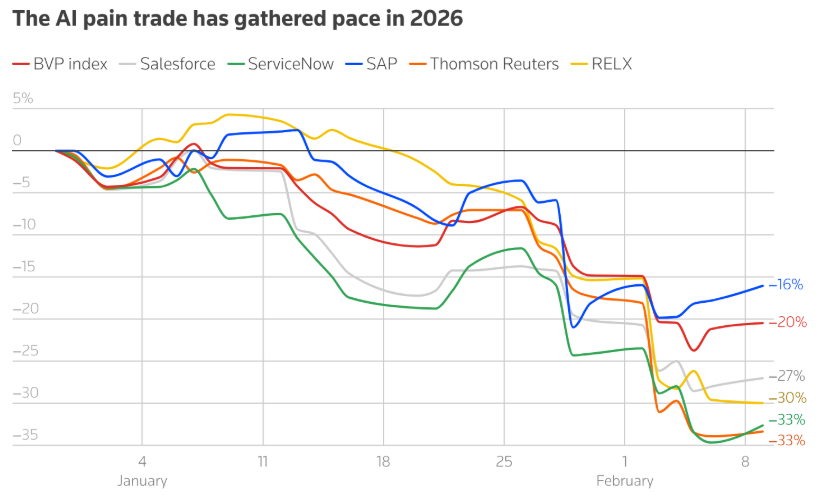
Group 1 - The core viewpoint is that artificial intelligence will impact existing software, data, and professional services companies, but it will not completely destroy them. Investors seem to share this perspective, as indicated by a Breakingviews analysis comparing valuation drops with recent analyst forecasts [1] - The BVP Nasdaq Emerging Cloud Index, a benchmark for software stocks, has declined by 20% year-to-date, raising concerns that AI chatbots like Claude from Anthropic could serve as flexible alternatives to existing company products [1] - Companies such as RELX and Thomson Reuters have seen their stock prices drop by approximately one-third since the end of 2025 due to this panic [1] Group 2 - ServiceNow's enterprise value is estimated at $105 billion, with free cash flow projected to grow from $5.8 billion this year to $10.3 billion by 2029. The implied value of recent cash flows, discounted at a 10% rate, is $27 billion [4] - After subtracting this amount from the enterprise value, ServiceNow's business value from 2030 onwards is approximately $78 billion, which translates to $114 billion in 2030 dollars using a 10% discount rate [5] - The long-term growth rate required to achieve this figure is only 0.9%, significantly lower than the previous year's growth rate of 5.7% [5] Group 3 - A study of 76 stocks, including BVP index components and some European software companies, shows a median long-term growth rate of 0.9%. About 60% of these companies are expected to grow from 2030, but only one-third will exceed a growth rate of 2% [6] - Companies like Monday.com, RingCentral, and Wix.com are exceptions that reflect expectations of significant declines in free cash flow starting in 2030 [6] Group 4 - Analysts caution that the analysis may be overly simplistic, as sell-side brokers might not have adjusted their forecasts for 2029, and a uniform 10% discount rate may not be appropriate across different industries [8] - The analysis suggests that AI is more likely to "zombify" existing companies rather than quickly eliminate them, raising questions about how CEOs should respond to this reality [8] - Stocks like SAP are trading close to what is termed "liquidation value," indicating a scenario where management accepts decline and cuts all growth-related spending to maximize cash extraction [8] Group 5 - Currently, no major data or software companies are pursuing a liquidation strategy, as many, like ServiceNow, continue to show strong growth. However, the market signals that many companies may soon stagnate or even face rapid decline [9] - If investors are pricing these companies as if they are zombie firms, it raises concerns about whether these companies will operate in a manner similar to actual zombie enterprises [9]


超级碗广告大战:Anthropic攻击OpenAI,Sam Altman怒斥"不诚实",软件股崩盘进行时
3 6 Ke· 2026-02-11 02:11
Core Insights - The market is undergoing a significant shift as AI agents are perceived not just as tools to assist human work but as potential replacements for traditional software, leading to a massive loss of nearly $1 trillion in tech stock market value within a week [1][2][32] - The release of a legal document review plugin by Anthropic triggered a sell-off in legal software stocks, indicating a broader recognition that AI could replace existing software solutions [1][2][32] Market Reaction - Major legal information companies experienced drastic stock declines: Wolters Kluwer down 13%, RELX down 15.8%, LegalZoom down 18%, and Thomson Reuters down 19% [2] - The software sector's forward 12-month P/E ratio dropped from 33.1 to 23.2, a 30% contraction, nearing the lows of the 2022 bear market [2][32] AI Agent Revolution - The AI agent revolution is just beginning, with implications for the software industry that could lead to the obsolescence of traditional software solutions [3] Super Bowl Advertising Battle - Anthropic launched a Super Bowl ad contrasting its ad-free AI assistant Claude with competitors that incorporate ads, targeting enterprise decision-makers rather than general consumers [5][6] - OpenAI's CEO Sam Altman responded aggressively to Anthropic's claims, framing the debate as a philosophical conflict over the future of AI [6][8][28] Market Share Dynamics - ChatGPT's market share plummeted from 69% in January 2025 to 45.3% in January 2026, while Gemini's share rose from 14.7% to 25.1%, and Grok's from 1.6% to 15.2% [8][28] Software Industry Disruption - The traditional view that AI would enhance software is being challenged; instead, AI is seen as a force that could eliminate the need for existing software [11][12] - The four levels of disruption include: 1. Functionality replacement, where AI can create user interfaces and databases tailored to individual needs [11][12] 2. Process reengineering, where AI can automate task management, rendering tools like Asana obsolete [12][14] 3. Pricing collapse, as AI reduces the cost of services, leading to renegotiation of software pricing [15][16] 4. Valuation compression, with software companies facing reduced future cash flow expectations [16] High-Risk Software Types - High-risk categories include: 1. Interface-driven software like monday.com and Asana, which lack unique data or algorithms [19][20] 2. Vertical industry information intermediaries, such as legal databases, which may be rendered unnecessary by AI's capabilities [20][21] 3. RPA tools that rely on manual configuration, which AI can automate without pre-programmed workflows [21][22] Value Capture in AI Era - Potential beneficiaries of the AI shift include foundational model companies (OpenAI, Anthropic), cloud infrastructure providers (AWS, Azure), chip manufacturers (Nvidia), and AI-native development studios [23][24][26] - The AI revolution may not yield clear winners, as traditional software companies face erosion of revenue and profits while foundational model companies engage in intense competition [27][28] Philosophical Divide - The advertising battle between Anthropic and OpenAI highlights a deeper philosophical divide regarding the future of AI: rapid commercialization versus responsible deployment [28][30] - The outcome of this conflict could significantly impact the software industry, with potential for both rapid disruption and the establishment of protective barriers for existing companies [30][31]

AI fears hit MoneySuperMarket as ChatGPT insurance rival launches
Yahoo Finance· 2026-02-10 18:44
MoneySuperMarket is one of Britain’s biggest price comparison websites - Chris Batson/Alamy The owner of MoneySuperMarket has lost £144m in value following the launch of a new insurance price comparison app on ChatGPT. Shares in Mony Group, which owns some of the biggest price comparison websites in Britain, fell by up to 13.8pc on Tuesday as investors feared it could be undercut by artificial intelligence-powered rivals. It suffered a hit alongside insurance company Admiral and GoCompare owner Future ...
2 Internet Content Stocks to Buy From a Prospering Industry
ZACKS· 2026-02-09 19:31
Core Insights - The Zacks Internet - Content industry is experiencing growth due to strong demand for digital offerings, video content, and cloud-based applications, aided by advancements in AI and Generative AI [1][3] - Despite growth opportunities, the industry faces challenges from macroeconomic conditions affecting advertising spending, which is a primary revenue source [1][4] Industry Description - The industry includes providers of video encoding platforms, Internet content, staffing services, and online travel companies, among others, and is undergoing rapid digitalization [2] - Advertising remains a major revenue source, prompting companies to enhance their digital presence across various platforms [2] Trends - There is a growing demand for digital offerings driven by technological advancements and the proliferation of smart devices [3] - The industry is characterized by frequent product introductions and evolving consumer behavior [3] Advertising and Revenue - Marketing efforts are focused on increasing website traffic, with advertising and subscriptions being key revenue sources [4] - Consumer spending trends, particularly during holidays, significantly influence revenue, although macroeconomic challenges are expected to impact ad spending in the near term [4] Regulatory Environment - Increased regulatory pressures, especially in China and the EU, are affecting industry participants, particularly regarding advertising practices [5] - The implementation of the General Data Protection Regulation and the Digital Markets Act in the EU adds to the challenges faced by online content providers [5] Industry Ranking - The Zacks Internet - Content industry holds a Zacks Industry Rank of 55, placing it in the top 23% of over 250 Zacks industries, indicating a generally positive outlook [6] - However, the near-term prospects are considered dim, with the industry underperforming compared to the broader market [7][10] Earnings Outlook - Analysts show optimism regarding the industry's earnings growth potential, with a 4.1% increase in the Zacks Consensus Estimate for 2026 earnings since November 30, 2025 [8] Stock Performance - The industry has underperformed the S&P 500 and the broader Zacks Computer and Technology sector over the past year, with a decline of 40.3% compared to the S&P 500's increase of 16.8% [10] Valuation - The industry is currently trading at a trailing 12-month price-to-sales ratio of 3.66X, lower than the S&P 500's 6.61X and the sector's 8.32X [13] Company Highlights - **RELX**: A Zacks Rank 1 (Strong Buy) company benefiting from a shift towards higher growth analytics and decision tools, with a steady earnings estimate of $1.95 per share for 2026 [16][17] - **Yelp**: A Zacks Rank 2 (Buy) stock experiencing growth from increased ad spending and consumer traffic, with a steady earnings estimate of $2.39 per share for 2026 [20][21]


从DeepSeek恐慌到Cowork恐慌
3 6 Ke· 2026-02-08 23:50
Core Insights - The software sector is experiencing a significant sell-off, termed "SaaSpocalypse," with major companies like Thomson Reuters and Salesforce facing steep declines in stock prices, with the S&P 500 Software and Services Index dropping nearly 13% over five trading days and 26% from its October peak [1] - The launch of Anthropic's Claude Cowork, a general AI agent capable of interacting with user files, has raised concerns about the viability of traditional SaaS business models, as users may achieve results comparable to expensive enterprise software through natural language commands [1] - The current market panic mirrors a previous incident involving DeepSeek, which also caused a rapid sell-off in tech stocks, highlighting a pattern of investor reaction to emerging AI technologies [2][3] Market Reactions - The sell-off triggered by Cowork has been more prolonged than the DeepSeek panic, with the latter's effects dissipating within a day, while Cowork's impact has spread over a week, affecting markets globally [5] - The Cowork panic is driven by a closed-source model from a U.S. company, contrasting with DeepSeek's open-source model from China, suggesting a deeper challenge to established software companies [4] SaaS Pricing Models - Traditional SaaS companies are transitioning from fixed pricing models to usage-based pricing due to the increased efficiency and accessibility of AI, with 79 out of 500 tracked companies adopting point-based pricing, a 126% increase year-on-year [8] - Companies like Salesforce have struggled with pricing strategies, leading to a shift towards usage-based models as they face rising operational costs [8] AI Integration Challenges - Traditional software companies face resistance to price increases associated with AI integration, as seen in Microsoft's case, where customers rejected higher fees for AI features [9] - Many established firms are struggling to effectively incorporate AI into their existing products, leading to inefficiencies and a lack of user engagement [9] Emerging Trends - The rise of Vibe Coding, which allows individuals and companies to create their own tools, poses a threat to traditional software sales, as businesses may prefer to develop customized solutions rather than purchase third-party software [11] - The demand for software is shifting towards solutions that address specific, non-standard needs, indicating a potential decline in the traditional SaaS model [13]

Wall Street urgently warns software stocks after Anthropic AI move
Yahoo Finance· 2026-02-06 19:03
Core Insights - The artificial intelligence debate in the markets has entered a new phase, shifting from a focus on software companies to broader implications across various sectors [1] - Anthropic's introduction of new plug-ins for its Claude Cowork agent has raised concerns about business model risks rather than just incremental productivity [2] - The sell-off in European and U.S. software stocks is indicative of a broader market reaction, with fears stemming from the rapid pace of AI integration [3] Software Sector - European and U.S. software stocks are experiencing significant declines, with investors reacting to the speed of AI advancements [3] - The transition of AI agents from demonstrations to real workflows is outpacing the ability of companies to adjust their pricing models, leading to a reevaluation of previously stable stocks [4] Legal and Data Analytics - Legal and data analytics stocks have been particularly hard hit, with companies like RELX and Wolters Kluwer facing sharp declines as AI threatens their subscription-based models [5] - Thomson Reuters has seen its largest decline in years due to concerns over its Westlaw legal research business, which has been a key profit driver [6] - The market is increasingly skeptical about the viability of traditional legal tools if AI can perform similar tasks more efficiently [7] Anthropic's Impact - Anthropic's Claude Cowork is viewed as more than just a consumer feature; it is considered a significant enterprise workflow tool that could disrupt existing business models [8]

Big Techs $600 billion spending plans exacerbate investors AI headache
MINT· 2026-02-06 18:48
By Lucy Raitano, Dhara Ranasinghe and Chibuike OguhNEW YORK/LONDON, Feb 6 (Reuters) - A planned $600 billion artificial intelligence spending splurge by big tech firms in 2026 is adding to investor unease as they assess the implications for profitability as well as a potential existential threat to software firms.Shares of Amazon, which had announced a $200 billion capital expenditure outlay, slid 7% on Friday while Alphabet lost 3% after the company said on Wednesday that capital spending could double this ...