
中信保诚基金

Search documents
中信保诚基金姜鹏:哑铃行情向均衡修复 中证A500或迎配置机遇
Zhong Guo Jing Ji Wang· 2025-08-25 01:47
Core Viewpoint - The current A-share market is experiencing a rapid rotation of styles, leading investors to focus on index-enhanced products to achieve stable excess returns [1] Group 1: Market Structure and Investment Strategy - The market is transitioning from a "barbell" structure to a more balanced recovery, with funds beginning to flow back to mid-cap stocks, which have solid fundamentals and reasonable valuations [1] - The China Securities A500 Index is highlighted for its dual advantages in market capitalization style and alpha space, making it a favorable path for capturing excess returns [1] - Approximately 70% of the A500 index constituents overlap with the CSI 300 index, providing stability, while the remaining 30% includes more growth-oriented sectors like TMT, offering higher growth potential [1][2] Group 2: Factor Selection and Risk Management - The investment strategy employs a combination of 60% fundamental factors and 40% price-volume factors, focusing on fundamental momentum and turnaround situations [2] - The risk management approach has evolved from static to dynamic, allowing for adjustments based on individual stock liquidity, estimated impact costs, and fundamental strength [2] - The strategy emphasizes a disciplined and systematic approach to quantitative investment, prioritizing long-term, reusable frameworks over short-term gains [4]
中信保诚基金姜鹏: 哑铃行情向均衡修复 中证A500或迎配置机遇
Zheng Quan Shi Bao· 2025-08-24 22:24
Core Viewpoint - The current A-share market is experiencing rapid style rotation, leading investors to focus on index-enhanced products to achieve stable excess returns [1] Group 1: Market Structure and Investment Strategy - The market has shown a "barbell structure" over the past two years, with funds concentrated in low-valuation large-cap blue chips and small-cap stocks, while mid-cap stocks have been under pressure [2] - As the policy environment improves and risk appetite rises, funds are beginning to flow back into mid-cap stocks, creating a potential allocation window for companies with solid fundamentals and reasonable valuations [2] - The introduction of the CSI A500 index enhancement product aims to balance win rates and odds, targeting more attractive investment opportunities to enhance cost-effectiveness [2] Group 2: Characteristics of CSI A500 Index - Approximately 70% of the CSI A500 index constituents overlap with the CSI 300 index, providing stability in fundamentals, while about 30% are closer to the CSI 500 index, featuring higher growth potential in emerging industries [2] - This balanced structure offers a good equilibrium between safety margins and upside potential [2] Group 3: Factor Selection and Dynamic Risk Control - The quantitative team employs a systematic model to achieve sustainable excess returns, focusing on factor selection and dynamic risk control [3] - The strategy combines 60% fundamental factors and 40% price-volume factors, with an emphasis on fundamental momentum and turnaround factors [3] - Dynamic risk control measures are tailored based on individual stock liquidity, estimated impact costs, sentiment, and fundamental strength, allowing for more precise risk management [4] Group 4: Market Performance and Strategy Adaptation - Recent market performance has seen extreme institutional clustering in certain technology sectors, increasing the demands on quantitative strategies to generate excess returns [5] - The CSI A500 index enhancement strategy will maintain a balanced exposure without extreme bets on style, focusing on stability in win rates and drawdown management [6] - The quantitative investment philosophy emphasizes discipline and systematic approaches, aiming to enhance strategy effectiveness through detailed optimization [6]
中信保诚基金姜鹏: 哑铃行情向均衡修复中证A500或迎配置机遇
Zheng Quan Shi Bao· 2025-08-24 21:04
Core Viewpoint - The focus is on how to achieve stable excess returns through index enhancement products in the rapidly rotating A-share market, with a specific emphasis on the CSI A500 index as a promising investment path due to its dual advantages in market capitalization style and alpha space [1][2]. Market Structure Analysis - The market has exhibited a "barbell structure" over the past two years, with significant capital flowing into low-valuation large-cap blue chips for safety and small-cap stocks for high elasticity, leaving mid-cap stocks under pressure [2]. - There is a shift occurring as the policy environment improves and risk appetite rebounds, leading to capital flowing back into mid-cap stocks, which may present a configuration window for fundamentally solid and reasonably valued companies [2]. CSI A500 Index Characteristics - Approximately 70% of the CSI A500 index constituents overlap with the CSI 300 index, providing stability in fundamentals, while about 30% are closer to the CSI 500 index, featuring many emerging industries with higher growth elasticity [2]. - This balanced structure offers a good equilibrium between safety margins and upside potential, making the CSI A500 index an attractive investment option [2]. Factor Selection and Dynamic Risk Control - The quantitative team employs a systematic model to achieve sustainable excess returns, focusing on two key aspects: factor selection and weighting, and dynamic risk control [3]. - The strategy primarily utilizes fundamental factors, supplemented by price-volume factors, with a proposed configuration of 60% fundamental factors and 40% price-volume factors [3]. - Key fundamental factors include fundamental momentum and distress reversal, while price-volume factors are enhanced through both manual and machine learning techniques [3]. Dynamic Risk Management - The strategy has evolved from static to dynamic risk control, adjusting individual stock deviation limits based on micro liquidity, estimated impact costs, event sentiment, and fundamental strength [4]. - Different risk management measures are applied to stocks with strong fundamentals and positive event drivers compared to those with weaker factor performance, optimizing the risk-return profile [4]. Market Performance and Strategy Adaptation - Recent market performance has seen extreme institutional clustering in certain technology sectors, necessitating higher demands on quantitative strategies to achieve excess returns [5]. - The management of the CSI A500 index enhancement strategy emphasizes balanced exposure without extreme bets, focusing on stability in win rates and drawdown management across different market environments [6]. Long-term Investment Philosophy - The quantitative team at CITIC Prudential has maintained a long-term investment philosophy of logical quantification, ensuring rigor in factor research, portfolio construction, risk control, and trade execution [6]. - Continuous integration of cutting-edge research from artificial intelligence and behavioral finance aims to enhance strategy robustness and interpretability in complex market conditions [6].
中信保诚基金姜鹏:把握中证A500指数赔率优势构建动态量化增强框架
Shang Hai Zheng Quan Bao· 2025-08-24 15:36
Group 1 - The core viewpoint is that the recent recovery in the equity market presents an opportunity for the CITIC Prudential CSI A500 Index Enhanced Fund, which aims to leverage the index's potential for higher odds and returns [1][2] - The fund manager, Jiang Peng, believes that the A-share market is undergoing structural changes, with mid-cap assets that have been undervalued likely to see a return to normal winning rates [1][2] - The CSI A500 Index combines characteristics of both large-cap and mid-cap stocks, with about 70% of its constituent stocks overlapping with the CSI 300, making it a favorable choice in the current market environment [2] Group 2 - Jiang Peng emphasizes the importance of balancing three key aspects in index enhancement: factors, risk control, and trading [2][3] - The factor selection strategy includes approximately 60% fundamental factors, focusing on profitability quality and growth stability, while the remaining 40% targets trading behavior and volume-price factors [2] - In risk control, a dynamic approach is adopted, allowing for greater deviations for fundamentally strong companies while tightening constraints for those with poor liquidity or negative sentiment [3] Group 3 - The trading aspect is described as a long-term project requiring continuous optimization of execution details, with public quantitative trading facing more constraints compared to private equity [3] - Recent efforts include incorporating unstructured information into factor research, utilizing sentiment analysis and semantic judgment to extract quantifiable factors from historical reports [3] - The fundamental investment logic revolves around two main strategies: identifying and extending momentum in strong fundamentals and capitalizing on rebounds from low points [3]
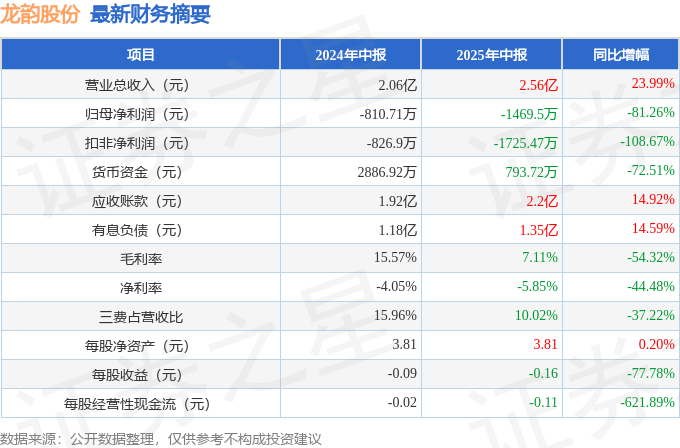
龙韵股份2025年中报简析:增收不增利,短期债务压力上升
Zheng Quan Zhi Xing· 2025-08-23 23:15
Core Viewpoint - Longyun Co., Ltd. (603729) reported mixed financial results for the first half of 2025, with revenue growth but significant losses in net profit and declining profitability metrics [1][3]. Financial Performance - Total revenue reached 256 million yuan, a year-on-year increase of 23.99% [1] - Net profit attributable to shareholders was -14.695 million yuan, a decline of 81.26% year-on-year [1] - Gross margin decreased to 7.11%, down 54.32% compared to the previous year [1] - Net margin was -5.85%, a decrease of 44.48% year-on-year [1] - Operating cash flow per share was -0.11 yuan, a significant decline of 621.89% [1] Cost and Expense Analysis - Total selling, administrative, and financial expenses amounted to 25.6511 million yuan, accounting for 10.02% of revenue, down 37.22% year-on-year [1] - Sales expenses decreased by 32.99% due to business adjustments [3] - Management expenses fell by 24.51% as a result of reduced personnel costs and operational expenses [3] - Financial expenses increased by 13.93% due to higher bank loan interest [3] Balance Sheet Insights - Current ratio stood at 0.91, indicating rising short-term debt pressure [1][5] - Cash and cash equivalents decreased by 72.51% to 7.9372 million yuan, primarily due to payments for business expenses [3] - Accounts receivable increased by 14.92% to 220 million yuan [1] Investment Returns - The company's return on invested capital (ROIC) was 2.87%, indicating weak capital returns [4] - Historical data shows a median ROIC of 4.09% since listing, with a notably poor ROIC of -24.89% in 2022 [4] Market Position and Fund Holdings - The primary fund holding Longyun Co., Ltd. shares is CITIC Prudential Anxin Return Bond A, with 115,000 shares held [5]


中信保诚基金姜鹏:中证A500布局正当时,量化赋能捕捉超额收益
Zhong Guo Zheng Quan Bao· 2025-08-21 23:29
Group 1 - The core viewpoint of the articles is that the A-share market is experiencing a gradual recovery in sentiment, with structural opportunities emerging, particularly in mid-cap growth stocks that were previously undervalued [1][2] - The market is entering a critical window for style rebalancing, with a shift in risk appetite towards rational equilibrium, leading to potential investment opportunities in quality mid-cap growth stocks driven by valuation recovery and performance improvement [1][2] - The launch of the CITIC Prudential CSI A500 Index Enhanced Securities Investment Fund aims to capture excess returns through quantitative models amid changing market styles [1][2] Group 2 - The CITIC Prudential CSI A500 Index is seen as having high cost-effectiveness for allocation, with a significant overlap with the CSI 300 Index and inclusion of high-growth sectors like semiconductor equipment and industrial robots [2] - The index reflects the performance of 500 representative listed companies across various industries, aiming to depict the overall performance of core assets amid China's economic transformation [2] - The investment strategy focuses on both fundamental analysis and quantitative factors, with a particular emphasis on identifying mispriced opportunities in mid-cap stocks [3][5] Group 3 - The quantitative enhancement strategy is divided into two approaches: one focusing on fundamental alpha factors for stocks overlapping with the CSI 300 Index, and the other leveraging quantitative factors to identify mispriced mid-cap stocks [3][5] - The team has shifted from static risk analysis to a more dynamic risk management approach, allowing for customized risk thresholds based on various factors such as sentiment and liquidity [5][6] - Continuous iteration and adaptation of quantitative strategies are emphasized, particularly in response to changing market conditions and the effectiveness of different factors [4][5]
中信保诚基金姜鹏: 中证A500布局正当时 量化赋能捕捉超额收益
Zhong Guo Zheng Quan Bao· 2025-08-21 22:27
Group 1 - The A-share market is experiencing a gradual recovery in sentiment, with structural opportunities emerging, indicating a key time window for style rebalancing [1] - The launch of the CITIC Prudential CSI A500 Index Enhanced Securities Investment Fund aims to capture excess returns through quantitative models amid changing market styles [1][2] - The CSI A500 Index is seen as having high cost-effectiveness for allocation, with a significant overlap with the CSI 300 Index and representation of high-growth sectors like semiconductor equipment and industrial robots [2] Group 2 - The quantitative enhancement strategy for the CSI A500 Index can be divided into two approaches: focusing on fundamental alpha factors for overlapping stocks and utilizing price-volume factors for mid-cap stocks [3] - The team emphasizes the importance of dynamic risk control, adapting to market changes and allowing for customized risk deviation thresholds based on various factors [5][6] - Continuous iteration and reflection in quantitative investment strategies are crucial, with the team striving to optimize trading behaviors and find more scientific alternatives due to regulatory constraints [4][6]
中证A500布局正当时 量化赋能捕捉超额收益
Zhong Guo Zheng Quan Bao· 2025-08-21 20:11
Core Viewpoint - The A-share market is experiencing a gradual recovery in sentiment, with structural opportunities emerging, as noted by the fund manager from CITIC Prudential Fund, Jiang Peng [1] Group 1: Market Sentiment and Investment Strategy - The current market is at a critical time for style rebalancing, with a shift towards rational equilibrium in risk appetite, leading to opportunities in quality mid-cap growth stocks that were previously undervalued [1] - CITIC Prudential Fund has launched the CITIC Prudential CSI A500 Index Enhanced Securities Investment Fund, managed by Jiang Peng and Huang Zhi, aiming to capture excess returns through quantitative models amid changing market styles [1][2] - The CSI A500 Index is seen as having high cost-effectiveness for allocation, with many constituent stocks overlapping with the CSI 300 Index, providing both stability and growth potential [1][2] Group 2: Quantitative Strategy and Stock Selection - Jiang Peng's quantitative enhancement strategy for CSI A500 constituents focuses on two main approaches: deepening fundamental alpha factors for stocks overlapping with the CSI 300 Index and utilizing basic stock selection methods based on performance quality and cash flow stability [2][3] - The strategy also incorporates a focus on high volatility characteristics of mid-cap stocks, using both fundamental and price-volume factors to identify mispriced opportunities [3] Group 3: Risk Management and Dynamic Adjustment - The quantitative team emphasizes the need for continuous reflection and iteration in response to rapidly changing market conditions, moving from static to dynamic risk management approaches [4][5] - A dynamic risk control system has been implemented, allowing for customized risk deviation thresholds based on various factors such as sentiment and institutional research, enhancing the stability of product net values [5]
6家公募出手!热门指基迎新布局
券商中国· 2025-08-21 15:41
Core Viewpoint - The article discusses the recent launch of new index funds tracking the CSI A500 Dividend Low Volatility Index, highlighting the growing interest and competition among fund companies in this segment [2][3]. Group 1: New Index Fund Launches - As of August 21, several public funds, including Huabao Fund and Ping An Fund, have initiated the issuance of the CSI A500 Dividend Low Volatility ETF, which tracks a newly introduced index in Q2 of this year [2][3]. - The CSI A500 Dividend Low Volatility Index incorporates four optimization indicators, making it a differentiated product in the broad dividend space compared to traditional dividend indices [3][4]. Group 2: Fund Company Participation - A total of 76 fund companies have engaged in the CSI A500 index fund market since September of last year, with 128 different CSI A500 index fund products established as of August 21, totaling nearly 280 billion yuan [5][6]. - The largest CSI A500 ETF is the Huatai-PB CSI A500 ETF, with a scale of 20.39 billion yuan, while six other ETFs exceed 10 billion yuan in scale [6]. Group 3: Challenges in Fund Growth - Despite the increasing number of funds, newly established funds generally have smaller scales, with many not exceeding 1 billion yuan, indicating a challenge for fund companies in marketing and scaling their products [9]. - The phenomenon of funds not growing significantly post-establishment poses a marketing challenge, particularly for smaller fund companies, as they compete with larger firms that have more resources [9][10].

A股开启“欢乐派对” 公募机构“冷静而持稳”
Zhong Guo Zheng Quan Bao· 2025-08-17 20:07
Group 1 - The equity market shows significant signs of recovery, with the Shanghai Composite Index breaking through 3700 points, driven by multiple favorable factors including policy support and increased liquidity from various investors [1][2][3] - Public fund institutions highlight that the recent market rally is supported by improved external conditions and a potential interest rate cut by the Federal Reserve, which could benefit the A-share market [2][3] - The technology sector is experiencing positive momentum, with leading companies in the optical module space reporting better-than-expected earnings, and advancements in AI technology further boosting investor sentiment [2][3][7] Group 2 - There is a notable increase in trading activity and liquidity in the market, with retail investors showing heightened interest and institutional investors maintaining a long-term investment perspective [1][3][4] - Recent data indicates a surge in inquiries about equity products, with many investors shifting from bond funds to stock funds, reflecting a rising risk appetite [4][6] - The current market environment is characterized by a structural rally, with many undervalued sectors and companies identified as key investment opportunities [5][6][8] Group 3 - The strong market performance is attributed to supportive policies and liquidity measures, including accelerated special bond issuance and relaxed real estate policies [6][7] - Fund managers express optimism about maintaining a high-risk appetite, with a focus on sectors that may benefit from strong earnings reports and thematic catalysts [7][8] - The innovative drug sector is gaining attention, with many companies reaching performance inflection points, suggesting potential for further investment [8]