Scale AI

Search documents
又一华人 AI 估值快 100 亿美金了
投资实习所· 2025-07-28 10:23
Core Insights - The article discusses the rapid growth and funding activities of AI companies, particularly focusing on Cognition, which is seeking to raise $300 million at a $10 billion valuation, following a previous round that valued it at $4 billion just months prior [2][4]. Group 1: Cognition's Growth and Valuation - Cognition's valuation is projected to increase from $4 billion to $10 billion in less than six months, indicating a significant growth trajectory [2]. - The company has achieved an Annual Recurring Revenue (ARR) of approximately $150 million, driven by its product Devin, which alone has an ARR between $70 million and $80 million [2][3]. - Cognition has secured major enterprise clients, including Citigroup and Goldman Sachs, which plan to deploy hundreds to thousands of Devin agents for software development tasks [3]. Group 2: Investment and Team Background - Cognition's investors are closely linked to Peter Thiel, with Founders Fund and 8VC being key backers, reflecting a strong network of support [5]. - The founding team of Cognition consists of multiple International Olympiad in Informatics (IOI) medalists, enhancing the company's credibility and appeal to investors [5][6]. - The ongoing investment interest in Cognition is attributed to the team's ability to continuously optimize and improve their product, despite earlier performance concerns [4][6]. Group 3: Product and Market Positioning - Devin is positioned as a highly autonomous AI software engineer capable of end-to-end software development, which includes coding, debugging, and deployment [3][6]. - Cognition aims to create AI that can perform logical reasoning and long-term planning, distinguishing itself from existing AI tools that primarily serve as assistants [6]. - The article also mentions another AI company, Cursor, which has reached a valuation of $28 billion but faces risks due to its dependency on Anthropic for model development [6][7].

深度|95后Scale AI创始人:AI能力指数级增长,生物进化需要百万年,脑机接口是保持人类智慧与AI共同增长的唯一途径
Z Potentials· 2025-07-28 04:17
Core Insights - The article discusses the rapid advancement of AI technology and its implications for human evolution and society, emphasizing the need for brain-computer interfaces to keep pace with AI development [5][7][22]. Group 1: AI and Data - AI is compared to oil, serving as a crucial resource for future economies and military capabilities, with the potential for unlimited growth through self-reinforcing cycles [22][23]. - Data is highlighted as the new "oil," essential for feeding algorithms and enhancing AI capabilities, with companies competing for data center dominance [23][24]. - The three key components for AI development are algorithms, computational power, and data, with a focus on improving these elements to enhance AI performance [24][25]. Group 2: Brain-Computer Interfaces - Brain-computer interfaces (BCIs) are seen as the only way to maintain human relevance alongside rapidly advancing AI, despite the significant risks they pose [7][22]. - Potential risks of BCIs include memory theft, thought manipulation, and the possibility of creating a reality where individuals can be controlled or influenced by external entities [6][7][26]. - The technology could enable profound enhancements in human cognition, allowing individuals to access vast amounts of information and think at superhuman speeds [9][10]. Group 3: Scale AI - Scale AI, founded by Alexandr Wang, provides essential data support for major AI models, including ChatGPT, and is valued at over $25 billion [2][10]. - The company initially gained recognition for creating large-scale datasets and has since expanded its focus to include partnerships with significant clients, including the U.S. Department of Defense [11][56]. - Scale AI's growth trajectory has been rapid, expanding from a small team to approximately 1,100 employees within five years, with a strong emphasis on the autonomous driving sector [64].

人工智能:2025年二季度投融市场报告
Lai Mi Yan Jiu Yuan· 2025-07-28 03:35
Investment Rating - The report does not explicitly state an investment rating for the artificial intelligence industry Core Insights - China's AI technology has made significant progress, contributing 61.5% of the global patents in generative AI, but still lags behind the US in core technologies [9] - The market for AI applications is rapidly expanding, with notable growth in user engagement and revenue generation [10][11] - The investment landscape is becoming increasingly active, with a notable increase in financing cases and amounts in Q2 2025 compared to previous quarters [21][22] Summary by Sections Industry Overview - The report highlights a significant increase in AI patent filings in China, with 27,000 out of 45,000 global patents in 2024 [9] - The competitive landscape shows a "duopoly" emerging in general AI assistants, with DeepSeek and Doubao dominating the market [10] - AI commercialization is accelerating, with several companies reporting substantial annual recurring revenue (ARR) [11] Q2 Investment Dynamics - In Q2 2025, there were 332 financing cases in the AI sector, a 37.8% increase from the previous quarter, with a total disclosed financing amount of 20.19 billion yuan [21] - Robotics and AI software platforms led in financing cases, with robotics receiving the most investments [21] - The report notes a shift towards later-stage financing, with early-stage investments decreasing in both number and amount [22] Active Investors - A total of 486 institutions invested in AI projects in Q2 2025, with 40 institutions making three or more investments [40] - The report lists several active investors and their focus areas, particularly in robotics and AI software [41] Key Financing Events - Significant financing events include Anysphere's $900 million Series C round and the $1 billion B3 round for Jiushi Intelligent [42] - The report details various companies and their respective financing rounds, highlighting the growing interest in AI technologies [42] Industry Trends - The report discusses the emergence of AI programming tools, which are transforming software development processes [44][49] - AI programming tools are gaining traction, with a projected market size of $29.57 billion in 2025, expected to grow to $64.68 billion by 2030 [51][53] - The competitive landscape in AI programming features both large tech companies and innovative startups [49][50]
Jinqiu Select | 为什么具身机器人的未来无关形态
锦秋集· 2025-07-26 03:00
Core Insights - The breakthrough success of Physical Intelligence's π VLA model marks a significant turning point in the robotics industry, revealing the complexity and fragmentation involved in building true robotic intelligence [1] - The future of robotics will not be about creating more human-like robots but rather about developing a more powerful and flexible technology stack [2] - The article emphasizes that the next wave of successful robotics will focus on diverse forms shaped by tasks, terrain, and environments rather than converging on a single humanoid form [6][14] Group 1: Robotics Evolution - The robotics technology stack is undergoing a major deconstruction, similar to the development of autonomous driving and VR industries, where specialized companies excel in specific areas rather than trying to dominate the entire industry [1] - The success of the π0.5 model raises the stakes for the entire industry, as robotics must prove itself in the real world filled with physical constraints [1] - The article draws parallels between the evolution of robotics and the concept of carcinization in biology, where different species evolve similar traits to adapt to their environments [5] Group 2: Human-like Robots vs. Functional Design - The assumption that robots must mimic human forms to be effective is termed the "humanoid fallacy," which overlooks the potential for innovation through non-human designs [8][9] - The efficiency of bipedal locomotion is questioned, with evidence showing that wheeled robots are significantly more efficient than humanoid robots [9][11] - Successful consumer robots, like vacuum cleaners, thrive not because they resemble humans but due to their unique designs that cater to specific tasks [10] Group 3: Practicality and Deployment - The article highlights that practical applications and deployment in real-world environments are crucial for generating valuable training data for robots [18] - Companies like Formic emphasize that the only way to achieve large-scale deployment is through useful robots that provide economic value from day one [18] - The focus should shift from creating humanoid robots to developing specialized robots that can perform tasks effectively in various environments [12][19] Group 4: Learning and Adaptation - The future of robotics lies in decoupling intelligence from specific forms, allowing for generalized learning across different embodiments [13][14] - Physical Intelligence's approach to cross-modal and cross-embodiment learning demonstrates that diverse data sources can enhance robotic learning and performance [17] - The article suggests that the next generation of robotics will benefit from a model that aggregates data from various physical forms and tasks, leading to improved generalization [16][17] Group 5: Robotics Stack - A clear hierarchical map of the robotics system is proposed, breaking down the components from data collection to intelligent control [20] - Each layer of the robotics stack supports the next, facilitating the flow of data from deployed robots into structured training for models like π0.5 [20]


Meta announces its Superintelligence Labs Chief Scientist: former OpenAI GPT-4 co-creator Shengjia Zhao
VentureBeat· 2025-07-26 00:58
Core Insights - Meta has appointed Shengjia Zhao, a former OpenAI researcher and co-creator of GPT-4, as the Chief Scientist of its newly established Meta Superintelligence Labs (MSL) [1][2] - The lab aims to focus on building artificial superintelligence (ASI) aligned with human interests, with Zhao leading the scientific agenda alongside Mark Zuckerberg and Alexandr Wang [2][8] - Meta's aggressive hiring strategy includes significant investments in AI talent, with compensation packages reportedly reaching up to $300 million over four years [5][6] Company Strategy - Meta is making a multibillion-dollar investment in superintelligence, having recently invested $14.3 billion in Scale AI and acquiring a 49% stake [5] - Zuckerberg has expressed ambitions to position Meta as a leader in AI, planning to invest hundreds of billions of dollars into computing resources for superintelligence development [7][11] - The creation of MSL represents a shift towards a more product-focused approach in Meta's AI efforts, emphasizing the alignment of ASI with human interests [8] Talent Acquisition - Zhao's background includes significant contributions to foundational AI models like GPT-4, and he is recognized for his academic work in generative models [4] - Meta's hiring blitz has included poaching talent from major AI companies, indicating a competitive landscape for AI expertise [5] - Reports suggest that Meta's top AI scientists may be receiving compensation exceeding $10 million annually, reflecting the high stakes in attracting elite talent [6] Challenges and Criticism - Meta's recent rollout of the Llama 4 model family faced criticism for poor real-world performance and inconsistent quality, impacting the company's credibility in generative AI [9][10][11] - The company has been accused of "benchmark gamesmanship," although it has denied using optimized versions of Llama 4 to enhance public perception [10] - Internal sources attribute the issues to rapid rollout timelines and bugs, which have raised concerns as Meta embarks on its ambitious superintelligence initiative [11]


Mark Zuckerberg names ex-OpenAI employee chief scientist of new Meta AI lab
CNBC· 2025-07-25 20:44
Core Insights - Meta has appointed Shengjia Zhao, co-creator of OpenAI's ChatGPT, as the chief scientist of Meta Superintelligence Labs [1][3] - The company has made significant investments in artificial intelligence, including a $14 billion investment in Scale AI [2] - Meta Superintelligence Labs was established to bring together top AI researchers and engineers, with Zhao being a key figure from its inception [2][3] Investment and Hiring Strategy - Zuckerberg has been actively hiring AI talent, indicating a multibillion-dollar investment strategy in the AI sector [2] - The establishment of Meta Superintelligence Labs is part of a broader initiative to enhance the company's capabilities in artificial intelligence [2] Leadership and Vision - Shengjia Zhao is recognized for his pioneering work in AI, including a new scaling paradigm, and will collaborate closely with Zuckerberg and Alexandr Wang, Meta's chief AI officer [3][4] - Zuckerberg expressed enthusiasm about working with Zhao to further advance the scientific vision of the lab [4]

bootstrap 到十亿美元 ARR:Surge AI 这匹黑马如何颠覆 Scale 霸权 ?
海外独角兽· 2025-07-25 09:52
Core Insights - Surge AI, founded in 2020, has rapidly become a leading player in the data annotation market, achieving an ARR of over $1 billion by 2024, surpassing Scale AI's $870 million revenue [3][4] - The company focuses on providing high-quality data annotation services for AI models, emphasizing the importance of data quality over quantity [3][4] - Surge AI's client base includes top tech companies such as Google, OpenAI, and Meta, highlighting its reputation in the industry [3] Group 1: Data Annotation Market - The data annotation market is divided into two main categories: BPO "human intermediaries" and AI-native "factories" like Surge AI, which provide comprehensive services to meet complex market demands [11][12] - Clients prioritize data quality, processing speed, cost, scalability, compliance, and expertise when selecting data suppliers [12] - The market exhibits high client relationship fluidity, with customers often employing a "multi-supplier parallel" strategy to avoid over-reliance on a single vendor [12] Group 2: Founding Intent of Surge - Edwin Chen, the founder, faced challenges in obtaining quality data for model training, leading to the creation of Surge AI to address these needs [24] - Surge AI's approach diverges from typical Silicon Valley practices by focusing on product quality and customer satisfaction rather than rapid fundraising [25] - The company's commitment to data quality has established it as a recognized leader in the industry [25] Group 3: Underlying Technology for High-Quality Delivery - Surge AI employs a combination of machine learning and human feedback to enhance its annotation capabilities, creating a feedback loop that improves data quality [27] - The company emphasizes the importance of understanding language nuances and context in data annotation, particularly in specialized fields [28][30] - Surge AI's unique evaluation metrics include emotional tone and intent judgment, allowing for more accurate data classification [29] Group 4: Customer Case Studies - Surge AI developed the GSM8K dataset for OpenAI, which includes 8,500 elementary math problems, ensuring high quality through rigorous standards and expert involvement [36][40] - For Anthropic, Surge AI provided a tailored data annotation solution that addressed challenges in acquiring high-quality human feedback data for their Claude model [42][50] Group 5: Founding Team - Edwin Chen, the CEO, has a strong background in machine learning and data annotation, having worked at major tech companies like Google and Facebook [55][56] - The team includes experts from various fields, ensuring a diverse skill set that enhances Surge AI's capabilities in data annotation [59][62]

37岁理工男,估值1000亿
投资界· 2025-07-25 07:32
Core Viewpoint - Surge AI, a hidden unicorn in the AI sector, has initiated its first round of financing, aiming to raise $1 billion with a valuation reaching $15 billion (approximately 100 billion RMB) [1][7]. Company Overview - Founded in 2020 by Edwin Chen, a Chinese entrepreneur with a background in mathematics, linguistics, and computer science from MIT, Surge AI has achieved over $1 billion in annual revenue within five years without external financing [2][3][5]. - Surge AI specializes in data annotation, focusing on complex tasks that require significant time investment, and charges 2 to 5 times more than competitors like Scale AI [6][7]. Market Position and Growth - Surge AI has collaborated with major companies such as OpenAI, Google, Microsoft, and Meta, surpassing Scale AI's revenue of $870 million during the same period [7][10]. - The global data annotation market is experiencing explosive growth, with a compound annual growth rate of 29.1%, driven by increasing demand for high-quality data across various sectors [11]. Talent Acquisition in AI - The article highlights a trend of major tech companies aggressively recruiting top Chinese AI talent, indicating a significant shift in the AI landscape towards Chinese professionals [13][15]. - Notable figures include Ruoming Pang, who was offered a $200 million annual salary by Meta, and other prominent AI researchers from leading institutions joining major firms like Nvidia [13][14][15].

硅谷华人能不能站起来把钱挣了?
虎嗅APP· 2025-07-25 01:01
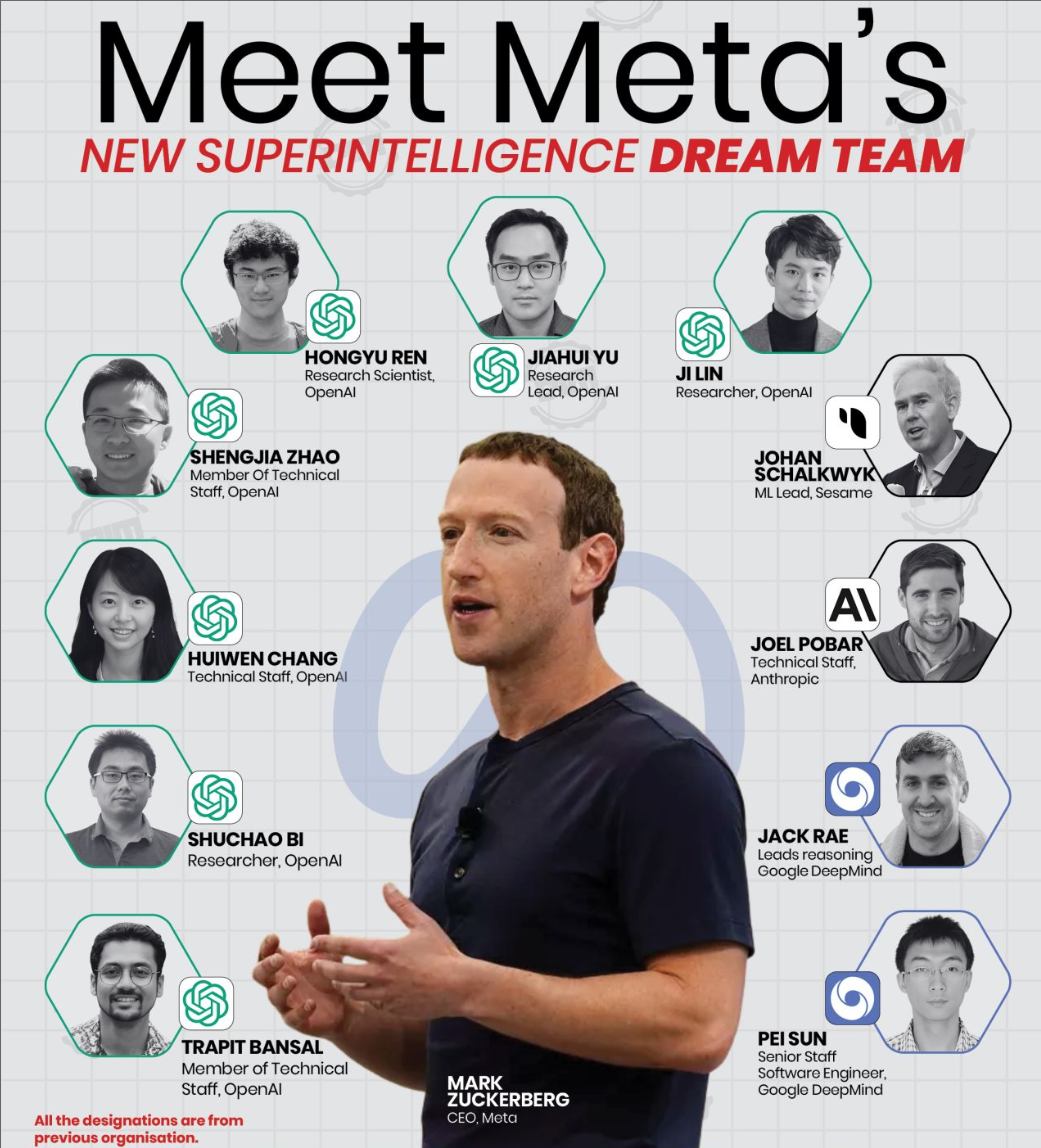
Core Viewpoint - The article discusses the recent developments in the American AI sector, focusing on Meta's restructuring of its AI team, the challenges faced by its LLaMA models, and the increasing influence of Chinese talent in the AI field [3][5][8]. Group 1: Meta's AI Team Restructuring - Meta's AI team underwent significant restructuring, with a large number of new hires and the dismissal of older staff, indicating a shift in strategy due to underperformance of previous models [5][8]. - The core of Meta's AI team now reportedly consists of at least 50% Chinese talent, many of whom have experience in major AI companies [5][8]. - Yann LeCun, a prominent AI figure and former chief scientist at Meta, was replaced due to dissatisfaction with current model architectures, highlighting a broader industry consensus on the need for architectural improvements [8][17]. Group 2: Challenges and Competition - The performance of LLaMA models has been criticized, particularly LLaMA 4, which was seen as lacking in reliability and presence in the open-source community [5][8]. - The article notes a shift in focus within the AI community from AGI (Artificial General Intelligence) to SSI (Superintelligent Systems), with both concepts being difficult to define and assess [17][18]. - The emergence of Chinese open-source models, such as DeepSeek, is seen as a challenge to American closed-source models, potentially destabilizing the commercial promises associated with AGI [18][22]. Group 3: Ethnic Dynamics in AI - The article highlights the paradox of Chinese talent being crucial to the success of American AI while facing systemic discrimination and a lack of recognition [10][24]. - It discusses the tendency of some Chinese professionals in the U.S. to adopt a subservient attitude, which does not alleviate the discrimination they face [10][24]. - The narrative suggests that the American AI industry is heavily reliant on Chinese talent, particularly in high-tech sectors like AI and semiconductors, yet continues to perpetuate negative stereotypes about Chinese innovation [10][24].

硅谷华人能不能站起来把钱挣了?
Hu Xiu· 2025-07-24 23:24
Group 1 - The core focus of the article revolves around the recent developments in the American AI sector, particularly the restructuring of Meta's AI team and the competitive landscape with Chinese open-source models [1][2][3] - Meta's AI team has undergone significant changes, with a large number of new hires and the departure of older staff, indicating a shift in strategy to improve performance in AI model development [2][3][4] - The article highlights the increasing prominence of Chinese teams in the open-source AI model space, suggesting that Meta's Llama series has fallen behind compared to its Chinese counterparts [2][3][4] Group 2 - The restructuring at Meta is seen as a necessary move to maintain competitiveness, especially as the company has ample resources but has not delivered satisfactory results in recent AI projects [3][7] - The article discusses the high proportion of Chinese talent within Meta's AI team, with at least half of the core members being of Chinese descent, reflecting the significant role of Chinese professionals in the American AI industry [4][10] - The article critiques the leadership of Alexander Wang from Scale AI, questioning the appropriateness of his background in data labeling for overseeing AI model development, which has raised concerns within the industry [8][9][10] Group 3 - The shift in focus from AGI (Artificial General Intelligence) to SSI (Superintelligence) in the AI discourse is noted, with both terms being described as vague and lacking clear definitions [22][24] - The article argues that the promises associated with AGI and SSI create unrealistic expectations for investment returns, complicating the financial viability of AI projects [24][25] - The emergence of Chinese open-source models, such as those from DeepSeek, is seen as a challenge to the traditional closed-source models from American companies, potentially destabilizing the market dynamics [25][30][31]