江苏银行

Search documents
经营贷利率下探至“2字头”
第一财经· 2026-01-19 13:44
Core Viewpoint - The article discusses the recent implementation of a package of policies by the State Council to promote domestic demand through financial and fiscal collaboration, focusing on optimizing loans for service industry entities and personal consumption loans to lower financing costs and stimulate consumer spending [3]. Group 1: Business Loan Market - Business loan interest rates have generally decreased to the "2" range, with banks increasing loan amounts, terms, and product flexibility, making it a key focus for credit allocation [3][5]. - State-owned banks maintain stable pricing for business loans, with rates around 3%, while collateralized loans can be as low as 2.5% for qualified clients [5]. - Joint-stock banks offer more flexible product structures, with some collateralized loans having rates as low as 2.3%, depending on property evaluations [5][6]. - City commercial banks are competitive, with some offering collateralized business loans at rates as low as 2.2% and flexible repayment options [5]. Group 2: Consumer Loan Market - Consumer loan interest rates have stabilized around 3%, with limited room for further decreases, as products with rates below 3% have largely exited the market [8][9]. - Major state-owned banks have consumer loan rates ranging from 3.0% to 4.5%, with specific products like ICBC's "融e借" averaging 3.5% to 3.65% [8]. - Joint-stock and city commercial banks are also active in the consumer loan market, with some offering interest subsidies to enhance product attractiveness [9]. Group 3: Credit Demand and Risk Control - Despite ongoing financial policies to boost consumption, demand for consumer loans remains weak, with significant declines in both short-term and long-term consumer loans reported [10]. - The tightening of risk controls by banks is evident, with stricter scrutiny on the use of consumer loan funds and customer eligibility to prevent misuse [10][11]. - The asset quality of consumer loans is under observation, with projections indicating a slight increase in the non-performing loan rate for 2026 [11].


利率下探至“2字头” 经营贷成银行新宠
Di Yi Cai Jing· 2026-01-19 13:34
Core Insights - The State Council has implemented a package of fiscal and financial policies to stimulate domestic demand, focusing on optimizing service industry loans and personal consumption loan interest subsidies to lower financing costs and boost consumer spending [1] Group 1: Business Loan Trends - Business loan interest rates have generally decreased to the "2% range," with increased flexibility in terms of limits, duration, and product offerings, becoming a key focus for bank credit allocation [1] - State-owned banks maintain stable pricing for business loans, with rates around 3%, while collateralized loans can be as low as 2.5% for qualified clients [2] - Regional banks are more competitive, with some offering business loans at rates as low as 2.2% and flexible repayment options to meet various cash flow needs [2][3] Group 2: Consumer Loan Trends - Personal consumption loan rates have stabilized around 3%, with limited room for further decreases, as most products now fall within the 3% to 4.5% range [4] - Major banks like ICBC and CCB offer consumer loans with rates between 3.0% and 3.65%, while lower rates below 3% have largely disappeared from the market [4][5] - Some regional banks are enhancing product appeal through interest subsidies for specific consumer categories, such as education and healthcare [5] Group 3: Risk Management and Market Dynamics - Despite ongoing financial policies to promote consumption, demand for consumer loans remains weak, with significant declines in both short-term and long-term consumer loans reported [6] - Banks are tightening risk controls, with stricter scrutiny on the use of consumer loan funds and customer eligibility to prevent misuse of low-cost funds [6][7] - The asset quality of consumer loans is under observation, with projections indicating a potential increase in non-performing loan rates due to stricter regulations and market conditions [7]
利率下探至“2字头”,经营贷成银行新宠
Di Yi Cai Jing· 2026-01-19 12:52
Core Viewpoint - The recent government policies aim to lower financing costs and stimulate consumer spending, leading to a divergence in bank credit allocation, with operational loan rates dropping to the "2s" and consumer loan rates stabilizing around 3% [1][2][4]. Group 1: Operational Loan Rates - Operational loan rates have generally decreased to the "2s," with banks increasing credit limits, terms, and product flexibility [1][2]. - State-owned banks maintain operational loan rates around 3%, with collateralized loans potentially as low as 2.5% for qualified clients [2]. - Some joint-stock banks offer more flexible product structures, with collateralized loans' rates dynamically adjusted based on property evaluations, with some rates dropping to 2.3% [2]. - City commercial banks are aggressively competing, with some offering collateralized operational loans at rates as low as 2.2% and credit limits up to 20 million yuan [2]. Group 2: Consumer Loan Rates - Consumer loan rates have stabilized around 3%, with limited downward movement expected [4][5]. - Major state-owned banks' consumer loan rates range from 3.0% to 4.5%, with specific products like ICBC's "融e借" averaging between 3.5% and 3.65% [4][5]. - Joint-stock and city commercial banks are also active in the consumer loan market, with some offering interest rate subsidies to enhance product appeal [5]. Group 3: Credit Demand and Risk Control - Despite ongoing financial policies to promote consumption, demand for consumer loans remains weak, with significant declines in both short-term and long-term consumer loans reported [6]. - Banks are tightening risk controls, with stricter scrutiny on the use of consumer loan funds and customer eligibility to prevent misuse [6][7]. - The asset quality of consumer loans is under observation, with projections indicating a potential increase in non-performing loan rates in 2026 [7].
银行股配置重构系列八:指数基金波动,优质银行股超跌
Changjiang Securities· 2026-01-19 12:44
Investment Rating - The investment rating for the banking sector is "Positive" and is maintained [13]. Core Insights - The market sentiment has significantly improved since the beginning of the year, leading to substantial net outflows from major index funds like CSI 300 and SSE 50, with bank stocks experiencing the highest decline among primary sectors [2][6]. - Despite the recent pressure on bank stocks due to net outflows from index funds, there is an expectation that the market will continue to focus on high-quality bank stocks with stable or improving fundamentals, presenting good investment opportunities [2][8]. - The pricing power of fundamental factors for bank stocks is expected to increase in 2026, with a projected reversal in net interest income growth and stable performance from major banks [10]. Summary by Sections Market Dynamics - Since Q3 2025, bank stocks have been under pressure due to capital outflows, primarily from public funds and ETFs, reflecting a shift in institutional investor strategies [6][7]. - The net outflow from CSI 300 and SSE 50 ETFs reached 103.6 billion and 19.7 billion respectively during January 15-16, significantly above normal levels [7]. Valuation and Dividend Yield - Bank stocks are considered systematically undervalued under the PB-ROE framework, with current PB valuations below net asset value [9]. - The expected dividend yields for major state-owned banks have risen above 4%, with some leading banks like China Merchants Bank and Jiangsu Bank reaching yields of 5% to 6% [9][26]. Performance Outlook - Major banks are expected to maintain stable growth in 2026, with credit growth projected to be flat year-on-year, focusing on operational efficiency rather than scale [10]. - The non-interest income pressure from financial market activities has eased, and overall revenue growth is anticipated to be driven by net interest income [10].




中小银行开年激战揽储
3 6 Ke· 2026-01-19 11:48
"每天一睁眼,就惦记着那500万元的揽储任务。"陈浩说。 陈浩是一家民营银行的客户经理。过去半个多月,他成了多个社交平台的常客,从提供咨询服务、指导 外地客户线上开户,到帮助储户申请礼品折现,其手机屏幕几乎没暗过。 2026年1月初,陈浩所在的民营银行吹响了揽储的号角。因该行仅在江浙沪地区设立了一家线下网点, 线上成了揽储的主战场。 1月至3月是该行的"开门红"周期,1月更是被视作"黄金窗口期",不仅存款产品给了很大的优惠力度, 利率也相对处于阶段性高位。相应地,考核压力也高悬于顶。 对于中小银行而言,存款高利率曾是吸引储户的"杀手锏",可随着市场利率持续下行,这一优势正在被 稀释。 为了在2026年"开门红"期间获得阶段性优势,不少中小银行采取"长升短降"的利率调整策略:逆势上调 部分期限的存款利率,特别是1年期、3年期在内的长期存款,调降3个月、6个月等短期存款利率,部分 银行甚至将活期类短期存款利率调降至0.05%;即使是备受关注的大额存单产品,部分银行也设置起了 封顶金额,多数依旧需要限量抢购。 但即便存款利率有所提升,大多数中小银行的存款利率仍在2%以下。这也让陈浩在内的一线业务员 们,不得不在利率 ...
中小银行开年激战揽储
经济观察报· 2026-01-19 09:37
Core Viewpoint - Many small and medium-sized banks are adopting a "long rise, short drop" interest rate adjustment strategy to gain a temporary advantage during the 2026 "opening red" period, despite most deposit rates remaining below 2% [1][3]. Group 1: Interest Rate Adjustments - The "opening red" period from January to March is crucial for banks, with January seen as a "golden window" for attracting deposits through favorable interest rates [2]. - Small and medium-sized banks are adjusting deposit rates by increasing long-term rates (1-year and 3-year) while decreasing short-term rates (3-month and 6-month), with some banks lowering instant deposit rates to as low as 0.05% [3][5]. - For example, a bank's 3-year fixed deposit rate was raised to 2.20% but was subsequently reduced to 1.80% with a cap on the maximum deposit amount [5][6]. Group 2: Customer Acquisition Strategies - With limited appeal from deposit rates, banks are resorting to incentives such as cash rebates, gift cards, and other rewards to attract customers [10][11]. - Some banks offer a rebate of 50 yuan for every 10,000 yuan deposited, which can elevate the effective interest rate above 2% for certain products [10]. - Customer managers are often required to subsidize the costs of gifts and rewards to meet their deposit targets, leading to financial strain on employees [11][12]. Group 3: Regulatory Environment - The practice of offering cash rebates and gifts to attract deposits has raised regulatory concerns, as it may violate guidelines set by financial authorities [12]. - The ongoing pressure on small and medium-sized banks to expand their scale amidst declining market interest rates and narrowing net interest margins is creating a cycle of challenges for frontline employees [12].

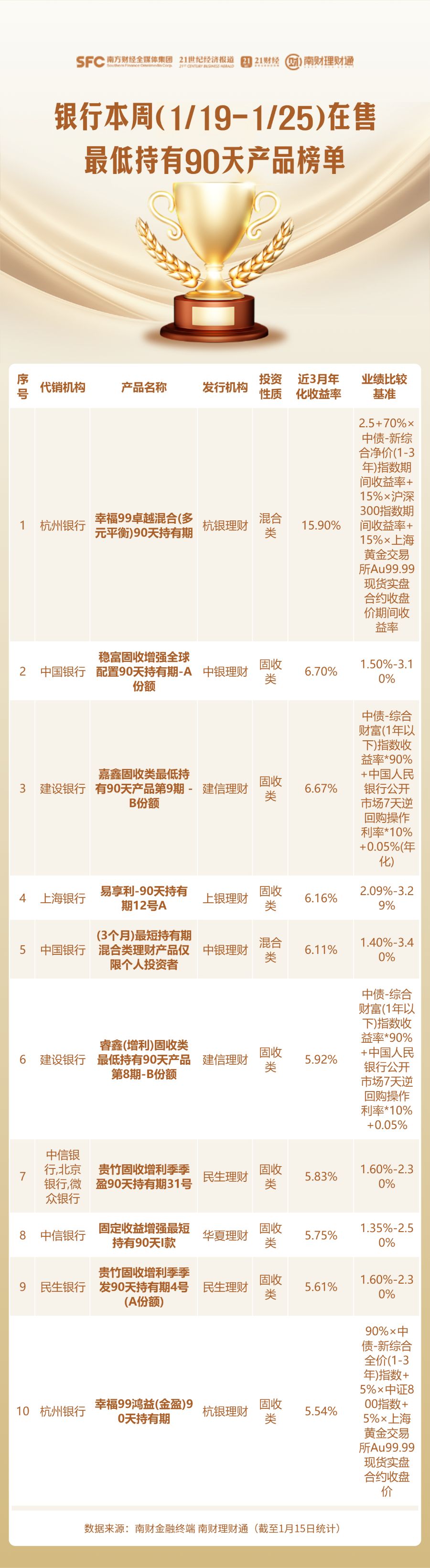
代销银行持有期产品排名出炉!混合类产品收益领先
2 1 Shi Ji Jing Ji Bao Dao· 2026-01-19 09:35
| 序 代销机构 | 产品名称 | 发行机构 | 投资 性质 | 近3月年 化收益率 | 业绩比较 基准 | | --- | --- | --- | --- | --- | --- | | | | | | | 2.5+70%× | | | | | | | 中债-新综 | | | | | | | 合净价(1-3 | | | | | | | 年)指数期 | | | | | | | 间收益率+ | | | | | | | 15%×沪深 | 本期,南财理财通重点关注最低持有期人民币公募产品的业绩表现,按照90天、180天、365天持有期限分类对产品业绩进行排 名,业绩指标采用年化收益率,计算区间与持有期限相同,如90天持有期产品的业绩计算区间为近三月年化收益率,同机构同 系列同投资周期产品保留一只参与排名。 统计代销机构(28家):工商银行、中国银行、农业银行、邮储银行、建设银行、交通银行、招商银行、中信银行、光大银 行、民生银行、兴业银行、浦发银行、广发银行、浙商银行、华夏银行、平安银行、恒丰银行、渤海银行、北京银行、宁波银 行、江苏银行、上海银行、南京银行、杭州银行、徽商银行、微众银行、网商银行、百信银行。 需要 ...
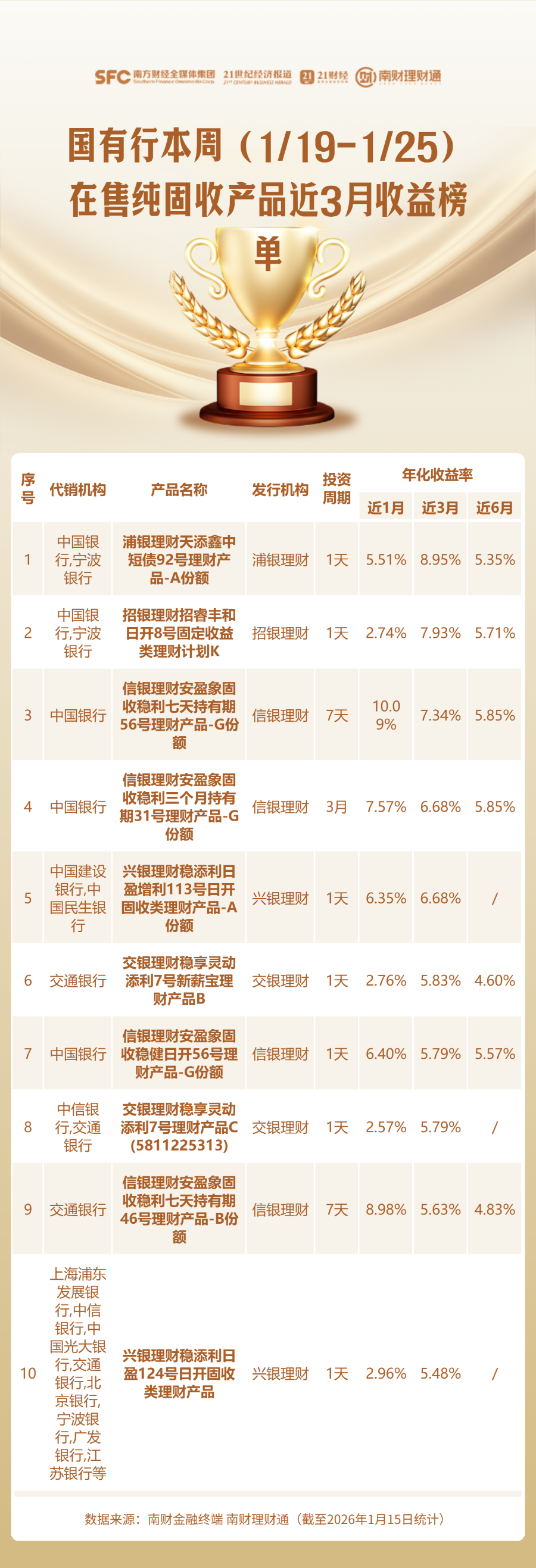
本周在售纯固收:股份行、城商行理财公司产品收益领先
2 1 Shi Ji Jing Ji Bao Dao· 2026-01-19 09:16
本期,课题组重点关注理财公司发行的纯固收产品,从代销渠道为投资者筛选出表现较优的在售产品。 为提供有效的选品参考,榜单展示了产品近一月、近三月及近六月的年化业绩,并按照近三月年化收益率进行排序,以此反映 其在近期市场波动中的多维度收益表现。 统计代销机构(28家):工商银行、中国银行、农业银行、邮储银行、建设银行、交通银行、招商银行、中信银行、光大银 行、民生银行、兴业银行、浦发银行、广发银行、浙商银行、华夏银行、平安银行、恒丰银行、渤海银行、北京银行、宁波银 行、江苏银行、上海银行、南京银行、杭州银行、徽商银行、微众银行、网商银行、百信银行。 需要特别提醒的是:本榜单对理财产品"在售"状态的判断基于其投资周期推算。但实际情况中,部分产品可能因额度售罄,或 银行针对不同客户展示的产品清单存在差异而无法购买。因此,建议投资者以代销银行APP的实际展示为准。 此外,南财理财通虽力求客观公正,但不对本评价榜信息的真实性、完整性和准确性作任何保证,排名信息仅供参考。 | 를 | 代销机构 | 产品名称 | 发行机构 | 投资 周期 | | 年化收益率 | | | --- | --- | --- | --- | --- ...
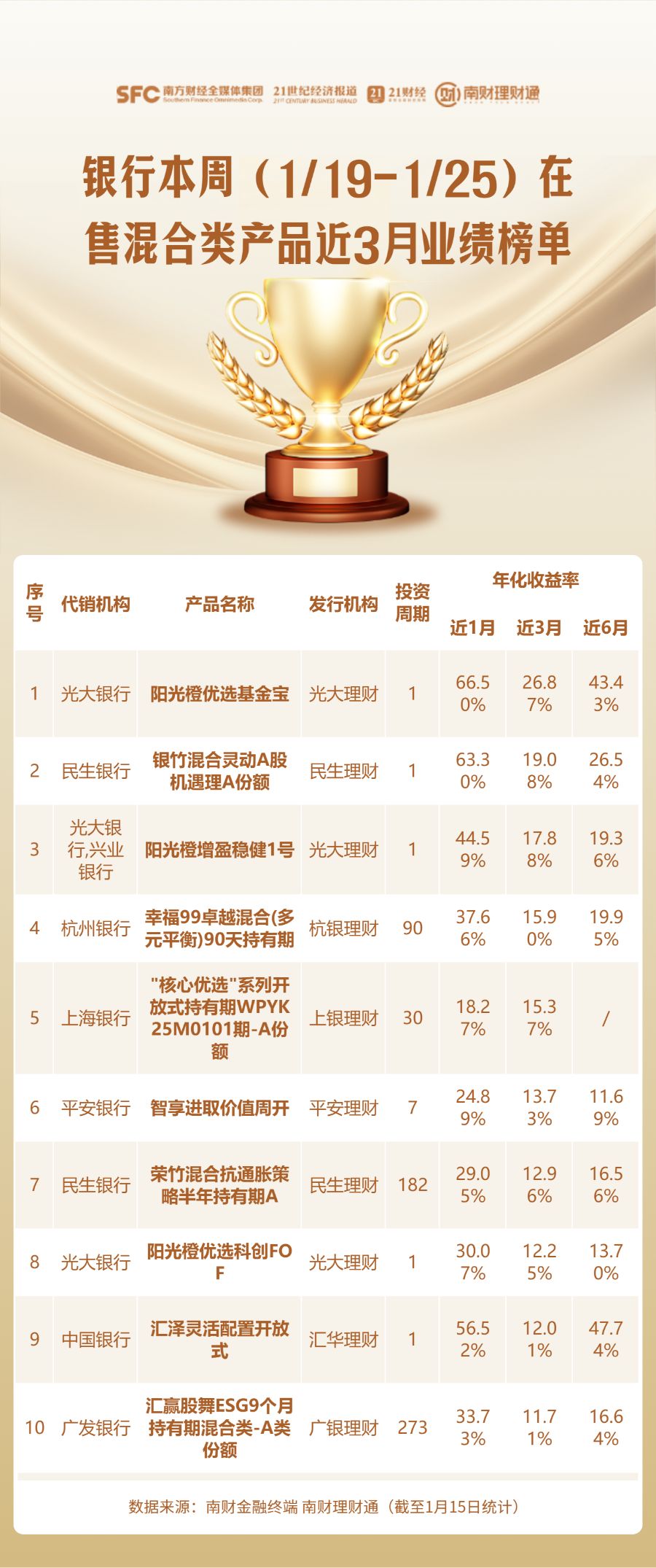
混合类产品短期收益亮眼,近1月年化冲破60%
2 1 Shi Ji Jing Ji Bao Dao· 2026-01-19 09:02
Group 1 - The focus of the research group is on mixed-asset products issued by wealth management companies, highlighting superior performing products available for sale through distribution channels [1] - A ranking list is provided, showcasing the annualized performance of products over the last month, three months, and six months, sorted by the three-month annualized yield to reflect multidimensional performance amid recent market fluctuations [1] - A total of 28 distribution institutions are involved, including major banks such as Industrial and Commercial Bank of China, Bank of China, Agricultural Bank of China, and others [1] Group 2 - The ranking list includes specific products with their respective annualized yields: for example, the "阳光橙优选基金宝" from 光大银行 has a one-month yield of 66.5%, a three-month yield of 26.8%, and a six-month yield of 43.4% [3] - Other notable products include "机遇理A份额" from 民生银行 with a three-month yield of 8% and "阳光橙墙盈稳健1号" from 光大银行 with a three-month yield of 8% [4] - The data is sourced from 南财金融终端 and 南财理财通, with statistics as of January 15 [4]
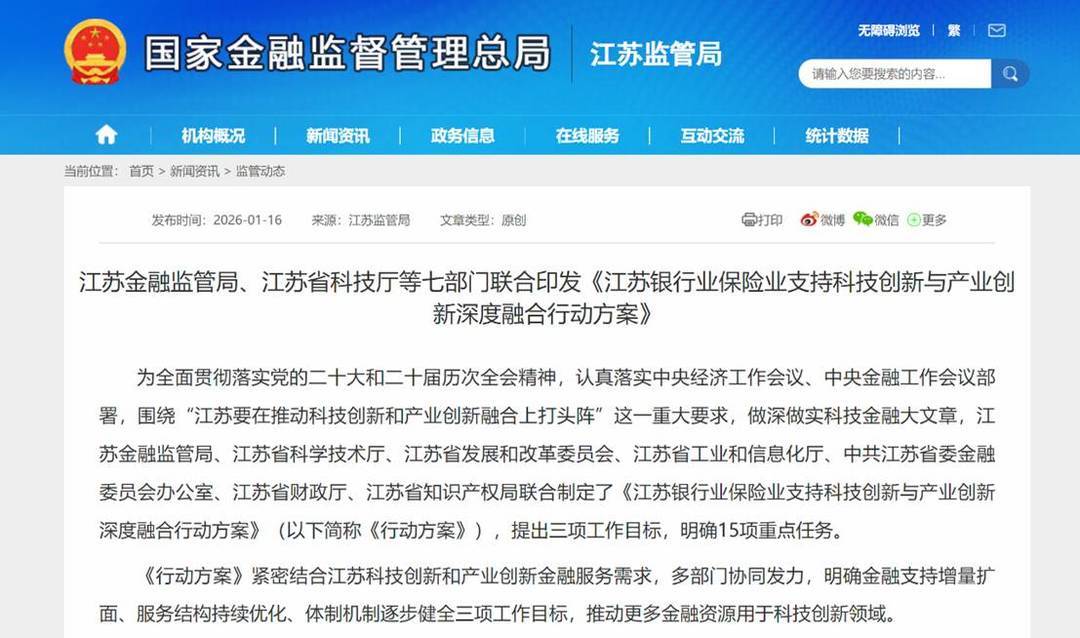
金融支持科技创新与产业创新深度融合,江苏七部门联合印发行动方案
Yang Zi Wan Bao Wang· 2026-01-19 06:55
Core Viewpoint - The Jiangsu Financial Regulatory Bureau, along with several provincial departments, has jointly developed an action plan to support the deep integration of technology and industrial innovation in Jiangsu, aiming to enhance financial services for technological innovation and industry development [1][3]. Group 1: Action Plan Overview - The action plan is designed to implement the spirit of the 20th National Congress of the Communist Party and subsequent meetings, focusing on Jiangsu's role in promoting the integration of technological and industrial innovation [3]. - It sets three main goals: increasing financial support, optimizing service structures, and gradually improving institutional mechanisms to channel more financial resources into technology innovation [3][4]. Group 2: Key Tasks - The action plan outlines 15 key tasks across four areas: 1. Enhancing professional service capabilities, including improving organizational structures and risk management [4]. 2. Innovating product service systems, such as expanding technology finance policy trials and increasing technology credit [4]. 3. Strengthening support for key areas, including backing technological research and modern industrial system construction [4]. 4. Promoting external collaboration, focusing on information sharing and establishing financial reward mechanisms [4]. Group 3: Financial Goals - By the end of 2025, the total balance of technology loans in Jiangsu is projected to reach 5.46 trillion yuan, an increase of 800.3 billion yuan from the beginning of the year, reflecting a growth rate of 17.18% [5].