
中国进出口银行

Search documents
长江产业集团联手九大银行打造“长江科创金融港”2.0 构筑区域科创金融新高地
Zheng Quan Shi Bao Wang· 2025-06-29 14:10
Core Viewpoint - The establishment of the "Yangtze Innovation Financial Port" marks a significant milestone in enhancing cooperation between Yangtze Industrial Group and nine major banks, focusing on building a financial service ecosystem for technological innovation in Hubei province [1][2]. Group 1: Key Developments - The Yangtze Innovation Financial Port aims to address the financing challenges faced by tech enterprises and accelerate the integration of technological and industrial innovation [1]. - Since its opening, the port has attracted over 20 leading institutions, achieving an occupancy rate exceeding 90% [1]. - More than 80 angel and venture funds have been established, with a management scale surpassing 170 billion yuan [1]. - The port has facilitated the incubation of 4 new listed companies, bringing the total to 54 [1]. - The establishment of the Yangtze AIC Fund Group has introduced a new collaborative model between national and local platforms [1]. Group 2: Future Plans - Future initiatives include the development of multifunctional platforms such as the "Yangtze Roadshow Hall," "Yangtze Innovation Investment Academy," "Hubei Capital Market Salon," and "Hubei Listed Companies Industry-Finance Club" [2]. - The goal is to enhance the national influence of the Yangtze Innovation Financial Port and establish it as a key hub for innovation capital [2].
违规掩盖处置不良、违规放贷揽储!审计署剑指商业银行乱象
券商中国· 2025-06-28 05:05
Core Viewpoint - The audit report highlights weaknesses in financial risk management among certain financial institutions, including issues related to non-compliance in asset disposal and improper lending practices. Financial Risk Weaknesses - The audit report indicates that while financial risks are being effectively managed, there are still notable weaknesses, such as six banks issuing a total of 20.968 billion yuan in development loans to real estate projects lacking complete documentation since 2022 [3] - Seven banks failed to adhere to guidelines that differentiate between the overall risk of real estate companies and the risks of individual projects when issuing loans [3] - Five banks exhibited inadequate supervision over unusual account fund flows, leading to 11 local financing platforms raising 24.743 billion yuan from the public, primarily to repay existing debts [4] Improper Disposal of Non-Performing Assets - The audit revealed that major banks, including the Agricultural Development Bank of China and the Export-Import Bank of China, did not classify 19.38 billion yuan in loans as non-performing despite borrowers being unable to repay [6] - Three local small and medium-sized banks concealed 31.8 billion yuan in non-performing loans by extending repayment periods and adjusting repayment plans, resulting in a true non-performing loan ratio of 2.77%, significantly higher than the national average [7] Non-Compliance in Lending Practices - The report noted that the Agricultural Development Bank of China issued loans to 270 enterprises with fabricated documents from November 2020 to 2024, indicating a lack of due diligence [13] - The Export-Import Bank of China engaged in improper fundraising practices by linking deposit and loan rates, increasing financing costs for enterprises [13] - The report emphasizes that issues identified in policy banks are indicative of broader risks faced by many commercial banks [14] Trends in Deposit Competition - As major state-owned banks have lowered deposit rates, the phenomenon of "deposit migration" has intensified, leading to unconventional deposit solicitation methods [15] - Some banks have offered promotional activities, such as deposits linked to popular IP products, reflecting the pressure on banks to attract deposits [16] - A report from Dongfang Securities indicates that while the overall deposit gap in the banking sector has eased since 2025, state-owned banks still face significant deposit shortages, highlighting a divergence in deposit growth between large and small banks [17][18]




又见千万罚单!
Zhong Guo Ji Jin Bao· 2025-06-28 03:01
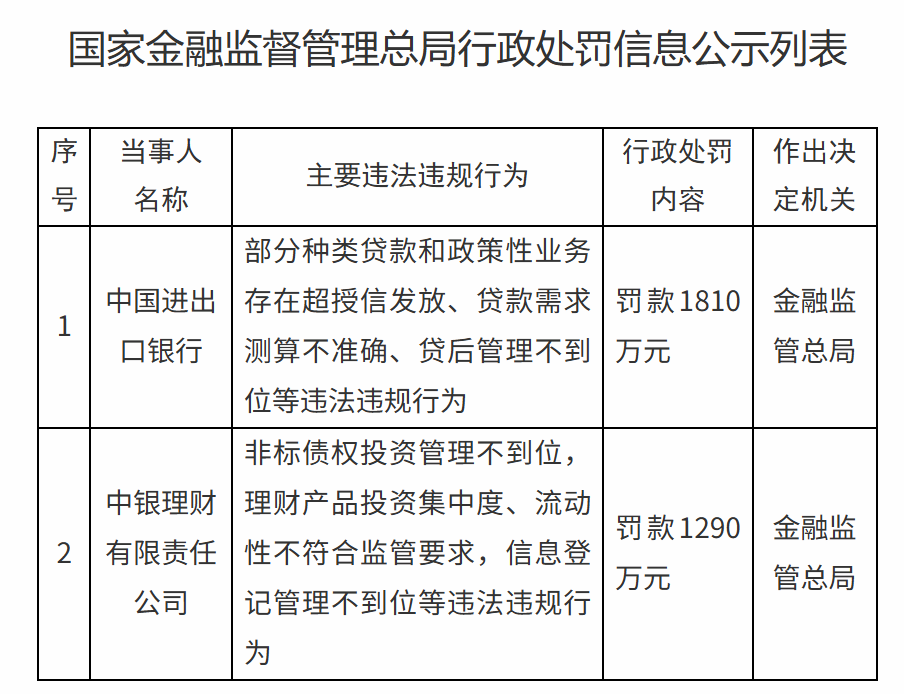
具体来看,中国进出口银行的主要违法违规行为包括:部分种类贷款和政策性业务存在超授信发放、贷款需求测算不准确、贷后 管理不到位等。 对此,中国进出口银行回应称,此次处罚是基于原银保监会在2022年坚守职能定位稽核调查中发现问题作出的。中国进出口银行 表示,对于此次处罚涉及的问题,该行已按照监管要求认真制定整改方案并按进度推进落实各项整改措施。下一步将严格落实监 管要求,聚焦主责主业,坚守政策性金融职能定位,更好地服务于国家战略和实体经济发展。 据悉,中国进出口银行是由国家出资设立、直属国务院领导、支持中国对外经济贸易投资发展与国际经济合作、具有独立法人地 位的国有政策性银行。 近期,审计署发布《国务院关于2024年度中央预算执行和其他财政收支的审计工作报告》。其中提到,中国进出口银行存在违规 掩盖处置不良资产、违规放贷揽储等问题。 【导读】中国进出口银行、中银理财分别被罚款1810万元、1290万元 金融监管持续从严,又有银行接到千万元级罚单! 6月27日,国家金融监督管理总局发布新一期行政处罚信息公示列表。其中显示,中国进出口银行被罚款1810万元,中银理财有 限责任公司被罚款1290万元。 | 序 | 当事 ...
又见千万罚单!
中国基金报· 2025-06-28 02:41
Group 1 - The core viewpoint of the article highlights the recent penalties imposed on China Export-Import Bank and Bank of China Wealth Management, indicating a trend of strict financial regulation in China [2][3] - China Export-Import Bank was fined 18.1 million yuan for violations including excessive credit issuance, inaccurate loan demand assessments, and inadequate post-loan management [2] - Bank of China Wealth Management was fined 12.9 million yuan for issues such as inadequate management of non-standard debt investments and non-compliance with regulatory requirements regarding investment concentration and liquidity [3] Group 2 - China Export-Import Bank acknowledged the penalties and stated that it has developed a rectification plan to address the issues identified by regulators, emphasizing its commitment to policy-oriented financial functions [2] - Bank of China Wealth Management has also committed to rectifying the identified issues and has stated that all problems will be resolved by June 2024, while ensuring orderly operation of its wealth management products [3] - As of the end of 2024, Bank of China Wealth Management reported a registered capital of 10 billion yuan, total assets of 19.36 billion yuan, net assets of 18.853 billion yuan, and a net profit of 1.963 billion yuan [4]

违规掩盖处置不良资产、违规放贷揽储,审计署报告披露金融业这些问题
Xin Lang Cai Jing· 2025-06-25 13:10
Core Insights - The audit report by the National Audit Office reveals significant issues in the financial sector, particularly among state-owned banks and insurance companies, highlighting discrepancies in reporting and compliance with regulations [1][2] Group 1: Financial Institutions Findings - The audit focused on two policy banks and three state-owned insurance companies, uncovering problems such as inaccurate data regarding support for national strategies and the real economy, as well as violations in managing non-performing assets [1] - Four financial institutions overstated insurance coverage and policy loan amounts by a total of 508.437 billion yuan, with specific examples including the Agricultural Development Bank of China misclassifying loans [1] - The Agricultural Development Bank and the Export-Import Bank of China failed to classify 193.8 billion yuan in loans as non-performing despite borrowers being insolvent or overdue by more than 90 days [1] Group 2: Regulatory Violations - The report highlighted issues of improper lending practices, including the Agricultural Development Bank issuing loans to 270 companies with fabricated documents and the Export-Import Bank using illegal methods to attract deposits, increasing financing costs for businesses [2] - The report indicates that sectors with concentrated power and resources, such as finance and state-owned enterprises, remain hotspots for corruption, with examples of individuals exploiting their positions for personal gain [2] Group 3: Corruption Cases - A case involving the former head of a provincial securities regulatory bureau was reported, where he colluded with three companies to obscure the source of investment funds and profited significantly from stock sales post-listing [3]
审计署:部分银行存在掩盖不良资产、违规放贷揽储等情况
2 1 Shi Ji Jing Ji Bao Dao· 2025-06-25 10:48
Group 1 - The audit report reveals that several financial institutions have engaged in irregular practices in the disposal of non-performing assets, with a total of over 50 billion yuan being concealed through various means [1][2] - The audit focused on two policy banks and three local small and medium-sized banks, which were found to have issues not only with non-performing assets but also in areas such as real estate financing and account supervision [1][2] - A total of 209.68 billion yuan in loans was improperly issued to real estate projects lacking complete documentation, while 247.43 billion yuan in public fundraising risks were identified [2][3] Group 2 - The report indicates that while financial risks are being effectively mitigated, there are still weak links, particularly in the issuance of loans to real estate projects without proper risk assessment [2][3] - Three major issues were highlighted: inaccurate reporting of data related to national strategy and the real economy, concealment of non-performing asset disposal, and significant irregularities in lending practices [3] - Specific cases include the failure of certain banks to classify 193.8 billion yuan in loans as non-performing despite borrowers being unable to repay, and the extension of repayment terms by local banks to hide 318 billion yuan in non-performing loans [3]

为科技企业提供接力式金融服务
Jing Ji Ri Bao· 2025-06-24 22:08
Core Viewpoint - The development of a technology finance ecosystem is essential to meet the financing needs of technology enterprises throughout their lifecycle, from startup to maturity, emphasizing the importance of patient capital and collaborative investment models [1][2][3]. Group 1: Technology Finance Ecosystem - The Ministry of Science and Technology and six other departments released policies in May 2023 to accelerate the construction of a technology finance system, highlighting its role in promoting deep integration of technological and industrial innovation [1]. - Industry experts advocate for a systematic, full-chain, and integrated technology finance ecosystem to support technology enterprises effectively [2]. - Financial institutions must adapt their evaluation criteria to focus on technology rather than traditional financial metrics, as technology enterprises' core value lies in their innovations [1][3]. Group 2: Collaborative Financial Services - A comprehensive financial service model is needed, which includes direct investment, investment banking, commercial banking, insurance, and guarantees to support technology enterprises at various stages [2]. - Clear division of responsibilities among financial institutions, market players, and regulatory bodies is crucial for effective service delivery [2][3]. Group 3: Product and Service Adaptation - Financial institutions should shift their focus from what they can provide to what technology enterprises need, continuously upgrading their products and services to meet the specific demands of different lifecycle stages [3]. - A robust supporting mechanism is necessary to address the unique characteristics of technological innovation, including profit-sharing, risk-sharing, and accountability frameworks [3]. Group 4: Innovative Investment Models - The integration of equity financing, debt financing, and insurance is essential for providing comprehensive financial services to technology enterprises [4]. - China Life Insurance is exploring a new "S Fund Relay Investment" model, which allows insurance funds to invest in technology enterprises at a more mature stage, enhancing the efficiency of government funds [6]. Group 5: Stable Funding Sources - Policy-based finance plays a strategic role in supporting technology enterprises by providing long-term and patient capital, especially during the product commercialization phase [7]. - The Export-Import Bank of China aims to enhance support for high-tech product export enterprises, facilitating technology upgrades and digital transformation [8][9].
金融反腐半年考:至少23名干部落马 超半数是“一把手”
Nan Fang Du Shi Bao· 2025-06-24 05:12
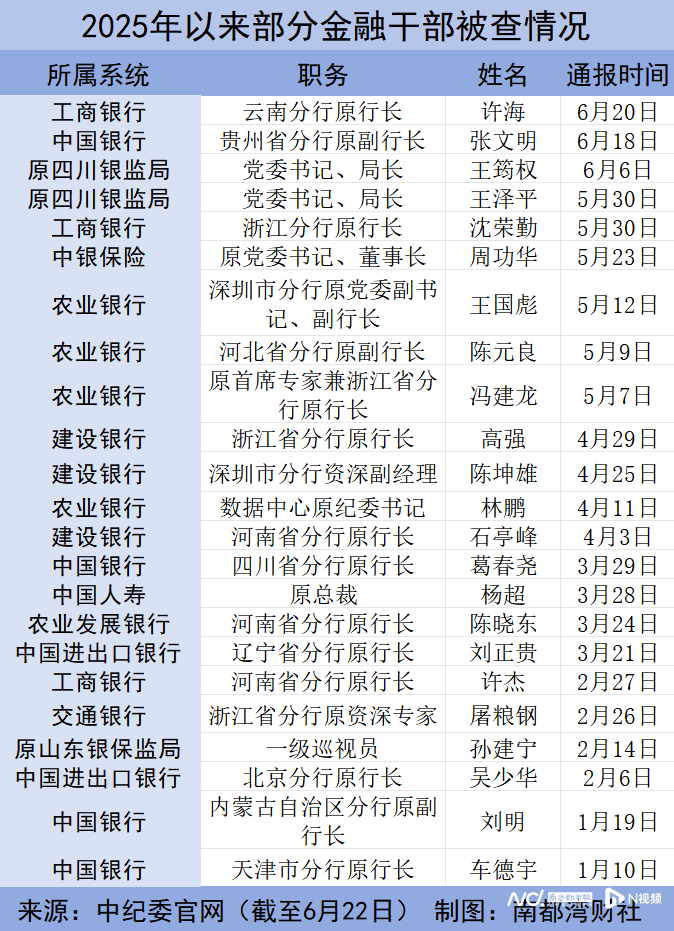
Core Viewpoint - The ongoing financial anti-corruption campaign in China has intensified, with a significant number of financial executives being investigated, particularly from state-owned banks, indicating a strong commitment to maintaining high-pressure oversight in the financial sector [1][4][8]. Group 1: Investigation and Disciplinary Actions - As of June 22, 2025, at least 23 individuals in the financial system have been investigated, with a notable proportion being from state-owned banks, particularly highlighting the prevalence of investigations among top executives [1][2]. - The majority of those investigated are former leaders, with 15 out of 23 being former "first leaders" from various banks, indicating a focus on high-ranking officials [4][3]. - In 2024, the China Banking sector faced over 120 fines totaling more than 63 million yuan, with the largest single fine reaching 4.3 million yuan, reflecting ongoing compliance and regulatory challenges [8]. Group 2: Characteristics of Corruption - The phenomenon of "first leaders" being targeted has become a defining characteristic of the current financial anti-corruption efforts, with a significant number of these leaders being from local branches [4][5]. - Corruption cases often revolve around the misuse of power, particularly in areas such as credit approval, procurement, and resource allocation, which are identified as high-risk zones for corrupt practices [12][16]. - The financial sector is characterized by a concentration of power and resources, making it a hotspot for corruption, especially in state-owned banks [16][12]. Group 3: Focus Areas for Oversight - The Central Commission for Discipline Inspection emphasizes the need for enhanced supervision of "first leaders" and leadership teams, recognizing them as critical points for potential corruption [5][6]. - Key areas of concern include credit approval processes, where significant corruption has been reported, necessitating a comprehensive approach to governance and oversight [12][16]. - The anti-corruption campaign aims to address not only existing corruption but also to prevent future occurrences by tightening regulations and enhancing accountability within the financial sector [16][12].
中资银行提供有力金融支持
Jin Rong Shi Bao· 2025-06-24 01:45
Group 1: Overview of China-Central Asia Cooperation - The second China-Central Asia Summit was held in Astana, resulting in over 100 cooperation agreements between China and the five Central Asian countries [1] - The historical ties and the Silk Road friendship serve as a foundation for deepening cooperation and financial support in the region [1] Group 2: Financial Institutions' Expansion in Central Asia - Chinese banks have been increasing their presence in Central Asia, aligning with the Belt and Road Initiative, which has led to enhanced trade and investment [2] - The Industrial and Commercial Bank of China (ICBC) established its first branch in Kazakhstan in 1993, becoming the first Chinese bank in the region [2] - The China Construction Bank opened its Astana branch in 2019, focusing on providing comprehensive financial services across the five Central Asian countries [2][3] Group 3: Support for Green Development Projects - The China Development Bank and the Export-Import Bank of China announced a financing window of 350 billion RMB to support Belt and Road projects, including green initiatives in Uzbekistan [4] - The first phase of a project in Uzbekistan involved a loan for the procurement of 1,000 new energy and natural gas buses, enhancing the public transport system [5] - The Export-Import Bank has been involved in various green projects in Central Asia, including renewable energy and infrastructure development [5] Group 4: Trade Growth and Economic Impact - Trade between China and Central Asia has seen significant growth, with imports and exports reaching 286.42 billion RMB in the first five months of the year, a 10.4% increase year-on-year [6] - The total trade volume has expanded from 312.04 billion RMB in 2013 to 674.15 billion RMB in 2024, marking a 116% increase [6] - Experts highlight that expanding into Central Asia is crucial for diversifying China's export markets and enhancing economic resilience [6] Group 5: Cross-Border Financial Services - Cross-border RMB settlement services are being utilized by companies engaged in trade with Central Asia, improving transaction efficiency and reducing currency risk [7] - A company representative noted that using RMB for settlements has significantly sped up payment processing times compared to foreign currency transactions [7]



金融牵线搭桥 护航中非贸易向深向实
Jin Rong Shi Bao· 2025-06-24 01:43
Core Insights - The fourth China-Africa Economic and Trade Expo successfully held in Changsha, showcasing significant achievements in China-Africa cooperation with 176 projects signed, amounting to $11.39 billion [1] - Financial institutions play a crucial role in facilitating China-Africa economic cooperation, providing essential cross-border financial services to support trade and investment [1][4] Group 1: Economic Cooperation - The expo attracted representatives from 53 African countries and over 4,700 enterprises, highlighting the growing importance of this biannual event for fostering trade relationships [1][2] - The event serves as a platform for businesses to secure new trade agreements, with commercial banks acting as key facilitators in connecting enterprises [2][3] Group 2: Financial Services - Chinese banks, including the Export-Import Bank of China and major commercial banks, showcased their financial products aimed at enhancing cross-border trade and investment [1][4][11] - The introduction of efficient cross-border payment systems has significantly improved transaction speed and reliability for businesses engaged in trade with Africa [4][5] Group 3: Trade Opportunities - Various African products, such as Kenyan coffee and Tanzanian avocados, are increasingly finding markets in China, reflecting the growing trade dynamics between the two regions [6][7] - The expo also highlighted the potential for Chinese enterprises to expand into African markets, supported by tailored financial solutions from banks [7][8] Group 4: Infrastructure and Industry Development - Chinese banks are actively investing in infrastructure and industrial projects across Africa, with significant financing provided for over 130 projects in 27 African countries [11] - The focus is shifting towards high-value, technology-intensive sectors, indicating a transformation in the trade model between China and Africa [10][11] Group 5: Future Prospects - The ongoing collaboration aims to enhance the quality of economic ties, with banks developing targeted financial services to support the "Ten Major Cooperation Actions" between China and Africa [11][12] - The commitment to continuous cooperation is expected to drive further economic integration and development opportunities in both regions [12]

