
英特尔

Search documents
英特尔去年第四季度营收同比减少4.1% 盘后跌超5%
Mei Ri Jing Ji Xin Wen· 2026-01-22 21:17
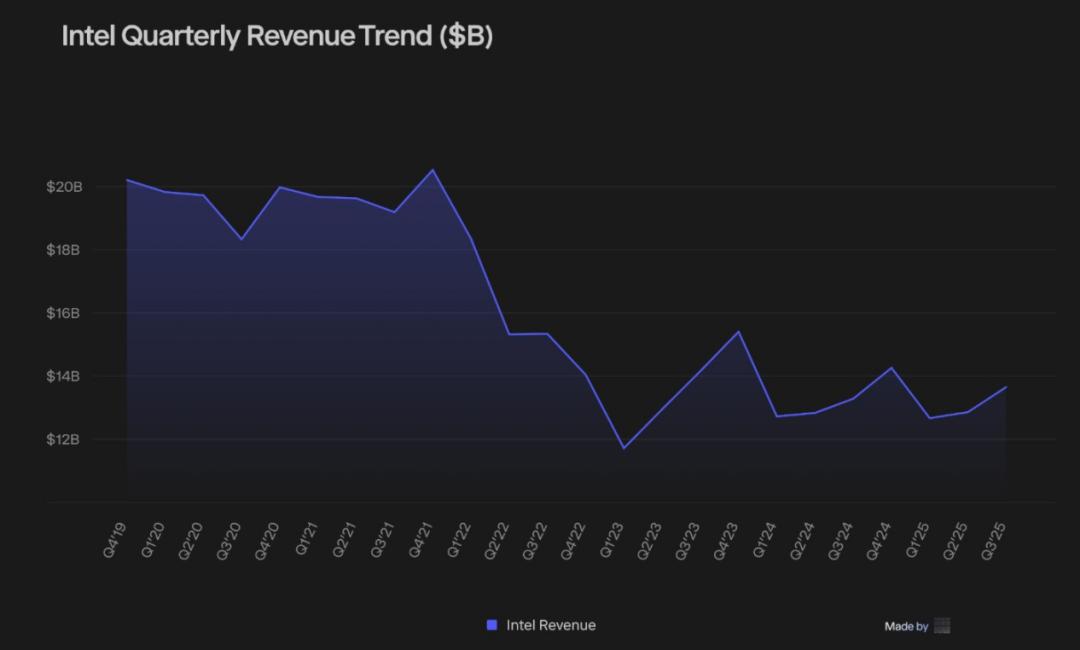
每经AI快讯,1月23日,英特尔去年第四季度营收136.7亿美元,同比减少4.1%,市场预估134.3亿美 元;第四季度调整后每股收益0.15美元,上年同期0.13美元,预估0.09美元。英特尔预计第一季度调整 后每股收益0.0美元,市场预估0.08美元;预计第一季度营收117亿美元至127亿美元,预估125.6亿美 元。英特尔盘后跌超5%。 (文章来源:每日经济新闻) ...

英特尔(INTC.O)Q1营收展望为117亿至127亿美元,市场预期为126亿美元。
Jin Rong Jie· 2026-01-22 21:16
英特尔(INTC.O)Q1营收展望为117亿至127亿美元,市场预期为126亿美元。 本文源自:金融界AI电报 ...
英特尔(INTC.O)2025年Q4营收136.7亿美元,市场预期133.7亿美元,上年同期142.6亿美元。
Jin Rong Jie· 2026-01-22 21:16
本文源自:金融界AI电报 英特尔(INTC.O)2025年Q4营收136.7亿美元,市场预期133.7亿美元,上年同期142.6亿美元。 ...
英特尔四季度数据中心和AI营收47.4亿美元,预期44.2亿美元。预计一季度营收117亿-127亿美元,分析师预期125.6亿美元
Hua Er Jie Jian Wen· 2026-01-22 21:02
市场有风险,投资需谨慎。本文不构成个人投资建议,也未考虑到个别用户特殊的投资目标、财务状况或需要。用户应考虑本文中的任何 意见、观点或结论是否符合其特定状况。据此投资,责任自负。 英特尔四季度数据中心和AI营收47.4亿美元,预期44.2亿美元。 预计一季度营收117亿-127亿美元,分 析师预期125.6亿美元。 风险提示及免责条款 ...
CPU产能告急要涨价,英特尔股价半年狂飙180%
2 1 Shi Ji Jing Ji Bao Dao· 2026-01-22 15:01
Group 1 - The core viewpoint of the article highlights the surge in CPU concept stocks in the A-share market, driven by the AI wave and a significant shift in the global CPU supply-demand landscape, leading to optimistic market sentiment and price increase expectations [2][3] - Major players like Intel and AMD have seen their server CPU capacities for 2026 nearly sold out due to aggressive procurement by large cloud service providers, prompting both companies to plan a price increase of 10% to 15% for server CPUs [3] - The traditional view of CPUs as steadily growing products is changing, as the supply-demand dynamics are becoming more elastic, similar to the storage chip market, with pricing power shifting towards sellers [6] Group 2 - The rapid evolution of artificial intelligence has created a strong demand for high-performance computing and storage facilities, benefiting companies like Micron and Western Digital, while the market is now looking for the next structural opportunity, with CPUs being identified as a potential area of growth [7] - The importance of CPUs is expected to increase as new computing scenarios emerge, requiring higher computational speed and precision, especially as AI transitions from simple assistants to more complex agents [8][9] - Intel's upcoming quarterly earnings report is seen as a critical moment to assess the initial results of its recent transformation under CEO Pat Gelsinger, who emphasizes engineering innovation and customer-centric strategies [11][12]

年内已经上涨37%,明早的英特尔财报看什么?
Hua Er Jie Jian Wen· 2026-01-22 14:35
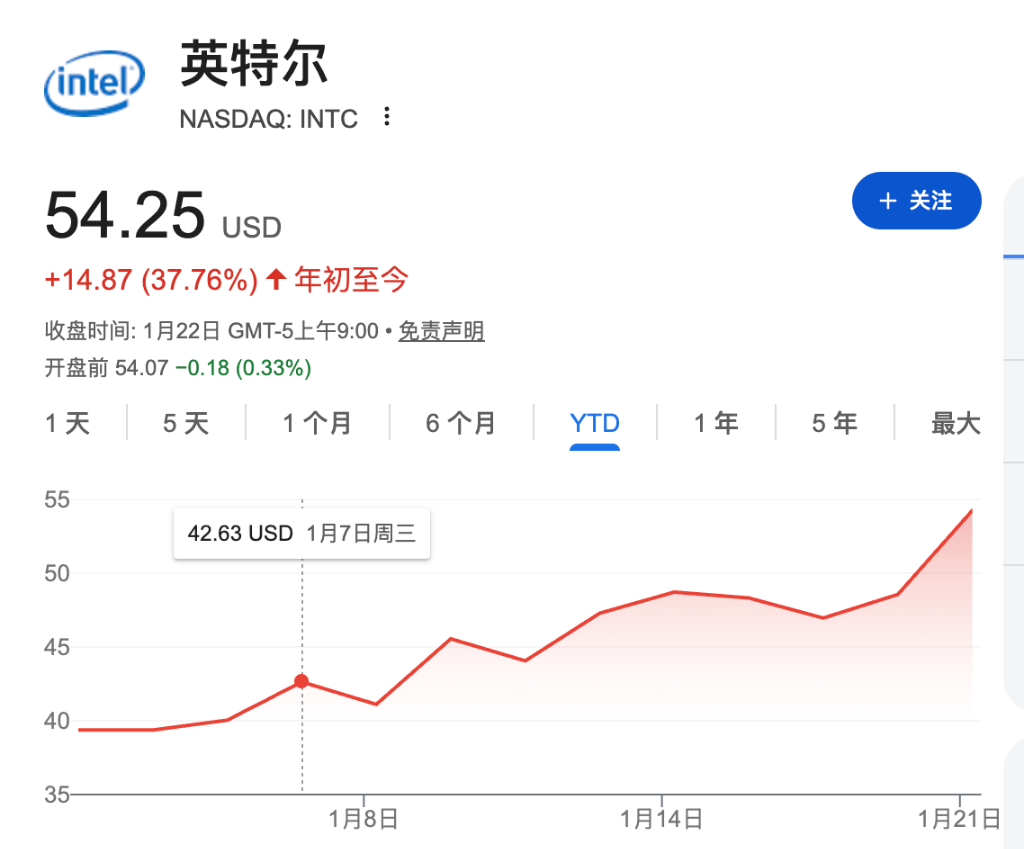
Core Viewpoint - Intel's stock has risen 37% this year, closing at $54.25 on January 21, marking a new high since January 2022. The upcoming quarterly earnings report is anticipated to focus on three core growth drivers: AI Agent-driven CPU demand, advancements in the 18A process technology, and breakthroughs in the foundry business [1]. Group 1: AI Agent and Server CPU Demand - The market views AI Agents as a key growth driver for Intel's server business, with KeyBanc reporting that Intel's server CPU capacity for 2026 is nearly sold out. HSBC predicts that demand for server CPUs driven by Agentic AI could grow by 30%-40%, significantly exceeding the market's expected growth of 4%-6% [3]. - The earnings report will focus on two key indicators: revenue growth in the Data Center and AI (DCAI) business, which Morgan Stanley expects to grow by 11.5% quarter-over-quarter, and the average selling price (ASP) of server CPUs, which has reportedly increased by 10%-15% [4][5]. Group 2: 18A Process and Panther Lake Progress - The 18A process is critical for Intel's return to process leadership, with the Panther Lake processor being the first product to utilize this technology. The earnings report will look for signals regarding DCAI revenue and ASP increases, which could validate the demand from AI Agents [4][5]. - The yield and production pace of the 18A process will directly impact Intel's gross margin recovery and cost competitiveness. Positive early orders or collaboration intentions from PC manufacturers regarding the Panther Lake processor would demonstrate the commercial viability of the 18A process [5]. Group 3: Foundry Business Developments - Intel's foundry business (IFS) is seen as a key growth curve for valuation reformation, but market skepticism remains regarding its ability to attract external customers. Reports indicate a lack of visibility in potential collaborations with major companies like Apple and NVIDIA [6]. - Any progress reported during the earnings call regarding external customer acquisition or actual orders for advanced packaging technologies would significantly boost market expectations. This will be crucial for validating Intel's transition from an IDM 2.0 strategy to a market-oriented foundry business [6].
AI推理引爆需求!CPU产能告急,涨价来袭
2 1 Shi Ji Jing Ji Bao Dao· 2026-01-22 13:56
Group 1: Market Dynamics - The AI wave has caused a dramatic reversal in the global CPU supply-demand landscape, leading to a surge in optimism for CPU-related stocks, with notable increases in share prices for companies like Loongson Technology and Chipsea Technology [1] - In the US market, Intel's stock rose by 11% and AMD by 7%, with Intel's price rebounding approximately 180% over the past six months, reaching a new high since January 2022 [1] - KeyBanc data indicates that Intel and AMD's server CPU capacity for 2026 is nearly sold out due to aggressive procurement by major cloud service providers, prompting both companies to plan a price increase of 10% to 15% for server CPUs [1] Group 2: Industry Trends - The traditional view of CPUs as steadily growing products is shifting, as the CPU market begins to exhibit high elasticity similar to the storage industry, with pricing power moving towards sellers due to rigid capacity constraints and recovering demand [2] - The AI boom has led major cloud service providers to significantly increase capital expenditures, purchasing GPUs and related AI acceleration cards, while traditional server upgrades are being delayed due to power supply and space constraints [2] - Intel's financial report indicates a projected revenue decline of 2% in 2024, with a net loss of $18.8 billion, highlighting the need for a more conservative strategy in production and inventory management [2] Group 3: Technological Evolution - The rapid evolution of AI has ignited global demand for high-performance computing and storage facilities, with DRAM and NAND Flash experiencing explosive demand, benefiting companies like Micron and Western Digital [3] - The shift in computing architecture is crucial, as CPUs are expected to play a more significant role in AI applications, moving from a supporting role to a central one as the demand for general-purpose computing increases [3][4] - Intel's recent introduction of AI NAS products aims to capture new market demands from small and medium enterprises and home users, indicating a strategic pivot towards edge computing and private cloud solutions [5] Group 4: Intel's Strategic Initiatives - Intel's upcoming quarterly financial report will be a critical test of the company's recent transformation under CEO Pat Gelsinger, who emphasizes engineering innovation and customer-centric strategies [6] - The launch of the third-generation Core Ultra processors, manufactured using Intel's advanced 18A process, represents a significant milestone in the company's commitment to AI-driven product development [6] - Intel's revival strategy focuses on three pillars: reshaping the x86 ecosystem, seizing AI opportunities, and achieving breakthroughs in advanced manufacturing processes, with the success of the 18A process being a key variable for the company's future [7]
冰与火之歌:英特尔的绝地反击与王者归来
3 6 Ke· 2026-01-22 10:36
Core Viewpoint - Intel, once a dominant player in the PC market, faced significant challenges over the past five years, including a $2.92 billion loss in Q2 2025 and a declining market share due to competition from AMD and TSMC. However, a series of strategic investments and internal reforms have positioned the company for a potential turnaround by late 2025, driven by government support and partnerships with industry giants like NVIDIA [1][2][3][5][11]. Group 1: Challenges Faced - Intel reported a net loss of $2.92 billion in Q2 2025, with a gross margin falling below 30% and core business struggles [2]. - AMD's EPYC series captured over 40% market share, leading to a 15% year-over-year decline in orders for Intel's Xeon series due to its lagging 10nm technology [2]. - The company's foundry business has been unprofitable, with a market share of less than 3% and quarterly losses exceeding $1 billion [2]. Group 2: Strategic Turnaround - In August 2025, the U.S. government invested $8.9 billion to acquire a 9.9% stake in Intel, becoming its largest shareholder, signaling a commitment to U.S. chip independence [3][5]. - SoftBank invested $2 billion in Intel's foundry business, while NVIDIA invested $5 billion at a 14% premium to the government's share price, marking a significant partnership for AI chip development [4][5]. - Intel's cash reserves increased to $30.9 billion following these investments, providing a financial cushion for future operations [5]. Group 3: Internal Reforms - CEO Pat Gelsinger initiated a major restructuring, laying off 35,000 employees to reduce annual operating costs by $23.3 billion, with funds redirected to advanced process technology and AI teams [6][7]. - The company reintroduced a "20% free time" policy for engineers to foster innovation, leading to significant improvements in the yield of its 18A process technology [7]. - Intel has begun to embrace an open business model, securing orders from Apple for M-series chips and negotiating future iPhone production contracts [7]. Group 4: Market Dynamics - By 2026, Intel faced a "happy trouble" with a chip shortage driven by unexpected demand for server CPUs, particularly in data centers and AI applications [8]. - However, this shortage was complicated by a mismatch in production capacity, as Intel and OEMs overestimated demand for next-generation CPUs while the majority of demand remained for older models [9]. - The price increases for Intel CPUs were largely driven by OEMs paying "supply chain congestion fees," contrasting with AMD's pricing strategy [9]. Group 5: Future Outlook - Intel's revival is seen as a case study in corporate transformation, highlighting the importance of aligning with national strategies and industry trends while fostering internal innovation [11]. - Despite the positive momentum, challenges remain, including the need for successful mass production of the 18A process and ongoing competition from AMD [11]. - The upcoming Q4 2025 financial report will be critical in assessing Intel's recovery trajectory and its role in the global semiconductor landscape [11].
科技股最新财报季来了!英特尔打头阵,美股科技七巨头走势分化?
Xin Lang Cai Jing· 2026-01-22 10:08
Group 1 - Intel will be the first major U.S. company to report earnings in the current tech earnings season, with the report expected after market close on the 22nd [1][2] - Artificial Intelligence (AI) is anticipated to be a focal point in this earnings season, with investors keen on how major tech firms will monetize their substantial investments in this area [1][3] - Investors are particularly interested in Intel's PC chip sales, with potential performance boosts from Microsoft's discontinuation of Windows 10 support, although ongoing global memory shortages may dampen sales outlook [1][3] Group 2 - The performance of the "Big Seven" tech stocks is showing divergence, attributed to the ongoing AI investment race, which has led to a differentiation among these companies [2][3] - Michael Hartnett, a strategist at Bank of America, noted that the initial grouping of these stocks was due to their size and operational strength, but the AI arms race has caused a split among them [2] - There is an expanding range of stocks benefiting from AI investments, suggesting that new "Big Seven" companies will emerge, particularly those demonstrating that AI is transforming their large businesses [2][3]