TotalEnergies SE

Search documents
背靠农夫山泉,这对夫妻要IPO了
Sou Hu Cai Jing· 2025-11-11 00:47
Core Viewpoint - Jiangtian Technology has successfully passed the IPO review by the Beijing Stock Exchange, indicating its readiness to enter the capital market after over 20 years in the packaging industry, serving major fast-moving consumer goods brands [1][3]. Group 1: IPO Details - Jiangtian Technology plans to publicly issue no more than 176.18 million shares, aiming to raise a total of 531 million yuan, which will be used entirely for the construction of the Jiangtian R&D and manufacturing comprehensive base, including the establishment of intelligent production lines and upgrades to the technology R&D center [2][3]. - The initial fundraising target was 611 million yuan, which included 80 million yuan for working capital. However, after two rounds of inquiries from the Beijing Stock Exchange, the company voluntarily reduced the fundraising amount to alleviate concerns regarding the necessity of the funds [3]. Group 2: Company Background - Established in 2002 and headquartered in Suzhou, Jiangtian Technology specializes in the R&D, production, and sales of label printing products, focusing on self-adhesive labels used in various fast-moving consumer goods sectors [6][8]. - The company has evolved from a regional label printing factory to a significant player in the mid-to-high-end consumer goods market by developing integrated label solutions from design to mass delivery [8]. Group 3: Ownership and Governance - The actual controllers of Jiangtian Technology, Teng Qi and Huang Yanguo, are a married couple, with Teng Qi serving as the chairman and Huang Yanguo as the general manager. Together, they control 88.70% of the voting rights through a joint action agreement [9][10]. - The company has not introduced external institutional investors, resulting in a highly concentrated capital structure, which raises regulatory concerns regarding governance, independence, and future capital operations [10]. Group 4: Client Relationships - Jiangtian Technology's growth is closely tied to its deep relationship with major clients, particularly Nongfu Spring, which accounted for approximately 40% of its sales [11][12]. - The company has established long-term partnerships with well-known brands such as Unilever, Procter & Gamble, Shell, Total, Wyeth, Mondelēz, Xiangpiaopiao, Heytea, Yili, Mengniu, Haidilao, and Blue Moon [13].



五大西方能源巨头三季度业绩略有改善
中国能源报· 2025-11-11 00:06
Core Insights - The five major Western energy giants reported their Q3 earnings, showing an overall increase in profits compared to Q2, but still facing significant pressure [1][3]. ExxonMobil - ExxonMobil reported a Q3 profit of $7.55 billion, a year-on-year decline of 12.3% but a quarter-on-quarter increase of 6.6%, with total revenue of $85.29 billion [5]. - Daily net production reached 4.7 million barrels of oil equivalent, driven by strong output from Guyana and the Permian Basin, with Guyana's daily production exceeding 700,000 barrels [5]. - The company invested $2.4 billion in "growth acquisitions" during the quarter, including multiple block transactions in the Permian Basin [5]. - ExxonMobil plans to add three floating production storage and offloading units in Guyana by 2029, aiming to increase daily production to nearly 1.5 million barrels [5]. - The CEO stated that new low-cost capacity remains competitive for decades, with projects in Guyana and the Permian Basin breakeven at oil prices below $35 per barrel [5]. - Capital expenditures for the year are expected to be in the range of $27 billion to $29 billion, with structural cost savings exceeding $14 billion since 2019, aiming for over $18 billion by the end of 2030 [5]. Chevron - Chevron achieved a Q3 profit of $3.54 billion, a year-on-year decline of 21% but a quarter-on-quarter increase of 42.2%, with total revenue of $49.73 billion [7]. - The acquisition of Hess Corporation contributed to increased oil production and cash flow, with daily production reaching 4.1 million barrels of oil equivalent [7]. - The CEO emphasized efforts to transform the company into a stable cash flow "generator" to better withstand oil market volatility [7]. - Chevron is controlling production growth in capital-intensive shale fields and implementing a global workforce reduction of 20% to enhance cash flow [7]. BP - BP reported a Q3 net profit of $2.21 billion, with little year-on-year change and a slight quarter-on-quarter decline [9]. - Operational improvements and increased oil and gas production offset the impact of falling oil prices, leading to solid performance in Q3 [9]. - The CEO highlighted progress in cost reduction, strengthening the balance sheet, and increasing cash flow and returns, while accelerating strategic adjustments [10]. - BP aims to reduce net debt to $14 billion to $18 billion by the end of 2027, with capital expenditures expected to be around $14.5 billion this year [10]. Shell - Shell reported a Q3 net profit of $5.4 billion, a slight year-on-year decline but a quarter-on-quarter increase of 26.8%, with total revenue of $68.153 billion [12]. - Record production was achieved in Brazil's deepwater and the highest output in 20 years from the U.S. Gulf of Mexico, contributing to the second-highest quarterly profit in over a decade [12]. - The CEO noted strong performance across all business segments, particularly in marketing and deepwater assets, supporting a new round of stock buybacks [12]. - Shell plans to return $3.6 billion to shareholders through stock buybacks, marking the 16th consecutive quarter of at least $3 billion in buybacks [12]. - Capital expenditures for the year are expected to be in the range of $20 billion to $22 billion [12]. TotalEnergies - TotalEnergies reported an adjusted net profit of $3.98 billion for Q3, a year-on-year decrease of 2.9% but a quarter-on-quarter increase of 10.6%, with total revenue of $43.84 billion [14]. - The company benefited from increased oil and gas production and improved downstream performance, with exploration and production earnings of $2.2 billion and downstream earnings of $1.1 billion [14]. - The CEO attributed strong financial performance to over 4% year-on-year growth in oil and gas production and improved downstream results [14]. - TotalEnergies plans to convert its American Depositary Receipts into common stock, aiming to reduce the stock's discount relative to U.S. peers [14]. - Investment spending for the year is expected to remain in the range of $17 billion to $17.5 billion [14].



Big Oil Earnings Season Marks A Return To Basics With Lower Profits
Forbes· 2025-11-10 18:55
Core Insights - The quarterly earnings season for major oil companies revealed a trend of lower profits compared to previous years, signaling a return to oil and gas fundamentals [1][2][4] - The global crude oil benchmark Brent has seen a nearly 16% decline year-to-date, raising concerns about a potential oil supply glut [3][5] Financial Performance - Major oil companies reported annual profit declines ranging from 2% to 12%, with specific figures including Chevron (-2%), TotalEnergies (-2%), BP (-6%), Shell (-10%), and ExxonMobil (-12%) [4][5] - Saudi Aramco, the largest by market capitalization, reported a 2.3% decline in profits [5] Investment Trends - Industry leaders emphasized the need for increased investment in oil and natural gas to meet ongoing demand, which is expected to remain above 100 million barrels per day beyond 2040 [6][7] - TotalEnergies' CEO highlighted that the energy transition requires more energy with fewer emissions, indicating a continued reliance on oil and gas [8] Strategic Shifts - BP's CEO announced a strategic shift back to traditional hydrocarbon investments, reducing its focus on low-carbon initiatives after previous costly ventures [9][10] - Other companies, such as Chevron and Shell, have also significantly cut their low-carbon spending, indicating a broader trend within the industry to prioritize higher returns from hydrocarbon projects [10][11] Market Outlook - The industry is facing a potential energy shock if oil project investments are not managed properly, as demand continues to grow [7] - Executives from various companies have expressed a cautious approach to low-carbon spending, citing disappointing demand and inadequate global policies as barriers to investment [11]
炼油利润率强劲抵消油价低迷影响 欧洲能源巨头Q3盈利展现超预期韧性
智通财经网· 2025-11-10 06:52
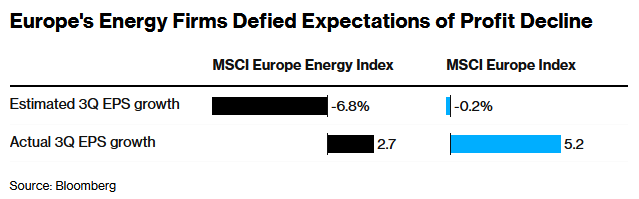
Core Viewpoint - European energy companies outperformed expectations in Q3, driven by strong refining margins that offset weak oil prices, despite an unclear outlook for 2026 [1][3]. Group 1: Company Performance - The MSCI Europe Energy Index saw a 2.7% increase in earnings per share in Q3, contrasting with a market expectation of a 6.8% decline [1]. - Major oil companies like Shell, BP, and Eni were key contributors to the earnings surprise in the MSCI Europe Energy Index [3]. - BP's Q3 profits exceeded expectations, boosting investor confidence in its business recovery [3]. - Shell's profits and free cash flow also surpassed expectations, driven by strong natural gas trading and improved refining margins [3]. - Repsol is entering Q4 with positive momentum from its refining business, which helps mitigate macroeconomic headwinds and weak benchmark oil prices [3]. Group 2: Industry Insights - Other European companies like Galp Energia, Total, and OMV achieved solid profits due to their refining business advantages [4]. - Analysts believe the market has not fully recognized the current strength of refining margins [4]. - The optimistic outlook from major oil companies has reassured investors, with expectations for continued stock buybacks and dividends [4]. - Shell's strategy to increase investments in oil and gas while cautiously expanding renewable energy is seen as prudent and beneficial for mid-term earnings and shareholder returns [4]. Group 3: Future Outlook - The oil and gas industry remains susceptible to further oil price fluctuations, with a projected oil price of around $68 per barrel for 2026 [7]. - A drop in oil prices to $60 could lead to a 20% reduction in earnings per share across the sector [7]. - The current strong refining margins may not be sustainable, as they are expected to normalize [7]. - Despite the robust performance in Q3, the earnings of the five major oil giants are still less than half of their 2022 levels, indicating a long recovery path for the industry [7].
道达尔能源将出售北美太阳能资产
Zhong Guo Hua Gong Bao· 2025-11-10 02:56
Core Viewpoint - TotalEnergies has agreed to sell 50% of its solar project assets in North America to KKR for approximately $1 billion, which includes a total installed capacity of 1.4 GW across multiple solar facilities [1] Company Summary - The transaction involves six utility-scale solar power facilities and 41 distributed generation facilities [1] - TotalEnergies' head of gas, renewables, and power, Stéphane Michel, stated that the deal will unlock asset value and enhance the profitability of the company's integrated power business [1] Industry Summary - According to the American Solar Energy Association, nearly 18 GW of new solar capacity was added in the first half of the year, accounting for 82% of all new power generation capacity [1] - However, due to policies from the Trump administration, it is projected that the U.S. solar industry will see 44 GW less new capacity than previously expected by 2030 [1]


记者观察:全球首个商业“碳坟场”什么样?
Xin Hua She· 2025-11-09 04:07
Core Insights - The world's first full-chain carbon capture and storage (CCS) project, known as "Longship," has commenced commercial operations in Norway, marking a significant milestone in the CCS industry [1][3][4] - Norway's unique resources, geographical conditions, and financial strength have positioned it as a leader in advancing CCS projects, although operational and regulatory frameworks still require improvement [1][6] Investment and Financial Aspects - The "Longship" project has a total investment of 340 billion Norwegian Krone (approximately 33.8 billion USD), making it Norway's largest climate investment project to date [3][4] - The Norwegian government has provided around 220 billion Norwegian Krone (21.9 billion USD) in subsidies for construction and operation, while the EU has allocated 1.31 billion Euros (1.5 billion USD) to support the project [4][6] Technical and Operational Details - The project captures CO2 from a waste incineration plant and a cement factory in Oslo, transporting it via ship to a seabed geological layer for permanent storage at depths of 2,600 meters [3][4] - In its first phase, the project aims to sequester 1.5 million tons of CO2 annually, increasing to 5 million tons per year after 2028 [4][6] Strategic Partnerships and Future Prospects - The project is a collaboration between Equinor, Shell, and TotalEnergies, with Chinese shipbuilding companies involved in constructing the CO2 transport vessel [4][6] - The "Longship" project targets European companies in sectors like cement, steel, refining, and chemicals, indicating a broad commercial potential [10] Regulatory and Management Framework - The Norwegian government has established Gassnova, a state-owned enterprise, to oversee the CCS industry, ensuring effective risk management and coordination among various projects [10][11] - Despite significant government support, the regulatory framework for CCS still needs enhancement to build investor confidence and reduce operational costs [10][11]

Constellation Energy Q3 Earnings Lag Estimates, Revenues Rise Y/Y
ZACKS· 2025-11-07 16:56
Core Insights - Constellation Energy Corporation (CEG) reported Q3 2025 earnings of $3.04 per share, which was 2.89% below the Zacks Consensus Estimate of $3.13, but represented a 10.9% increase from $2.74 in the same quarter last year [1][9] Financial Performance - Total revenues for Q3 2025 reached $6.57 billion, exceeding the Zacks Consensus Estimate of $6.12 billion by 7.3%, and showing a slight increase of 0.3% from $6.55 billion in Q3 2024 [2][9] - Total operating expenses were $5.48 billion, up 7.8% from $5.1 billion in the year-ago period, while operating income decreased to $1.08 billion from $1.47 billion [3] - Net interest expenses decreased by 8.8% to $134 million from $147 million in the previous year [3] Operational Highlights - CEG's owned output from the Salem and South Texas Project Generating Stations produced 46,477 gigawatt-hours (GWhs) in Q3 2025, an increase from 45,510 GWhs in Q3 2024 [4] - Renewable energy capture for the company's wind, solar, and run-of-river hydro fleet improved to 96.8% compared to 96% in the same quarter last year [4] Strategic Developments - The company reached a settlement with the Maryland Department of the Environment, allowing continued operation of the Conowingo dam, which supports the operation of its hydroelectric facility [5] Financial Position - As of September 30, 2025, CEG had cash and cash equivalents of $3.96 billion, up from $3.02 billion as of December 31, 2024 [6] - Long-term debt stood at $7.27 billion, a decrease from $7.38 billion as of December 31, 2024 [6] - Cash provided from operating activities in the first nine months of 2025 was $3.43 billion, compared to $1.45 billion used in the same period last year [6] Capital Expenditures - Total capital expenditures in the first nine months of 2025 were $1.96 billion, an increase from $1.83 billion a year ago [7] Guidance - CEG narrowed its full-year 2025 adjusted operating earnings guidance to a range of $9.05-$9.45 per share, down from the previous range of $8.90-$9.60, with the Zacks Consensus Estimate at $9.44 per share [8]


全球液化天然气分析 2035_液化天然气供应增长凸显需求侧基础设施必要性-Global LNG Analyzer 2035_ Rising LNG supply underscores need for demand-side infrastructure
2025-11-07 01:28
Summary of Global LNG Market Analysis Industry Overview - The global LNG market is entering a multi-year period of unprecedented supply expansion, with approximately **400 Bcm/year** of new projects under construction and scheduled to come online between **2025 and 2035** [6][21][50] - The US leads the export project pipeline, accounting for **51%** of total capacity under construction, followed by Qatar (**17%**), Canada/Mexico (**10%**), and the UAE (**3%**) [6][21][26] Demand Dynamics - Demand growth in key established LNG markets—China, Japan/South Korea, and Europe—is slowing [6][21] - China is expected to see LNG imports peak at **120 Bcm** in **2032** [6][21] - Japan and South Korea are increasingly prioritizing nuclear and renewables, reducing reliance on imported LNG and coal, with projected growth of **15 Bcm** in LNG imports between **2025 and 2035** [6][21] - European LNG imports are projected to grow moderately by **26 Bcm** over the next decade [6][21] Emerging Markets - The onus to accommodate new LNG supply is shifting to emerging LNG markets in APAC (Taiwan, India, Thailand, Pakistan, Bangladesh, Indonesia), where demand is expected to more than double from **127 Bcm** in **2025** to **280 Bcm** by **2035** [6][21] - However, the APAC gas market faces significant challenges, including tightening regasification capacity and limited gas storage infrastructure [6][21] Infrastructure Needs - Upgrading demand-side infrastructure will be critical for global LNG demand growth to keep pace with the anticipated supply expansion [6][21] - The spread between US and global natural gas prices is expected to narrow, with the US emerging as the marginal supplier [6][21] Regional Insights North America - The US is projected to add approximately **26 Bcm/year** of liquefaction capacity in **2026**, with significant growth expected in **2028 and 2029** [31] - Canada is also expanding its LNG export capacity, with projects like LNG Canada and Coastal GasLink pipeline [32][33] Middle East - Qatar's LNG capacity increases represent the second-largest source of new supply after the US, with significant projects like North Field East and North Field South [34][38] Africa - Africa is the third-largest region for new LNG export capacity additions, led by Mozambique LNG and Nigeria [75][76] - Security concerns in Mozambique and operational challenges in Nigeria may hinder capacity utilization [80] Australia and the Pacific - Australia's LNG exports are expected to marginally increase in the near term but face long-term challenges due to resource constraints and regulatory risks [56][60] - Indonesia is undergoing a transformation in its natural gas sector, with new offshore discoveries expected to boost production [68] Conclusion - The global LNG market is poised for significant changes driven by supply expansions, shifting demand dynamics, and the need for infrastructure upgrades. Emerging markets in APAC will play a crucial role in absorbing new supply, while established markets face challenges in growth. The interplay between supply and demand will shape pricing and operational strategies in the coming years [6][21][50]

$60 Oil Undercuts Trump’s ‘Drill, Baby, Drill’ Agenda
Yahoo Finance· 2025-11-07 01:00
Core Theme - The U.S. shale oil industry is not primarily focused on increased drilling despite favorable regulatory conditions and support from the Trump administration [1][3]. Production Strategies - U.S. oil and gas producers are enhancing production through consolidation and efficiency improvements rather than drilling new wells, utilizing drilled but uncompleted wells (DUCs) to increase output [2][3]. - The total rig count has decreased to 546, down by 39 rigs from the previous year, indicating a decline in drilling activity [4]. Market Conditions - The U.S. benchmark oil price has fallen by approximately 15% since President Trump's inauguration, affecting producers' strategies [2]. - Industry executives suggest that if oil prices remain around $60 per barrel, the shale industry may plateau or begin to decline [5][6]. Production Outlook - U.S. oil output is projected to grow by 300,000 to 400,000 barrels per day this year, but this growth is contingent on oil prices remaining favorable [5]. - Current WTI prices have fluctuated just below or above $60 per barrel, with concerns of an impending oversupply in the market [6].
National Fuel Gas Q4 Earnings Beat Estimates, Revenues Increase Y/Y
ZACKS· 2025-11-06 17:41
Core Insights - National Fuel Gas Company (NFG) reported strong fourth-quarter fiscal 2025 adjusted operating earnings of $1.22 per share, exceeding the Zacks Consensus Estimate of $1.08 by 12.96% and marking a 58% increase from the previous year's figure of 77 cents [1][7] - Total revenues for the quarter were $456.4 million, falling short of the Zacks Consensus Estimate of $547 million by 16.6%, but representing a 22.6% increase from $372.1 million in the prior year [2] - NFG announced a significant acquisition of CenterPoint Energy's Ohio natural gas utility for $2.62 billion, expected to close in the fourth quarter of 2026, which is anticipated to double the Utility segment's rate base [5][7] Financial Performance - Fiscal full-year operating earnings reached $6.91 per share, up 37.9% from $5.01 in fiscal 2024 [1] - Total operating expenses decreased to $276.6 million, down 51.35% from $568.6 million in the year-ago quarter, leading to an operating income of $179.8 million compared to an operating loss of $196.6 million in the previous year [4] - Net cash provided by operating activities for fiscal 2025 totaled $1.1 billion, slightly up from $1.07 billion in the previous year [8] Segment Performance - Utility segment revenues totaled $87.8 million, a 10% increase from $79.8 million in the year-ago quarter [3] - Integrated upstream and Gathering and Other segments reported revenues of $300.4 million, up 33.6% from $224.9 million in the prior year [3] - Pipeline and Storage segment revenues amounted to $68.2 million, reflecting a 1.3% increase from $67.3 million recorded in the year-ago quarter [3] Production and Guidance - During the fiscal fourth quarter, Seneca produced 112 billion cubic feet (Bcf) of natural gas, an increase of 20 Bcf, or 21%, from the prior-year level [5] - NFG provided guidance for adjusted earnings per share for fiscal 2026 in the range of $7.60 to $8.10, with the Zacks Consensus Estimate at $7.83 [9] - The company expects capital expenditure for fiscal 2026 to be between $0.96 billion and $1.07 billion, with production anticipated in the range of 440-455 Bcf [9]