
苏州银行

Search documents
AI走进指数投资,大模型青睐银行股、“易中天”
Di Yi Cai Jing Zi Xun· 2025-11-12 07:49
Core Insights - The integration of AI technology into the securities industry is accelerating, with a focus on utilizing large language models for investment decision-making and risk management [1][4] - The "Large Model Stable 50" index, launched by GaoHua Securities, has achieved a cumulative return of 23.2% since its inception, outperforming other indices [1][2] - The index primarily includes banking stocks, indicating a preference for stable, dividend-paying companies [2][6] Index Performance - The "Large Model Stable 50" index reached a point of 2007.24, with a monthly increase of 3.75% and a year-to-date increase of 16.8%, reflecting a historical annualized return of 20.5% [2] - The "Large Model New Quality Productivity" index, focusing on sectors like semiconductors and AI, has a year-to-date increase of 41.28% and a historical annualized return of 17.61% [2] - The top ten constituents of the "Large Model Stable 50" index are predominantly banks, with over 40% of the index's weight in the financial sector [2][3] Sector Focus - The "Large Model New Quality Productivity" index has a high concentration of technology stocks, with the top three constituents being New Yi Sheng, Hikvision, and Tianfu Communication [2][3] - The information technology sector comprises over half of the companies in the index, followed by communication services and industrial sectors [3] Investment Themes - The themes of dividends and growth are highlighted as significant for A-share investments, with a noted increase in the popularity of dividend-focused strategies over the past few years [6][7] - The integration of AI in investment strategies is expected to strengthen as the trend of index-based investing continues to grow [4][5] - The use of AI models for portfolio adjustments is based on comprehensive assessments of market data, fundamentals, and sentiment, ensuring a systematic approach to risk management [7]





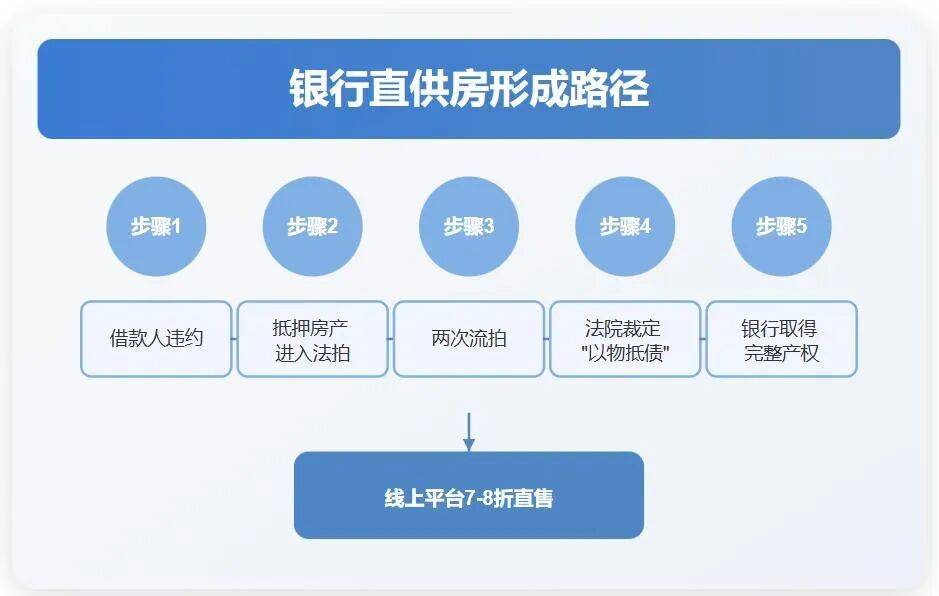
银行亲自下场卖房,世界终于开始颠了!
Sou Hu Cai Jing· 2025-11-12 07:14
Core Viewpoint - The recent surge in banks selling properties is primarily driven by an increase in mortgage defaults, leading banks to directly dispose of non-performing assets through property sales [1][9]. Group 1: Current Market Situation - Various banks have listed a significant number of properties for sale, with Sichuan Agricultural Credit Cooperative being the largest with over 24,000 listings [2]. - The average disposal period for judicial auction properties is around two years, indicating inefficiencies in the current system [3]. - The pricing system for auctioned properties is not well-established, leading to many properties failing to sell at auction [3]. Group 2: Reasons for Banks Selling Properties - The increase in mortgage defaults has resulted in banks needing to handle a larger volume of properties [9]. - Traditional methods of asset disposal, such as judicial auctions and asset management companies (AMCs), have proven to be inefficient and often result in significant losses [9]. - Banks are compelled to sell properties directly to expedite asset disposal and reduce non-performing asset ratios [10]. Group 3: Challenges in Property Sales - Properties sold by banks are typically priced 20% to 30% below market value, yet sales remain sluggish [7]. - The actual market price of properties can fluctuate significantly, complicating the sale process [8]. - The core issue remains the pricing of properties, as many judicial auction properties fail to sell due to unrealistic price expectations [10]. Group 4: Implications for the Banking Sector - Direct property sales by banks are a response to the accumulation of non-performing assets, necessitating a more hands-on approach to asset management [10]. - While this strategy may improve asset disposal efficiency, it does not guarantee better overall outcomes if pricing issues are not addressed [10]. - The current situation reflects a broader trend where banks, previously insulated from market pressures, are now facing significant challenges [11].

三季度公募含“银”量创五年新低,四季度银行股修复动能渐显
第一财经· 2025-11-11 14:59
Core Viewpoint - The article highlights the significant changes in the banking sector, particularly focusing on the increasing shareholding of local state-owned enterprises and insurance funds in various banks, while public funds and northbound capital are reducing their holdings. The overall market sentiment for bank stocks is showing signs of recovery in the fourth quarter after a challenging third quarter [3][10][12]. Group 1: Shareholding Changes - Action Person's total shareholding ratio has risen to 19.17%, making it the largest shareholder of Qingdao Bank [3]. - Many city commercial banks and national banks have disclosed shareholding increase plans or have already implemented them, including Chengdu Bank, Nanjing Bank, and Postal Savings Bank [3]. - The number of shareholders in banks like China Merchants Bank and Beijing Bank has increased significantly, indicating a rise in retail investor participation alongside a decline in institutional holdings [5][6]. Group 2: Fund Holdings and Market Performance - Public funds' exposure to bank stocks has dropped to a five-year low, with a decrease in their overall holdings [4][6]. - The banking sector saw a decline of 8.68% in the third quarter but rebounded with an increase of 8.23% in the fourth quarter as of November 11 [3]. - Northbound capital inflow into banks decreased by 31.66% in the third quarter, with only a few banks like Ningbo Bank and Chengdu Bank seeing net inflows [7]. Group 3: Institutional Investment Trends - Insurance funds and state-owned capital have maintained relatively stable holdings in bank stocks, with state-owned funds holding a total market value of 4.5 trillion yuan [8]. - The increase in local state-owned capital investments in city commercial banks reflects a strategy to strengthen regional financial resource control and capitalize on low valuations [9]. - The investment sentiment in the banking sector is expected to improve in the fourth quarter, with several banks announcing share buyback plans [10][11]. Group 4: Future Outlook - The article suggests that the banking sector may experience structural recovery opportunities in the fourth quarter, driven by high dividend yields and the resilience of regional banks [10][12]. - Analysts believe that the combination of increased institutional investment and favorable market conditions could lead to a stabilization phase for bank stocks [11][12].

三季度公募含“银”量创五年新低 四季度银行股修复动能渐显
Di Yi Cai Jing· 2025-11-11 13:51
Core Viewpoint - Qingdao Guoxin Financial Holdings has become the largest shareholder of Qingdao Bank with a total holding of 19.17% [1] - The banking sector is experiencing a mixed performance with increased shareholder activity, particularly from local state-owned and industrial capital, while facing pressure from public funds and northbound capital [1][2] Group 1: Shareholder Activity - Multiple city commercial banks and national banks have reported significant shareholder increases this year, including Chengdu Bank, Nanjing Bank, and Postal Savings Bank [1] - Public funds have reduced their holdings in bank stocks, with the proportion of public fund investment in bank stocks dropping to 1.78%, the lowest level in five years [2][3] - Northbound capital has also decreased its investment in banks, with a 31.66% decline in total market value held by northbound funds [3] Group 2: Market Performance - The banking sector saw an 8.68% decline in Q3 but rebounded with an 8.23% increase in Q4 as of November 11 [1] - The overall market style shift has led to a significant reallocation of funds from low-volatility bank stocks to high-growth sectors, with the Wind All A Index rising by 19.5% during the same period [4] Group 3: Institutional Investment Trends - Insurance and state-owned funds have maintained stable holdings in bank stocks, with state-owned funds holding a total market value of 4.5 trillion yuan [5][6] - Local state-owned and industrial capital are increasingly investing in city commercial banks, driven by regional financial resource integration needs and attractive valuations [6] Group 4: Future Outlook - There is a growing sentiment of recovery in the banking sector, with several banks announcing share buyback plans and improved core revenue capabilities [7] - Analysts suggest that Q4 presents structural recovery opportunities, particularly for quality regional banks and high-dividend state-owned banks [8]
三季度公募含“银”量创五年新低,四季度银行股修复动能渐显
Di Yi Cai Jing· 2025-11-11 13:40
Core Viewpoint - Qingdao Guoxin Chanin Holdings has become the largest shareholder of Qingdao Bank with a total holding of 19.17% [1] - The banking sector is experiencing a mixed performance with significant shareholder activity, particularly in the context of third-quarter financial reports [1][2] Shareholder Activity - Multiple city commercial banks and national banks have reported shareholding increases, including Chengdu Bank, Nanjing Bank, and Postal Savings Bank [1] - Public funds have reduced their holdings in bank stocks, with the proportion of public funds in bank stocks dropping to 1.78%, a decrease of 2.55 percentage points [2][3] Market Performance - The banking sector saw a decline of 8.68% in the third quarter but rebounded with an increase of 8.23% in the fourth quarter as of November 11 [1] - The overall market style shift has led to a significant reallocation of funds from low-volatility bank stocks to high-growth sectors [4] Fund Composition - Active funds have reduced their positions in major banks like China Merchants Bank and Jiangsu Bank, while some banks like Ningbo Bank and Chengdu Bank saw an increase in holdings [3] - Passive funds also exhibited a reduction in bank stock holdings, with a total market value of 841.12 billion yuan, down 5.67 percentage points [3] Institutional Investment Trends - Insurance and state-owned funds have maintained stable holdings in bank stocks, with state-owned funds holding a total market value of 4.5 trillion yuan [5][6] - Local state-owned capital is increasingly investing in city commercial banks, driven by regional financial resource integration needs and attractive valuations [6] Future Outlook - The fourth quarter has seen a wave of share buyback announcements from bank executives and major shareholders, signaling positive investment sentiment [7] - Analysts believe there are structural recovery opportunities in the banking sector, particularly for regional banks and high-dividend state-owned banks [7][8]
城商行板块11月11日跌0%,上海银行领跌,主力资金净流入2.41亿元
Zheng Xing Xing Ye Ri Bao· 2025-11-11 08:46
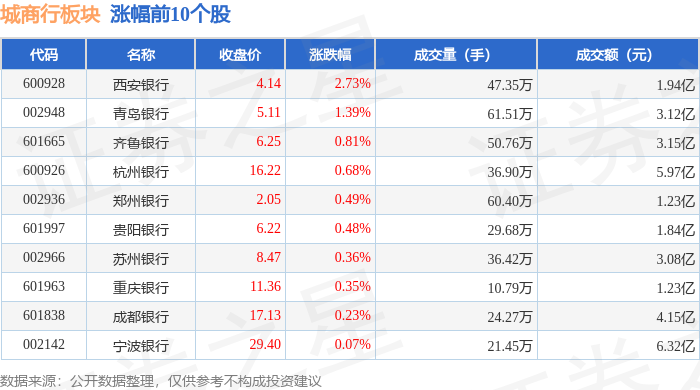
Market Overview - The city commercial bank sector experienced a slight decline of 0.0% on November 11, with Shanghai Bank leading the drop [1] - The Shanghai Composite Index closed at 4002.76, down 0.39%, while the Shenzhen Component Index closed at 13289.0, down 1.03% [1] Individual Bank Performance - Xi'an Bank saw the highest increase in share price, closing at 4.14 with a rise of 2.73% [1] - Qingdao Bank and Qilu Bank also reported positive performance, with increases of 1.39% and 0.81% respectively [1] - Shanghai Bank, on the other hand, closed at 10.13, down 0.98%, indicating a significant decline in its stock price [2] Trading Volume and Capital Flow - The city commercial bank sector recorded a net inflow of 241 million yuan from institutional investors, while retail investors saw a net outflow of 290 million yuan [2] - Jiangsu Bank attracted the highest net inflow from institutional investors at 113 million yuan, representing 11.75% of its trading volume [3] - In contrast, Zhengzhou Bank experienced a net outflow of 421,280 yuan from institutional investors, indicating a negative sentiment towards its stock [3]




真金白银!年内十余家上市银行获股东、高管增持,银行“防御性板块”角色要变?
Xin Lang Cai Jing· 2025-11-10 12:57
Core Viewpoint - The recent surge in share buybacks by various banks, including Qilu Bank and Qingdao Bank, reflects strong confidence in the long-term value of the banking sector, with over 10 listed banks participating in this trend [1][9][10]. Group 1: Share Buybacks - Qilu Bank announced that its directors, supervisors, and senior executives have collectively increased their holdings by 3.15 million yuan, accounting for 90% of the planned buyback amount [1]. - Qingdao Bank's major shareholder, Qingdao Guoxin Financial Holdings, increased its holdings by 957 million yuan, raising its stake to 15.42%, making it the largest shareholder [4]. - Xiamen Bank's executives completed a buyback plan exceeding the minimum target, with total contributions reaching 1.6857 million yuan [5]. Group 2: Market Sentiment - The buyback activities are interpreted as a recognition of the banking sector's valuation, with a current price-to-book ratio of 0.72 and a dividend yield of 3.99%, attracting long-term capital [10][12]. - The banking sector has seen a collective "self-purchase" phenomenon, with various regional banks also engaging in buybacks, indicating a broader trend across the industry [6][8]. Group 3: Performance and Valuation - Despite a slight decline in revenue and net profit for 42 A-share listed banks in the first quarter, 24 banks reported growth in both metrics, particularly city and rural commercial banks [10]. - The net interest margin for listed banks is projected to stabilize, with a simulated net interest margin of 1.32% for Q3 2025, marking a potential turning point after four years of decline [12]. - Long-term capital, particularly from insurance funds, has been increasingly allocated to the banking sector, with a reported increase of 8.36 billion shares held by insurance funds in Q3 2025 [12][13].





银行股增持潮持续升温,“国信系”跃居青岛银行第一大股东
Nan Fang Du Shi Bao· 2025-11-10 11:17
Core Viewpoint - Local state-owned enterprises are significantly increasing their stakes in listed banks, indicating a strategic move to enhance control over regional financial resources and support local economic development [2][8]. Group 1: Shareholding Changes - Qingdao Bank announced that its largest shareholder, Guoxin Industrial Investment Holding Group Co., Ltd., has increased its stake to 19.17%, surpassing previous major shareholders [2][3]. - The shareholding increase was executed through a rapid four-round acquisition, raising the stake from 11.26% to 15.42% within two months, demonstrating a strategic approach to financial resource allocation [3]. Group 2: Financial Performance - Qingdao Bank reported a net profit of 3.992 billion yuan for the first three quarters of 2025, a year-on-year increase of 15.54%, with total revenue reaching 11.013 billion yuan, up 5.03% [4]. - The bank's total assets grew to 765.571 billion yuan, reflecting a 10.96% increase from the previous year, while the non-performing loan ratio improved to 1.10% [4]. Group 3: Challenges and Market Conditions - Despite strong performance, Qingdao Bank faces challenges, including a slight decline in third-quarter revenue and a 10.72% drop in non-interest income [5]. - The bank's capital adequacy ratios have decreased, with the core tier one capital ratio at 8.75%, down 0.36 percentage points from the previous year [5]. Group 4: Broader Market Trends - Several banks, particularly city commercial banks, have seen significant shareholding increases from major stakeholders, indicating a trend of confidence in the banking sector [6][7]. - The overall performance of listed banks has been positive, with over 60% reporting year-on-year revenue growth, contributing to a favorable environment for shareholding increases [7].
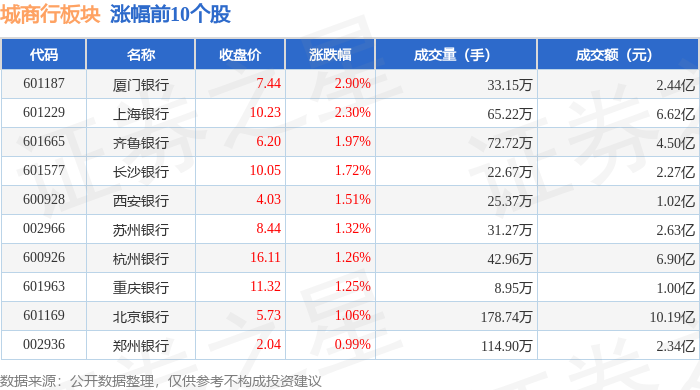
城商行板块11月10日涨0.96%,厦门银行领涨,主力资金净流入7750.91万元
Zheng Xing Xing Ye Ri Bao· 2025-11-10 08:48
Market Performance - The city commercial bank sector increased by 0.96% on November 10, with Xiamen Bank leading the gains [1] - The Shanghai Composite Index closed at 4018.6, up 0.53%, while the Shenzhen Component Index closed at 13427.61, up 0.18% [1] Individual Bank Performance - Xiamen Bank's closing price was 7.44, with a rise of 2.90% and a trading volume of 331,500 shares, amounting to 2.44 billion yuan [1] - Shanghai Bank closed at 10.23, up 2.30%, with a trading volume of 652,200 shares and a transaction value of 660 million yuan [1] - Qilu Bank saw a closing price of 6.20, increasing by 1.97%, with a trading volume of 727,200 shares and a transaction value of 450 million yuan [1] - Other notable banks include Changsha Bank, Xi'an Bank, and Suzhou Bank, with respective increases of 1.72%, 1.51%, and 1.32% [1] Capital Flow Analysis - The city commercial bank sector experienced a net inflow of 77.51 million yuan from institutional investors, while retail investors saw a net outflow of 10.29 million yuan [1] - Beijing Bank had a significant net inflow of 1.35 billion yuan from institutional investors, but a net outflow of 582.22 million yuan from retail investors [2] - Jiangsu Bank also reported a net inflow of 103 million yuan from institutional investors, with retail investors experiencing a net outflow of 91.58 million yuan [2]

从增量扩面到提质控险 银行业普惠金融迈向差异化精准服务
2 1 Shi Ji Jing Ji Bao Dao· 2025-11-10 04:21
Core Insights - The report highlights the significant growth and development of inclusive finance in China, particularly focusing on small and micro enterprises and rural areas, with a notable annual growth rate of over 20% in inclusive micro loans during the 14th Five-Year Plan period [1][2] - As of June 2025, the balance of inclusive micro loans reached 36 trillion yuan, which is 2.3 times that of the end of the 13th Five-Year Plan, with a decrease in interest rates by 2 percentage points [1][2] - The average interest rate for newly issued inclusive micro loans was 3.48% as of June 2025, reflecting a decrease of 66 basis points year-on-year [1][2] Group 1: Digital Empowerment - Digital technology has been a key driver for the development of inclusive finance, with banks utilizing big data and AI to enhance loan approval efficiency and reduce financing costs [2][7] - The market structure among banks is changing, with large commercial banks holding a 45.11% share of inclusive micro loans, while rural financial institutions have seen a decline in their market share [2][3] - The average growth rate of inclusive micro loans has been slowing down, with a decrease from 30.9% in 2020 to 12.3% by mid-2025 [2][3] Group 2: Performance of Listed Banks - Among listed banks, Agricultural Bank of China, Industrial and Commercial Bank of China, and Beijing Bank reported the highest growth rates in inclusive micro loans at 18.50%, 17.30%, and 17.27% respectively [3][4] - In contrast, some banks, including Shanghai Bank and Zhengzhou Bank, experienced negative growth rates of -3.97% and -2.06% [3][4] - The performance of different banks varies significantly, with state-owned banks generally showing stronger growth in inclusive micro loans compared to smaller banks [3][4] Group 3: Interest Rates and Risk Management - The interest rates for newly issued inclusive micro loans have decreased across various banks, with the highest rate at 4.20% and the lowest at 2.94% [7][8] - The gap in interest rates between large and small banks is narrowing, with some large banks' rates aligning closely with those of smaller banks [8][9] - The report emphasizes the importance of risk management in the inclusive finance sector, with several banks focusing on improving asset quality and managing non-performing loans [9][10]
