
步步高

Search documents
步步高涨2.02%,成交额9.97亿元,主力资金净流出4914.24万元
Xin Lang Cai Jing· 2025-10-15 03:23
Core Viewpoint - The stock of Bubugao has shown significant volatility, with a year-to-date increase of 53.16%, but a recent decline over the past 20 days, indicating mixed investor sentiment and market performance [1][2]. Group 1: Stock Performance - As of October 15, Bubugao's stock price rose by 2.02% to 6.05 CNY per share, with a total market capitalization of 16.267 billion CNY [1]. - The stock has experienced a 5.77% increase over the last five trading days, a 9.30% decrease over the last 20 days, and a 23.72% increase over the last 60 days [1]. - The company has appeared on the trading leaderboard 10 times this year, with the most recent appearance on September 9, where it recorded a net buy of -51.528 million CNY [1]. Group 2: Financial Performance - For the first half of 2025, Bubugao reported a revenue of 2.133 billion CNY, reflecting a year-on-year growth of 24.39%, and a net profit attributable to shareholders of 201 million CNY, which is a substantial increase of 357.71% [2]. - The company has cumulatively distributed 1.677 billion CNY in dividends since its A-share listing, with no dividends paid in the last three years [3]. Group 3: Shareholder Information - As of June 30, 2025, the number of shareholders increased by 96.50% to 88,500, while the average number of circulating shares per person decreased by 49.11% to 17,105 shares [2]. - Hong Kong Central Clearing Limited is the tenth largest circulating shareholder, holding 10.5068 million shares as a new shareholder [3]. Group 4: Business Overview - Bubugao operates primarily in the retail sector, with its main business segments being supermarkets (64.34% of revenue), other retail (27.44%), department stores (6.01%), and logistics and advertising (2.21%) [1]. - The company is categorized under the general retail sector, with concepts including prepared dishes, community group buying, duty-free concepts, new retail, and unified market [2].
主力资金丨超硬材料龙头,尾盘获逆市抢筹
Zheng Quan Shi Bao Wang· 2025-10-14 10:38
Group 1 - A-shares experienced a collective pullback on October 14, with the three major indices declining, while over 1700 stocks rose, and nearly 50 stocks hit the daily limit up [1] - The port and shipping sector rose against the trend, while the semiconductor sector collectively declined, and the non-ferrous metals sector saw a pullback after a rise [1] - The net outflow of main funds in the Shanghai and Shenzhen markets reached 62.98 billion yuan, with only three sectors—food and beverage, comprehensive, and construction decoration—seeing net inflows of 231 million yuan, 222 million yuan, and 186 million yuan respectively [1] Group 2 - Among the 56 stocks with net outflows exceeding 300 million yuan, companies like CATL, Newyeason, Luxshare Precision, Oriental Fortune, Tongfu Microelectronics, and Zhongji Xuchuang each saw outflows exceeding 1 billion yuan [2] - Shanzi Gaoke received a net inflow of 1.081 billion yuan, with its stock price hitting the limit up for the fourth time in six trading days, totaling a rise of 35.43% [2] - Longi Green Energy saw a net inflow of 702 million yuan, securing five overseas component orders in September, totaling 1.787 GW across multiple regions including Australia, the USA, and Romania [2] Group 3 - At the end of the trading day, the main funds in the Shanghai and Shenzhen markets saw a net outflow of 15.6 billion yuan, with only the comprehensive, retail, and beauty care sectors experiencing net inflows exceeding 15 million yuan [3] - Power Diamond recorded a net inflow of over 100 million yuan at the close, following a recent announcement from the Ministry of Commerce and the General Administration of Customs regarding export controls on certain materials [3] - Companies like ZTE, CATL, and Luxshare Precision experienced net outflows exceeding 300 million yuan at the end of the trading day [3]



免税店概念涨0.76%,主力资金净流入这些股
Zheng Quan Shi Bao Wang· 2025-10-14 09:10
Core Insights - The duty-free shop concept index rose by 0.76%, ranking 10th among concept sectors, with 22 stocks increasing in value, led by Bubu Gao, Hainan Development, and Caesar Travel, which rose by 3.31%, 2.52%, and 2.42% respectively [1] - The duty-free shop sector experienced a net outflow of 2.3966 million yuan in capital, with 14 stocks seeing net inflows, and 6 stocks receiving over 10 million yuan in net inflows, led by Tibet Summit with 36.3033 million yuan [2][3] - The leading stocks in terms of net inflow ratio included Wushang Group, Zhu Mian Group, and Caesar Travel, with net inflow ratios of 6.42%, 6.22%, and 5.90% respectively [3] Sector Performance - The duty-free shop sector's performance was notable, with a total of 22 stocks increasing, while the top gainers included Bubu Gao, Hainan Development, and Caesar Travel [1] - The overall market saw various concept sectors with differing performances, such as the cultivated diamond sector rising by 3.74% and the national big fund holding sector declining by 5.47% [2] - The duty-free shop sector's net capital outflow indicates a mixed sentiment among investors, despite some individual stocks performing well [2][3] Stock Specifics - Key stocks in the duty-free shop sector included Tibet Summit, Caesar Travel, and Bubu Gao, which had significant net inflows of capital [2][3] - The stock performance varied, with some stocks like Nanning Department Store and ST Huayang experiencing declines of 1.91% and 1.41% respectively [1][4] - The trading volume and turnover rates for leading stocks in the duty-free sector were also highlighted, with Tibet Summit showing a turnover rate of 9.33% [3]


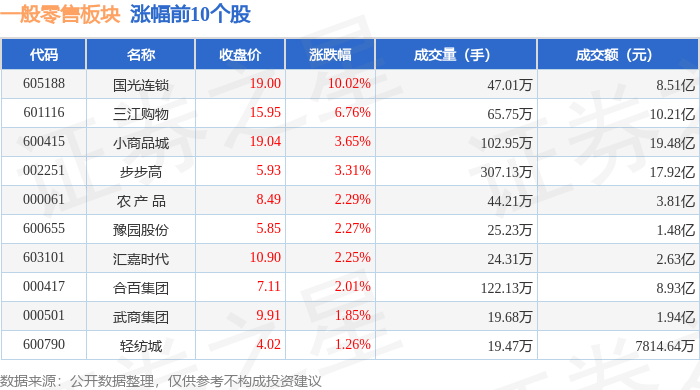
一般零售板块10月14日涨0.98%,国光连锁领涨,主力资金净流入784.3万元
Zheng Xing Xing Ye Ri Bao· 2025-10-14 08:41
Core Insights - The general retail sector increased by 0.98% on October 14, with Guoguang Chain leading the gains [1] - The Shanghai Composite Index closed at 3865.23, down 0.62%, while the Shenzhen Component Index closed at 12895.11, down 2.54% [1] Retail Sector Performance - Guoguang Chain (605188) saw a closing price of 19.00, with a significant increase of 10.02% and a trading volume of 470,100 shares, amounting to a transaction value of 851 million [1] - Sanjiang Shopping (601116) closed at 15.95, up 6.76%, with a trading volume of 657,500 shares and a transaction value of 1.021 billion [1] - Xiaoshangpin City (600415) closed at 19.04, up 3.65%, with a trading volume of 1,029,500 shares and a transaction value of 1.948 billion [1] - Other notable performers include Bubu Gao (002251) with a closing price of 5.93, up 3.31%, and Nongchanpin (000061) with a closing price of 8.49, up 2.29% [1] Capital Flow Analysis - The general retail sector experienced a net inflow of 7.843 million from institutional investors, while retail investors saw a net outflow of 18.1924 million [2][3] - Guoguang Chain had a net inflow of 92.2565 million from institutional investors, but a net outflow of 22.4213 million from speculative funds and 69.8352 million from retail investors [3] - Xiaoshangpin City recorded a net inflow of 16.7 million from institutional investors, while retail investors had a net outflow of 16.9 million [3]


长江消费周周谈
2026-01-05 15:42
Summary of Key Points from Conference Call Records Industry or Company Involved - **Pork Industry**: Focus on companies like Muyuan, Dekang, Wens, Shennong, and Juxing Agriculture - **Beauty and Personal Care Industry**: Highlighting brands such as Mao Ge Ping and Shangmei - **Gold and Jewelry Industry**: Recommendations for Changhongqi and Caibai - **Retail Industry**: Emphasis on Xiaoshangpin City and Bubu Gao - **Education and Training Sector**: Focus on K12 education leaders and AI applications - **Restaurant and Beverage Sector**: Recommendations for Mixue and Guming - **Automotive Industry**: Focus on Huawei's smart vehicles and Changan Automobile - **Textile Manufacturing Sector**: Recommendations for companies in the ASEAN region and Nike's supply chain - **Innovative Pharmaceutical Industry**: Focus on companies with high R&D investment Core Points and Arguments - **Pork Industry**: The significant impact of pork prices on CPI, with a noted 8.5% decrease in pork prices leading to a 0.12 percentage point drop in CPI in June 2025. The strategy of capacity control to boost pork prices is crucial to mitigate CPI pressure [2][3][4] - **Beauty and Personal Care**: The industry is in a traditional off-season, but high-end brands like Mao Ge Ping and operationally strong brands like Shangmei are recommended due to low base effects from last year [6] - **Gold and Jewelry**: Despite a 20% drop in gold jewelry consumption in Q2, brands with strong same-store performance like Changhongqi and low-valuation, high-dividend companies like Caibai are recommended [6] - **Retail Sector**: Xiaoshangpin City is highlighted for its strong business certainty, while Bubu Gao is noted for potential investment opportunities post-unlock of shares [7] - **Education Sector**: K12 education leaders and AI applications are emphasized, with companies like Dou Shen and Fen Bi showing strong growth [8] - **Restaurant Sector**: The rise of takeaway services is noted, with companies like Guming and Mixue recommended for their growth potential [8][9] - **Automotive Sector**: Huawei's smart vehicles are performing well, with new models like M7 and M8 expected to launch soon, while Changan's S9 model shows stable delivery [10][11][12] - **Textile Manufacturing**: The sector is expected to see performance and stock price turning points, with a focus on companies benefiting from reduced tariffs in the ASEAN region [13][14][15] - **Innovative Pharmaceutical Industry**: A new cycle of R&D investment is anticipated, with a focus on companies sensitive to domestic demand recovery and those specializing in large molecules and oncology [26][27] Other Important but Possibly Overlooked Content - **Pork Industry**: The adjustment in the pork breeding sector is linked to broader economic conditions and CPI management strategies [3][4][5] - **Retail Sector**: The potential for supermarkets and department stores to experience operational turning points is noted [7] - **Automotive Sector**: The upcoming launch of multiple new models indicates a strategic push for market share [10][11][12] - **Textile Manufacturing**: The impact of tariff changes on the competitive landscape and the potential for recovery in the sector is highlighted [14][15] - **Innovative Pharmaceutical Industry**: The increasing trend of funding sources and the focus on early-stage research are critical for future growth [26][27]
地摊经济板块10月13日跌1.33%,千里科技领跌,主力资金净流出13.26亿元



Sou Hu Cai Jing· 2025-10-13 13:12
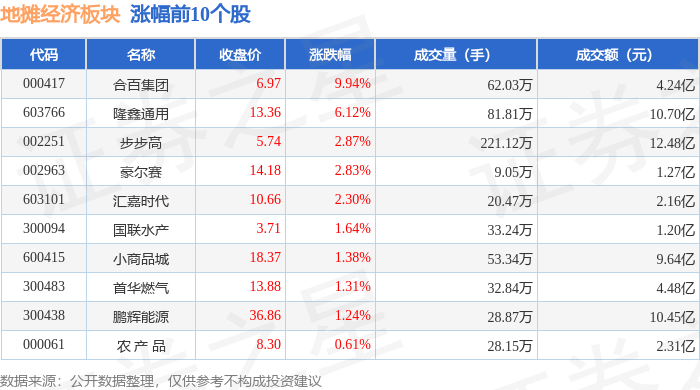
Market Overview - The street vendor economy sector declined by 1.33% compared to the previous trading day, with Qianli Technology leading the decline [1] - The Shanghai Composite Index closed at 3889.5, down 0.19%, while the Shenzhen Component Index closed at 13231.47, down 0.93% [1] Stock Performance - Notable gainers in the street vendor economy sector included: - Hebai Group (Code: 000417) with a closing price of 6.97, up 9.94% and a trading volume of 620,300 shares, totaling 424 million yuan [1] - Longkui General (Code: 603766) with a closing price of 13.36, up 6.12% and a trading volume of 818,100 shares, totaling 1.07 billion yuan [1] - Bubu Gao (Code: 002251) with a closing price of 5.74, up 2.87% and a trading volume of 2.21 million shares, totaling 1.25 billion yuan [1] - Major decliners included: - Qianli Technology (Code: 601777) with a closing price of 11.32, down 4.15% and a trading volume of 721,500 shares, totaling 815 million yuan [2] - Silis (Code: 601127) with a closing price of 161.50, down 3.68% and a trading volume of 501,700 shares, totaling 8.11 billion yuan [2] - Zhejiang Yongqiang (Code: 002489) with a closing price of 3.64, down 2.67% and a trading volume of 404,700 shares, totaling 14.6 million yuan [2] Capital Flow - The street vendor economy sector experienced a net outflow of 1.326 billion yuan from institutional investors, while retail investors saw a net inflow of 920 million yuan [2][3] - Specific stock capital flows included: - Bubu Gao (Code: 002251) had a net inflow of 94.14 million yuan from institutional investors, but a net outflow of 52.50 million yuan from speculative funds [3] - Hebai Group (Code: 000417) saw a net inflow of 76.46 million yuan from institutional investors, with a net outflow of 32.28 million yuan from speculative funds [3] - Xiaoshangpin City (Code: 600415) had a net inflow of 48.60 million yuan from institutional investors, with a net outflow of 29.51 million yuan from speculative funds [3]
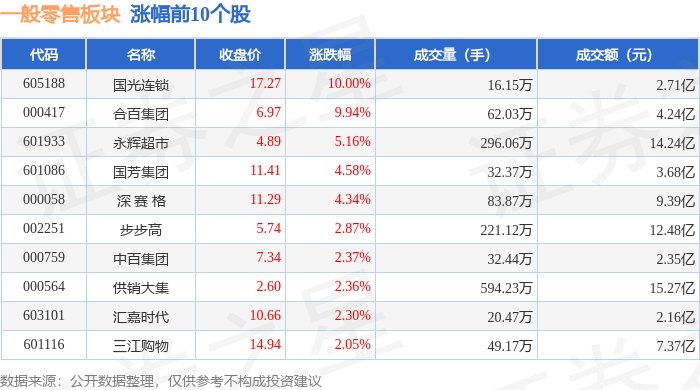
一般零售板块10月13日涨1.04%,国光连锁领涨,主力资金净流入7.06亿元
Zheng Xing Xing Ye Ri Bao· 2025-10-13 12:45
Core Insights - The general retail sector experienced a rise of 1.04% on October 13, with Guoguang Chain leading the gains [1] - The Shanghai Composite Index closed at 3889.5, down 0.19%, while the Shenzhen Component Index closed at 13231.47, down 0.93% [1] Retail Sector Performance - Guoguang Chain (605188) saw a closing price of 17.27, with a significant increase of 10.00% and a trading volume of 161,500 shares, amounting to a transaction value of 271 million yuan [1] - HeBai Group (000417) closed at 6.97, up 9.94%, with a trading volume of 620,300 shares and a transaction value of 424 million yuan [1] - Yonghui Supermarket (601933) closed at 4.89, increasing by 5.16%, with a trading volume of 2,960,600 shares and a transaction value of 1.424 billion yuan [1] - Other notable performers included Guofang Group (601086) with a 4.58% increase and a closing price of 11.41, and Bubu Gao (002251) with a 2.87% increase and a closing price of 5.74 [1] Capital Flow Analysis - The general retail sector saw a net inflow of 706 million yuan from institutional investors, while retail investors experienced a net outflow of 470 million yuan [2] - The main capital inflow was observed in Yonghui Supermarket, which had a net inflow of 227.1 million yuan, accounting for 15.93% of its total capital [3] - Guoguang Chain also had a significant net inflow of 101 million yuan, representing 37.22% of its total capital [3] - Conversely, retail investors showed a net outflow in several companies, including Guoguang Chain and HeBai Group, indicating a shift in investor sentiment [3]


又一巨头倒下,中期销售狂降不涨,为什么大家都不愿意逛商场了?
Sou Hu Cai Jing· 2025-10-13 09:42
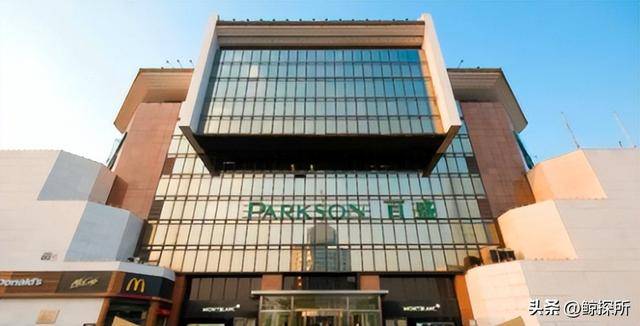
Core Viewpoint - The retail industry, particularly shopping malls, is facing a significant decline, with many well-known brands closing stores due to changing consumer preferences and market dynamics [1][5][23] Group 1: Store Closures - Beijing Baisheng, the first store of Baisheng Group in mainland China, will close by the end of the year, marking the end of an era [1] - A large number of stores are expected to close by mid-2025, including 227 stores from Yonghui, 88 from Jiumaojiu Group, and 4 from Bubugao, indicating a rapid increase in closure rates in the supermarket and restaurant sectors [3] - Major retailers like Walmart, Yonghui, and Starbucks have also been part of the store closure trend over the past two years, raising questions about the diminishing appeal of shopping malls [5] Group 2: Changing Consumer Behavior - Shopping malls, once central to consumer spending due to their ability to provide a one-stop shopping experience, are losing relevance due to the rise of instant retail, which offers quick delivery of fresh produce and daily necessities [7] - New shopping channels, such as specialty snack stores and discount brand stores, are expanding rapidly, further constraining the survival space of traditional malls [9] - Consumers are becoming more rational in their spending, focusing on value for money, which clashes with the traditional mall model that often lacks differentiation [9][11] Group 3: Operational Challenges - Many malls rely on a brand consignment model, limiting their control over products, inventory, and pricing, making it difficult to adapt to market changes [11] - Aging infrastructure in many malls, combined with high rental costs and maintenance expenses, is creating significant financial pressure as long-term leases expire [13][15] - Baisheng faces a penalty of 11.7 million yuan for closing its store, while Yonghui incurs losses of 827 million yuan from lease compensation and asset write-offs, forcing them to close underperforming stores to mitigate losses [15] Group 4: Opportunities for Transformation - Despite the challenges, there are opportunities for malls to transform, as exemplified by Nanjing's Deji Plaza, which has successfully integrated unique brands and experiential elements to attract diverse consumers [17][19] - The key to overcoming the current crisis lies in adopting an "experiential and differentiated" approach, moving beyond traditional retail models [19] - The current wave of store closures is seen as a necessary industry cleansing process, shifting focus from expansion to improving operational efficiency [21][23]
永辉超市,今年1~8月员工累计分红超3100万元
Di Yi Cai Jing· 2025-10-13 09:30
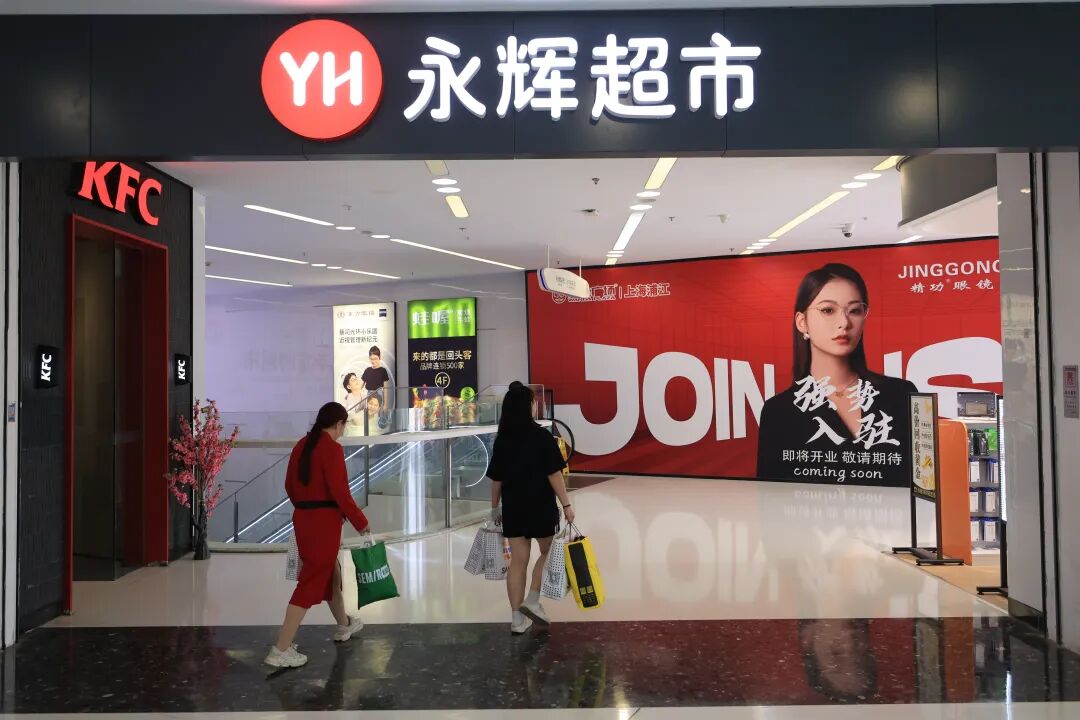
Core Insights - The retail industry, including Yonghui Supermarket, is struggling with intense competition and rising costs, leading to significant operational challenges [1][2] - Yonghui Supermarket reported a revenue decline of 14.07% year-on-year for 2024, with total revenue reaching 67.574 billion yuan, and a net loss of 1.465 billion yuan, marking the fourth consecutive year of losses [1][2] Company Strategy - In response to losses, Yonghui Supermarket has implemented a store closure strategy, shutting down 232 underperforming stores in 2024, and initiated the "Fat Donglai" reform plan [2] - The company aims for a comprehensive product-centric transformation over the next three years, involving 200 core strategic partners and 100 billion-yuan-level key products, with commitments to no channel fees, no delayed payments, and no malicious monopolies [2] Industry Trends - Other retailers are also enhancing their product and store reform strategies, indicating a shift in competition from expansion to supply chain, product, and store service levels [2] - Competitors like Bubugao and RT-Mart are also adapting their strategies, with Bubugao starting store reforms and RT-Mart launching a "Private Brand Festival" to focus on price competitiveness through direct factory connections and eliminating intermediaries [2]
步步高涨2.15%,成交额6.26亿元,主力资金净流出875.62万元
Xin Lang Zheng Quan· 2025-10-13 05:30
Group 1 - The core viewpoint of the news is that Bubu Gao's stock has shown significant fluctuations, with a year-to-date increase of 44.30% and a recent drop of 10.52% over the past 20 days [1] - As of October 13, Bubu Gao's stock price was 5.70 CNY per share, with a total market capitalization of 15.326 billion CNY [1] - The company has been active in the stock market, appearing on the "Dragon and Tiger List" 10 times this year, with the most recent appearance on September 9, where it recorded a net buy of -51.15 million CNY [1] Group 2 - Bubu Gao operates primarily in the retail sector, with its main business revenue composition being 64.34% from supermarkets, 27.44% from other businesses, 6.01% from department stores, and 2.21% from logistics and advertising [1] - As of June 30, the number of shareholders increased by 96.50% to 88,500, while the average circulating shares per person decreased by 49.11% to 17,105 shares [2] - For the first half of 2025, Bubu Gao reported a revenue of 2.133 billion CNY, representing a year-on-year growth of 24.39%, and a net profit of 201 million CNY, which is a significant increase of 357.71% [2] Group 3 - Since its A-share listing, Bubu Gao has distributed a total of 1.677 billion CNY in dividends, with no dividends paid in the last three years [3] - As of June 30, 2025, Hong Kong Central Clearing Limited is the tenth largest circulating shareholder, holding 10.5068 million shares as a new shareholder [3]