
京东方A

Search documents
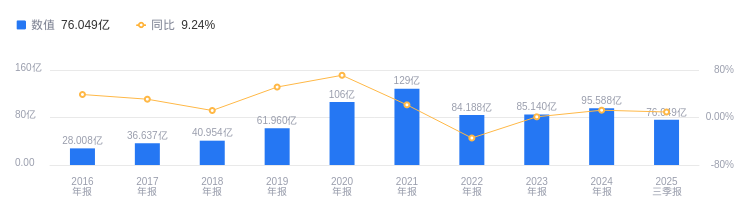
同兴达的前世今生:2025年三季度营收76.05亿行业第八,净利润 -3353.82万排名靠后
Xin Lang Cai Jing· 2025-10-30 15:02
Core Viewpoint - Tongxingda is a leading display module manufacturer in China, with a comprehensive industry chain layout and high product quality and technology levels [1] Group 1: Company Overview - Established on April 30, 2004, and listed on the Shenzhen Stock Exchange on January 25, 2017, Tongxingda is headquartered in Shenzhen, Guangdong Province [1] - The company engages in the R&D, design, production, and sales of LCD, OLED display modules, optical camera modules, and advanced semiconductor packaging [1] Group 2: Financial Performance - In Q3 2025, Tongxingda achieved a revenue of 7.605 billion yuan, ranking 8th among 38 companies in the industry [2] - The revenue breakdown includes 2.855 billion yuan from liquid crystal display modules (59.55%), 1.724 billion yuan from camera products (35.95%), and 215 million yuan from other businesses (4.49%) [2] - The net profit for the same period was -33.5382 million yuan, placing the company 31st in the industry [2] Group 3: Financial Ratios - As of Q3 2025, Tongxingda's debt-to-asset ratio was 73.27%, higher than the previous year's 70.59% and the industry average of 45.77% [3] - The gross profit margin for the period was 7.29%, down from 7.49% year-on-year and below the industry average of 14.89% [3] Group 4: Shareholder Information - As of September 30, 2025, the number of A-share shareholders decreased by 10.66% to 34,700 [5] - The average number of circulating A-shares held per shareholder increased by 11.93% to 7,205.99 [5] - Hong Kong Central Clearing Limited is the fifth-largest circulating shareholder, holding 2.9488 million shares as a new shareholder [5] Group 5: Executive Compensation - The chairman and general manager, Wan Feng, received a salary of 3.6488 million yuan in 2024, a decrease of 80,300 yuan from 2023 [4]


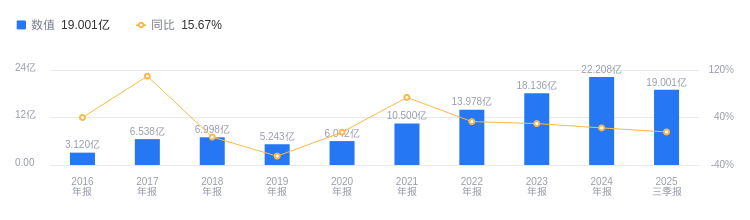
沃格光电的前世今生:2025年三季度营收19亿排名19/38,远低于龙头企业
Xin Lang Cai Jing· 2025-10-30 14:10
Core Viewpoint - Woge Optoelectronics, a leading manufacturer of glass-based circuit boards and related electronic devices in China, has shown steady revenue growth but faces challenges in profitability, with a significant net loss reported in the latest quarter [2][5]. Group 1: Company Overview - Woge Optoelectronics was established on December 14, 2009, and went public on April 17, 2018, on the Shanghai Stock Exchange, with its headquarters in Xinyu, Jiangxi Province [1]. - The company specializes in the research, development, and manufacturing of glass-based circuit boards and is one of the few globally with full-process capabilities in this area [1]. Group 2: Financial Performance - For Q3 2025, Woge Optoelectronics reported revenue of 1.9 billion CNY, ranking 19th among 38 companies in the industry, while the industry leader, BOE Technology Group, achieved revenue of 154.55 billion CNY [2]. - The company's net profit for the same period was -436.53 million CNY, placing it 33rd in the industry, with the average net profit for the sector being 66.81 million CNY [2]. Group 3: Financial Ratios - As of Q3 2025, Woge Optoelectronics had a debt-to-asset ratio of 68.67%, which is higher than the industry average of 45.77% [3]. - The gross profit margin for the company was 18.48%, exceeding both the previous year's margin of 16.74% and the industry average of 14.89% [3]. Group 4: Management Compensation - The chairman, Yi Weihua, received a salary of 1.083 million CNY in 2024, an increase from 1.0751 million CNY in 2023 [4]. - The general manager, Zhang Chunjiao, earned 970,200 CNY in 2024, up from 956,000 CNY in 2023 [4]. Group 5: Shareholder Information - As of September 30, 2025, the number of A-share shareholders increased by 5.55% to 20,700, with an average holding of 10,900 shares per shareholder [5]. - The top ten circulating shareholders include Changcheng Jiujia Innovation Growth Mixed Fund, holding 5.5 million shares, and Hong Kong Central Clearing Limited, a new shareholder with 1.9198 million shares [5]. Group 6: Future Outlook - The company is expected to see stable growth in its traditional glass processing business, with new projects like the Chengdu Woge glass-based etching project anticipated to begin trial production in Q4 2025 [5]. - The glass-based Mini LED backlight products are already in mass production, with expectations for further advancements in product yield and development within the next few months [6].

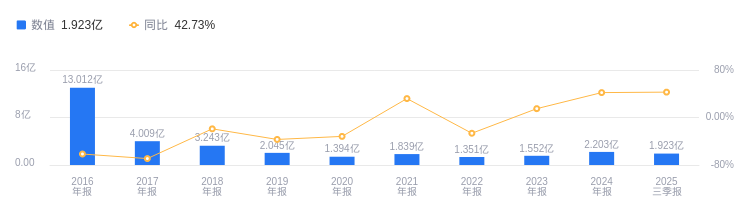
*ST宇顺的前世今生:2025年三季度营收1.92亿远低于行业平均,净利润 -901.21万元排名靠后
Xin Lang Zheng Quan· 2025-10-30 13:42
Core Viewpoint - *ST Yushun, established in 2004 and listed in 2009, operates in the electronic panel industry, focusing on LCD screens and modules, with a notable R&D capability [1] Group 1: Business Performance - In Q3 2025, *ST Yushun reported revenue of 192 million, ranking 36th among 38 companies in the industry, significantly lower than the top player BOE Technology Group's 154.55 billion and TCL Technology's 135.94 billion [2] - The company's net profit was -9.01 million, placing it 27th in the industry, with the leading company BOE reporting a profit of 4.40 billion [2] Group 2: Financial Ratios - As of Q3 2025, *ST Yushun's debt-to-asset ratio was 45.77%, in line with the industry average, but up from 22.88% year-on-year [3] - The gross profit margin for Q3 2025 was 20.05%, exceeding the industry average of 14.89% and improving from 18.59% in the previous year [3] Group 3: Shareholder Information - As of September 30, 2025, the number of A-share shareholders increased by 27.97% to 8,958, while the average number of circulating A-shares held per account decreased by 21.86% to 31,300 [5] Group 4: Leadership Compensation - The chairman and general manager, Ji Min, received a salary of 1.23 million in 2024 [4]
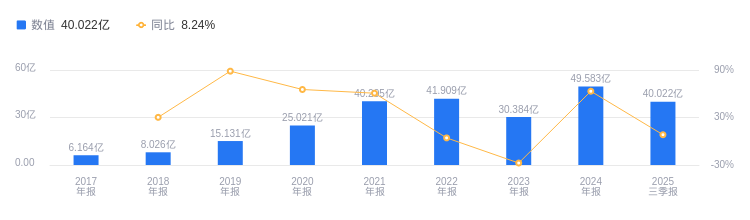
和辉光电的前世今生:2025年三季度营收40.02亿排行业第12,净利润亏损排第37
Xin Lang Zheng Quan· 2025-10-30 13:21
Core Viewpoint - Hehui Optoelectronics is a significant player in the domestic AMOLED semiconductor display panel industry, focusing on small and medium-sized AMOLED panels and possessing a full industry chain advantage [1] Group 1: Business Performance - In Q3 2025, Hehui Optoelectronics reported revenue of 4.002 billion yuan, ranking 12th among 38 companies in the industry [2] - The company's main business, AMOLED semiconductor display panels, generated revenue of 4.817 billion yuan, accounting for 97.16% of total revenue [2] - The net profit for Q3 2025 was a loss of 1.37 billion yuan, placing the company 37th in the industry [2] Group 2: Financial Ratios - As of Q3 2025, Hehui Optoelectronics had a debt-to-asset ratio of 68.44%, which is higher than the industry average of 45.77% [3] - The gross profit margin for Q3 2025 was -13.93%, lower than the industry average of 14.89%, although it improved from -23.70% in the same period last year [3] Group 3: Executive Compensation - The chairman, Fu Wenbiao, received a salary of 2.1163 million yuan in 2024, an increase of 128,600 yuan from 2023 [4] - The general manager, Liu Huiran, earned 2.0714 million yuan in 2024, up by 109,000 yuan from the previous year [4] Group 4: Shareholder Information - As of September 30, 2025, the number of A-share shareholders decreased by 0.61% to 116,000 [5] - The average number of circulating A-shares held per shareholder increased by 0.61% to 49,600 [5]

全球AI眼镜上半年出货量同比大增超64%!消费电子50ETF(159779)上涨2.31%
2 1 Shi Ji Jing Ji Bao Dao· 2025-10-21 02:44
Core Insights - The consumer electronics industry is experiencing a strong rally, with major indices rising significantly and key stocks like Luxshare Precision and Industrial Fulian seeing notable gains [1][2] - The global smart glasses market is projected to reach 4.065 million units shipped by the first half of 2025, marking a 64.2% year-on-year increase, with China expected to lead in growth [1] - The iPhone 17 has outperformed the iPhone 16 series in sales, with a 14% increase in the first ten days post-launch in both China and the US [2] Industry Summary - The consumer electronics sector is witnessing a robust performance, as indicated by the rise of the Consumer Electronics 50 ETF, which increased by 2.31% [1] - The smart glasses market is anticipated to become a significant growth driver for the consumer electronics market, with a compound annual growth rate of 55.6% in China from 2024 to 2029 [1] - New wearable devices are expected to revitalize the market, transitioning AR glasses from niche products to mainstream computing devices [1] Company Summary - Luxshare Precision leads the net buying amount among AI glasses concept stocks, with a net inflow of 5.007 billion yuan, followed by OmniVision Technologies with 2.032 billion yuan [2] - The Consumer Electronics 50 ETF tracks the CSI Consumer Electronics Theme Index, which includes 50 companies involved in component production and brand design [2] - The top ten constituents of the ETF include major players such as Luxshare Precision, SMIC, and Cambrian [2]
爆买!外资大举买入!电子等行业获环比加仓
Zheng Quan Shi Bao· 2025-10-15 13:09
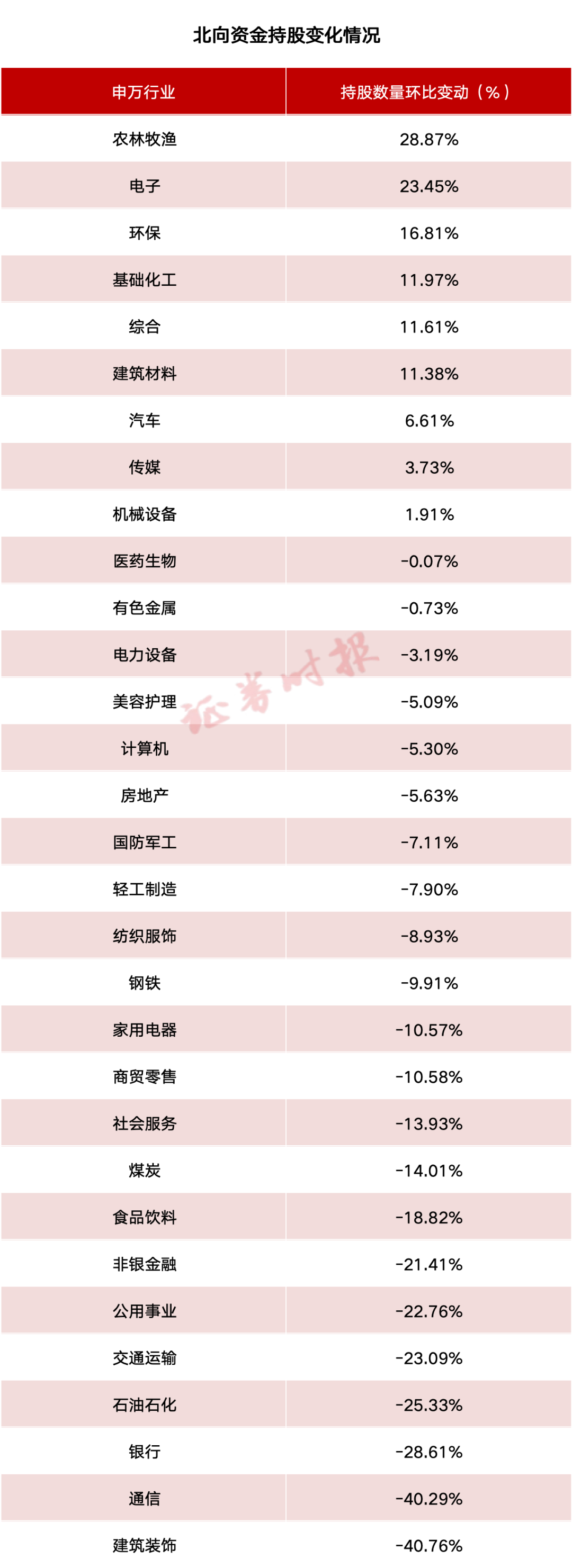
Core Insights - As of the end of Q3, northbound capital holdings in A-shares decreased by over 15 billion shares, but due to a favorable A-share market, the market value of these holdings increased by nearly 300 billion yuan [2] - The changes in northbound capital holdings reflect two major trends: valuation recovery driven by policy and structural adjustments against the backdrop of industrial upgrades [2] - Key sectors for foreign investment include technology and new energy, which are expected to be long-term focus areas as China's economy continues to develop [2] Industry Analysis - The top five industries by northbound capital holdings as of Q3 are: Banking (174.02 billion shares), Electronics (95.83 billion shares), Non-bank Financials (74.76 billion shares), Power Equipment (72.41 billion shares), and Non-ferrous Metals (63.27 billion shares) [3] - Nine industries saw an increase in holdings, including Agriculture, Electronics, Environmental Protection, Basic Chemicals, Comprehensive, Building Materials, Automotive, Media, and Machinery Equipment, with Agriculture and Electronics seeing increases of over 10% [4] - The Agriculture sector saw a significant increase of 28.87%, with holdings rising by 2.64 billion shares to a total of 11.80 billion shares [4][6] - The Electronics sector also experienced a notable increase of 23.45%, with holdings rising by 18.21 billion shares [8] Stock Performance - Northbound capital reduced holdings in several stable high-dividend sectors, including Banking, which saw a decrease of 69.75 billion shares, a reduction of 28.61% [9] - Key stocks held by northbound capital include Ningde Times (2,656.59 billion yuan), Kweichow Moutai (881.42 billion yuan), and Midea Group (716.48 billion yuan) [12][14] - Ningde Times saw an increase of 539.23 million shares, with a market value increase of 112.58 billion yuan due to a 60.02% rise in stock price [10][12] Market Sentiment - Global capital is reassessing the intrinsic value of Chinese assets, driven by a combination of factors including liquidity restructuring, economic resilience, and the rise of new productive forces [15] - Recent reports indicate a rebound in foreign capital inflows into the Chinese stock market, with net inflows reaching 4.6 billion USD in September, the highest since November 2024 [16]
又一主动投资巨头,杀入5万亿ETF赛道!
Zhong Guo Ji Jin Bao· 2025-10-01 02:09
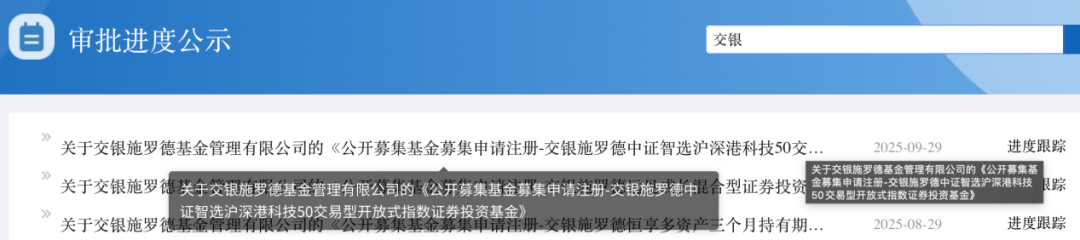
Core Insights - Two Shanghai-based fund companies, Jiao Yin Schroder Fund and Xing Quan Global Fund, have recently entered the ETF market, indicating a shift in strategy towards passive investment products [1][4][5] Group 1: Company Developments - Jiao Yin Schroder Fund has submitted an application for the "Jiao Yin Schroder CSI Selected Hong Kong and Mainland Technology 50 ETF," marking its first ETF in 14 years [2][3] - Xing Quan Global Fund has applied for the "Xing Quan Global CSI 300 Quality ETF," which would be its first ETF product since its establishment 22 years ago [2][3] Group 2: Market Context - The total scale of ETFs has surpassed 5 trillion yuan, with increasing competition among fund companies [1][5] - The ETF market is characterized by low fees, high transparency, and ease of trading, making it an attractive option for various investors [5][6] Group 3: Investment Opportunities - The CSI Selected Hong Kong and Mainland Technology 50 Index, which the Jiao Yin Schroder ETF will track, has seen a remarkable increase of over 50% this year, highlighting the growth potential in the technology sector [3] - There is a belief that the ETF market still has many gaps to fill, as current offerings do not fully meet investor needs [1][8] Group 4: Competitive Landscape - The ETF industry is highly competitive, with the top three ETF providers holding a combined market share of 46.4% as of June 2025 [6] - New entrants are encouraged to leverage their research capabilities and develop unique ETF products to differentiate themselves in the market [8]
又一主动投资巨头,杀入5万亿ETF赛道!
中国基金报· 2025-10-01 02:02
Core Viewpoint - Two prominent active equity investment fund companies in Shanghai, namely交银施罗德基金 and 兴证全球基金, have recently entered the ETF market, indicating a shift in strategy towards passive investment products as the ETF market continues to grow and diversify [1][11]. Group 1: ETF Market Entry - 交银施罗德基金 has re-entered the ETF space after 14 years, submitting the交银施罗德 中证智选沪深港科技50ETF for approval, which tracks the 中证智选沪深港科技50指数, showcasing strong performance with over 50% growth this year [5][6]. - 兴证全球基金 has also submitted its first ETF product, the兴证全球沪深300质量ETF, marking a significant milestone for the company after 22 years of operation [7][9]. Group 2: Market Dynamics and Competition - The ETF market has surpassed 5 trillion yuan in total scale, leading to increased competition among public funds, with many considering entry into the ETF space [11]. - The top three ETF providers, 华夏基金, 易方达基金, and 华泰柏瑞基金, hold a combined market share of 46.4%, while the top ten account for 80.2%, indicating a highly concentrated market [12]. Group 3: Strategic Considerations for New Entrants - New entrants should leverage their research capabilities to create unique ETF products based on existing indices, focusing on niche areas such as thematic and multi-asset indices [13]. - Collaborating with index companies to develop exclusive market indices can enhance competitive advantage, while also addressing the diverse needs of investors [13]. - The current market still has gaps in ETF offerings, suggesting that it is not too late for new entrants to establish themselves in the market [13].

光学光电子板块9月5日涨3.49%,腾景科技领涨,主力资金净流入13.05亿元
Zheng Xing Xing Ye Ri Bao· 2025-09-05 08:56
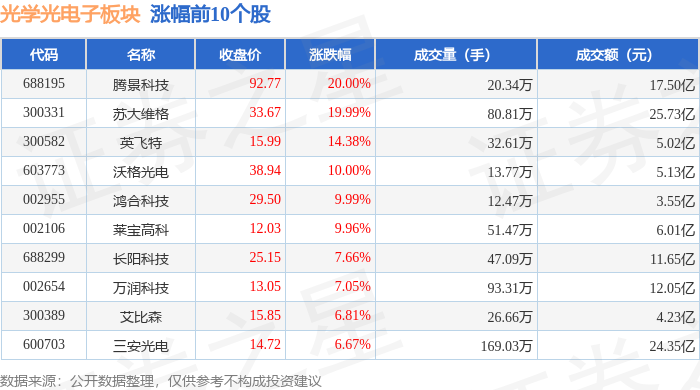
Market Performance - The optical and optoelectronic sector rose by 3.49% on September 5, with Tengjing Technology leading the gains [1] - The Shanghai Composite Index closed at 3812.51, up 1.24%, while the Shenzhen Component Index closed at 12590.56, up 3.89% [1] Stock Highlights - Tengjing Technology (688185) closed at 92.77, with a significant increase of 20.00% and a trading volume of 203,400 shares, amounting to a transaction value of 1.75 billion [1] - Su Da Weige (300331) also saw a notable rise of 19.99%, closing at 33.67 with a trading volume of 808,100 shares, resulting in a transaction value of 2.573 billion [1] - Other notable performers included Yingfeite (300582) with a 14.38% increase, Woge Optoelectronics (603773) up by 10.00%, and Jihuo Technology (002955) rising by 9.99% [1] Fund Flow Analysis - The optical and optoelectronic sector experienced a net inflow of 1.305 billion from institutional investors, while retail investors saw a net outflow of 197 million [2] - The main stocks with significant net inflows included Su Da Weige (3.38 million) and Wanrun Technology (1.86 million), while notable outflows were observed in stocks like Sanan Optoelectronics and Tengjing Technology [3]

电子行业2025半年报业绩综述:各细分业绩快增,AI相关表现亮眼
Dongguan Securities· 2025-09-04 09:26
Investment Rating - The report maintains an "Overweight" rating for the electronics industry [1] Core Insights - The electronics industry continues to show strong performance in the first half of 2025, driven by the recovery in demand for smart terminals and the increasing need for AI computing power, with revenue and profit maintaining double-digit growth [2][89] - Each sub-sector has experienced rapid growth, particularly in AI-related segments such as PCB and CCL, which have shown remarkable performance and significant improvements in profitability [2][89] Summary by Sections 1. Performance Overview for H1 2025 - The total revenue for the electronics industry reached CNY 1,499.979 billion, a year-on-year increase of 20.17% - The net profit attributable to shareholders was CNY 577.88 billion, with a year-on-year growth of 28.95%, while the net profit after deducting non-recurring gains and losses was CNY 490.27 billion, up 32.31% year-on-year - The industry's gross margin was 13.15%, a decrease of 0.38 percentage points year-on-year, while the net margin improved by 0.30 percentage points to 3.76% [12][11] 2. Sub-sector Performance PCB Sector - PCB sector revenue for H1 2025 was CNY 112.217 billion, with a year-on-year growth of 25.32% - The net profit attributable to shareholders was CNY 10.805 billion, up 61.03% year-on-year - The gross margin reached 22.25%, an increase of 2.24 percentage points, while the net margin improved to 9.56%, up 2.13 percentage points [22][33] CCL Sector - CCL sector revenue totaled CNY 19.130 billion, reflecting a year-on-year increase of 26.23% - The net profit attributable to shareholders was CNY 1.627 billion, with a year-on-year growth of 52.37% - The gross margin was 21.16%, up 3.76 percentage points, and the net margin was 9.56%, an increase of 2.21 percentage points [38][49] Consumer Electronics Sector - Revenue in the consumer electronics sector reached CNY 811.048 billion, a year-on-year increase of 27.28% - The net profit attributable to shareholders was CNY 290.43 billion, with a year-on-year growth of 25.67% - The gross margin was 9.96%, a decrease of 0.61 percentage points, while the net margin remained stable at 3.69% [57][72] Panel Manufacturing Sector - The panel manufacturing sector reported revenue of CNY 186.838 billion, a year-on-year increase of 7.62% - The net profit attributable to shareholders was CNY 51.30 billion, with a year-on-year growth of 56.45% - The gross margin was 13.95%, a decrease of 0.32 percentage points, while the net margin improved to 1.64%, up 0.89 percentage points [73][85] 3. Investment Recommendations - The report suggests focusing on two main lines: AI computing power and AI terminals - The demand for computing power is expected to increase due to the training and application of large AI models, with significant capital expenditure from overseas tech giants and domestic support for local computing applications - The second focus is on AI terminals, with expectations for a surge in new product releases in the consumer electronics sector in the second half of the year, particularly in the Apple supply chain and AI glasses industry [2][89]