
大参林

Search documents
大参林(603233) - 大参林医药集团股份有限公司关于对子公司提供担保的进展公告
2026-01-22 08:30
证券代码:603233 证券简称:大参林 公告编号:2026-002 大参林医药集团股份有限公司 关于为子公司提供担保的进展公告 本公司董事会及全体董事保证本公告内容不存在任何虚假记载、误导性陈述或者重 大遗漏,并对其内容的真实性、准确性和完整性承担法律责任。 重要内容提示: 担保对象及基本情况 | | | | 佛山市大参林医药贸易有限公司、茂名 | | | | --- | --- | --- | --- | --- | --- | | | | 被担保人名称 | 大参林连锁药店有限公司、南通市大参 | | | | 担 | 保 对 | | 林医药有限公司等 | | 12 家控股子公司 | | | | 本次担保金额 | 98,500 | 万元 | | | 象 | | 实际为其提供的担保余额 | 118,500 | 万元 | | | | | 是否在前期预计额度内 | 是 | □否 | □不适用:_________ | | | | 本次担保是否有反担保 | □是 | ☑否 | □不适用:_________ | 累计担保情况 | 对外担保逾期的累计金额(万元) | - | | --- | --- | | 截至本公告日 ...

医药商业板块1月20日跌0.48%,鹭燕医药领跌,主力资金净流出4.97亿元
Zheng Xing Xing Ye Ri Bao· 2026-01-20 08:51
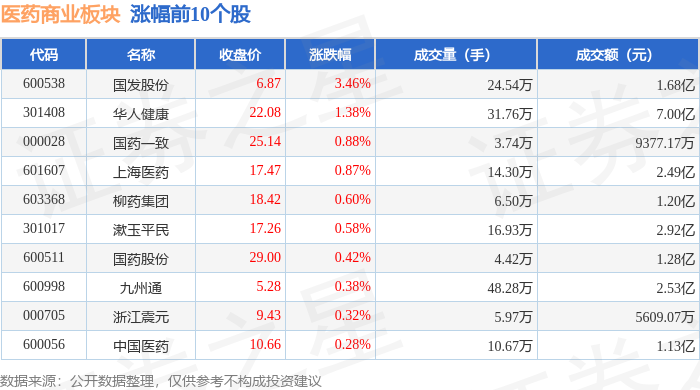
Market Overview - The pharmaceutical commercial sector experienced a decline of 0.48% on January 20, with Luyuan Pharmaceutical leading the drop [1] - The Shanghai Composite Index closed at 4113.65, down 0.01%, while the Shenzhen Component Index closed at 14155.63, down 0.97% [1] Stock Performance - Notable gainers in the pharmaceutical sector included: - Guofa Co., Ltd. (600538) with a closing price of 6.87, up 3.46% and a trading volume of 245,400 shares, totaling 168 million yuan [1] - Huaren Health (301408) closed at 22.08, up 1.38% with a trading volume of 317,600 shares, totaling 700 million yuan [1] - Conversely, significant decliners included: - Jianghe Pharmaceutical (002788) with a closing price of 16.64, down 6.04% and a trading volume of 872,500 shares, totaling 1.465 billion yuan [2] - Yingte Group (000411) closed at 13.84, down 2.40% with a trading volume of 230,300 shares, totaling 316 million yuan [2] Capital Flow - The pharmaceutical commercial sector saw a net outflow of 497 million yuan from institutional investors and a net outflow of 109 million yuan from speculative funds, while retail investors had a net inflow of 607 million yuan [2] - Key stocks with notable capital flows included: - Huaren Health (301408) with a net inflow of 46.16 million yuan from institutional investors, but a net outflow of 48.48 million yuan from retail investors [3] - Yifeng Pharmacy (603939) had a net inflow of 21.74 million yuan from institutional investors, but also saw a net outflow of 1.63 million yuan from retail investors [3]


医药商业板块1月19日涨0.39%,达嘉维康领涨,主力资金净流出4.36亿元
Zheng Xing Xing Ye Ri Bao· 2026-01-19 08:56
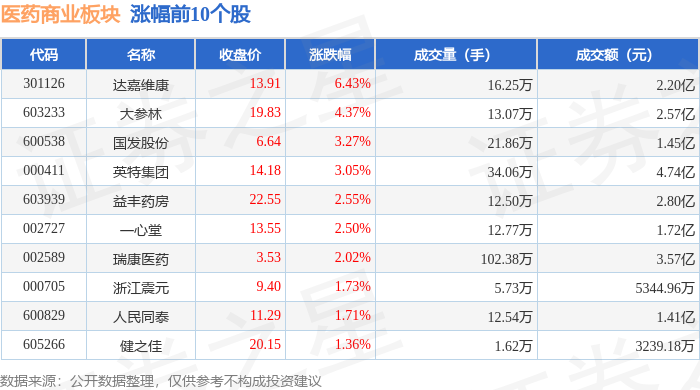
Core Viewpoint - The pharmaceutical commercial sector experienced a slight increase of 0.39% on January 19, with significant contributions from stocks like Dajia Weikang, which led the gains [1] Group 1: Market Performance - The Shanghai Composite Index closed at 4114.0, up by 0.29%, while the Shenzhen Component Index closed at 14294.05, up by 0.09% [1] - Dajia Weikang (301126) led the sector with a closing price of 13.91, reflecting a rise of 6.43% and a trading volume of 162,500 shares, amounting to a transaction value of 220 million yuan [1] - Other notable performers included Dacianlin (603233) with a 4.37% increase, Guofang Co. (600538) up by 3.27%, and Yifeng Pharmacy (603939) rising by 2.55% [1] Group 2: Fund Flow Analysis - The pharmaceutical commercial sector saw a net outflow of 436 million yuan from institutional investors, while retail investors contributed a net inflow of 486 million yuan [2] - The individual stock fund flow indicated that Ruikang Pharmaceutical (002589) had a net inflow of 19.77 million yuan from institutional investors, while it faced a net outflow of 17.52 million yuan from retail investors [3] - Dajia Weikang (301126) also experienced a net inflow of 13.40 million yuan from institutional investors, despite a net outflow of 15.06 million yuan from retail investors [3]


医药商业板块1月15日跌2.19%,华人健康领跌,主力资金净流出9.9亿元
Zheng Xing Xing Ye Ri Bao· 2026-01-15 08:58
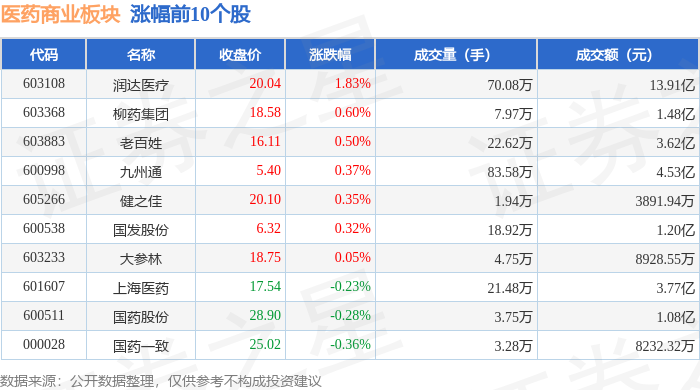
Market Overview - The pharmaceutical commercial sector experienced a decline of 2.19% on January 15, with Huaren Health leading the drop [1] - The Shanghai Composite Index closed at 4112.6, down 0.33%, while the Shenzhen Component Index closed at 14306.73, up 0.41% [1] Individual Stock Performance - Notable gainers included: - RunDa Medical (603108) with a closing price of 20.04, up 1.83% and a trading volume of 700,800 shares [1] - LiuYao Group (603368) closed at 18.58, up 0.60% with a trading volume of 79,700 shares [1] - LaoBaiXing (603883) closed at 16.11, up 0.50% with a trading volume of 226,200 shares [1] - Significant decliners included: - Huaren Health (301408) closed at 23.81, down 19.99% with a trading volume of 491,100 shares [2] - ShangYu PingMin (301017) closed at 18.50, down 13.75% with a trading volume of 373,900 shares [2] - YaoYiGou (300937) closed at 37.40, down 11.79% with a trading volume of 121,400 shares [2] Capital Flow Analysis - The pharmaceutical commercial sector saw a net outflow of 990 million yuan from institutional investors, while retail investors had a net inflow of 977 million yuan [2] - The table of capital flow indicates that: - LaoBaiXing (603883) had a net inflow of 46.10 million yuan from institutional investors [3] - JiuZhouTong (600998) had a net inflow of 40.43 million yuan from institutional investors [3] - RunDa Medical (603108) had a net inflow of 37.80 million yuan from institutional investors [3]




2025年1-11月医药制造业企业有9875个,同比增长0.84%
Chan Ye Xin Xi Wang· 2026-01-15 03:56
Group 1 - The core viewpoint of the article highlights the growth and current state of the pharmaceutical manufacturing industry in China, particularly focusing on the increase in the number of enterprises in this sector [1] - As of January-November 2025, the number of pharmaceutical manufacturing enterprises reached 9,875, marking an increase of 82 enterprises compared to the same period last year, which represents a year-on-year growth of 0.84% [1] - The pharmaceutical manufacturing sector accounts for 1.88% of the total industrial enterprises in China, indicating its significance within the broader industrial landscape [1] Group 2 - The article references a report by Zhiyan Consulting that discusses the market development trends and future outlook for the Contract Manufacturing Organization (CMO) and Contract Development and Manufacturing Organization (CDMO) sectors in China from 2026 to 2032 [1] - The report emphasizes the importance of in-depth industry research and tailored consulting services provided by Zhiyan Consulting, which has been active in the industry research field for over a decade [1]

药店即时零售业务该守还是该走?
Xin Lang Cai Jing· 2026-01-15 00:53
Core Viewpoint - Yangtianhe Pharmacy has announced the termination of its cooperation with certain O2O platforms, highlighting the challenges faced by retail pharmacies in the current O2O business environment [2][4]. Group 1: Company Actions - Yangtianhe's decision to withdraw from O2O platforms was publicly announced by its regional manager and later confirmed by the vice president, specifically targeting the JD O2O platform [2]. - The company emphasizes that it does not oppose innovation or the e-commerce model but is against the monopolistic rules set by platforms [2][3]. - Yangtianhe currently operates over 4,000 stores across 19 provinces in China, with its franchise model at the core of its business [2]. Group 2: Industry Challenges - Retail pharmacies are experiencing a loss of operational autonomy due to high commission rates and competitive pressures from O2O platforms [3][4]. - The average commission rate charged by platforms can reach 15%, which is higher than the maximum VAT rate for retail pharmacies, significantly squeezing profit margins [3][4]. - Delivery costs for O2O services are often higher than traditional B2C models, further impacting profitability for pharmacies [3][4]. Group 3: Market Trends - The O2O pharmaceutical market in China reached 29.1 billion yuan in August 2025, with a year-on-year growth of 29.6%, indicating a strong market demand despite challenges [4]. - Some industry experts believe that the O2O model will continue to thrive due to changing consumer habits and the integration of online medical insurance payment systems [4][5]. - The trend suggests that O2O business will increasingly concentrate among leading companies, creating a "stronger stronger" market dynamic [6]. Group 4: Recommendations for Improvement - Experts suggest that e-commerce platforms should lower commission rates and improve transparency in their fee structures to support retail pharmacies [8][9]. - Retail pharmacies are encouraged to enhance their operational capabilities, including maintaining a diverse product inventory and optimizing store layouts to meet consumer demand [9][10]. - The future of retail pharmacies may involve more specialized operations focusing on O2O, private traffic management, and regional distribution services [10].
大参林涨2.05%,成交额6506.94万元,主力资金净流入167.05万元
Xin Lang Cai Jing· 2026-01-14 03:26
Core Viewpoint - Dazhonglin's stock price has shown a positive trend in early 2025, with a notable increase in both revenue and net profit year-on-year, indicating a stable growth trajectory in the pharmaceutical retail sector [2][3]. Group 1: Stock Performance - As of January 14, Dazhonglin's stock price increased by 2.05%, reaching 18.91 CNY per share, with a trading volume of 65.07 million CNY and a turnover rate of 0.30% [1]. - Year-to-date, Dazhonglin's stock has risen by 7.32%, with a 4.36% increase over the last five trading days, an 8.99% increase over the last 20 days, and a 4.76% increase over the last 60 days [2]. Group 2: Company Overview - Dazhonglin Pharmaceutical Group Co., Ltd. was established on February 12, 1999, and went public on July 31, 2017. The company is based in Guangzhou, Guangdong Province [2]. - The company's main business includes the retail of traditional Chinese and Western medicines, health supplements, medical devices, and other products, with the revenue composition being 79.08% from Western and Chinese medicines, 10.87% from non-pharmaceuticals, and 10.05% from medicinal materials [2]. Group 3: Financial Performance - For the period from January to September 2025, Dazhonglin achieved a revenue of 20.068 billion CNY, reflecting a year-on-year growth of 1.71%, while the net profit attributable to shareholders was 1.081 billion CNY, marking a significant increase of 25.97% [2]. - Since its A-share listing, Dazhonglin has distributed a total of 3.740 billion CNY in dividends, with 2.009 billion CNY distributed over the past three years [3]. Group 4: Shareholder Information - As of September 30, 2025, Dazhonglin had 28,600 shareholders, a decrease of 9.38% from the previous period, with an average of 39,833 circulating shares per shareholder, which is an increase of 10.35% [2]. - Among the top ten circulating shareholders, Hong Kong Central Clearing Limited is the fourth largest, holding 84.9429 million shares, a reduction of 5.505 million shares compared to the previous period [3].
医疗健康的2025:神话是怎么碎成一地的?
Hua Xia Shi Bao· 2026-01-08 10:28
Group 1 - The healthcare industry in 2025 has faced significant challenges, including financial fraud leading to delistings and a decline in consumer trust [2][10] - Companies like Nohui Health, once celebrated as leaders in cancer screening, have faced severe repercussions for financial misconduct, resulting in their delisting [2][10] - The regulatory environment has tightened, with a clear stance on accountability for fraudulent practices, indicating a shift towards a more transparent market [2][10] Group 2 - The market for semaglutide, once viewed as a revolutionary weight-loss solution, has seen a drastic price drop due to impending patent expirations and the emergence of generic alternatives [4][10] - The rapid expansion of chain pharmacies post-pandemic has led to a significant number of closures, highlighting the unsustainable nature of overexpansion in the industry [5][10] - Traditional brands like Tongrentang have faced scrutiny for misleading marketing practices, demonstrating that even established names are not immune to consumer skepticism [7][8][10] Group 3 - The healthcare sector in 2025 is characterized by a series of dramatic events, including the collapse of once-prominent companies, aggressive market corrections, and a loss of consumer confidence [10][12] - The industry is urged to focus on genuine value and transparency rather than relying on historical reputation or marketing gimmicks [8][10]
2025,那些猜不着的结局:神话是怎么碎成一地的
Hua Xia Shi Bao· 2026-01-08 07:12
Group 1 - The healthcare industry in 2025 has faced significant challenges, including financial fraud leading to delistings and a loss of investor trust [4][10] - Companies like Nohui Health, once celebrated as leaders in cancer screening, have faced downfall due to financial misconduct, with a notable example being its delisting after a short period of success [4] - The market is undergoing a cleansing process where fraudulent companies are being removed, allowing for healthier competition [4][10] Group 2 - The drug Semaglutide, once hailed as a breakthrough for obesity treatment, has seen a drastic price drop due to impending patent expirations and the emergence of generic alternatives, leading to a collapse in stock prices [5][6] - The rapid expansion of chain pharmacies post-pandemic has resulted in a significant number of closures, indicating that mere proliferation does not guarantee profitability [7] - Traditional brands like Tongrentang have also faced scrutiny for exaggerated product claims, demonstrating that even established names are not immune to market pressures and consumer skepticism [9][10] Group 3 - The healthcare sector in 2025 is characterized by a series of dramatic events, including fraud, market corrections, and the collapse of once-trusted products and brands [10] - The industry is learning that credibility and trust cannot be bought; they must be earned through genuine quality and transparency [10]

中药板块医药商业有望拐点-低估值-高股息吸引大
2026-01-07 03:05
Summary of Key Points from the Conference Call Industry Overview: Traditional Chinese Medicine (TCM) Sector - The TCM sector is expected to face challenges in 2025 due to the renewal of centralized procurement for proprietary Chinese medicines and a weak outpatient market, but inventory destocking is gradually completing, leading to anticipated improvements in 2026 [1][2] - The Basic Drug List (GML) is expected to significantly enhance the TCM sector, with the new GML release providing growth opportunities [1][5] - Companies like Yiling and Teva have completed destocking earlier, while others like Taiji and Kew Flower face greater pressure [1] Core Insights and Arguments - The GML mandates that hospitals use a minimum percentage of basic drugs, which is crucial for hospital assessments, thus enhancing the TCM sector [5] - The centralized procurement policy has a strong protective effect on exclusive varieties, with price reductions generally around 20% for exclusive products and 40% for non-exclusive ones [6] - The cost of raw materials has been high since 2022 but is expected to decrease starting from late 2024, positively impacting the 2026 financial reports [6] Company-Specific Insights - **Zhaoli Pharmaceutical**: Expected net profit of approximately 650 million yuan in 2025 and 910 million yuan in 2026, with a current valuation of around 13 times earnings and a dividend yield close to 4.5% [1][9] - **Sanjin Pharmaceutical**: Benefits from favorable policies, stable performance, and low valuation, making it an attractive investment [10] - **Fangsheng Pharmaceutical**: Successfully included its blood-nourishing product in the medical insurance negotiation directory, with expected earnings of about 310 million yuan in 2025 and close to 370 million yuan in 2026 [11] - **MAYINGLONG**: Anticipated stable growth from core products and new growth points in ophthalmology and dermatology, with expected profits of 630 million yuan in 2025 and 730 million yuan in 2026 [12] Market Dynamics and Trends - The TCM inventory situation is crucial for future market performance, with a significant destocking process expected to complete by mid-2025 [3][4] - The chain pharmacy industry is undergoing rapid consolidation, shifting from rapid expansion to a focus on quality improvement, with expectations of 1-3 super-large chain giants emerging [3][13] - The outpatient market is gradually increasing, with an estimated 1-2% of prescriptions moving from hospitals to outpatient settings annually, indicating a long-term growth market [16] Additional Important Insights - The chain pharmacy sector faces challenges from policy tightening, a weak consumer environment, and online competition, but opportunities arise from prescription outflow and increased outpatient market share [14][20] - The future of small and medium-sized chain pharmacies is uncertain, with predictions of a wave of closures if they do not achieve profitability within the first few years [15] - The policy environment is evolving, with stricter management of outpatient insurance accounts and a gradual opening of non-drug sales, promoting diversified service development [20][21] Recommendations for Investment - Companies like Yifeng Pharmacy and Dafenlin are recommended for attention due to their strong cash flow and high dividend ratios, making them solid defensive investments [21][22] - The TCM sector is entering a critical phase with potential growth opportunities driven by industry consolidation and changes in business models [23]