
汉邦科技

Search documents
前11月12家企业登陆科创板 8家选标准一
Zhong Guo Jing Ji Wang· 2025-12-01 02:57
西安奕材、屹唐股份选择的上市标准为"(四)预计市值不低于人民币30亿元,且最近一年营业收 入不低于人民币3亿元"。 禾元生物、必贝特选择的第(五)项标准:"预计市值不低于人民币40亿元,主要业务或产品需经 国家有关部门批准,市场空间大,目前已取得阶段性成果。医药行业企业需至少有一项核心产品获准开 展二期临床试验,其他符合科创板定位的企业需具备明显的技术优势并满足相应条件"。 中国经济网北京12月1日讯(记者 蔡情)2025年前11月,上交所、深交所及北交所共计新增98家上 市企业,合计募集资金1003.59亿元。其中科创板有12家企业上市,合计募资179.62亿元。 | 代码 | 名称 | 上市日期 | 实际募资(亿元) | 承销保荐费用(万元) | 首发主承销商 | 企业适用 | | --- | --- | --- | --- | --- | --- | --- | | | | | | | | 上市标准 | | 688727.SH | 恒坤新材 | 2025-11-18 | 10.1030 | 8,237.21 | 中信建投证券股 | 标准1 | | | | | | | 份有限公司 | | | 688783 ...
最低仅获配39股!摩尔线程网下初配结果出炉
Sou Hu Cai Jing· 2025-11-26 04:42
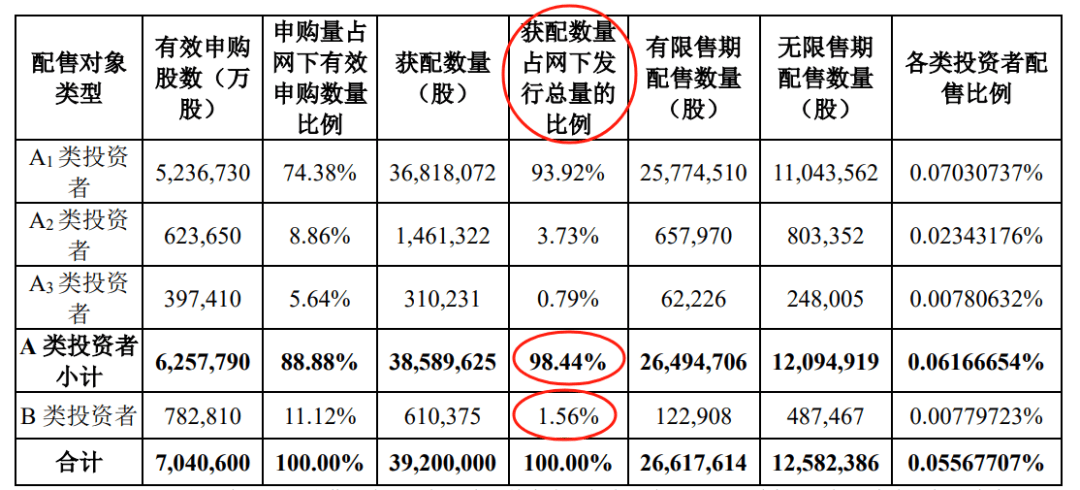
Core Viewpoint - The allocation results of offline subscription for Moer Thread indicate a significant shift in the distribution of shares, with A-class investors receiving 98.44% of the allocation and B-class investors only 1.56%, reflecting changes in the issuance and underwriting system for the Sci-Tech Innovation Board [1][3][9] Group 1: Allocation Results - A-class investors, which include public funds, social security funds, pension funds, and qualified foreign investors, received 98.44% of the shares allocated, while B-class investors received only 1.56% [1][3] - The specific allocation numbers show that some B-class investors received as few as 39 shares, highlighting the disparity in allocation [1] - Previous new stocks on the Sci-Tech Innovation Board also exhibited similar trends, with B-class investors typically receiving less than 5% of the allocation [4][5] Group 2: Subscription Rules - The reduction in B-class investor allocation is attributed to adjustments in the offline subscription rules, which now implement a new subscription method called "agreed lock-up" [7] - Under the agreed lock-up method, different lock-up periods and ratios are set for various investor classes, with A-class investors having the option to choose higher lock-up tiers [7][8] - For instance, the lock-up tiers for Moer Thread were set at three levels, with the first tier requiring a 9-month lock-up and a 70% lock-up ratio, while B-class investors could only subscribe at the lowest tier [7] Group 3: Impact on Investment Returns - The disparity in allocation ratios has led to a significant decrease in the share of B-class investors, which may affect their potential returns from new stock subscriptions [9] - Research indicates that the average return contribution from new stocks for A-class investors is significantly higher than for B-class investors, with A1-class investors potentially seeing returns of 0.116% compared to 0.014% for B-class investors [12] - The adjustments in the subscription rules aim to favor long-term investors, thereby increasing the allocation for those with a commitment to holding shares [11]

最低仅获配39股!摩尔线程网下初配结果出炉
证券时报· 2025-11-26 04:24
Core Viewpoint - The offline subscription for new shares is undergoing a significant change, with a marked reduction in the allocation for B-class investors compared to A-class investors, primarily due to the new subscription rules implemented for the Sci-Tech Innovation Board [2][8]. Summary by Sections Allocation Results - On November 25, the preliminary allocation results for Moer Thread showed that A-class investors received 98.44% of the shares, while B-class investors received only 1.56%. Some B-class investors received as few as 39 shares [2][4]. Investor Categories - A-class investors include public funds, social security funds, pension funds, bank wealth management products, insurance funds, and qualified foreign investors. B-class investors consist of private equity, securities asset management, and proprietary trading [2]. Subscription Rules - The new subscription rules for the Sci-Tech Innovation Board involve a "contractual lock-up" method, where different lock-up periods and ratios are set for various investor categories. A-class investors can choose from multiple lock-up tiers, while B-class investors are limited to the lowest tier [8][9]. Allocation Disparity - The allocation ratio for A-class investors is designed to be at least nine times that of B-class investors. For instance, the allocation ratio for A1-class investors was 0.07%, while for B-class investors, it was 0.0078%, indicating a significant disparity [9][10]. Historical Context - In previous subscriptions for Sci-Tech Innovation Board stocks, the allocation ratios between A and B-class investors were relatively close. However, recent changes have led to a substantial tilt towards A-class investors, with B-class allocations dropping below 5% in many cases [10][11]. Impact on Returns - The new rules are expected to affect the potential returns for B-class investors. For example, under the new allocation method, the average return contribution for A1-class investors is estimated at 0.116%, while B-class investors see a contribution of only 0.014% [12].

最低仅获配39股!摩尔线程打新出炉 B类投资者几乎被“忽视”
Zheng Quan Shi Bao Wang· 2025-11-25 23:59
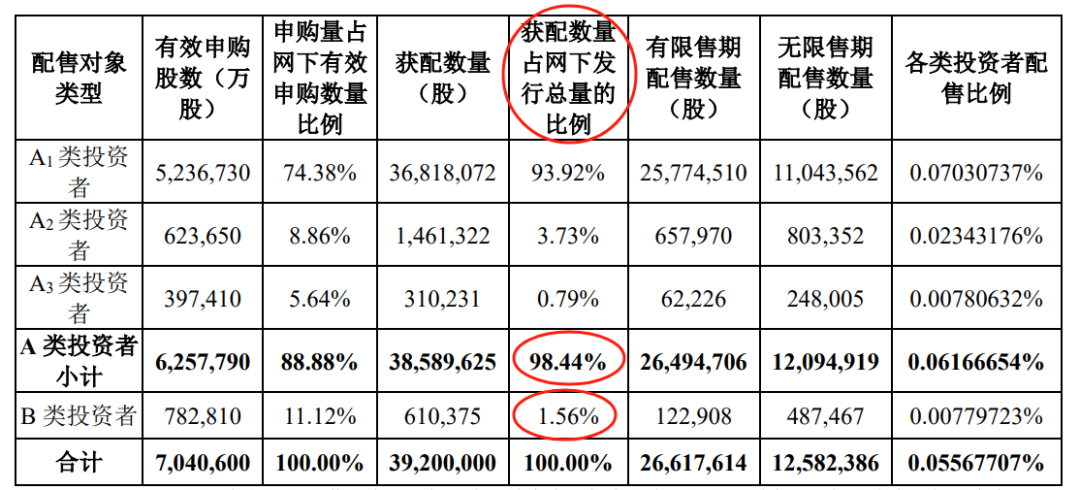
Core Viewpoint - The offline subscription for new shares in the Sci-Tech Innovation Board is experiencing a significant shift, with A-class investors receiving a dominant share of allocations compared to B-class investors due to new subscription rules [1][5][6]. Group 1: Allocation Results - A-class investors received 98.44% of the allocation, while B-class investors only received 1.56% in the recent subscription by Moer Thread [2][3]. - The allocation for B-class investors was notably low, with some receiving as few as 39 shares [1]. - Previous new shares in the Sci-Tech Innovation Board also showed a similar trend, with B-class allocations generally below 5% [3][4]. Group 2: Subscription Rules - The new subscription rules implemented for the Sci-Tech Innovation Board involve a "contractual lock-up" method, which sets different lock-up periods and ratios for A-class and B-class investors [5][6]. - A-class investors can choose from multiple lock-up tiers, while B-class investors are restricted to the lowest tier [5]. - The allocation ratios are designed to favor A-class investors significantly, with A1-class investors' allocation being at least nine times that of B-class investors [6]. Group 3: Impact on Investment Returns - The new rules are expected to impact the potential returns for B-class investors, as the disparity in allocation ratios may reduce their profitability from new share subscriptions [6][7]. - Research indicates that under the new allocation method, A1-class investors could see a return contribution of approximately 0.116% per new share, while B-class investors might only see a return contribution of 0.014% [8].
最低仅获配39股!摩尔线程打新出炉,B类投资者几乎被“忽视”
券商中国· 2025-11-25 23:22
Core Viewpoint - The offline subscription for new shares in the Sci-Tech Innovation Board is experiencing a significant shift, with A-class investors receiving a dominant allocation compared to B-class investors due to new subscription rules [1][5][9]. Group 1: Allocation Results - A-class investors received 98.44% of the allocation, while B-class investors only received 1.56% in the recent subscription by Moer Thread [2][3]. - The allocation for A-class investors in other recent Sci-Tech Innovation Board subscriptions also showed a similar trend, with A-class allocations ranging from 94.66% to 97.48% [3][4]. Group 2: Subscription Rules - The reduction in B-class investor allocations is attributed to the adjustment of offline subscription rules, which now implement a "contractual lock-up" method [5][6]. - The new rules allow A-class investors to choose from different lock-up periods and ratios, significantly favoring them over B-class investors [6][9]. Group 3: Impact on Investors - The disparity in allocation ratios has raised concerns about the potential impact on the returns for B-class investors, such as private equity firms [8]. - Research indicates that under the new subscription rules, the average return contribution for A-class investors is significantly higher than that for B-class investors, with A1 class potentially contributing 0.116% compared to B-class's 0.014% [9].

慢牛格局下的价值提升:上市公司高管共话市值管理新路径
Sou Hu Cai Jing· 2025-11-18 09:09
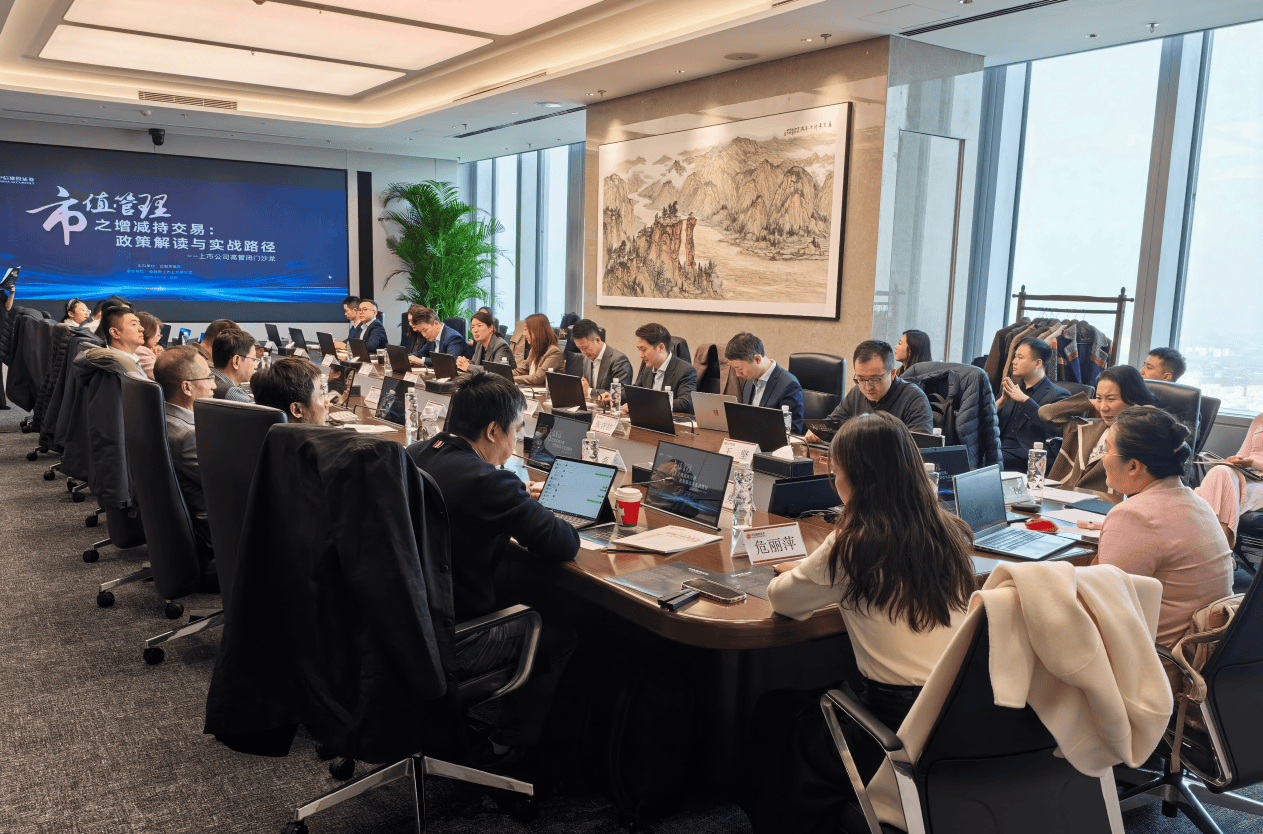
Group 1: Event Overview - The "Market Value Management: Policy Interpretation and Implementation Path" closed-door salon was successfully held in Beijing, organized by Financial界 Group, gathering experts from leading financial institutions and over thirty executives from various sectors [1] - The event focused on discussions around market value management, featuring insights from senior experts and scholars [1][3] Group 2: Strategic Directions - CITIC Securities aims to establish itself as a "value investment bank, new quality investment bank, and digital investment bank," providing comprehensive financial services throughout the enterprise lifecycle [3] - Financial界 Group emphasizes its role as a leading financial information service platform, aiming to connect high-quality financial institutions and listed companies for more precise and efficient value services [4] Group 3: Economic Insights - A macroeconomic analysis highlighted that China is undergoing a transition between old and new driving forces, with traditional industries facing challenges while emerging fields like AI present significant opportunities [7] - The M&A market in China shows signs of stabilization and recovery, particularly after new policies have increased the activity of major asset restructurings [7] Group 4: Practical Discussions on Market Value Management - The discussion on market value management revealed that companies now have more tools for managing their market presence, with a focus on compliance and policy evolution regarding share buybacks and increases [8] - Executives shared experiences on balancing investor relations and market value maintenance, emphasizing the need for effective communication with regulators and investors [9][11] Group 5: Future Directions and Collaboration - The importance of information dissemination in market value management was underscored, with Financial界 developing AI-based tools to enhance investor relations and market communication efficiency [22] - Participants acknowledged that market value management has entered a new phase of systematization and standardization, requiring collaborative efforts and a deep understanding of policies and rules [22]

汉邦科技11月17日获融资买入279.84万元,融资余额8022.40万元
Xin Lang Cai Jing· 2025-11-18 01:48
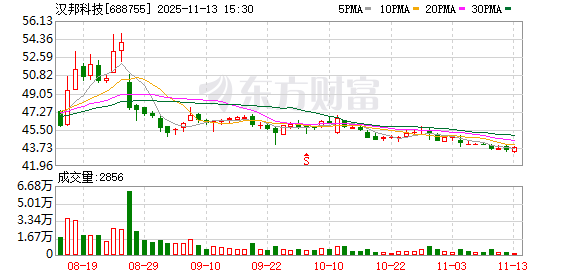
Core Points - Hanbang Technology's stock price decreased by 1.76% on November 17, with a trading volume of 42.3962 million yuan [1] - The company recorded a net financing purchase of 1.1831 million yuan on the same day, with a total financing balance of 80.224 million yuan, accounting for 10.58% of its market capitalization [1] - As of September 30, the company achieved a revenue of 506 million yuan, representing a year-on-year growth of 4.61%, while the net profit attributable to shareholders decreased by 17.27% to 37.0172 million yuan [2] Financing and Trading Data - On November 17, Hanbang Technology had a financing buy amount of 2.7984 million yuan and a financing repayment of 1.6154 million yuan [1] - The company had no short selling activity on November 17, with a short selling balance of 0 [1] - The total number of shareholders as of September 30 was 8,687, a decrease of 7.31% from the previous period [2] Business Overview - Hanbang Technology, established on October 28, 1998, specializes in providing separation and purification equipment, consumables, application technology services, and related technical solutions for the pharmaceutical and life sciences sectors [1] - The revenue composition of the company includes 70.99% from small molecule drug separation and purification equipment, 22.94% from large molecule drug separation and purification equipment, and 6.07% from other sources [1] - The company has distributed a total of 8.8 million yuan in dividends since its A-share listing [3]
汉邦科技:公司小分子液相色谱设备和大分子层析设备主要应用于生物制药领域
Mei Ri Jing Ji Xin Wen· 2025-11-13 10:49
Group 1 - The company, Hanbang Technology (688755.SH), focuses on small molecule liquid chromatography and large molecule chromatography equipment primarily used in the biopharmaceutical field, including the development and production of antibodies, recombinant proteins, vaccines, insulin, and peptides [1] - The company emphasizes technology research and development as its core, aiming to provide customers with integrated solutions of "equipment + consumables + process development" to support key technological breakthroughs in the biomanufacturing sector [1] Group 2 - An investor inquired about the company's separation and purification equipment used in biomanufacturing and whether its current R&D projects involve key technological breakthroughs in this field, as highlighted in the 14th Five-Year Plan [3]
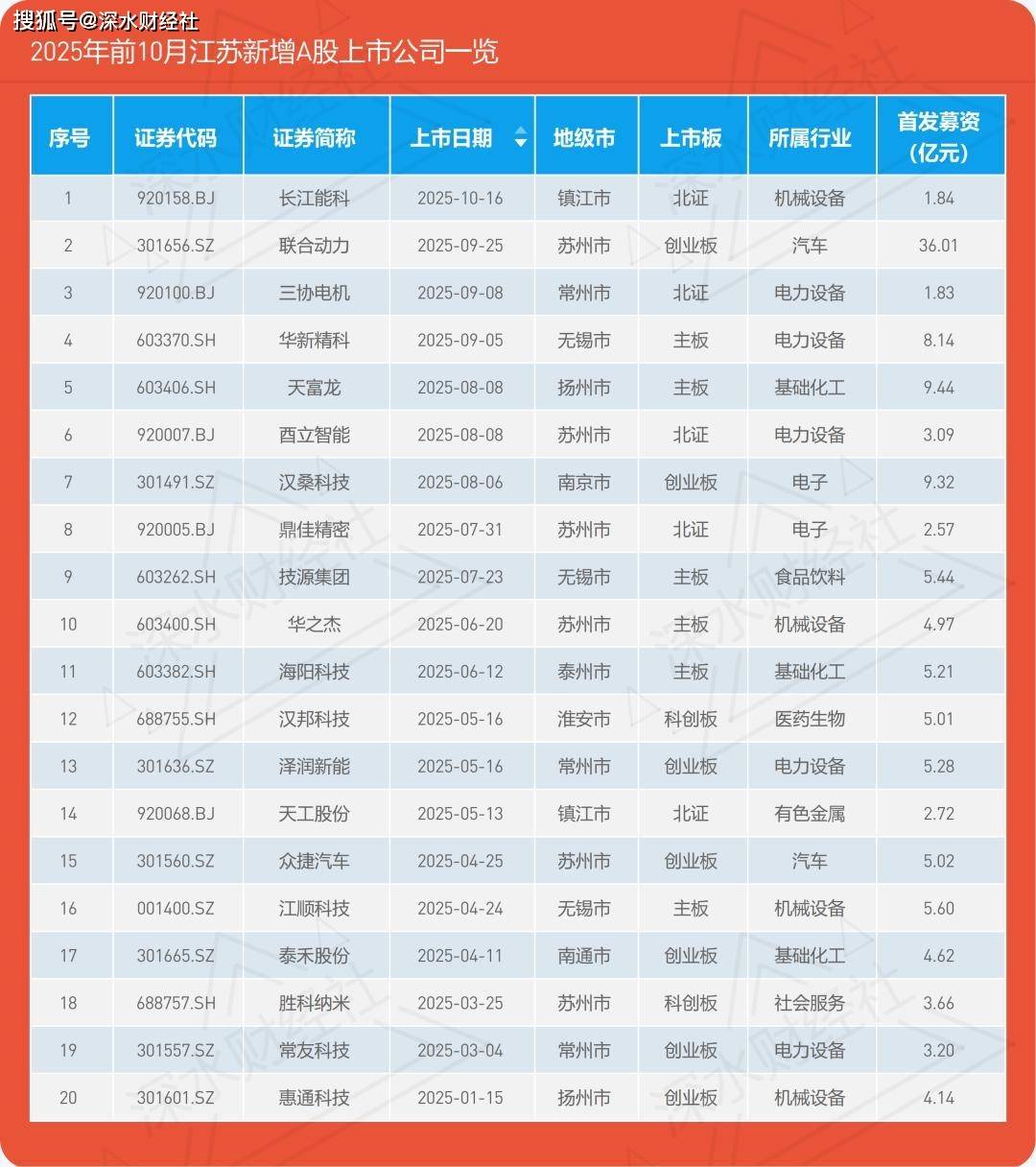
独家发布 | 2025年10月江苏A股公司IPO榜
Sou Hu Cai Jing· 2025-11-12 01:32
Core Insights - The report highlights the IPO activities in Jiangsu province for October 2025, indicating a stable trend with 9 new A-share companies listed, similar to previous months [1][10]. Group 1: IPO Overview - In October 2025, Jiangsu saw the listing of 1 new company, Changjiang Energy Materials, on the Beijing Stock Exchange, with a fundraising amount of 1.84 billion [2][10]. - For the first ten months of 2025, Jiangsu ranked first among provinces with 21 new A-share companies, surpassing Guangdong by 4 companies [10][17]. - The total fundraising amount for Jiangsu's IPOs in the first ten months reached 129.27 billion, placing it third nationally [17][29]. Group 2: City-wise IPO Distribution - Suzhou led the province with 7 new A-share companies in the first ten months, followed by Wuxi and Changzhou with 3 each [10][17]. - The distribution of new A-share companies by city in October 2025 shows that Jiangsu's cities are actively participating in the IPO market, with various cities contributing to the overall count [5][10]. Group 3: Fundraising Analysis - The total fundraising for Jiangsu's IPOs in October was relatively low at 1.84 billion, indicating a need for more robust fundraising activities [17]. - Suzhou's total fundraising amount for the first ten months was 57.48 billion, maintaining its position as the top city in Jiangsu for IPO fundraising [17][13]. Group 4: Sector and Board Distribution - The newly listed companies in Jiangsu for the first ten months were distributed across four boards, with the Growth Enterprise Market (GEM) having the highest number at 7 companies [17][11]. - The breakdown of the newly listed companies by board shows a diverse participation across different sectors, reflecting the province's economic landscape [11][17]. Group 5: IPO Pipeline and Support - As of the end of October, there were 301 companies in the IPO application queue nationwide, with Jiangsu having 51, ranking third in the country [29]. - Jiangsu also leads in the number of companies undergoing IPO guidance, with 243 firms, indicating a strong support system for potential IPO candidates [29][26].
汉邦科技:1059253股首发限售股11月17日上市流通
Zheng Quan Ri Bao Wang· 2025-11-10 08:10
Core Viewpoint - Hanbang Technology announced that its first public offering of offline placement restricted shares, totaling 1,059,253 shares, will be listed for circulation on November 17, 2025, representing 1.20% of the company's total share capital [1] Summary by Category - **Company Announcement** - Hanbang Technology will list 1,059,253 shares for circulation on November 17, 2025 [1] - The shares represent 1.20% of the total share capital of the company [1]