
Infineon

Search documents
SkyWater (NasdaqCM:SKYT) FY Conference Transcript
2026-01-14 19:32
Summary of SkyWater Technology Conference Call Company Overview - **SkyWater Technology** is the largest exclusively U.S.-based pure-play semiconductor foundry, serving both commercial and U.S. defense customers. The company operates facilities in Minnesota, Florida, and Texas, focusing on foundational nodes and advanced packaging to support critical infrastructure and supply chain resilience [1][9][10]. Core Business Model - SkyWater employs a **technology as a service** model, which emphasizes monetized R&D capabilities and partnerships with the U.S. government for domestic sourcing. The company has shifted focus from aerospace and defense to include quantum foundry technologies [9][10][14]. Facilities and Capabilities - **Minnesota**: Development center focusing on aerospace, defense, and quantum technologies. - **Florida**: Advanced packaging center with a $120 million program for wafer fan-out solutions, expected to produce prototypes in the second half of the year. - **Texas**: Volume manufacturing facility acquired to diversify into industrial and automotive sectors, enhancing scalability [10][12][14]. Market Trends and Positioning - There is a growing demand for U.S.-made semiconductors, driven by the need for critical infrastructure and supply chain resilience post-COVID. SkyWater aims to capture this demand by focusing on non-consumer markets [13][14]. - The company anticipates an upcycle in semiconductor demand and is positioned to benefit from emerging technologies, particularly in quantum computing and advanced packaging [13][14]. Federal Funding Environment - The federal funding landscape remains unpredictable, with potential government shutdowns impacting budgets. However, SkyWater has developed a strong A&D business and is prepared to navigate these challenges [19][20]. - Increased defense budgets are expected to positively impact SkyWater's ATS (Advanced Technology Services) business [21][22]. Fab 25 Insights - Fab 25 is the most advanced 200-millimeter fab in the U.S., currently producing 65-nanometer NOR Flash products and qualifying 45-nanometer products. The facility is expected to generate approximately **$80 million in quarterly revenue** [26][30]. - The acquisition of Fab 25 has increased SkyWater's wafer capacity from 100,000 to 500,000 wafers annually and added 180 engineers, enhancing ATS revenue potential [27][28]. Quantum Computing Business - SkyWater services various qubit modalities, including silicon, superconducting, and ion trap qubits. The company has established unique capabilities in cryo-electronics and advanced packaging, which are critical for quantum technologies [35][36]. - The quantum computing segment is projected to grow at a **30% rate**, with expectations for continued customer acquisition and product development [42][43]. Revenue Outlook - SkyWater anticipates total revenue of around **$600 million** for 2026, with significant contributions from Fab 25 and customer-funded tooling [44][46]. - The company is focused on converting ATS customers to wafer services, with timelines varying based on technology maturity [49][50]. Risks and Opportunities - Potential risks include delays in government funding and reliance on Infineon for revenue. However, there are numerous opportunities for growth, particularly if government budgets are released as expected [47][48]. - The company is exploring partnerships with Asian foundries to enhance domestic sourcing capabilities, which could provide additional revenue streams [55][56]. Strategic Goals - SkyWater's primary goals include executing A&D platforms, establishing the quantum foundry, and transitioning the Texas facility to a foundry model while backfilling it with new customers [59][60]. This summary encapsulates the key points discussed during the conference call, highlighting SkyWater Technology's strategic positioning, market trends, and future outlook.

Auto industry expands open-source pact to boost development, cut costs
Yahoo Finance· 2026-01-07 12:10
Core Viewpoint - More than 30 companies in the automotive supply chain are collaborating on open-source software to develop next-generation vehicles and reduce costs, as announced by Germany's VDA at the CES trade show in Las Vegas [1][2]. Group 1: Collaboration and Participants - The initiative has expanded from 11 to 32 participating firms, including Stellantis, Traton, Schaeffler, Infineon, and Qualcomm, alongside major German carmakers like Volkswagen, BMW, and Mercedes-Benz [2]. - This collaboration signifies a global shift towards open innovation within the automotive industry, as stated by Mike Milinkovich, executive director of the Eclipse Foundation [3]. Group 2: Goals and Benefits - The initiative aims to reduce development and maintenance efforts by up to 40% and accelerate time to market by up to 30% [2].


2026 年全球科技展望=Global Tech Outlook 2026
2026-01-07 03:05
Summary of Key Points from Morgan Stanley Research - Global Tech Outlook 2026 Industry Overview - **Focus**: The report primarily discusses the technology sector, with a specific emphasis on semiconductors and hardware within the Asia Pacific and European markets [20][40]. Core Insights and Arguments - **Semiconductor Demand**: The demand for AI hardware, particularly Nvidia GPU server racks, is expected to double year-over-year in 2026, with data center-related revenue projected to exceed 40% of overall revenue in 2025 and at least 50% in 2026 [20][21]. - **Substrate Demand**: Demand for ABF substrates has bottomed, driven by AI GPU/Accelerators, while BT substrates benefit from a memory super-cycle and rising raw material prices, leading to upward revisions in demand volumes and average selling prices (ASPs) [20][21]. - **Smartphone Market**: The smartphone industry is anticipated to face component cost increases in 2026, putting downward pressure on margins, particularly for mid-to-low-end products. High-end products are expected to perform better [20][21]. - **PC OEMs/ODMs**: Margin headwinds are expected for PC OEMs/ODMs due to rising memory prices, leading to multiple quarters of margin compression [20][21]. - **TV Panel Pricing**: TV panel prices are showing signs of bottoming out, but rising memory costs may pressure pricing in the near term [20][21]. Preferred and Least Preferred Companies - **Most Preferred**: - **AI Hardware**: Wiwynn, Accton, Kingslide, BizLink, Delta, Wistron - **Substrates**: Unimicron, SEMCO - **MLCC**: SEMCO - **Smartphones**: Xiaomi - **Display/TV**: BOE - **PC OEMs**: Lenovo [20][21]. - **Least Preferred**: - **AI Hardware**: Giga-Byte - **Substrates**: NYPCB - **Smartphones**: Mid-to-low-end products - **Display/TV**: Sanan - **PC OEMs**: Acer [20][21]. Market Dynamics - **DRAM Pricing**: DRAM pricing is expected to move higher into the first half of 2026, with inventory levels normalizing [27][30]. - **Automotive Semiconductors**: The automotive semiconductor market is experiencing a decline, with significant de-stocking challenges, but there are long-term tailwinds in data centers and grid optimization [50][53]. Company-Specific Insights - **ASML**: Positive momentum for lithography demand is expected, with strong DRAM spending and advanced logic speed. ASML is rated as a top pick with a price target of €1,000 [41][42]. - **ASM International**: Expected to benefit from leading-edge logic and advanced DRAM, with a price target of €625 [44]. - **Besi**: Anticipated strong growth across its portfolio, driven by AI [46]. - **Infineon**: Facing near-term de-stocking challenges but expected to benefit from long-term data center spending [53]. Additional Considerations - **Market Sentiment**: Investors are advised to monitor the cyclical and secular drivers affecting the semiconductor market, particularly in light of the ongoing AI infrastructure roll-out [53]. - **Valuation Methodology**: The report includes various price targets and valuation scenarios for the companies discussed, indicating a range of potential outcomes based on market conditions [41][44][46][53]. This summary encapsulates the critical insights and projections from the Morgan Stanley Research report, providing a comprehensive overview of the current state and future outlook of the technology sector, particularly in semiconductors and hardware.
欧盟半导体 2026 年展望-上调阿斯麦评级至 “跑赢大盘” 并列为首选标的-EU Semis 2026 outlook - Upgrading ASML to Outperform and Top Pick
2026-01-06 02:23
Summary of Key Points from the Conference Call Industry Overview: EU Semiconductors Company: ASML - ASML has been upgraded to an "Outperform" rating with a price target (PT) of €1,300.00, indicating a potential upside of 32% [2][7][54] - The company is positioned as the top pick in the EU semiconductor sector for 2026, driven by significant demand for DRAM and logic chips, particularly due to AI applications [8][9] Core Insights and Arguments - **DRAM Super Cycle**: The top three DRAM manufacturers are expected to add up to 250,000 wafers per month (kwpm) of new capacity in 2026, with a shift towards the 1c node, which has a lithography intensity of 28%, significantly higher than previous nodes [2][9] - **EUV Intensity**: The transition to the 1c node will increase EUV intensity, with Samsung and Hynix deploying 6 to 7 EUV layers, while Micron will adopt EUV for the first time with 2 to 3 layers [9][12] - **Earnings Growth**: ASML's earnings per share (EPS) growth is projected at an 18% compound annual growth rate (CAGR) from 2025 to 2027, surpassing the consensus estimate of 15% [2][54] - **Valuation**: ASML is currently trading at a trough premium over its peers, with a price-to-earnings (P/E) ratio of 1x compared to a historical average of 1.6x [2][54] Company: Besi - Besi's revenue forecast for 2026 has been cut by 8%, now 10% below consensus, due to slower adoption of fluxless TCB technology for HBM4 production [3][72] - The company maintains an "Outperform" rating but has reduced its price target to €165.00, reflecting near-term downward revisions [3][72] Company: Infineon - Infineon retains an "Outperform" rating, with significant growth expected from its AI server power business, projected to double revenue from €750 million in FY25 to €1.5 billion in FY26 [4][7] - Long-term growth is anticipated to be driven by power architecture changes, with a potential market share of 30-40% and revenue reaching €5 billion by 2030 [4][7] Additional Important Insights - **China Market Dynamics**: ASML anticipates a significant decline in revenue from China in 2026, but recent trends suggest a slower decline than previously expected, driven by strong demand for advanced logic and AI chips [35][36] - **Capacity Expansion**: Advanced logic capacity in China is projected to grow sixfold over the next three years, primarily due to AI chip demand [43][44] - **Hybrid Bonding Technology**: Adoption of hybrid bonding is expected to accelerate in 2027/28, with significant growth anticipated in TSMC's capacity for 3D ICs [77][79] Conclusion The semiconductor industry, particularly in the EU, is poised for significant growth driven by advancements in DRAM and logic technologies, with ASML leading the charge. While Besi faces challenges, Infineon is well-positioned for growth in the AI sector. The dynamics in the Chinese market and the adoption of new technologies will also play crucial roles in shaping the industry's future.

Major European Markets Move Higher; Miners, Bank Stocks Shine
RTTNews· 2025-12-30 13:41
Market Overview - European stocks experienced a broad increase, with the pan European Stoxx 600 climbing 0.56% and major indices such as the U.K.'s FTSE 100, Germany's DAX, and France's CAC 40 also showing gains of 0.5%, 0.57%, and 0.56% respectively [1] Sector Performance - In the resources, defense, and banking sectors, there was notable buying activity as investors prepared for the New Year holidays [1] - In the German market, Rheinmetall and Infineon saw increases of 2.5% and 2.7% respectively, while other companies like Bayer, Commerzbank, and Deutsche Bank gained between 1% to 1.7% [2] - The French market saw gains from Societe Generale, BNP Paribas, and Credit Agricole, which increased by 1.8%, 1.3%, and 1.2% respectively, along with other companies like Hermes International and Airbus moving up by 1% to 1.2% [2] UK Market Highlights - In the UK, mining companies such as Fresnillo, Anglo American Plc, and Antofagasta reported significant gains of 5.6%, 2.6%, and 2.5% respectively, with other miners like Glencore and Rio Tinto also showing sharp increases [3] - Bank stocks including Barclays, Standard Chartered, and HSBC Holdings rose by 1% to 1.5% [3] Weak Performers - DCC experienced a decline of about 2%, along with other companies like Experian and Compass Group which also traded weak [4]


New at Mouser: Infineon Technologies PSOC Edge Machine Learning MCUs for Robotics, Industrial, and Smart Home Applications
Businesswire· 2025-12-29 16:11
Core Insights - Mouser Electronics, Inc. is recognized as the leading New Product Introduction (NPI) distributor in the industry, offering the widest selection of semiconductors and electronic components [1] - The company has begun shipping the new PSOC™ Edge machine learning microcontrollers (MCUs) developed by Infineon Technologies, indicating a focus on advanced technology solutions [1] Company Overview - Mouser Electronics is an authorized global distributor known for providing the latest electronic components and industrial automation products [1] - The introduction of PSOC Edge MCUs highlights Mouser's commitment to enhancing its product offerings in the machine learning domain [1] Product Details - The PSOC Edge MCUs are characterized as enhanced and advanced high-performance machine learning microcontrollers, showcasing Infineon's innovation in this technology sector [1]


英伟达800伏电压“革命”:全球数据中心面临史上最大规模基础设施改造
Hua Er Jie Jian Wen· 2025-12-28 11:57
Core Insights - Nvidia is leading a significant shift in data center power architecture by transitioning from traditional AC power to 800V DC power, preparing for ultra-high-density computing environments with a power density of 1 megawatt (MW) per rack [1] - This transition is driven by the increasing power density demands of modern AI workloads, which are expected to exceed the capabilities of existing power systems [2] - The shift to 800V DC is anticipated to reduce total cost of ownership (TCO) by 30% in the long term, although it presents a substantial capital expenditure challenge in the short term [1][6] Group 1: Technological Transition - The 800V DC architecture allows for over 150% more power transmission on the same copper conductors compared to traditional systems, significantly enhancing energy efficiency [2] - Nvidia's new Vera Rubin NVL144 rack design incorporates liquid cooling technology and increased energy storage capacity to manage the extreme power density [2] - The transition will eliminate the need for traditional AC power distribution units (PDUs) and uninterruptible power supply (UPS) systems, reducing the demand for AC PDUs by up to 75% [3] Group 2: Market Impact - The shift to higher voltage systems is expected to increase revenue potential per megawatt from €2 million to €3 million in traditional data centers [4] - The industry anticipates that 80-90% of new data centers will adopt the 800V DC architecture in the future, despite currently only one-third of racks operating below 10kW [5] - Key suppliers in the semiconductor space, such as Analog Devices and Infineon, are positioning themselves to meet the demand for advanced chips required for 800V DC systems [5] Group 3: Infrastructure and Supply Chain - The transition will necessitate a comprehensive upgrade of the entire supply chain, including transformers, circuit breakers, and cooling systems [1] - Companies like Schneider Electric are targeting the market for racks capable of handling up to 1.2MW, while also developing solutions for liquid cooling systems [3] - Solid-state protection devices are replacing mechanical circuit breakers, with ABB leading in the development of solid-state breakers designed for DC distribution [5] Group 4: Timeline and Financial Considerations - The full commercial transition to 800V DC data centers is expected to align with the deployment of Nvidia's Kyber architecture by 2027, with significant scale effects anticipated around 2028 [6] - Data center operators will face substantial investment requirements over the next five years, in addition to addressing a $5 trillion AI funding gap [6]
中资半导体出海再遇“国家安全”壁垒:FTDI事件背后的全球产业博弈
Huan Qiu Wang· 2025-12-27 12:39
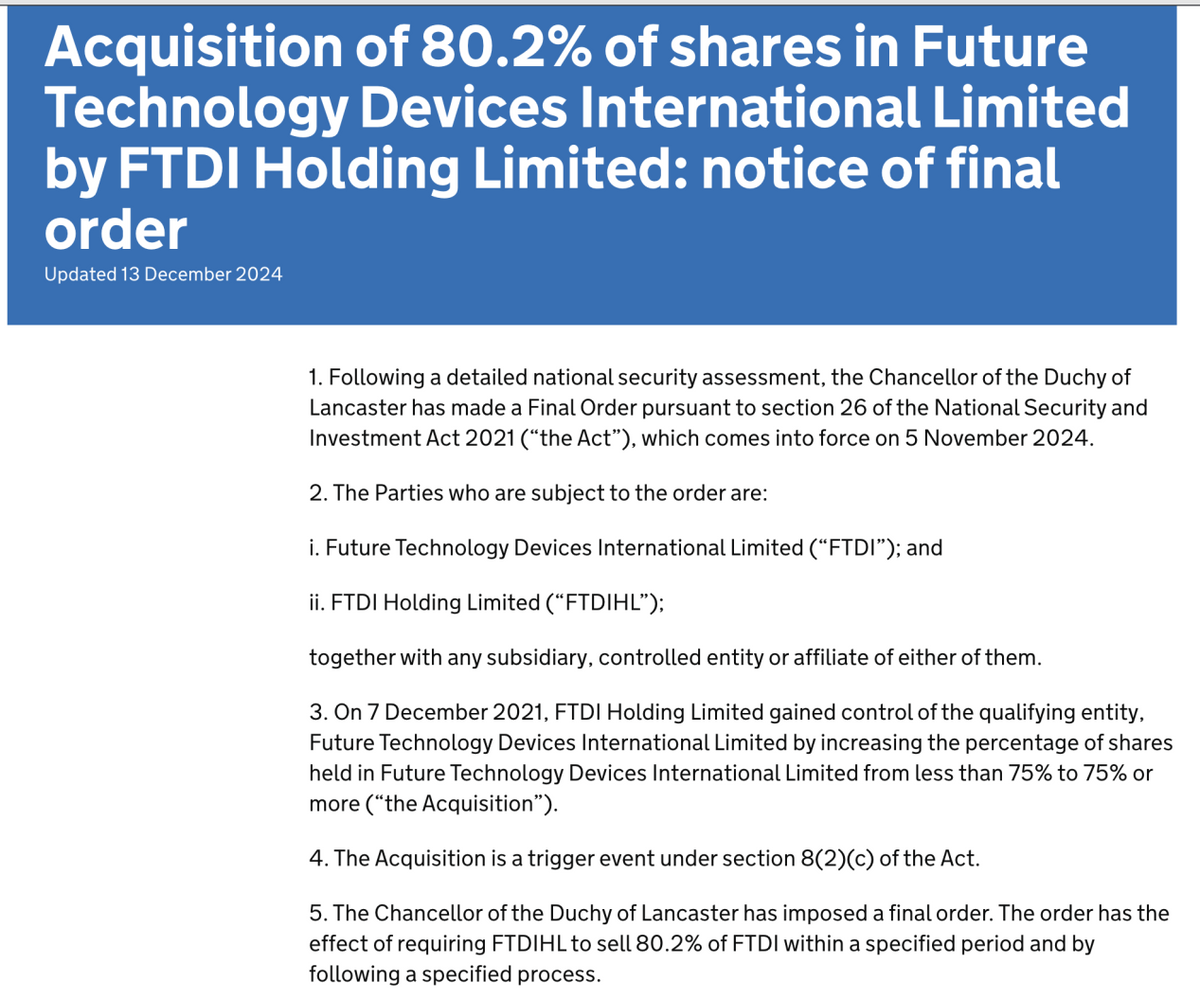
Core Viewpoint - The forced divestment of FTDI by the UK government highlights the increasing fragmentation and geopolitical tensions within the global semiconductor industry, particularly affecting Chinese investments in high-end technology sectors [1][5][7]. Group 1: Acquisition Details - In December 2021, Jian Guang Asset acquired 80.2% of FTDI for $414 million, marking a strategic move into the high-end analog chip sector by Chinese capital [1][3]. - FTDI, established in 1992, is a leading company in the USB bridge chip market with nearly 20% market share, crucial for various applications including automotive electronics and IoT [3][4]. - The acquisition was intended to integrate FTDI into the Chinese semiconductor ecosystem, addressing long-standing technological gaps [3][4]. Group 2: Regulatory Actions - The UK government initiated a security review under the National Security and Investment Act, classifying the acquisition as a "trigger event" [4][5]. - On November 5, 2024, the UK government mandated the sale of FTDI due to concerns over potential misuse of technology and threats to critical infrastructure, setting a deadline for divestment by December 2025 [1][4]. - Despite legal challenges from the Chinese entity, the UK High Court upheld the government's decision, removing legal obstacles to the forced sale [4][6]. Group 3: Implications for the Semiconductor Industry - The case reflects a broader trend of Western nations using "national security" as a rationale to restrict foreign investments, potentially leading to increased scrutiny of any Chinese semiconductor investments [5][6]. - The forced divestment of FTDI may undermine global supply chain stability and efficiency, as the semiconductor industry relies on international collaboration [7]. - The situation raises concerns about the potential for further fragmentation of the semiconductor market, which could exacerbate global chip shortages and price volatility [7]. Group 4: Future Considerations - The FTDI incident serves as a catalyst for reevaluating semiconductor governance rules, emphasizing the need for transparent and non-discriminatory international regulations [7]. - China advocates for open cooperation and fair competition in the semiconductor sector, contrasting with the political motivations observed in some Western countries [7].

Futures Pointing To Continued Strength On Wall Street

RTTNews· 2025-12-22 13:58
Market Overview - Major U.S. index futures indicate a higher open on Monday, with stocks expected to continue the upward trend from the previous sessions [1] - Technology stocks are likely to lead the market, following strong performances last Thursday and Friday [1] Company Highlights - Oracle (ORCL) shares surged by 2.6% in pre-market trading after Wells Fargo reiterated its Overweight rating [1] - Oracle's stock spiked by 6.6% following a memo from TikTok CEO indicating an agreement to sell its U.S. operations to a joint venture including Oracle and Silver Lake [5] - Nvidia (NVDA) shares jumped by 3.9% after reports of plans to ship AI chips to China before the Lunar New Year [6] - Micron Technology also showed strong performance after better-than-expected quarterly results and guidance [5] Economic Indicators - Existing home sales in the U.S. rose by 0.5% to an annual rate of 4.13 million in November, following a 1.5% increase in October [7] - Consumer sentiment index for December was revised down to 52.9 from a preliminary 53.3, still above November's 51.0 [9] Sector Performance - The tech-heavy Nasdaq closed up 301.26 points or 1.3% at 23,307.62, while the S&P 500 rose by 59.74 points or 0.9% to 6,834.50 [4] - Biotechnology stocks performed well, with the NYSE Arca Biotechnology Index surging by 3.1% [10] - Gold stocks saw strength, with the NYSE Arca Gold Bugs Index increasing by 2.7% amid rising gold prices [10] Commodity and Currency Markets - Crude oil futures rose by $1.28 to $57.80 per barrel [12] - Gold futures jumped by $69.50 to $4,456.80 per ounce [12] - The U.S. dollar traded at 157.04 yen, down from 157.75 yen [12]
汽车半导体:周期复苏的更多证据-UBS Global I_O Semiconductors _Automotive semis_ further evidence of cycle...__ Automotive semis_ further evidence of cycle recovery
UBS· 2025-12-15 01:55
Investment Rating - The report maintains a positive stance on the analog semiconductor sector, indicating a recovery in the automotive semiconductors market [2][7]. Core Insights - The automotive semiconductor market is projected to experience a revenue decline of -5% YoY in 2025E, an improvement from the previous estimate of -7% YoY, with a subsequent growth of +11.6% in 2026E [4][23]. - Analog revenue growth has returned to positive levels, with Q3'25 showing a 5% YoY increase, and expectations for Q4'25 to grow by 11% YoY [3][4]. - AI is emerging as a growth driver, contributing 5-10% of revenues, with significant increases in AI-related revenues anticipated for major players [5]. Summary by Sections Automotive Semiconductors - The automotive semiconductor revenue is expected to decline by -5% YoY in 2025E, improved from -7% previously, and is projected to grow by +11.6% in 2026E [4][23]. - China’s automotive semiconductor demand is forecasted to grow by 9% YoY in 2025E, down from 21% in 2024, indicating a normalization trend [6][28]. Analog Semiconductors - Analog revenue growth has shown positive momentum, with Q3'25 revenue up 5% YoY, and projections for Q4'25 to grow by 11% YoY [3][4]. - Industrial revenues are expected to grow by 10.8% YoY in 2025E, with a forecast of +14.5% YoY for 2026E [4]. AI and Growth Drivers - AI is becoming a significant growth driver, with major companies like Infineon and TI reporting substantial increases in AI-related revenues [5]. - Infineon anticipates AI revenue to rise from $860 million in FY'25E to $1.7 billion in FY'26E [5]. Regional Insights - The report indicates that while China’s growth is moderating, it remains a key market, with expectations of 6% growth in 2026E compared to 8% for non-China regions [6][28]. - Year-to-date, China’s car volumes grew 13% YoY, with NEV (New Energy Vehicle) volumes up 31% YoY [6]. Sector Preferences - The report highlights a preference for analog semiconductors, which are currently trading at approximately 20x P/E for 2026E, compared to a 10-year average of 19x [7]. - Preferred stocks include TI, IFX, and Renesas, while ON and Melexis are rated Neutral [7].


