氮化镓(GaN)

Search documents
三星大举进军GaN
半导体芯闻· 2026-03-20 10:08
Core Insights - Samsung Electronics plans to operate an 8-inch (200mm) GaN power semiconductor foundry line, expected to achieve full-scale production by Q2 2024, marking its official entry into the GaN wafer foundry business after over three years of announcements [1] - The company has secured one customer but anticipates revenues from the GaN foundry business to be below 1 trillion KRW due to a limited customer base [1] - Samsung aims to enhance profitability by offering a full suite of services without chip design and producing wafers in-house rather than sourcing them externally [1] Summary by Sections GaN Semiconductor Market - GaN devices are typically used in applications below 1200 volts, such as electric vehicle charging stations and smartphone chargers, and are critical for improving power conversion efficiency in AI data centers [2] - Nvidia promotes an 800V DC power architecture that requires high-voltage DC to be converted to lower voltages internally, where GaN-based converters are widely utilized [2] - GaN offers advantages in high-voltage operation and fast switching, leading to higher power density, lower heat generation, and more compact system designs [2] Samsung's Production Plans - Samsung previously announced plans to start power semiconductor foundry operations in 2025, but this timeline has been delayed [2] - Foundry companies typically secure customers before filling capacity, and Samsung's decision to advance its plans appears to be based on customer development over the past year [2] - The company also plans to launch a SiC power semiconductor foundry line this year, offering a full suite of services from design to packaging, with a voltage range of 1200 to 1700 volts [2] - Samsung has not confirmed specific details regarding the operation of the GaN power semiconductor foundry [2]

宏微科技(688711.SH):现有1700V GWB模块产品可适配固态变压器
Ge Long Hui· 2026-02-09 07:43
Core Viewpoint - The company has accumulated relevant technology in the field of solid-state transformers (SST) and is advancing the development and industrialization of third-generation power semiconductor devices such as silicon carbide (SiC) and gallium nitride (GaN) to support high-voltage, high-power applications [1] Group 1 - The company currently has 1700V GWB module products that are compatible with solid-state transformers [1] - The company will continue to monitor market dynamics and timely promote the industrialization of relevant technological achievements [1] - The focus is on providing support for the development of core power electronic equipment [1]

【招商电子】VIS 25Q4 跟踪报告:电源管理芯片营收同环比双增,2026年稼动率指引回升
招商电子· 2026-02-04 15:10
Core Viewpoint - World Advanced (VIS, 5347.TW) reported Q4 2025 earnings with revenue of NT$12.594 billion, a year-on-year increase of 9.0% and a quarter-on-quarter increase of 2.0%, driven by ASP growth and favorable exchange rates, despite a decline in wafer shipment volume [2][4]. Financial Overview - Q4 2025 revenue was NT$12.594 billion, with a gross margin of 27.5%, and a net profit of NT$1.748 billion, resulting in an EPS of NT$0.93. The revenue for the full year 2025 is projected to be NT$48.591 billion, a 10% increase from the previous year [2][14]. - The total wafer shipment volume for Q4 2025 was 626,000 pieces, with an ASP of $624 per piece, reflecting a 5% quarter-on-quarter increase [2][14]. Segment Performance - Revenue from processes below 0.18um slightly decreased quarter-on-quarter, while the share of power management chips continued to rise, accounting for 78% of total revenue in Q4 2025 [3][4]. - The revenue from power management chips was NT$9.823 billion, a year-on-year increase of 19.8% and a quarter-on-quarter increase of 7.5% [3]. Capacity and Utilization - The company expects wafer shipments in Q1 2026 to increase by 1%-3%, with ASP projected to decline by 3%-5% due to product mix changes. The gross margin is expected to be between 28%-30%, and capacity utilization is anticipated to rise to 80%-85% [4][15]. - The construction of the 12-inch factory in Singapore is progressing slightly ahead of expectations, with sample production expected to begin in mid-2026 [4][15]. Long-term Outlook - For 2026, wafer capacity is expected to decrease by 4% year-on-year, with capital expenditures projected to remain at NT$60-70 billion, primarily for the Singapore factory [4][15]. - The company anticipates a strong demand for power management products in automotive and data center applications, with significant growth expected in the power management and discrete device sectors [4][21]. Cost Structure and Profitability - The company expects depreciation expenses to increase by 12% in 2026, driven by ongoing capital expenditures and upgrades to production capacity [23]. - The operating expense ratio is projected to be around 12% of revenue in 2026, with a focus on maintaining a gross margin of over 30% when capacity utilization reaches 85%-90% [23].
撼动SiC霸权?现代汽车入股VisIC,GaN“杀入”汽车逆变器
半导体芯闻· 2026-01-16 10:27
Core Viewpoint - The entry of VisIC, an Israeli GaN chip company, into the electric vehicle (EV) traction inverter market challenges the traditional division between SiC and GaN technologies, as it aims to leverage its D³GaN technology to compete directly with SiC in high-voltage applications [1][16]. Group 1: Technology and Performance - VisIC's D-mode GaN technology offers advantages in reliability, consistency, lower switching losses, and safety, making it suitable for EV traction inverters [2]. - D-mode GaN can achieve a decoupling of threshold voltage and current capability, allowing for high current and high threshold voltage combinations, which is critical for high-power applications [2]. - In extreme conditions, D³GaN can withstand short-circuit peak currents approximately 3.74 times the rated operating current, outperforming E-mode GaN and approaching traditional IGBT and SiC devices [5]. Group 2: Efficiency and Testing - VisIC's GaN prototype traction inverter has achieved a peak efficiency of 99.67% during testing, demonstrating stable performance across various operational conditions [6]. - In light-load conditions, GaN shows approximately 2.5 times lower total losses compared to SiC, indicating a significant energy efficiency advantage in real-world applications [9][11]. Group 3: Market Strategy and Localization - VisIC aims to establish a localized ecosystem in China, focusing on building partnerships across the supply chain, including wafer fabrication, packaging, and software development [14][15]. - The company prioritizes the EV traction inverter market due to existing customer relationships and supply chain foundations, while also exploring opportunities in data centers [14]. Group 4: Future Outlook - VisIC predicts a long-term coexistence of GaN and SiC technologies, with GaN expected to play a more significant role in low-power fast charging, data center power supply, and high-power systems over the next decade [12]. - The competition between GaN and SiC in the power semiconductor field is just beginning, with VisIC's advancements potentially reshaping the market landscape [16].
广东东莞半导体巨头冲击IPO,已进入苹果、三星产业链,31亿估值
3 6 Ke· 2026-01-07 12:49
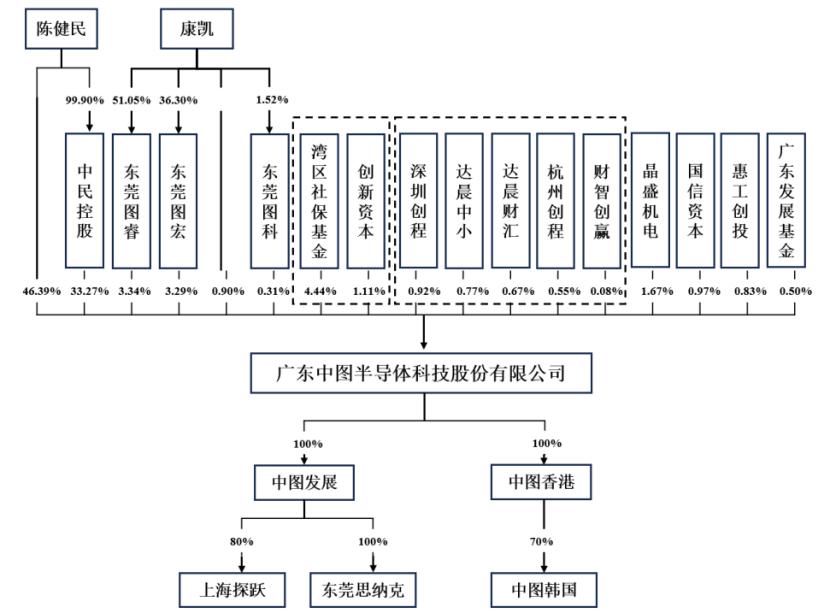
Core Viewpoint - The semiconductor sector is gaining attention with several companies experiencing significant stock price increases, and Guangdong Zhongtu Semiconductor Technology Co., Ltd. is seeking to go public on the STAR Market [1] Company Overview - Zhongtu Semiconductor was established in December 2013 and became a joint-stock company in September 2020, headquartered in Dongguan [2] - The actual controller, Chen Jianmin, holds 79.66% of the shares, while the top ten shareholders own 96.30% of the company [2] - The company focuses on the research, production, and sales of patterned substrate materials, particularly for GaN epitaxy [6][17] Financial Performance - The company reported revenues of 1.063 billion, 1.208 billion, 1.149 billion, and 532 million yuan for the years 2022, 2023, 2024, and the first half of 2025, respectively [9] - Net profits for the same periods were 42.20 million, 74.13 million, 94.46 million, and 42.13 million yuan [9] - The company’s total assets as of June 30, 2025, were approximately 2.625 billion yuan, with a debt-to-asset ratio of 36.50% [10] Product and Market Position - Zhongtu Semiconductor is a leading manufacturer of patterned sapphire substrates (PSS) and patterned composite material substrates (MMS), with an annual production capacity exceeding 18 million 4-inch substrates [6] - The company holds a global market share of approximately 32.76% in the patterned substrate sector [25] - The main applications of its products include Mini/MicroLED, automotive lighting, and various display technologies [6][17] Competitive Landscape - The company faces competition from a few downstream clients who have their own patterned substrate production capabilities, which could impact market share [16] - The company’s gross profit margins have shown an upward trend, reaching 22.51% in the first half of 2025 [12][13] - The company’s revenue from PSS has decreased from 83.12% in 2022 to 61.97% in the first half of 2025, while MMS revenue has increased significantly [11][12] Research and Development - Zhongtu Semiconductor has invested 157 million yuan in R&D over the past three years, representing 4.60% of total revenue [15] - The company’s procurement is highly concentrated, with the top five suppliers accounting for over 80% of total procurement costs [15] Future Outlook - The global demand for GaN LED epitaxial wafers is expected to grow, with production projected to reach 51.39 million units in 2025 [21] - The company’s ability to enhance its product matrix and competitive advantages will be crucial for maintaining its market position [25]
中图半导体冲击IPO,深耕图形化衬底材料领域,与少数客户存在竞争
Ge Long Hui· 2026-01-07 10:07
Core Viewpoint - The semiconductor sector is gaining attention with several companies experiencing significant stock price increases, and Guangdong Zhongtu Semiconductor Technology Co., Ltd. is seeking to go public on the STAR Market [1][2]. Company Overview - Zhongtu Semiconductor was established in December 2013 and became a joint-stock company in September 2020, headquartered in Dongguan [2]. - The company is a major manufacturer of patterned substrate materials, focusing on GaN epitaxy substrate materials [6][20]. Shareholding Structure - Before the issuance, the top ten shareholders held 96.30% of the shares, with Chen Jianmin controlling 79.66% [3][5]. - The main institutional shareholders include Shenzhen Capital Group and Dachen Venture Capital [3]. Financial Performance - Revenue for the years 2022, 2023, 2024, and the first half of 2025 was 1.063 billion, 1.208 billion, 1.149 billion, and 532 million respectively, with net profits of 42.20 million, 74.13 million, 94.46 million, and 42.13 million [10][11]. - The company’s gross margin for its main business has shown an upward trend, reaching 22.51% in the first half of 2025 [14]. Product and Market Position - Zhongtu Semiconductor's main products include 2 to 6-inch patterned sapphire substrates (PSS) and 4 to 6-inch patterned composite substrates (MMS), with an annual production capacity exceeding 18 million 4-inch equivalent substrates [6][12]. - The company holds approximately 32.76% of the global market share for patterned substrates [19][28]. Application Areas - The products are primarily used in Mini/MicroLED, automotive lighting, RGB direct display, backlight display, and general lighting [6][20]. - The company’s revenue from patterned sapphire substrates has decreased from 83.12% in 2022 to 61.97% in the first half of 2025, while revenue from patterned composite substrates has increased significantly [12][13]. Production and Supply Chain - The production process involves using sapphire wafers as the main raw material, with a focus on high-quality manufacturing processes [8][16]. - The company has a high supplier concentration, with the top five suppliers accounting for over 80% of total procurement [16]. Competitive Landscape - The company faces competition from downstream clients who may increase their in-house production of patterned substrates, potentially impacting market share [17][28]. - Major clients include well-known companies in consumer electronics and new energy vehicles, such as Apple, Samsung, and BYD [17].
英伟达800伏电压“革命”:全球数据中心面临史上最大规模基础设施改造
Hua Er Jie Jian Wen· 2025-12-28 11:57
Core Insights - Nvidia is leading a significant shift in data center power architecture by transitioning from traditional AC power to 800V DC power, preparing for ultra-high-density computing environments with a power density of 1 megawatt (MW) per rack [1] - This transition is driven by the increasing power density demands of modern AI workloads, which are expected to exceed the capabilities of existing power systems [2] - The shift to 800V DC is anticipated to reduce total cost of ownership (TCO) by 30% in the long term, although it presents a substantial capital expenditure challenge in the short term [1][6] Group 1: Technological Transition - The 800V DC architecture allows for over 150% more power transmission on the same copper conductors compared to traditional systems, significantly enhancing energy efficiency [2] - Nvidia's new Vera Rubin NVL144 rack design incorporates liquid cooling technology and increased energy storage capacity to manage the extreme power density [2] - The transition will eliminate the need for traditional AC power distribution units (PDUs) and uninterruptible power supply (UPS) systems, reducing the demand for AC PDUs by up to 75% [3] Group 2: Market Impact - The shift to higher voltage systems is expected to increase revenue potential per megawatt from €2 million to €3 million in traditional data centers [4] - The industry anticipates that 80-90% of new data centers will adopt the 800V DC architecture in the future, despite currently only one-third of racks operating below 10kW [5] - Key suppliers in the semiconductor space, such as Analog Devices and Infineon, are positioning themselves to meet the demand for advanced chips required for 800V DC systems [5] Group 3: Infrastructure and Supply Chain - The transition will necessitate a comprehensive upgrade of the entire supply chain, including transformers, circuit breakers, and cooling systems [1] - Companies like Schneider Electric are targeting the market for racks capable of handling up to 1.2MW, while also developing solutions for liquid cooling systems [3] - Solid-state protection devices are replacing mechanical circuit breakers, with ABB leading in the development of solid-state breakers designed for DC distribution [5] Group 4: Timeline and Financial Considerations - The full commercial transition to 800V DC data centers is expected to align with the deployment of Nvidia's Kyber architecture by 2027, with significant scale effects anticipated around 2028 [6] - Data center operators will face substantial investment requirements over the next five years, in addition to addressing a $5 trillion AI funding gap [6]

港股异动 | 英诺赛科(02577)午后涨超4% 英诺赛科在与英飞凌的专利诉讼中胜诉
智通财经网· 2025-11-19 07:05
Group 1 - InnoLux (02577) shares rose over 4%, currently trading at 75.8 HKD with a transaction volume of 218 million HKD [1] - The company achieved a significant legal victory regarding the validity of its two core GaN patents, with the Chinese National Intellectual Property Administration ruling in favor of InnoLux and rejecting Infineon's invalidation request [1] - Bank of America Securities highlighted InnoLux as a leading player in the GaN power semiconductor market, holding a 30% global market share by revenue last year [1] Group 2 - The global GaN power semiconductor market is projected to grow at a compound annual growth rate (CAGR) of 63% from 2024 to 2028, indicating strong long-term growth prospects for InnoLux [1] - Economies of scale and technological innovation are expected to continuously improve the company's profitability [1] - InnoLux's collaboration with NVIDIA to develop an 800V HVDC architecture is anticipated to enhance revenue potential starting in 2027 [1]
氮化镓和碳化硅,重磅宣布
半导体芯闻· 2025-09-11 10:12
Core Insights - Wolfspeed has officially commercialized its 200mm SiC material products, marking a significant milestone in the industry's transition from silicon to silicon carbide [2] - The 200mm SiC wafers and epitaxial layers are designed to enhance scalability and quality, supporting the development of next-generation high-performance power devices [2][3] - DB HiTek has completed the development of its next-generation power semiconductor process, the 650V E-Mode GaN HEMT, aimed at improving power efficiency in AI data centers and robotics [3][4] Wolfspeed Developments - The 200mm SiC wafers feature improved specifications, including a thickness of 350µm, and industry-leading doping and thickness uniformity, which enhance MOSFET yield and accelerate time-to-market [2] - The commercial launch of these products is driven by positive market feedback and the significant advantages they offer [2] - The company emphasizes that this advancement is not just about wafer size but represents a material innovation that enables customers to confidently accelerate their device roadmaps [3] DB HiTek Innovations - DB HiTek's new 650V GaN process is expected to significantly reduce power loss compared to silicon, making it a viable alternative for high-efficiency applications [4] - The company anticipates that the GaN process will synergize with its existing BCDMOS technology, which integrates analog, digital, and high-power circuits [4] - Market research predicts that the GaN market will grow at an annual rate of approximately 40%, increasing from $530 million in 2025 to $2.013 billion by 2029 [4] Capacity Expansion - To meet the growing demand for GaN technology, DB HiTek plans to expand its cleanroom capacity, increasing monthly wafer production from 154,000 to approximately 190,000 wafers, representing a 23% increase [4]

台积电终止GaN代工
半导体芯闻· 2025-07-02 10:21
Core Insights - Navitas Semiconductor has announced a strategic partnership with Powerchip Semiconductor Manufacturing Corporation (PSMC) to produce and develop 200mm silicon-based gallium nitride (GaN) technology after TSMC plans to terminate its GaN foundry business by 2027 [1][2] - The collaboration aims to meet the growing demand for GaN products in 48V infrastructure, including large-scale AI data centers and electric vehicles, with initial devices expected to be certified by Q4 2025 [1][2] Group 1 - Navitas will utilize Powerchip's 200mm wafer production capabilities at its 8B fab in Taiwan, which has been operational since 2019, to support various GaN mass production processes [1] - Powerchip's advanced 180nm CMOS technology will enhance performance, power efficiency, integration, and cost-effectiveness of Navitas's GaN product lineup, which will range from 100V to 650V [1][2] - The first 100V series is expected to enter production in H1 2026, while the 650V devices will transition from TSMC to Powerchip within the next 12-24 months [1] Group 2 - Navitas has made several announcements in the AI data center, electric vehicle, and solar markets, including collaborations with NVIDIA and Enphase, showcasing its GaN and SiC technology [2] - The CEO of Navitas expressed excitement about the partnership with Powerchip, emphasizing the commitment to continuous innovation in product performance and cost efficiency [2] - Powerchip's general manager highlighted the long-standing collaboration with Navitas in GaN-on-Si technology and the nearing completion of product certification, paving the way for mass production [2]