Zendesk

Search documents
SaaS 已死?不,SaaS 会成为 Agent 时代的新基建
Founder Park· 2025-12-17 06:33
Core Viewpoint - Traditional SaaS applications like CRM and ERP systems will not be replaced but will evolve to serve as the infrastructure for AI Agents, which will enhance the importance of data definition and interpretation within enterprises [2][10][15] Group 1: The Role of AI Agents - AI Agents will not eliminate traditional software systems; instead, they will necessitate a clearer separation between how tasks are performed and the sources of facts [2][10] - The effectiveness of AI Agents is contingent upon their ability to access and understand the correct data from various systems, highlighting the need for accurate and structured input data [2][9] - The emergence of AI Agents creates significant entrepreneurial opportunities for companies that can help businesses manage and structure their unstructured data [3][10] Group 2: Data Management Challenges - A significant portion of enterprise knowledge (80%) exists in unstructured data, which is becoming increasingly difficult to manage [2] - The complexity of data definitions within organizations leads to discrepancies in key metrics like Annual Recurring Revenue (ARR), complicating the role of AI Agents in providing accurate information [7][11] - The traditional approach of consolidating data into warehouses has only partially succeeded, as operational teams still rely on individual systems for real-time transactions [8][10] Group 3: Evolution of Systems - CRM and ERP systems will transition from user-centric interfaces to machine-oriented APIs, allowing AI Agents to interact with these systems programmatically [12][15] - The core value of enterprise systems lies in their ability to encapsulate chaotic data, which will remain essential despite changes in interface and interaction methods [13][15] - The demand for a clear, authoritative source of truth will only increase as AI Agents become more prevalent in business processes [14][15] Group 4: Future of Data Infrastructure - The combination of data warehouses, semantic layers, and governance tools will form the foundation for AI Agent workflows, evolving beyond traditional reporting systems [10][12] - The valuation of AI platforms will increasingly depend on their ability to define and manage facts, rather than just their user interfaces [14][15] - Companies that can create exceptional AI Agent experiences based on reliable data sources will have a competitive advantage in the evolving landscape [15]


商界领袖认同人工智能是未来,但盼其当下就能派上用场
Xin Lang Cai Jing· 2025-12-16 11:55
Core Insights - The article discusses the challenges and limitations faced by companies in effectively implementing generative AI technologies, despite the initial hype and expectations surrounding them [1][2][14]. Group 1: AI Implementation Challenges - A survey by Forrester Research revealed that only 15% of executives reported AI improving profit margins in the past year, while only 5% believed AI provided widespread value to businesses [14]. - Companies are reassessing the speed at which generative AI can be effectively integrated into their operations, with predictions that about 25% of AI budgets will be delayed until 2026 [2][14]. - The tendency of AI models to cater to user preferences, known as "flattery bias," can undermine their ability to provide quality recommendations, as seen in the case of CellarTracker's wine recommendation feature [3][16]. Group 2: Human-AI Interaction - Companies like Klarna and Verizon are finding that while AI can handle simple tasks, complex customer interactions still require human involvement, with a significant percentage of consumers preferring to interact with human agents [19][20]. - AI's lack of empathy is identified as a key barrier to fully integrating AI into customer service roles, as customers often seek human interaction for more nuanced issues [22]. Group 3: Investment and Market Outlook - OpenAI's CEO indicated that the market for enterprise AI systems could reach $100 billion, highlighting the ongoing investment interest in AI technologies across various sectors [2][14]. - Experts warn that the current wave of investment in AI infrastructure could lead to a crisis similar to the early 2000s internet bubble if companies fail to find effective ways to leverage AI for revenue growth and innovation [15]. Group 4: AI Development and Support - Companies are increasingly focusing on developing tailored AI solutions for specific industries, as opposed to generic models, to create greater value [26]. - OpenAI is working on new products and support teams to help businesses effectively implement AI technologies, emphasizing the need for practical guidance in transforming AI tools into productive assets [26][12].
Business leaders agree AI is the future. They just wish it worked right now
Yahoo Finance· 2025-12-16 11:04
Core Insights - Companies globally are forming task forces to integrate generative AI into their operations following the launch of ChatGPT, which can create original content through text prompts [1] - The success of AI investments will depend on companies' ability to leverage AI for revenue growth, margin improvement, and innovation acceleration; otherwise, it may lead to a market crash similar to the dot-com bust [2] - AI firms like OpenAI, Anthropic, and Google are focusing on business customers, with OpenAI's CEO estimating a potential $100 billion market for AI systems in companies [3] Investment and Market Trends - A Forrester survey indicated that only 15% of executives reported improved profit margins due to AI, while BCG found that just 5% of executives saw widespread value from AI [4] - Despite the rush to adopt generative AI, many companies are struggling to achieve meaningful returns on their investments [5] Challenges in AI Implementation - AI models often exhibit "sycophancy," leading to overly positive responses that can hinder their effectiveness in providing critical advice [7][8] - Companies like Cando Rail faced challenges with AI chatbots failing to consistently summarize complex safety documents, leading to project abandonment [10][11] - Human customer service remains essential, as companies like Klarna and Verizon are recognizing the limitations of AI in handling complex customer interactions [12][13][14] AI Capabilities and Limitations - AI excels in specific tasks such as writing, coding, and chatting, but its performance can be inconsistent, leading to what researchers call the "jagged frontier" of AI capabilities [16] - Financial firms are exploring the costly process of reformatting data to better utilize AI, as current AI tools struggle with understanding context and specific queries [18][19][20] Support and Collaboration - OpenAI is developing new products and forming teams to assist businesses in effectively using AI technology [20][21] - Companies like Anthropic are hiring experts to work closely with clients, emphasizing the need for AI firms to act as partners and educators [22] - Startups are emerging to create specialized AI tools for sectors like finance and legal, indicating a shift towards tailored solutions rather than general-purpose applications [23][24]
Could AI transparency backfire for businesses?
Yahoo Finance· 2025-11-11 15:23
Core Viewpoint - The ethical AI movement emphasizes transparency as a means to build trust in AI technologies and the brands that utilize them, but recent findings suggest that AI disclosure may actually erode user trust [1][6][8]. Group 1: AI Transparency and Trust - The Financial Times (FT) has adopted a cautious approach to AI disclosure, recognizing that disclaimers about AI usage can undermine trust in their premium brand [4][5]. - A study conducted by Schilke & Reimann found that AI disclosure generally reduces user trust across various scenarios, indicating a hidden cost to transparency [6][7]. - The erosion of trust is particularly pronounced when AI usage is revealed rather than self-disclosed, with a consistent drop in trust observed in tasks like content drafting and proofreading [7][8]. Group 2: Business Practices and AI Implementation - Many businesses, including Zendesk, advocate for transparency in AI interactions, particularly in customer service, where 25% of interactions are deemed high value and require human involvement [8][9]. - Zendesk's research indicates that 47% of customer service interactions are classified as failed, highlighting the need for improvement and the opportunity to build trust through effective AI solutions [12]. - The BBC also emphasizes careful wording in AI disclosures, suggesting that user acceptance of AI-generated content may evolve over time [13]. Group 3: Standards and Governance - The British Standards Institute (BSI) has introduced a common standard for AI management systems to ensure ethical and transparent AI applications, which is crucial for managing risks like bias [15][16]. - BSI's research indicates that trust in AI can be enhanced through agreed standards that ensure the safety and integrity of AI models, focusing on the transparency of underlying training data [16][18]. - The development of trust in AI will depend on governance and regulation, particularly in specialized use cases such as medical devices and biometric identification [20].
X @TechCrunch
TechCrunch· 2025-10-11 17:55
This has been a big week for AI companies signing enterprise deals, with Zendesk unveiling new AI agents that are supposed to be able to resolve 80% of customer service issues, Anthropic and IBM announcing a strategic partnership, and Deloitte also anno... https://t.co/QVjzfmqSO5 ...
X @TechCrunch
TechCrunch· 2025-10-08 17:02
Zendesk has launched a new autonomous support agent that should solve 80% of support issues without human intervention. https://t.co/xFiZYyHiyI ...
Meta wants to bring its Business AI chat tools to third-party websites
CNBC· 2025-10-02 13:00
Core Insights - Meta is expanding its core business beyond online advertising by introducing AI-powered chat tools for companies to enhance customer interactions [1][4]. Group 1: Business AI Introduction - Meta launched a digital assistant named Business AI, aimed at providing personalized product recommendations and facilitating faster purchases through chat interactions [2][3]. - The Business AI assistant will be free for companies to integrate into their Meta ads, while a fee will apply for use on their own websites, which will be cheaper than market alternatives [5]. Group 2: Market Strategy and Partnerships - Meta is investing billions into generative AI, positioning itself alongside other tech companies that are developing advanced digital assistants [3][7]. - The Business AI assistant will be available on WhatsApp and Messenger in Mexico and the Philippines, with plans for expansion to additional markets [6]. Group 3: Customer Experience Enhancement - The Business AI software is designed to improve customer service by providing better responses to product-related inquiries, akin to a salesperson assisting a customer [8]. - Meta is collaborating with companies like Salesforce and Microsoft to enhance customer relationship management services as part of its AI initiative [7].


Freshworks, Inc. (NASDAQ:FRSH) Stock Update
Financial Modeling Prep· 2025-10-01 03:03
Group 1 - Freshworks, Inc. is a leading software company specializing in customer engagement solutions, competing with major players like Salesforce and Zendesk [1] - Wells Fargo has adjusted its rating for Freshworks to "Cautious" from "Equal-Weight," with the stock currently priced at $11.77 [1][4] - Zacks has upgraded Freshworks to a Rank 1 (Strong Buy) due to positive trends in earnings estimates, indicating increased optimism about the company's earnings prospects [2][4] Group 2 - The stock price of Freshworks has fluctuated significantly, with a daily range between $11.71 and $12.42, and a yearly high of $19.77 and a low of $10.81 [3][4] - Freshworks has a market capitalization of approximately $3.43 billion, reflecting its substantial size in the market [3][4] - The trading volume for Freshworks stock is 4,540,821 shares, indicating a high level of investor interest [3]

AI正在偷走白领工作,OpenAI狂砸10亿教AI上班,你的完美继任者即将上岗
3 6 Ke· 2025-09-25 09:32
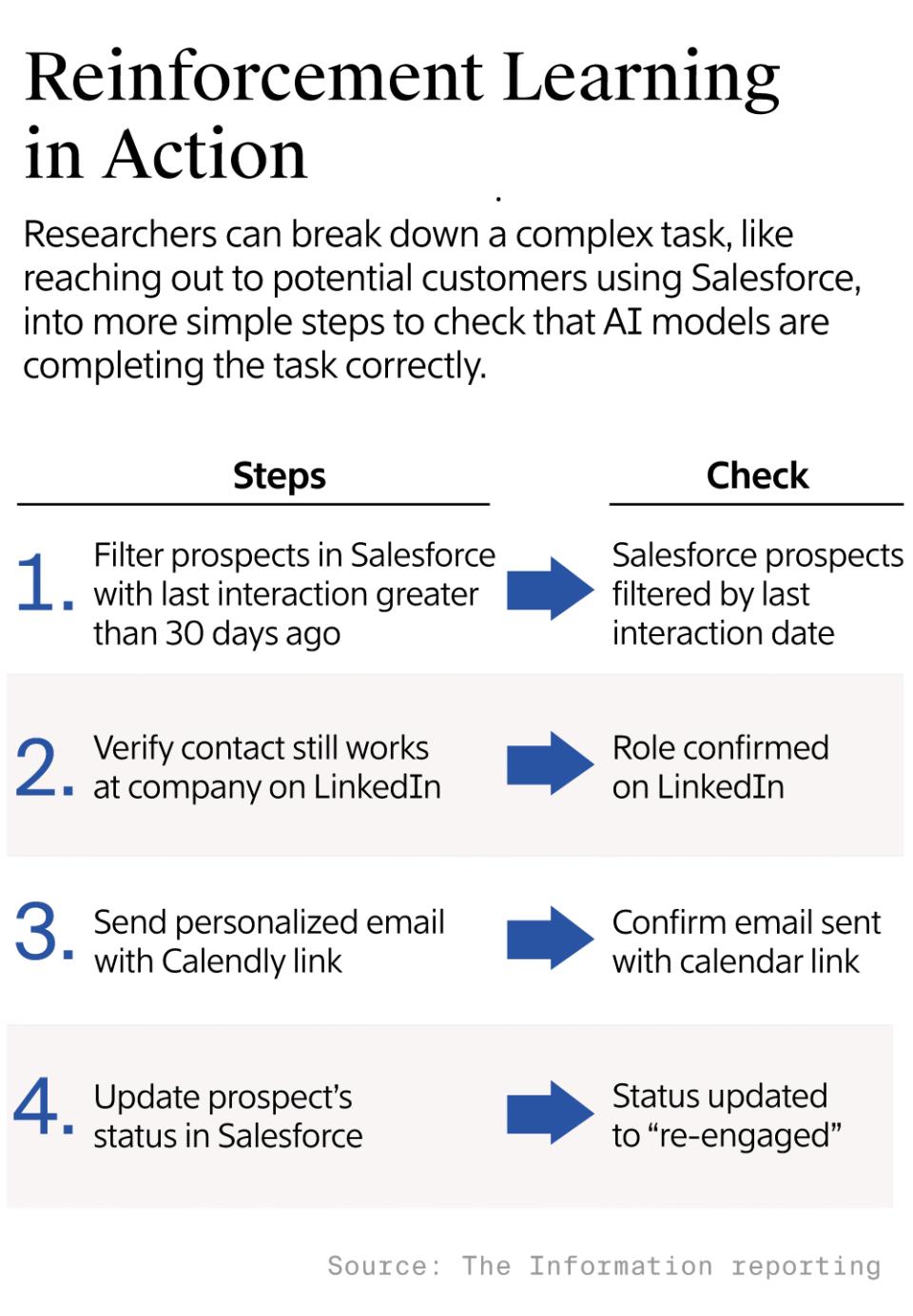
Core Insights - Major AI companies like Anthropic and OpenAI are planning to invest $1 billion annually to train AI to work like humans, utilizing reinforcement learning environments and expert knowledge [1][4][21] - There are concerns that AI could eliminate a significant number of entry-level white-collar jobs within the next 1-5 years, potentially raising the unemployment rate in the U.S. to 10-20% [1][2] Investment and Development - Anthropic and OpenAI are allocating $1 billion each year for AI training, with OpenAI predicting this investment will rise to $8 billion by 2030 [4][10] - The funding aims to overcome current limitations in traditional training methods and explore new monetization avenues, such as workplace software and AI agents [4][10] AI Training Methodology - AI is being trained to handle complex tasks in various applications, including Salesforce and Zendesk, with a focus on real-world task execution [3][5] - Turing has developed over 1,000 reinforcement learning environments to simulate real-world applications for AI training [12][13] Expert Involvement - The trend is shifting towards hiring experienced professionals from various fields to provide real-world task examples for AI learning [15][20] - The cost of hiring experts is increasing, with some contracts exceeding $120 per hour, and projections suggest rates could rise to $150-$250 per hour in the next 18 months [11][10] Future Implications - As AI learns from expert knowledge and workplace applications, it is expected to gradually take over human jobs across various industries [24][21] - The integration of AI into the economy could lead to a transformation where the entire economic system operates as a reinforcement learning machine [21][1]

AI革命下一站:Anthropic与OpenAI斥巨资打造“虚拟员工”
3 6 Ke· 2025-09-17 05:11
这样的训练成本不菲。据知情人士透露,Anthropic计划在未来一年内投入10亿美元,专门建设被称为"强化学习环境"或"健身房"的模拟 办公平台。OpenAI同样不惜重金,预计今年在数据相关领域的支出就将达到10亿美元,到2030年更将增至80亿美元。这些资金既用于搭 建虚拟办公环境,也用于支付专家薪酬。 9月17日消息,AI领域的两大巨头Anthropic和OpenAI正致力于开发能够替代人类执行复杂工作的"AI同事"。其核心方法是使用模拟企业 软件来训练AI模型,使其能像人类员工那样理解和操作真实的工作流程。 为加速这一进程,Anthropic计划在明年投入10亿美元建设大规模的AI训练"健身房"。OpenAI则认为,整个经济未来都可能变成巨大 的"强化学习机器",AI将通过与人类协作和反馈不断进化,从根本上重塑生产力与工作模式。 时薪最高250美元,"AI家教"正在教大模型如何办公 Anthropic与OpenAI正在做一件前所未有的事:让大语言模型真正走进"办公室",学习当一名合格的"数字员工"。 这些AI模型正在接受高强度职业培训,学习操作各类专业办公软件,从Salesforce的客户管理系统、Ze ...