OPPO

Search documents
苹果宣布:华为、小米等安卓机型也可“以旧换新”
证券时报· 2026-01-16 07:58
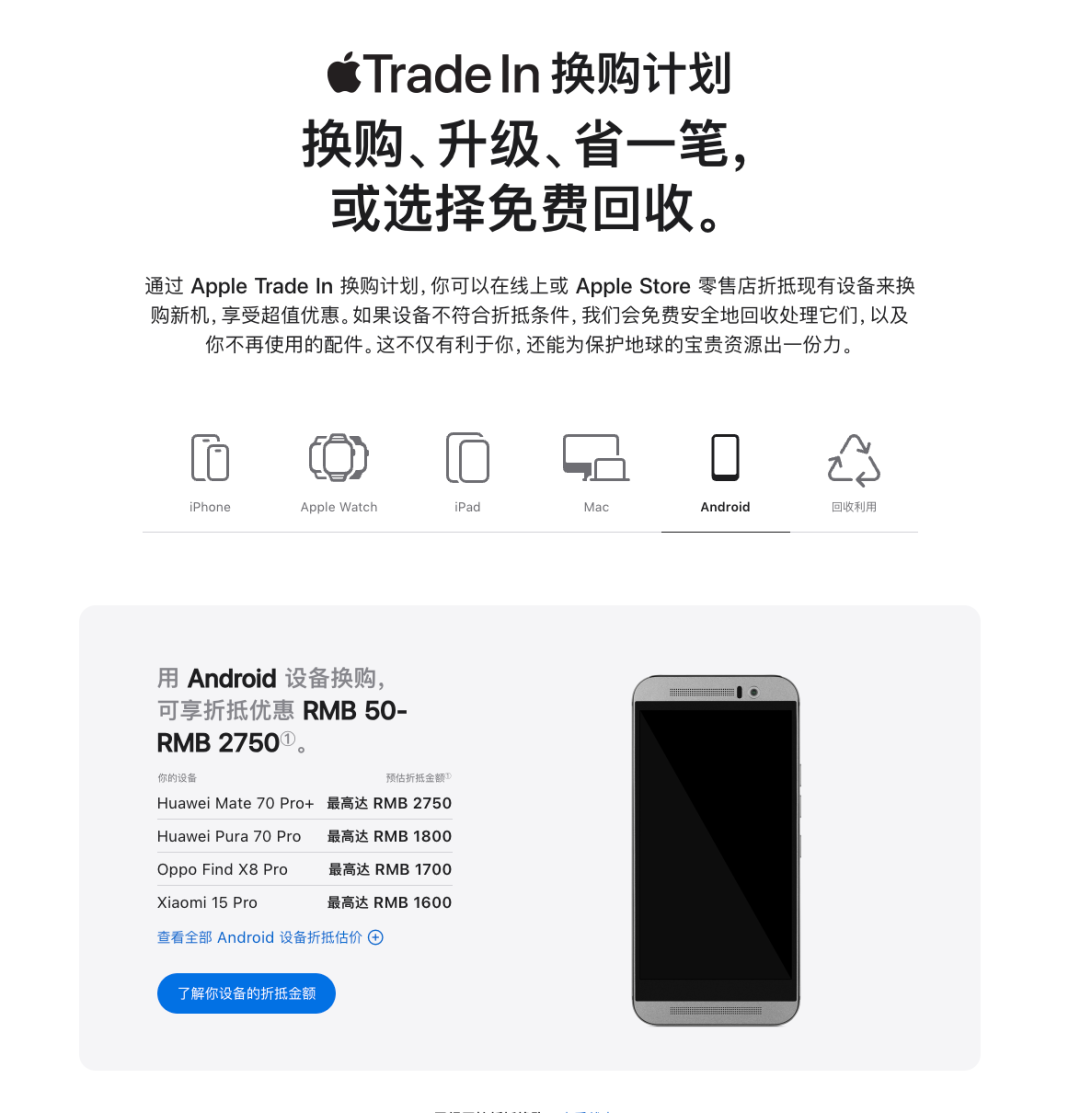
Group 1 - Apple has adjusted the trade-in values for devices such as iPhone, iPad, and Mac, including Android models from Huawei and Xiaomi [1][3] - The maximum trade-in value for iPhone 16 Pro Max in China is 5800 yuan; for iPad Pro, it is also 5800 yuan, while iPad Air can be traded in for up to 3500 yuan; MacBook Pro has a maximum of 6050 yuan, and Mac Pro can reach 14000 yuan [1] - For Android devices, Huawei Mate 70 Pro+ can be traded in for up to 2750 yuan; Oppo Find X8 Pro for 1700 yuan; Vivo iQOO 13 for 1600 yuan; and Xiaomi 15 Pro for 1600 yuan [3] Group 2 - The trade-in service is provided by Apple's trade-in service partners, and the quoted trade-in amounts are estimates that may vary based on the device's condition, configuration, release year, and the country or region of sale [5]


苹果突然宣布,支持华为、小米等以旧换新
Zhong Guo Ji Jin Bao· 2026-01-16 07:34
Group 1 - Apple has included Huawei, Xiaomi, and other Android brands in its latest Apple Trade In program, allowing for trade-in discounts on these devices [1][2] - The updated trade-in values for Apple devices include up to 5800 yuan for iPhone 16 Pro Max and iPad Pro, and up to 6050 yuan for MacBook Pro [1] - Specific trade-in values for Android devices include up to 2850 yuan for Huawei Mate X5 and 1600 yuan for Xiaomi 15 Pro [1] Group 2 - Prior to this update, Apple's trade-in program only accepted its own devices, while other platforms like JD and Tmall supported cross-brand trade-ins [2] - Apple states that the trade-in values are estimates and may vary based on the device's condition, configuration, and release year [2] Group 3 - According to IDC, global smartphone shipments are projected to reach 1.26 billion units by 2025, with Apple leading the market with 247 million units shipped, a 6.3% year-on-year increase [4][5] - In the Chinese market, Huawei is expected to lead in shipments with a 16.4% market share, closely followed by Apple at 16.2% [6] - IDC warns that the smartphone market, particularly for Android manufacturers, will face significant challenges in 2026 due to a reversal of the trend towards high-end configurations becoming more accessible [6]
苹果突然宣布,支持华为、小米等以旧换新
中国基金报· 2026-01-16 07:33
Group 1 - Apple's Trade In program now includes Android brands such as Huawei and Xiaomi for device trade-in [2][3] - The trade-in values for various devices are as follows: iPhone 16 Pro Max up to 5800 yuan, iPad Pro up to 5800 yuan, iPad Air up to 3500 yuan, MacBook Pro up to 6050 yuan, and Mac Pro up to 14000 yuan [4] - Specific trade-in values for Android devices include: Huawei Mate X5 up to 2850 yuan, Huawei Mate 70 Pro+ up to 2750 yuan, Oppo Find X8 Pro up to 1700 yuan, Vivo iQOO 13 up to 1600 yuan, and Xiaomi 15 Pro up to 1600 yuan [4] Group 2 - Previously, only e-commerce platforms like JD and Tmall supported cross-brand trade-in services, while Apple's official site only accepted its own brand devices [6] - IDC forecasts that global smartphone shipments will reach 1.26 billion units by 2025, with Apple maintaining the top position in shipments at 247 million units, a 6.3% year-on-year increase [7] - In the Chinese market for 2025, Huawei is projected to lead with a market share of 16.4%, closely followed by Apple at 16.2% [7] - IDC warns that the smartphone market, particularly for Android manufacturers, will face significant challenges in 2026, with a potential decline in sales due to a shortage of storage chips [7]

荣耀联姻泡泡玛特:一部潮玩手机背后的商业突围战
Xin Lang Cai Jing· 2026-01-16 07:31
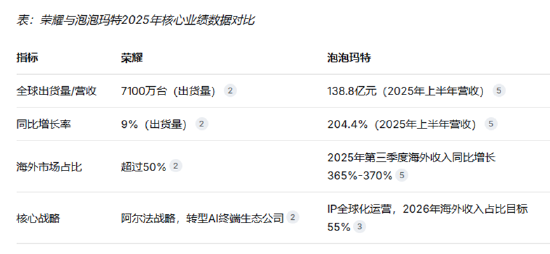
Core Insights - Honor will launch the industry's first trendy toy smartphone in collaboration with Pop Mart on January 19, 2026, reflecting both companies' ambitions for differentiation and new commercial strategies [1][9] - The global smartphone market has seen a decline in shipment volumes for several consecutive quarters, making collaborative partnerships a strategic choice rather than just a marketing gimmick [10][12] Group 1: Market Context - In Q3 2025, China's smartphone market shipped approximately 68.4 million units, a slight year-on-year decrease of 0.5%, with Honor and OPPO tied for fifth place with 9.9 million units each [12] - The smartphone industry's cost structure is rising, putting significant operational pressure on global manufacturers, while high-end market consumers remain less price-sensitive if products demonstrate sufficient technological innovation [12] - Honor's collaboration with Pop Mart aims to achieve product differentiation through trendy toy IPs, breaking through the homogenization of competition [12] Group 2: Company Performance - Honor's global shipment volume reached 71 million units in 2025, with a 9% year-on-year increase, and overseas sales grew by 47%, marking the first time overseas sales accounted for over half of total sales [10][13] - Pop Mart reported a revenue of 13.88 billion yuan in the first half of 2025, a year-on-year increase of 204.4%, with significant growth in both domestic and overseas markets [10][13] Group 3: IP Value and Business Logic - Pop Mart's IP empire is expanding rapidly, with the LABUBU series generating 4.81 billion yuan in revenue in the first half of 2025, a staggering year-on-year growth of 668% [14][16] - The collaboration with Honor allows Pop Mart to extend its IP value into the 3C digital field, reaching a broader audience beyond its core fan base [14] - Analysts categorize IP collaborations into lightweight partnerships focusing on branding and deep customizations that integrate IP culture throughout the product lifecycle [14][15] Group 4: Future Outlook - The collaboration between Honor and Pop Mart has the potential to create genuine value integration, moving beyond superficial marketing tactics [17] - Pop Mart's global strategy aims for overseas revenue to account for 55% by 2026, with significant growth in international markets already observed [17][18] - Recent trends in Pop Mart's blind box business show a divergence between online sales and secondary market performance, indicating a more rational development phase in the trendy toy market [18]

苹果以旧换新抵扣价更新!华为、小米等安卓机型也纳入折抵范围
2 1 Shi Ji Jing Ji Bao Dao· 2026-01-16 07:04
Core Insights - Apple has adjusted the trade-in values for devices such as iPhone, iPad, and Mac, now including Android models from Huawei and Xiaomi in the trade-in program [1] Trade-In Program Details - The Apple Trade In program allows customers to trade in their devices for credit towards new Apple products, with specific trade-in values for various Android models [1] - Huawei Mate X5 can be traded in for up to 2850 yuan, Huawei Mate 70 Pro+ for up to 2750 yuan, Oppo Find X8 Pro for up to 1700 yuan, Vivo iQOO 13 for up to 1600 yuan, and Xiaomi 15 Pro for up to 1600 yuan [1] - The trade-in values are estimated and may vary based on the device's condition, specifications, release year, and the country or region of sale [1]
芯片ETF(512760)涨超2%,行业复苏与技术创新成焦点
Mei Ri Jing Ji Xin Wen· 2026-01-16 06:44
Core Insights - The application of 3D printing in consumer electronics is expected to accelerate, driven by successful implementations in foldable devices by Honor and OPPO, as well as increased investments from Apple [1] - The AI wave is leading to a surge in demand for computing power, significantly increasing the value in sectors such as servers, AI chips, optical chips, storage, and PCBs [1] - The reduction in training and inference costs is likely to foster the growth of AI applications [1] Industry Trends - The potential for edge AI is substantial, with headphones and glasses expected to become key carriers for edge AI agents [1] - Apple is anticipated to lead the trend in AI phones, with the introduction of smarter Siri and the expansion of AI into more regions potentially triggering a super upgrade cycle [1] - There is a positive outlook for the recovery of upstream sectors represented by passive components, digital SoCs, RF, storage, packaging, and panels, with storage prices hitting a bottom and gradually recovering [1] Market Performance - The Chip ETF (512760) tracks the China Semiconductor Index (990001), which selects listed companies involved in semiconductor materials, equipment, design, manufacturing, packaging, and testing to reflect the overall performance of the semiconductor industry [1]
苹果官网活动扩容:华为、小米、OV也能“以旧换新”了
Guan Cha Zhe Wang· 2026-01-16 06:31
Core Insights - Apple's "Trade in" program has expanded to include devices from Chinese brands such as Huawei, Xiaomi, OPPO, and vivo, in addition to its own products [1][3] Group 1: Trade-in Program Details - The trade-in values for selected devices are as follows: Huawei Mate 70 Pro+ can be traded in for up to RMB 2750, Huawei Pura 70 Pro for up to RMB 1800, OPPO Find X8 Pro for up to RMB 1700, Xiaomi 15 Pro for up to RMB 1600, and vivo iQOO 13 for up to RMB 1600 [3][5] - Huawei devices dominate the trade-in list, including models like Huawei Mate X5, Mate X3, Mate 70 series, and P60 series, while OPPO follows with devices like OPPO Find N3 and Find X8 series [3][4] Group 2: Market Performance - According to IDC, the total shipment of smartphones in China for 2025 is projected to be approximately 285 million units, a slight decline of 0.6% year-on-year [6] - Huawei leads the Chinese market with a shipment of 46.7 million units, a year-on-year decrease of 1.9%, holding a market share of 16.4% [6] - Apple follows closely with 46.2 million units shipped, marking a 4% increase year-on-year and a market share of 16.2% [6] - In the fourth quarter, Apple achieved a shipment of 16 million units, securing a market share of 21.1%, with a significant year-on-year increase of 21.5% [7]
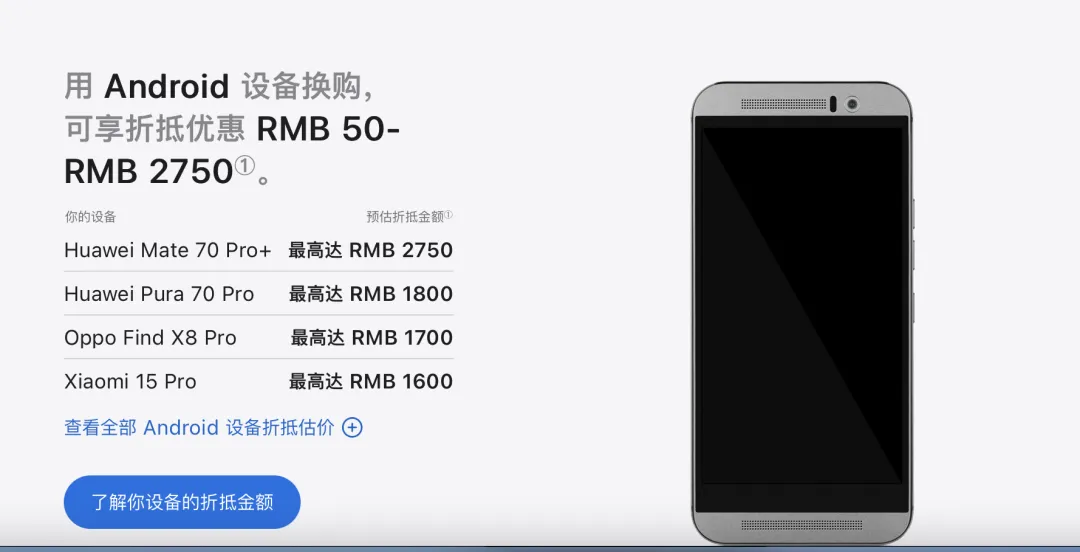
华为、小米等品牌被纳入iPhone以旧换新范围
Di Yi Cai Jing· 2026-01-16 06:18
Core Viewpoint - Apple has included brands such as Huawei, OPPO, vivo, and Xiaomi in its Trade-in program, allowing customers to receive discounts on the purchase of iPhone models by trading in these brands' smartphones [1] Group 1 - The Trade-in program offers discounts for customers trading in specific models from Huawei and other brands, with a maximum discount of 4000 yuan for a 1TB iPhone 17 Pro [1]

苹果官宣:华为、小米也能以旧换新了
财联社· 2026-01-16 05:49
Core Viewpoint - Apple has adjusted the trade-in values for its devices, including iPhones, iPads, and Macs, and has also included Android models from brands like Huawei and Xiaomi in the trade-in program [1][4]. Group 1: Trade-in Values for Apple Devices - The Apple Trade In program offers significant trade-in values for various devices, with the iPhone 16 Pro Max having a maximum trade-in value of RMB 5800 [4][5]. - Other iPhone models have varying trade-in values, such as RMB 4900 for the iPhone 16 Pro, RMB 4175 for the iPhone 16 Plus, and RMB 3400 for the iPhone 16 [5]. - For iPads, the iPad Pro can be traded in for up to RMB 5800, while the iPad Air has a maximum value of RMB 3500 [7]. - Mac devices also have substantial trade-in values, with the MacBook Pro reaching up to RMB 6050 and the Mac Pro up to RMB 14000 [10]. Group 2: Trade-in Values for Android Devices - The trade-in program now includes several Android devices, with the Huawei Mate X5 having a maximum trade-in value of RMB 2850, and the Huawei Mate 70 Pro+ valued at RMB 2750 [10]. - Other Android models such as the Oppo Find X8 Pro, Vivo iQOO 13, and Xiaomi 15 Pro have trade-in values of RMB 1700, RMB 1600, and RMB 1600 respectively [10]. Group 3: Trade-in Program Details - The trade-in values provided are estimates and the actual amount may vary based on the device's condition, configuration, release year, and the country of sale [12]. - Participation in the trade-in program is limited to individuals aged 18 and above, and the trade-in value can be applied towards the purchase of new Apple devices [12].
荣耀CEO李健入选“2025年度手机行业六大杰出人物”
Sou Hu Cai Jing· 2026-01-16 04:16
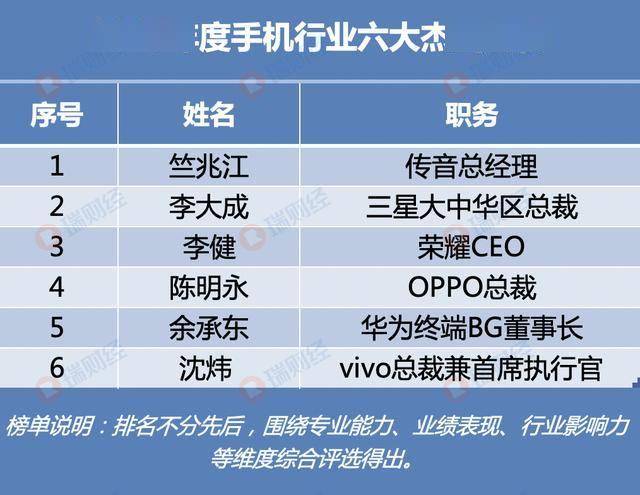
"2025年度手机行业六大杰出人物"榜单围绕专业能力、业绩表现、行业影响力等维度综合评选得出。 李健,1973年生,毕业于西安电子科技大学通信工程学院信息工程专业,现任荣耀终端股份有限公司 CEO。2001年加入华为,历任尼日利亚代表处代表、西非地区部总裁、东北欧地区部总裁、人力资源委 员会成员、美洲片区总裁、欧洲片区总裁等职。2017年起进入华为监事会,担任干部管理团队成员、 ICT基础设施业务管理委员会成员。2021年加入新荣耀,任董事、副董事长、人力资源部总裁等职。 2025年1月17日接任荣耀CEO。 2025年,李健带领荣耀实现海外销量首次破50%,全面启动阿尔法战略。 | 序号 | 姓名 | 职务 | | --- | --- | --- | | T | 竺兆江 | 传音总经理 | | 2 .. 019 | 15 李大成 | 三星大中华区总裁 | | 3 | 李健 | 荣耀CEO | | 4 | 陈明永 | OPPO总裁 | | 5 | 余承矢 | 华为终端BG董事长 | | 6 % | 沈炜 | vivo总裁兼首席执行官 | | | 榜单说明:排名不分先后,围绕专业能力、业绩表现、行业影响力 | ...