vivo

Search documents
AI新纪元,谁在制造爆款新广货?
2 1 Shi Ji Jing Ji Bao Dao· 2026-01-14 12:42
Group 1 - The global consumer market is expected to see a strong start in 2026, with various events and innovations showcasing new consumption methods and products [1] - Guangdong's manufacturing, known for its high-quality products, continues to evolve with advancements in AI technology, leading to the emergence of new popular products [2][5] - The "Guangdong Goods" brand has a rich history, evolving from traditional products to high-tech innovations like electric vehicles and AI glasses, demonstrating resilience through economic cycles [1][2][6] Group 2 - The "Guangdong Goods Going Global" spring campaign will kick off on January 15, 2026, featuring nearly 30 key events and participation from over 6000 enterprises [2] - The transformation of Guangdong's manufacturing sector is highlighted by companies like TCL, which has successfully transitioned to smart technology and achieved significant revenue growth [4][5] - The integration of AI across various industries in Guangdong, including home appliances and textiles, is accelerating product innovation and market responsiveness [5][6] Group 3 - Guangdong has become a global manufacturing hub, producing a significant share of the world's smartphones and drones, with major brands like Huawei and OPPO leading the market [7] - The rise of innovative pharmaceuticals from Guangdong, such as the dual-target antibody developed by Kangfang Biotech, showcases the region's capabilities in high-tech industries [8][9] - The collaborative environment in innovation hubs like Guangzhou International Bio Island fosters rapid development and commercialization of new products [9][10] Group 4 - The rapid development of AI technology is reshaping global industry dynamics, with companies in Guangdong leveraging this to enhance their competitive edge [5][11] - The CES exhibition highlighted the global appeal of new Guangdong products, indicating a shift from simple product exports to comprehensive global strategies [12] - Companies like Raybird Innovation and others are achieving significant market shares in their respective fields, reflecting the successful globalization of Guangdong's manufacturing [12]
中国手机厂商撑起全球六成市场,海外出货结构进入重构期
Di Yi Cai Jing· 2026-01-14 12:41
Core Insights - The overseas expansion of Chinese manufacturers continues, but the competitive strategies and target price segments are undergoing significant changes [1][2][4] - The global smartphone industry is entering a new structural adjustment cycle, driven by rising storage chip prices and supply chain costs [1][6] Market Trends - According to IDC, global smartphone shipments are projected to grow by 2.3% year-on-year in Q4 2025, reaching 1.26 billion units, with an annual growth of 1.9% [1] - The growth is primarily driven by high-end models, foldable phones, and consumers' anticipation of future price increases [1][2] - Apple and Samsung are the fastest-growing manufacturers among the top five, with year-on-year growth rates of 6.3% and 7.9%, respectively, increasing their combined market share to 39% from 37% in 2024 [2] Competitive Landscape - Chinese manufacturers are facing structural pressures as the market shifts towards higher price segments, which have traditionally been their stronghold in overseas markets [2][4] - Honor is noted as the fastest-growing Chinese manufacturer overseas, with a year-on-year growth of approximately 55% in the first three quarters of 2025, focusing on the $300 to $500 price range [4][5] - Other Chinese brands like OPPO and Xiaomi are also adjusting their strategies to target mid-range markets, with OPPO moving from entry-level products to more mid-range offerings [5] Cost and Supply Chain Challenges - The uncertainty in 2026 is largely centered around costs and supply chain issues, particularly the volatility in storage prices [6][7] - Counterpoint Research predicts a 40% to 50% increase in storage chip prices in Q1 2026, with further increases expected in Q2 [6] - The rising costs of components are significantly impacting the pricing and sales of low-end models, making the business model for sub-$100 devices increasingly fragile [7]


2025年中国智能手机市场出货量约2.85亿部 同比下降0.6%
Zheng Quan Shi Bao Wang· 2026-01-14 12:06
Group 1 - The global smartphone market is expected to show resilience in 2025, with a projected year-on-year growth of 1.9%, reaching 1.26 billion units for the year, despite challenges such as tariff fluctuations and supply chain disruptions [1] - The fourth quarter of 2025 is anticipated to see a 2.3% year-on-year increase in global smartphone shipments, totaling 336.3 million units [1] - High-end models and strong performance of foldable phones, along with consumer anticipation of price increases, are driving market growth [1] Group 2 - In the Chinese market, smartphone shipments are projected to be approximately 75.78 million units in the fourth quarter of 2025, reflecting a slight year-on-year decline of 0.8% [2] - Huawei has regained the top position in the Chinese smartphone market with a market share of 16.4%, followed by Apple, Vivo, Xiaomi, and OPPO [2] - Local brands in China are adjusting their product strategies by reducing low-end model shipments to maintain profitability amid rising storage chip costs [2] Group 3 - The market environment for smartphones in 2026 is expected to differ significantly, with a forecasted decline due to ongoing storage chip shortages [3] - The duration of the storage chip shortage will directly impact the extent of market contraction, emphasizing the importance of scale and supply chain management for manufacturers [3] - Despite overall shipment pressures, the average selling price is expected to continue rising due to increased costs [3]
时隔五年后,华为手机重返第一
Hua Er Jie Jian Wen· 2026-01-14 11:25
Core Insights - Huawei has regained the top position in the Chinese smartphone market with a market share of 16.4% in 2025, marking its return to the number one spot for the first time since 2020 [2][4] - The overall smartphone market in China is facing challenges, with a projected shipment volume of approximately 285 million units in 2025, reflecting a year-on-year decline of 0.6% [2][4] - Huawei's resurgence is attributed to a combination of technological advantages, product line restructuring, and a strong focus on high-end market segments [2][3] Market Dynamics - The competitive landscape is intense, with Huawei's market share closely contested by Apple, Vivo, Xiaomi, and OPPO, all of which have market shares ranging from 15.2% to 16.2% [4][5] - Huawei's growth strategy includes a diverse product structure, with high-end models like the Mate and Pura series recovering market share from Apple, while mid-range models like the Nova series appeal to a broader consumer base [3][4] - Despite regaining the top position, Huawei's performance in the latter half of 2025 showed signs of weakness, ranking third and fourth in the third and fourth quarters, respectively [4] Competitive Pressures - Apple and Xiaomi have also shown strong performance in the high-end market, with their new models experiencing significant sales growth of 22% and 21% year-on-year, respectively [5] - Honor, once a competitor to Huawei, has struggled to maintain its market position following Huawei's return to the 5G market, leading to a decline in its market presence [5][6] - Other brands like Vivo, Xiaomi, and OPPO are feeling increased pressure, prompting strategic moves such as OPPO's integration of the Realme brand to enhance competitiveness [6] Future Outlook - While Huawei has reclaimed its market leadership, it still faces significant challenges, including a substantial gap from its historical peak market share of 46% and ongoing pressures from rising component costs [7] - The smartphone market is expected to experience further declines in shipment volumes in 2026, indicating a challenging environment ahead for all manufacturers [7]
Omdia: Global Smartphone Market Grew 4% in 4Q25 as Apple Leads the Market for the Third Consecutive Year
Businesswire· 2026-01-14 11:18
Core Insights - The global smartphone market experienced a 4% year-on-year growth in Q4 2025, driven by seasonal demand and improved inventory management, despite rising component costs affecting some vendors [1][3] - Apple maintained its position as the leading smartphone vendor with a 25% market share in Q4 2025, achieving record shipment volumes due to strong demand for the iPhone 17 series [1][4] - Samsung followed with an 18% market share, benefiting from strong sales in the sub-$300 segment, particularly the Galaxy A17 models [2][6] - Xiaomi retained third place with an 11% market share, although it faced challenges in key markets [2][6] - The overall global smartphone shipments for 2025 reached 1.25 billion units, reflecting a 2% year-on-year increase, with a notable recovery in the second half of the year [3] Vendor Performance - Apple recorded its highest-ever fourth-quarter shipment volumes, driven by solid demand for the iPhone 17 series and older models during the holiday season [4][5] - Samsung's growth was primarily in the budget segment, with the Galaxy A17 models contributing significantly to its market share [2][6] - Xiaomi's market share declined to 11% in Q4 2025, indicating challenges in maintaining volume in competitive markets [2][6] - Vivo held an 8% market share, supported by strong performance in India, while OPPO re-entered the top five with an 8% share, marking a positive turnaround [2][6] Market Dynamics - The smartphone industry is facing supply-side pressures due to tight DRAM supply, which is expected to impact the market significantly in 2026 [5] - Rising memory costs and a slowing refresh cycle are anticipated to constrain shipment momentum, prompting vendors to adopt tighter configurations and align launch strategies with component availability [5] - The trend towards consolidation is evident, with realme moving under OPPO's umbrella to achieve greater scale and manage rising costs [5]


IDC:2025年Q4 vivo中国市场出货1200万台,排名第二
Feng Huang Wang· 2026-01-14 10:08
Core Insights - The report by IDC indicates that the Chinese smartphone market is expected to see a slight decline in shipments, with approximately 75.78 million units expected in Q4 2025, representing a year-on-year decrease of 0.8% [1] - Apple leads the market in Q4 2025, followed by vivo, OPPO, Huawei, and a tie between Honor and Xiaomi in fifth place [1] - For the entire year of 2025, the Chinese smartphone market is projected to ship around 285 million units, down 0.6% year-on-year [1] - The top five brands in terms of annual shipments in China for 2025 are Huawei, Apple, vivo, Xiaomi, and OPPO, with Honor falling out of the top five [1] - Globally, the total smartphone shipments are expected to reach approximately 1.26 billion units in 2025, reflecting a year-on-year growth of 1.9% [1] - The global smartphone shipments for Q4 2025 are projected to be 336.3 million units, showing a year-on-year increase of 2.3% [1]

南财快评|从广货到“新广货” 为何全球爆款频出?
2 1 Shi Ji Jing Ji Bao Dao· 2026-01-14 09:00
Core Viewpoint - The "Guangdong Products Going Global" spring campaign will kick off a series of promotional activities aimed at showcasing the diverse charm of Guangdong manufacturing, highlighting its evolution from traditional goods to advanced technology products like smart appliances and drones [1][2]. Group 1: Geographic and Trade Advantages - Guangdong's geographic location provides significant advantages for trade, facilitating industrialization and attracting foreign investment, which are foundational for the success of Guangdong products [2]. - The historical success of Guangdong products is attributed to its trade structure, which evolved from initial processing trades to attracting foreign capital and advanced manufacturing techniques, laying the groundwork for Guangdong's economic development [2]. Group 2: Technological Advancements and Industry Evolution - The current competitive edge of Guangdong products is driven by smart manufacturing, moving from traditional appliances to innovative products like smart glasses and drones, reflecting a shift towards intelligent production [3]. - Guangdong has established nine trillion-yuan industrial clusters, with projected revenues exceeding 19 trillion yuan by 2025, and is home to over 800,000 industrial enterprises, leading the nation in industrial output [3]. Group 3: Traditional and Emerging Industries - Traditional industries remain crucial for Guangdong's economic foundation, with significant contributions to the production of consumer electronics, such as televisions and air conditioners, and advancements in production efficiency through technology [4]. - Guangdong is a major hub for the smartphone industry, producing a significant portion of the world's smartphones and achieving breakthroughs in semiconductor technology, which supports the ongoing innovation in the sector [5]. Group 4: Future Prospects - Initiatives like "Smart Electric Guangdong," "Fashion in Guangdong," and "Guangdong Quality Products" are set to enhance the technological capabilities of Guangdong products, ensuring continuous innovation and market expansion [5].
从广货到“新广货”,为何全球爆款频出?
2 1 Shi Ji Jing Ji Bao Dao· 2026-01-14 08:49
Core Viewpoint - The "Guangdong Products Going Global" spring promotional campaign is set to launch in Foshan, marking the beginning of the 2026 online promotional activities for Guangdong products, showcasing the diverse appeal of Guangdong manufacturing [2] Group 1: Geographic and Trade Advantages - Guangdong's geographic location, backed by the Nanling Mountains and facing the South China Sea, provides excellent conditions for foreign trade and industrialization, forming the foundation for the success of Guangdong products [3] - The evolution of trade structures has allowed Guangdong to continuously upgrade its products, with initial trade models attracting foreign investment and advanced manufacturing techniques, contributing to the wealth of Guangdong products [3] Group 2: Technological Advancements and Manufacturing - The current competitive edge of Guangdong products lies in intelligent manufacturing, moving from traditional appliances to smart devices like drones and robots, reflecting the region's adaptation to technological revolutions [4] - Guangdong is home to nine trillion-yuan industrial clusters, with projected revenues exceeding 19 trillion yuan by 2025, and it leads the nation in the number of industrial enterprises, producing a significant share of global consumer drones and smartphones [4] Group 3: Traditional and Emerging Industries - Traditional industries remain crucial for the legacy of Guangdong products, with ongoing transformations enhancing their viability through strategic investments in future industries [5] - Guangdong is a major hub for smartphone manufacturing, with significant advancements in technology, including breakthroughs in high-end chips and AI integration in mobile devices, further solidifying its position in the global market [6] Group 4: Future Prospects - Initiatives like "Smart Electric Guangdong Manufacturing" and "Fashion from Guangdong" are expected to further enhance the iterative upgrades of Guangdong products, indicating a promising future for the region's manufacturing sector [6]
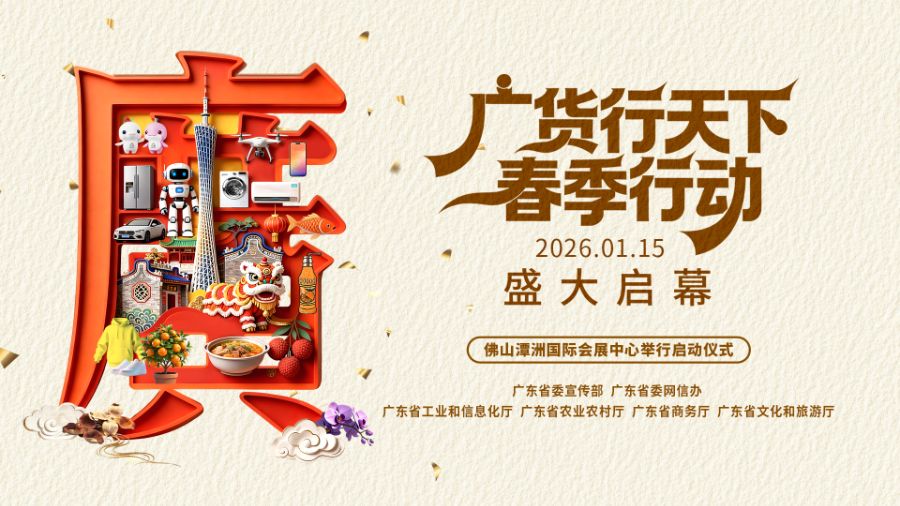
“广货行天下”春季行动启动仪式将于1月15日在佛山举行
Nan Fang Ri Bao Wang Luo Ban· 2026-01-14 08:40
Core Insights - Guangdong's manufacturing sector is showcasing its diverse capabilities, from smart home appliances to high-end mobile phones, fashion apparel, gourmet food, and modern agriculture, emphasizing innovation and quality development [1][2][3] Food Industry - Guangdong's food industry is projected to achieve a revenue of 896.87 billion yuan in 2024, with soy sauce production accounting for over 60% of the national output and mooncake exports representing 90% of the total [2] - The industry is driven by digitalization, biotechnology, and regional collaboration, with major cities like Guangzhou, Foshan, and Dongguan each exceeding 100 billion yuan in food industry scale [2][3] Home Appliances - Guangdong's home appliance sector, representing nearly 50% of the national market, has established a robust supply chain with over 4,400 enterprises, including three with revenues exceeding 100 billion yuan [4][5] - Major companies like Midea and Hisense are localizing their research, production, and sales globally, with Midea operating 33 R&D centers and 43 manufacturing bases worldwide [5][6] Agriculture - Guangdong's agricultural sector is characterized by its "土特生金" (specialty products generate wealth) strategy, achieving a grain production capacity increase from 12.38 million tons in 2021 to 12.98 million tons in 2025 [7][9] - The province leads in various agricultural outputs, with total agricultural production value reaching 677.56 billion yuan in the first three quarters of 2025, marking a 4.9% year-on-year growth [7][9] Textile and Apparel - Guangdong's textile and apparel industry boasts 4,240 enterprises, accounting for 18.34% of the national total, with a production output of 3.44 billion garments in 2024 [15][16] - The industry is undergoing digital transformation, with companies implementing AI and big data for precise design and flexible production, significantly enhancing efficiency [15][16] Mobile Phones - Guangdong produces one in every three mobile phones globally, with a complete supply chain that allows for rapid assembly of 95% of components within a one-hour commute [10][11] - Innovations such as satellite communication technology and AI integration are being developed to enhance product capabilities and market reach [10][11] Cultural and Tourism - The "请到广东过大年" (Come to Guangdong for the New Year) campaign aims to enhance tourism through cultural experiences, with events showcasing traditional customs and local cuisine [12][13] - The initiative includes a series of activities and performances to attract visitors, emphasizing the cultural richness and festive atmosphere of Guangdong [12][13]
IDC:2025年华为重返中国市场第一,OPPO四季度增长超10%
Feng Huang Wang· 2026-01-14 07:30
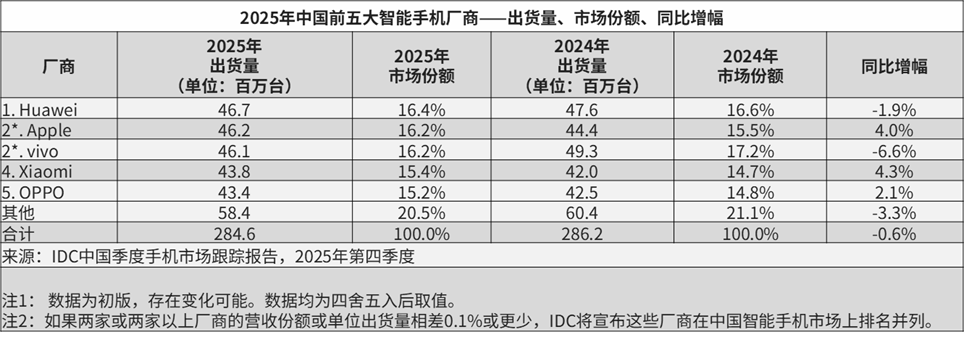
Core Insights - The report by IDC indicates that the top five smartphone brands in China for 2025 will be Huawei, Apple, vivo, Xiaomi, and OPPO, with Honor falling out of the top five [1] - The overall shipment volume for the Chinese smartphone market in 2025 is projected to be 284.6 million units, showing a slight decline of 0.6% compared to 2024 [2] - The global smartphone shipment volume is expected to reach approximately 1.26 billion units in 2025, reflecting a year-on-year growth of 1.9% [2] Group 1: Market Performance - Huawei is projected to ship 46.7 million units in 2025, holding a market share of 16.4%, which is a decrease of 1.9% from 2024 [2] - Apple is expected to ship 46.2 million units, with a market share of 16.2%, marking a growth of 4.0% from the previous year [2] - vivo's shipment is forecasted at 46.1 million units, also with a market share of 16.2%, but it will see a decline of 6.6% compared to 2024 [2] - Xiaomi is anticipated to ship 43.8 million units, achieving a market share of 15.4%, with a growth of 4.3% year-on-year [2] - OPPO is projected to ship 43.4 million units, holding a market share of 15.2%, reflecting a growth of 2.1% from 2024 [2] Group 2: Quarterly Insights - In the fourth quarter of 2025, the Chinese smartphone market is expected to see a shipment volume of approximately 75.78 million units, which represents a slight decline of 0.8% year-on-year [3] - OPPO is noted to achieve a significant growth of 10.2% in the same quarter, becoming the only Android brand in China to record positive growth [3]