
纳科诺尔

Search documents
北证50日内涨幅达3.02%
Mei Ri Jing Ji Xin Wen· 2026-02-03 06:40
(文章来源:每日经济新闻) 每经AI快讯,2月3日,北证50日内涨幅达3.02%。成分股中,连城数控涨18.73%,戈碧迦涨10.85%,一 诺威涨7.24%,纳科诺尔涨7.09%。 ...
北证50日内涨幅达2.10%
Mei Ri Jing Ji Xin Wen· 2026-02-03 03:40
Group 1 - The core point of the article highlights that the North Stock Exchange 50 index has increased by 2.10% over the past 50 days [1] - Among the constituent stocks, Liancheng CNC has seen a significant rise of 14.07% [1] - Other notable performers include Xingtum Measurement and Control with an increase of 8.99%, Yinuowei rising by 7.17%, and Naconoer up by 6.39% [1]
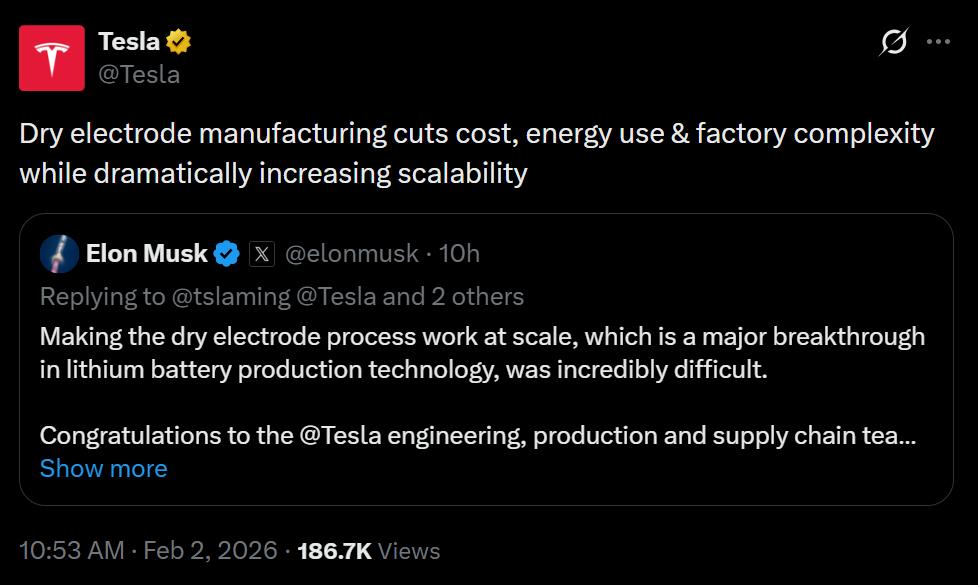
马斯克宣布:量产
3 6 Ke· 2026-02-03 02:43
Group 1 - The core achievement of Tesla is the scalable production of dry electrode technology, which significantly reduces costs, energy consumption, and factory complexity while enhancing scalability [1][3] - Tesla has patented a method for low binder content dry electrode films, which involves a specific sequence of mixing active materials and conductive carbon to avoid damage from high shear forces [3] - The dry electrode process, also known as dry processing, eliminates solvent use and drying steps, relying instead on high shear dry mixing and fiberization to achieve uniform material dispersion [3] Group 2 - Tesla's CFO highlighted that battery production remains the biggest constraint for Full Self-Driving (FSD) technology, despite ongoing optimization efforts [3] - According to Dongwu Securities, while wet processing is still the primary choice for solid-state battery production lines, dry processing is gradually becoming the mainstream method due to its cost and process advantages [3] - Companies like Sanfu New Technology are actively investing in dry electrode technology, with plans to invest 620 million yuan in key materials for high-safety dry electrode batteries by the end of 2027 [3][4] Group 3 - Winbond Technology has introduced solutions covering both wet and dry processes for solid-state batteries and is working to optimize dry electrode production equipment for faster industrial application [4] - According to Guangfa Securities, global solid-state battery shipments are expected to reach 181 GWh by 2030, indicating a growing demand for equipment manufacturers as the industry evolves [4] - The changes in solid-state battery processes will create increased equipment demand, suggesting a focus on leading lithium battery solution providers and equipment manufacturers benefiting from these technological shifts [4]


未知机构:国金电新特斯拉干法工艺实现规模化生产干法设备值得关注当地时-20260203
未知机构· 2026-02-03 01:55
Summary of Conference Call Notes Company and Industry Involved - The discussion primarily revolves around **Tesla** and its advancements in **lithium battery production technology** through the implementation of **dry electrode manufacturing processes** [1][1]. Core Points and Arguments - **Achievement of Scale Production**: Tesla has successfully achieved large-scale production of the dry electrode process, which is considered a significant breakthrough in lithium battery production technology [1]. - **Cost and Efficiency Benefits**: The dry electrode manufacturing process is expected to lower costs, reduce energy consumption, and simplify factory operations while significantly enhancing scalability [1]. - **Advancements in Battery Technology**: The move reflects major progress in the dry process for liquid batteries, indicating Tesla's commitment to advancing its in-house 4680 battery production [1]. - **Comparison with Traditional Methods**: Traditional lithium battery electrode production typically uses a wet process, which involves mixing materials into a slurry, coating, and drying. In contrast, the dry process eliminates solvent use and drying steps, utilizing high-shear dry mixing and fiberization equipment to achieve direct film formation [1]. Other Important but Possibly Overlooked Content - **Future Prospects**: The dry process is not only a preferred method for all-solid-state batteries but also holds potential applications in conventional batteries, suggesting a broader impact on the battery manufacturing industry [2]. - **Companies to Watch**: Attention is drawn to companies involved in the dry process segment, specifically **MacroTech** and **Naconor**, indicating potential investment opportunities in this area [3]. - **Additional Companies Mentioned**: Other companies mentioned include **Mannstaedt**, which may also be relevant in the context of dry electrode technology [4].
未知机构:ZX机械固态设备观点更新20260202固态电池是算力卫星配储的最优选择-20260203
未知机构· 2026-02-03 01:45
Summary of Key Points from the Conference Call Industry Overview - The focus is on the solid-state battery sector, particularly in relation to the deployment of a satellite constellation by SpaceX, named "SpaceX Orbital Data Center System" [1][2]. Core Insights and Arguments - SpaceX plans to deploy up to 1 million satellites in orbits ranging from 500 to 2000 kilometers, aiming for global computational coverage [1]. - Over 94% of the satellites in the constellation will require energy storage batteries to ensure continuous power supply during shadow periods [2]. - Each satellite is estimated to need a 100 kWh battery, leading to a total energy storage requirement of 100 GWh for the entire constellation [2]. - Solid-state batteries are identified as the optimal choice for these satellites due to their advantages such as wide temperature range, radiation resistance, and long endurance, which are better suited for space environments compared to traditional liquid batteries [2]. - The energy density of solid-state batteries can reach twice that of liquid batteries, significantly reducing weight and launch costs, which is crucial for the deployment of 1 million satellites [2]. - The demand for 100 GWh of energy storage is expected to accelerate the development of the solid-state battery industry as SpaceX's satellite plans progress [2]. Investment Recommendations - There is a strong bullish outlook on the solid-state battery sector due to upcoming catalysts, including the CASIP solid-state battery conference and announcements regarding sample results and production line tenders [3]. - Key companies in various segments of the solid-state battery supply chain are highlighted: - **Complete Line Equipment**: XianDao Intelligent, HaiMuXing, LiYuanHeng - **Dry Electrode Equipment**: HongGong Technology, NaKeNuoEr - **Isostatic Pressing Equipment**: RongQi Technology, LiTong Technology - **PACK Pressurization Devices**: XianHui Technology, HangKe Technology - **Solid Electrolyte Equipment**: HongGong Technology, LingGe Technology - **High-Pressure Formation and Capacity**: HangKe Technology, HuaZi Technology - **Laser Welding Equipment**: LianYing Laser - **Lithium Iodide & Lithium Sulfide**: BoYuan Shares - **Solid Thermal Insulation Materials**: BoZhong Precision Engineering [3].
特斯拉,固态电池技术大突破!
DT新材料· 2026-02-02 16:05
Core Viewpoint - Tesla has achieved large-scale production of dry electrode technology, marking a significant breakthrough in lithium battery production technology, which can lower costs, energy consumption, and factory complexity while significantly improving scalability [4]. Group 1: Dry Electrode Technology - Dry electrode technology is a process that manufactures battery electrodes using dry powder materials without solvents, utilizing polytetrafluoroethylene (PTFE) as a binder, which simplifies the process and reduces energy consumption [5]. - The core advantages of dry electrode technology include eliminating reliance on toxic solvents, reducing environmental pressure, and enhancing battery safety and stability by avoiding adverse reactions with solid electrolytes [5][6]. - The technology is crucial for the industrialization of next-generation all-solid-state batteries, which are expected to have higher energy density and cycle stability due to better particle contact and higher compaction density [6]. Group 2: Challenges in Industrialization - The industrialization of dry electrode technology faces significant challenges, including: 1. Binder compatibility issues, as PTFE can decompose in low-potential environments, affecting battery cycle life [8]. 2. High equipment requirements, with precision roller presses needed for dry production being five times more expensive than traditional equipment and having lower mass production efficiency [9]. 3. High difficulty in process control, requiring precise mixing uniformity and stability in self-supporting film formation [9]. Group 3: Industry Developments - Several domestic companies are actively advancing in the dry electrode field: - CATL has focused on the development and adaptation of dry processes for positive electrodes, achieving a compaction density of 3.8 g/cm³ [10]. - Shanghai Lianjing has developed composite binders to improve compatibility and has implemented dynamic rolling technology to address issues with material mixing and cracking [10]. - Nakanor has delivered dry electrode roller press equipment with precision levels far exceeding industry averages, improving yield rates for solid-state battery electrodes to over 98% [10]. - Qingyan Electronics has established a production line for solid-state batteries with a yield rate of 85% [11]. - Bettery has successfully tackled core process challenges for continuous production of electrode sheets [12]. Group 4: Future Outlook - Although the solid-state battery route is not fully confirmed, the changes in equipment and processes compared to liquid batteries are expected to drive increased demand for new equipment [13].
马斯克官宣干电极工艺突破,固态电池产业化加速
Sou Hu Cai Jing· 2026-02-02 08:56
Group 1 - Tesla has achieved large-scale production of dry electrode technology, marking a significant breakthrough in lithium battery production technology [1] - The dry electrode manufacturing process can reduce costs, energy consumption, and factory complexity while significantly improving scalability [1] - Tesla's recent patent details a method for producing low-binder-content dry electrode films, emphasizing the specific order of mixing materials to avoid damage [3] Group 2 - Tesla has positioned dry electrode technology as a core manufacturing process for its 4680 battery, which is expected to reach its final design by 2024 [3] - Domestic companies are actively investing in dry electrode technology, with Sanfu New Materials planning to invest 620 million yuan in a project expected to be completed by the end of 2027 [4] - According to Guangfa Securities, global solid-state battery shipments are projected to reach 181 GWh by 2030, indicating a growing market for equipment manufacturers [4]
马斯克官宣:干电极工艺量产
财联社· 2026-02-02 08:36
以下文章来源于科创日报 ,作者张真 科创日报 . 科创圈都在关注的主流媒体,上海报业集团主管主办,《科创板日报》出品。 当地时间2月1日,马斯克在社交平台表示:"实现干电极工艺的规模化生产,这在锂电池生产技术上是一项重大突破,难度极高。祝贺特斯 拉工程、生产和供应链团队以及我们的战略合作伙伴供应商取得的卓越成就。" 随后,特斯拉官方团队转发了这则消息,并回复称:"干电极制造工艺可降低成本、能源消耗和工厂复杂性,同时显著提高可扩展性。" 就在日前,特斯拉公布了一项名为"低粘结剂含量干电极膜的组合物和制备方法"的专利。其通过先混合活性材料和导电碳,再添加干粘结剂 的特定顺序,避免了高剪切力对颗粒的损伤。专利规定,导电碳含量不超过8%重量比,粘结剂用量需低于2%。 纳科诺尔投资者关系活动记录表显示,公司将积极配合下游客户对干法电极生产设备进行调整和优化,以加快推进干法电极工艺的 产业化应用速度。 投资方面,广发证券表示,预估2030年全球全固态电池的出货量将达到181GWh。新产业初期,设备厂商将率先受益,尽管目前固态电池 路线尚未完全确认,但相较液态电池, 固态电池设备在前中后道均有变化,工艺的变化势必带来设备的 ...

本周北证指数震荡回调,我国将布局更多“太空+”产业
Guotou Securities· 2026-02-01 10:48
2026 年 02 月 01 日 北交所定期报告 本周北证指数震荡回调,我国将布局 更多"太空+"产业 本周市场回顾: 本周上证指数上涨 0.09%,北证 A 股指数下跌 3.54%,跑输上证综指 3.63pct,北证 50 指数下跌 4.29%,跑输上证综指 4.38pct,创业板指 数下跌 2.41%,科创板指数下跌 3.18%; 流动性方面,本周北证 A 股总成交额为 1436.6 亿元,北证 50 总成交 额 492.3 亿元,占北证 A 股总成交额的 34.3%,环比+1.87pct。北证 A 股日均成交额 287.31 亿元,环比+8.8%,区间日均换手率为 4.65%, 较上一区间提升 0.38pct; 估值方面,截至 2026 年 1 月 30 日,北证 A 股市盈率中位数为 45.52X; 同期科创板、创业板 PE 中位数分别为 36.28X、37.23X。 个股表现&新股上市情况: 截至 2026 年 1 月 30 日,北交所上市公司总数为 292 家,涨幅靠前的 分别为:科力股份、秋乐种业、连城数控、戈碧迦、美邦科技、蘅东 光、康农种业、铜冠矿建、志高机械、欧福蛋业;跌幅靠前的分别为: ...
纳科诺尔(920522) - 2025 Q4 - 年度业绩预告
2026-01-29 11:25
Financial Forecast - The company forecasts a net profit for 2025 between CNY 58 million and CNY 68 million, representing a decline of 57.98% to 64.16% compared to the previous year's net profit of CNY 161.83 million[5]. - The performance forecast data is preliminary and has not been audited by an accounting firm, with final figures to be disclosed in the 2025 annual report[8]. Profit Decline Factors - The decline in profit is attributed to a slowdown in the lithium battery industry, increased market competition, and longer project delivery cycles[6]. - There is a provision for inventory impairment due to declining product prices and signs of impairment in inventory[7]. Operational Strategy - The company has secured sufficient orders and is showing resilience in development as the industry gradually recovers[7]. - Increased investment in market expansion and R&D has led to higher operating expenses during the reporting period[7]. - The company plans to continue stable operations, enhance cost reduction measures, and optimize management across the supply chain[7].