
微型计算机设备

Search documents
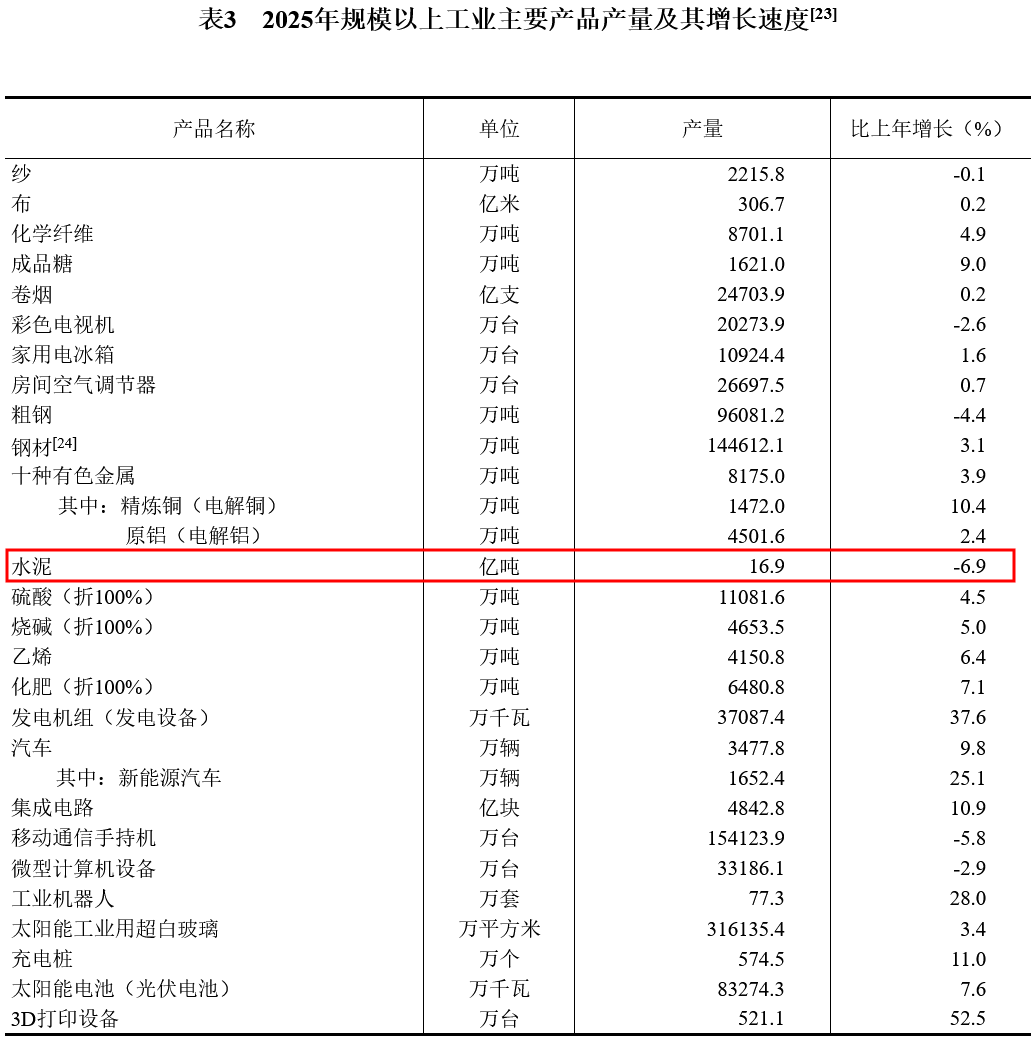
国家统计局:2025年中国水泥产量16.9亿吨
Guo Jia Tong Ji Ju· 2026-02-28 02:08
Group 1 - The National Bureau of Statistics of China released the "Statistical Bulletin on National Economic and Social Development for 2025," highlighting various industrial growth rates [1] - The agricultural and sideline food processing industry saw an increase in value added by 5.6% compared to the previous year [1] - The automotive manufacturing industry experienced significant growth of 11.5%, while the electrical machinery and equipment manufacturing sector grew by 9.2% [1] Group 2 - The cement production in China reached 1.69 billion tons in 2025, marking a decline of 6.9% year-on-year [1][3] - The textile industry reported a growth of 3.0%, while the chemical raw materials and chemical products manufacturing industry grew by 7.8% [1] - The production of new energy vehicles surged by 25.1%, indicating a strong trend towards sustainable transportation [3]

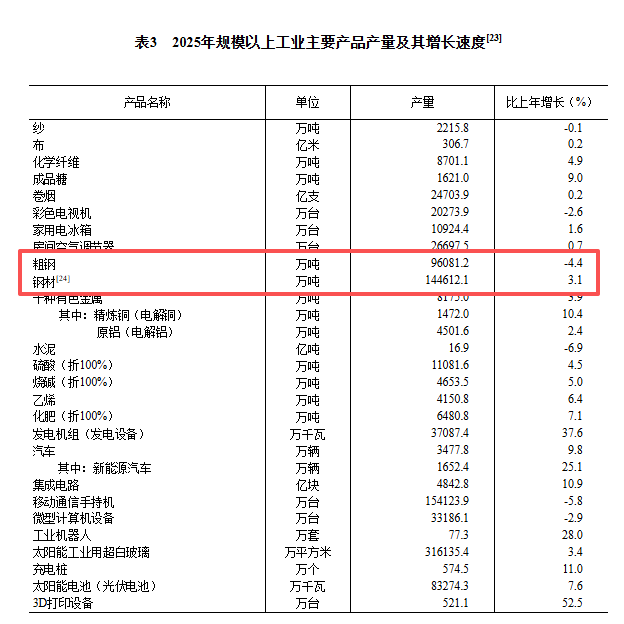
国家统计局:2025年中国粗钢产量96081.2万吨
Guo Jia Tong Ji Ju· 2026-02-28 01:46
Group 1 - In 2025, China's crude steel production reached 96,081.2 million tons, a year-on-year decrease of 4.4% [1] - The total steel output in 2025 was 144,612.1 million tons, showing a year-on-year increase of 3.1% [1] Group 2 - The production of refined copper was 1,472.0 million tons, reflecting a growth of 10.4% [2] - The output of aluminum (electrolytic aluminum) was 4,501.6 million tons, with a growth rate of 2.4% [2] - Cement production decreased to 16.9 billion tons, down by 6.9% compared to the previous year [2] - The production of electric power generation units reached 37,087.4 million kilowatts, marking a significant increase of 37.6% [2] - The output of new energy vehicles was 1,652.4 million units, representing a growth of 25.1% [2]
中华人民共和国2025年国民经济和社会发展统计公报
Guo Jia Tong Ji Ju· 2026-02-28 01:33
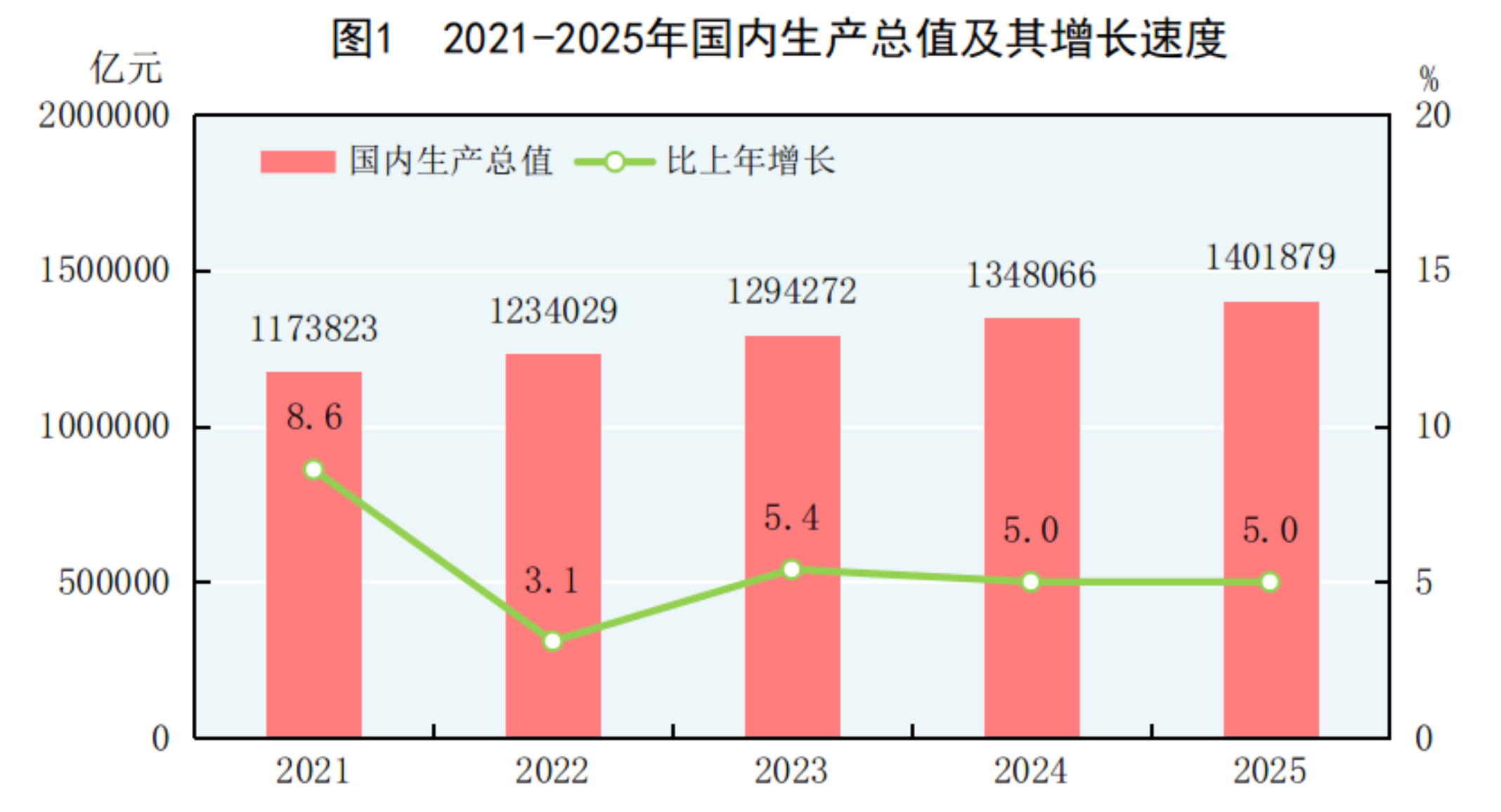
Economic Overview - The GDP for the year reached 140,187.9 billion yuan, growing by 5.0% compared to the previous year [3] - The primary industry added value was 93,347 billion yuan (3.9% growth), the secondary industry was 499,653 billion yuan (4.5% growth), and the tertiary industry was 808,879 billion yuan (5.4% growth) [3] - The per capita GDP was 99,665 yuan, reflecting a 5.1% increase year-on-year [3] Population and Employment - The total population at the end of the year was 1,404.89 million, a decrease of 3.39 million from the previous year [9] - The urban population was 953.80 million, accounting for 67.9% of the total population [7] - The total employment reached 72.50 million, with an urban employment rate of 65.6% [8] Industrial Performance - The total industrial added value was 416,826 billion yuan, marking a 5.8% increase [24] - The manufacturing sector saw a growth of 6.4%, with significant increases in automotive manufacturing (11.5%) and high-tech manufacturing (9.4%) [26][31] - The profits of industrial enterprises reached 73,982 billion yuan, a 0.6% increase year-on-year [31] Agricultural Output - The total grain output was 714.88 million tons, an increase of 1.2% from the previous year [21] - The production of pork was 59.38 million tons, reflecting a growth of 4.1% [23] Service Sector Growth - The value added by the wholesale and retail sector was 145,808 billion yuan, growing by 5.0% [36] - The information transmission, software, and IT services sector grew by 11.1% [36] Trade and Investment - The total import and export value reached 454,685 billion yuan, with exports growing by 6.1% and imports by 0.5% [60] - Foreign direct investment amounted to 747.7 billion yuan, a decrease of 9.5% [69] Financial Sector - The broad money supply (M2) increased by 8.5% to 340.3 trillion yuan [76] - The total social financing scale increased by 35.6 trillion yuan, with a year-end balance of 442.1 trillion yuan [77]
2025年中国微型计算机设备产量为33186.1万台 累计下降2.9%
Chan Ye Xin Xi Wang· 2026-02-23 01:49
Group 1 - The core viewpoint of the article highlights a decline in the production of microcomputer devices in China, with a significant drop of 14.1% year-on-year in December 2025 [1] - The cumulative production of microcomputer devices in China for the entire year of 2025 reached 33,186.1 million units, reflecting a decrease of 2.9% compared to the previous year [1] Group 2 - Listed companies mentioned include Haier Smart Home (600690), Digital China (000034), and Inspur Information (000977) [1] - The report referenced is the "2026-2032 China Microcomputer Industry Market Operation Pattern and Industry Demand Research Report" published by Zhiyan Consulting [1][2]

2025年电子信息制造业生产快速增长
Ke Ji Ri Bao· 2026-02-09 09:44
Core Viewpoint - The electronic information manufacturing industry in China is expected to experience rapid growth in production by 2025, with stable exports and improving efficiency, indicating a positive overall development trend [1] Group 1: Industry Growth - By 2025, the added value of the electronic information manufacturing industry is projected to grow by 10.6% year-on-year, outpacing the growth rates of the overall industrial sector and high-tech manufacturing by 4.7 and 1.2 percentage points respectively [1] - In December, the added value of the electronic information manufacturing industry increased by 11.8% year-on-year [1] Group 2: Production and Exports - Major products in the industry include 1.54 billion mobile phones produced, a decrease of 5.8% year-on-year, with smart phones accounting for 1.27 billion units, down by 0.9% [1] - The production of microcomputer devices reached 332 million units, reflecting a year-on-year decline of 2.9% [1] - Integrated circuit production totaled 484.3 billion units, marking a year-on-year increase of 10.9% [1] - By 2025, the cumulative export delivery value of the electronic information manufacturing industry is expected to remain flat year-on-year, while in December, the export delivery value grew by 1.2% year-on-year [1] - Customs statistics indicate that China exported 133 million notebook computers, 751 million mobile phones, and 34.95 billion integrated circuits, with the latter showing a year-on-year growth of 17.4% [1]
最新!全国城市GDP20强来了
Sou Hu Cai Jing· 2026-02-04 15:06
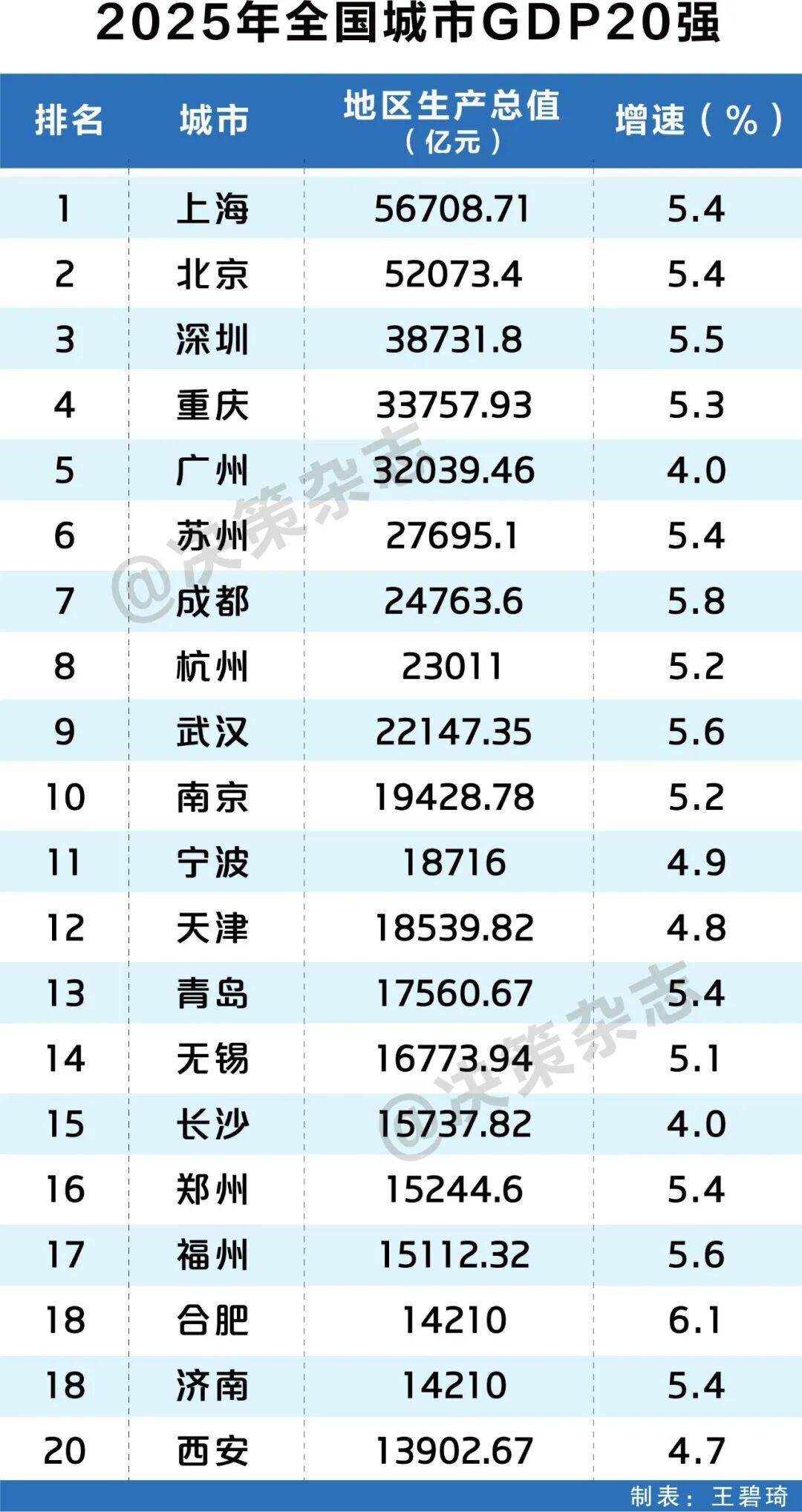
Core Insights - The latest GDP rankings reveal that Shanghai maintains its leading position with an economic total of 56,708.71 billion yuan, while Beijing becomes China's second city to surpass the 50 trillion yuan mark [1][4] - Hefei has made significant progress, ranking 18th in the top 20 cities and achieving a growth rate of 6.1%, the highest among these cities [1][12] GDP Rankings and Growth Rates - Shanghai: 56,708.71 billion yuan, growth rate 5.4% [2] - Beijing: 52,073.4 billion yuan, growth rate 5.4% [2] - Shenzhen: 38,731.8 billion yuan, growth rate 5.5% [2] - Chongqing: 33,757.93 billion yuan, growth rate 5.3% [2] - Guangzhou: 32,039.46 billion yuan, growth rate 4.0% [2] - Hefei: 14,210 billion yuan, growth rate 6.1% [3][12] Economic Structure and Key Industries - In Shanghai, the integrated circuit, biomedicine, and artificial intelligence sectors are projected to grow by 9.6%, with total output surpassing 2 trillion yuan [3] - Beijing's GDP is supported by key industries such as information transmission, software, IT services, finance, and industrial value-added, which together account for 51.8% of its GDP [4] - Shenzhen's new industries contribute significantly, with emerging sectors accounting for 43.0% of its GDP [5] - Chongqing's new energy vehicle sector shows a growth of 13.4%, contributing 60.9% to its industrial economy [5] Consumption and Market Dynamics - Cities with GDPs over 20 trillion yuan typically exhibit strong manufacturing bases, high-income populations, and large populations, which support rising consumption [9] - The consumption market in cities like Chengdu continues to grow, with retail sales reaching 1.14 trillion yuan [6] - The distinction of being a "trillion consumption city" is evident, with cities like Shanghai, Beijing, and Shenzhen leading the way [9] Hefei's Economic Performance - Hefei's industrial value-added grew by 17.6%, with significant contributions from sectors like computer and communication equipment manufacturing [14] - The city's total import and export volume reached 455.18 billion yuan, growing by 20.2% [15] - Fixed asset investments in advanced manufacturing and high-tech services are also on the rise, indicating a shift towards higher efficiency and growth [15]
城记 | 合肥晋级后,长三角“双万城市后备队”集结
Xin Hua Cai Jing· 2026-02-04 14:02
Core Viewpoint - The emergence of Hefei as a "Double Ten Thousand City" signifies its transition from a regional center to a nationally significant urban node, driven by steady economic growth and population influx [2][4]. Economic Growth - Hefei's GDP surpassed 1.4 trillion yuan, achieving an annual growth rate of 6.1%, marking a significant milestone as it crossed four hundred billion yuan thresholds [1][2]. - The city's GDP is projected to grow from 11.41 trillion yuan in 2021 to 14.21 trillion yuan by 2025, indicating a robust economic trajectory [2]. Population Dynamics - Hefei's resident population exceeded 10 million, with a net inflow of over 700,000 people, highlighting its attractiveness as a destination for migration [1][2]. - The city became the 18th in China to reach a population of over 10 million, reflecting its growing urban appeal [2]. Innovation and Industry - The continuous influx of talent has bolstered Hefei's technological innovation and industrial upgrading, with strategic emerging industries expected to grow by 16.6% by 2025 [3]. - Key industrial outputs include 1.371 million new energy vehicles, accounting for 8.3% of the national total, and significant increases in semiconductor and robotics production [3]. Regional Context - The Yangtze River Delta now hosts four "Double Ten Thousand Cities," including Shanghai, Suzhou, Hangzhou, and Hefei, showcasing the region's urban development leadership [4]. - The next potential "Double Ten Thousand City" is likely to emerge from the Yangtze River Delta, with cities like Wenzhou, Ningbo, and Nanjing being strong candidates due to their economic performance [4]. Wenzhou's Aspirations - Wenzhou has set a clear goal to achieve "Double Ten Thousand City" status by 2025, with a GDP target of 10213.9 billion yuan and a population of over 10 million [5][6]. - The city has experienced significant economic growth, with a 10.3% increase in industrial output and a strong focus on innovation and industrial transformation [6]. Long-term Development Strategy - Wenzhou is positioning itself for long-term growth with a strategic vision that includes enhancing its metropolitan area and establishing itself as a key regional center [7].
2025年我国规上电子信息制造业 增加值同比增长10.6%
Zhong Guo Zheng Quan Bao· 2026-02-02 20:53
Group 1 - The core viewpoint is that China's electronic information manufacturing industry is experiencing rapid growth, with a projected increase in value added of 10.6% year-on-year by 2025, outperforming the overall industrial and high-tech manufacturing sectors [1] - In December 2025, the value added of the electronic information manufacturing industry increased by 11.8% year-on-year, with major products showing varied performance: mobile phone production decreased by 5.8% to 1.54 billion units, while integrated circuit production rose by 10.9% to 484.3 billion units [1] - The industry achieved stable export delivery value in 2025, with a year-on-year growth of 1.2% in December, despite declines in notebook and mobile phone exports by 7.1% and 7.7% respectively, while integrated circuit exports increased by 17.4% [1] Group 2 - The electronic information manufacturing industry reported a total operating revenue of 17.4 trillion yuan in 2025, reflecting a year-on-year growth of 7.4%, and a total profit of 750.9 billion yuan, which is a 19.5% increase [2] - Operating costs also rose to 15.1 trillion yuan, marking a 6.9% increase year-on-year, while the operating profit margin improved to 4.3%, up by 0.2 percentage points compared to the first eleven months of 2025 [2] - However, fixed asset investment in the electronic information manufacturing sector declined by 3.8% year-on-year, which is 6.4 percentage points lower than the growth rate of industrial investment during the same period [2]
收评:三大指数均跌超2% 电网设备板块逆势走强
Xin Hua Cai Jing· 2026-02-02 07:45
Market Overview - The A-share market experienced a decline on Monday, with all three major indices falling over 2%. The Shanghai Composite Index closed at 4015.75 points, down 2.48%, the Shenzhen Component Index at 13824.35 points, down 2.69%, and the ChiNext Index at 3264.11 points, down 2.46% [1] - The total trading volume in the Shanghai and Shenzhen markets was 2.58 trillion yuan, a decrease of 250.8 billion yuan compared to the previous trading day [1] Sector Performance - The electric grid equipment and liquor sectors showed strong performance, with stocks like Huan Tai Liquor and Jin Hui Liquor experiencing multiple days of gains, while Water Well Liquor hit the daily limit [2] - Conversely, resource cyclical sectors such as metals, oil and gas, chemicals, coal, and steel faced significant declines [1][2] Individual Stocks - Over 4600 stocks in the market experienced declines, indicating a broad-based sell-off [3] Institutional Insights - According to Jifeng Investment Advisory, the market is currently in a correction phase, but the overall trend remains upward. They suggest focusing on leading companies in previously popular sectors that have seen price corrections [4] - CITIC Securities noted that the price of Moutai has continued to rise, with expectations for the liquor sector to perform well around the Spring Festival. They believe the sector is currently undervalued and presents a strong bottom-fishing opportunity [4] - According to招商证券, the market is expected to remain volatile in February, particularly due to the upcoming Spring Festival, which may lead to decreased market activity [4] Industry Data - The Ministry of Industry and Information Technology projected that by 2025, the added value of the electronic information manufacturing industry will grow by 10.6% year-on-year, outpacing the overall industrial and high-tech manufacturing growth rates [6] - In December, the added value of the electronic information manufacturing industry increased by 11.8% year-on-year, with specific product outputs showing varied trends, such as a 5.8% decline in mobile phone production [6] Policy Developments - The Guangdong Provincial Development and Reform Commission announced a plan to support the construction of a carbon emissions trading market and the potential introduction of carbon emission-related futures products [7]
工业和信息化部:2025年我国规上电子信息制造业增加值同比增长10.6%
Xin Hua Cai Jing· 2026-02-02 02:54
Core Insights - The electronic information manufacturing industry in China is experiencing rapid production growth, stable export performance, and improving profitability, despite a decline in investment [1][2]. Group 1: Production and Growth - In 2025, the added value of the electronic information manufacturing industry above designated size increased by 10.6% year-on-year, outpacing the growth rates of the overall industrial sector and high-tech manufacturing by 4.7 and 1.2 percentage points, respectively [1]. - In December 2025, the added value of the electronic information manufacturing industry grew by 11.8% year-on-year [1]. - Major products saw varied production trends: mobile phone production reached 1.54 billion units, down 5.8% year-on-year, with smart phones at 1.27 billion units, down 0.9%; microcomputer equipment production was 332 million units, down 2.9%; integrated circuit production was 484.3 billion units, up 10.9% [1]. Group 2: Export Performance - In 2025, the total export delivery value of the electronic information manufacturing industry remained flat year-on-year, while in December, it grew by 1.2% year-on-year [1]. - Notable export figures include 133 million notebook computers, down 7.1% year-on-year; 751 million mobile phones, down 7.7%; and 349.5 billion integrated circuits, which saw a significant increase of 17.4% year-on-year [1]. Group 3: Financial Performance - The electronic information manufacturing industry achieved operating revenue of 17.4 trillion yuan in 2025, a year-on-year increase of 7.4%, while operating costs rose by 6.9% to 15.1 trillion yuan [2]. - The total profit reached 750.9 billion yuan, reflecting a year-on-year growth of 19.5%, with an operating profit margin of 4.3%, up by 0.2 percentage points compared to January-November [2]. Group 4: Investment Trends - Fixed asset investment in the electronic information manufacturing industry declined by 3.8% year-on-year, which is 0.6 percentage points lower than the decline observed in January-November, and 6.4 percentage points lower than the growth rate of industrial investment during the same period [2].