Capital Group

Search documents
活动邀请 | 晨星投资洞察分享会:解码2025年第三季度全球公募市场资金流向与产品创新机遇
Morningstar晨星· 2025-11-20 01:05
Core Insights - The article highlights the significant trends in global investment, particularly focusing on the strong inflow into bond funds and the record growth of active ETFs, while also noting the resilience of digital asset funds as alternative investments [1][10]. Fund Flows and Market Trends - In Q3 2025, bond funds saw a net inflow exceeding $368 billion, which is five times the inflow of equity funds [1]. - Active ETFs continued their strong momentum with a quarterly net inflow of over $153 billion, marking a historical high, while passive open-end funds experienced rare net outflows [1]. - Digital asset funds, as an alternative investment, grew by 23% compared to the end of Q2 2025, indicating sustained interest in this sector [1]. Product Issuance and Market Position - China led the world in the number of new fund issuances, while globally, the issuance of active ETFs outpaced that of passive ETFs [1]. - In mature markets, alternative assets and trading tool-type products are dominating the trend of new fund issuances [1]. Research and Analysis Tools - The article emphasizes the use of Morningstar Direct, a professional analysis platform covering over 600,000 investment products, to capture global asset management trends and identify market opportunities [2][18]. - Participants in the event will receive insights from the "Morningstar Fund Company Rating Panorama Report," which discusses the relationship between fund company fee structures, product line stability, and future performance [5][9].


Ackman unveils $300B plan to rescue Fannie Mae and Freddie Mac
Youtube· 2025-11-19 14:15
Core Viewpoint - The Trump administration is considering IPOs for mortgage giants Fannie Mae and Freddie Mac, but billionaire investor Bill Ackman argues that now is not the right time for the Treasury to sell its stakes in these firms [1][2][3]. Group 1: Proposed Strategy for Fannie Mae and Freddie Mac - Ackman suggests that the Treasury should cancel the government's senior preferred shares and exercise warrants to buy up to 79.9% of the common stock, relisting both companies on the New York Stock Exchange, which could generate approximately $300 billion for taxpayers [3][9]. - He believes that rushing into an IPO is a mistake and that these entities will be worth significantly more over time, emphasizing the need for a slow and steady approach to privatization [5][11]. - Ackman highlights the importance of resetting capital levels, establishing the right management teams, and ensuring that shareholders are excited about the companies before proceeding with an IPO [8][18]. Group 2: Financial Performance and Market Potential - Fannie Mae and Freddie Mac have paid back $301 billion to the government after receiving $191 billion in loans, resulting in a return of nearly 12%, exceeding the expected 10% [9][24]. - Ackman projects that the stocks could trade in the $40 range, leading to a market cap approaching $400 billion, which would represent significant value creation [10][11]. - He argues that the government should retain its 79.9% stake while allowing the companies to optimize their operations, particularly in the context of advancements in AI that could enhance efficiency and profitability [15][16]. Group 3: Regulatory and Market Considerations - Ackman calls for revised capital rules to allow the government-sponsored enterprises (GSEs) to earn adequate returns, noting that current capital requirements are excessively high [30][32]. - He emphasizes that raising guarantee fees to meet capital requirements would ultimately increase mortgage interest rates for borrowers, which is not desirable [33][34]. - By listing the companies on an exchange while they remain in conservatorship, Ackman believes it would create transparency and potentially lower mortgage spreads, benefiting the overall mortgage market [35][36].

全球资管深研系列(二):组合个性化,税务效率化
Guoxin Securities· 2025-11-19 13:07
Core Insights - Separate Managed Accounts (SMA) are customized investment tools for high-net-worth and institutional clients, allowing investors to directly own each security in their account while benefiting from professional management, combining the advantages of fund-like management with personal asset control [3][6][10] - Compared to Model Portfolios, SMAs offer significant differences in customization, ownership, and tax management, enabling tailored investment strategies based on individual risk preferences and ESG considerations [3][10] - The global SMA market is evolving towards digitalization, deeper ESG customization, and scalability, with opportunities for domestic accounts to adopt similar strategies to enhance personalization and tax efficiency [3][10] Overview of SMA Business - SMA allows investors to have direct ownership of securities, providing transparency and tax efficiency, making it a preferred choice for high-net-worth and institutional investors [6][10] - Various forms of SMA exist, including discretionary, non-discretionary, model-driven, multi-manager, and tax-optimized types, catering to different investor preferences and needs [12][10] International SMA Practices - J.P. Morgan is a leading SMA provider with over $300 billion in assets under management, utilizing a tax-driven index strategy that has significantly outperformed benchmarks [24][3] - Vanguard's SMA strategy focuses on low-cost, direct indexing, enhancing tax efficiency through coordinated rebalancing, with a minimum investment threshold of $10,000 [31][3] - Fidelity employs a tax-smart investing approach, utilizing a proprietary STAR Score system for stock selection and achieving a tax efficiency rate of 85% in 2024 [34][35] Key Features of SMA Providers - J.P. Morgan's SMA includes a comprehensive management structure with dedicated teams for investment management and client service, ensuring tailored solutions and compliance monitoring [16][24] - Vanguard's SMA leverages a direct indexing platform to provide personalized investment solutions, enhancing tax management and cost efficiency [31][32] - Morgan Stanley's SMA platform emphasizes professional management and tax optimization, allowing clients to directly hold assets while benefiting from expert guidance [51][53] Investment Strategies and Performance - J.P. Morgan's Large Cap Growth Strategy SMA achieved a five-year annualized net return of 15.25%, significantly outperforming the Russell 1000 Growth Index [24][3] - Morgan Stanley's ClearBridge Small Cap SMA focuses on undervalued small-cap stocks, employing a probability distribution valuation model to identify long-term growth opportunities [59][60] - Fidelity's cross-account tax loss harvesting technology enhances after-tax returns by 0.5%-1.2%, demonstrating the effectiveness of tax optimization strategies [35][3]


US ETF Market Splits Into Distinct Price Segments
Wealth Management· 2025-11-17 21:36
Core Insights - The U.S. ETF industry is experiencing rapid growth, with net inflows in 2025 surpassing the previous record of $1.2 trillion set in 2024, indicating a shift towards price-based segments with distinct product offerings and market leaders [1] Low-Cost Segment - The low-cost segment, defined as ETFs with net expense ratios of 0.25% and below, accounted for 79% of the U.S. ETF market by assets as of November 7, 2025, with the "Big 3" (Vanguard, BlackRock, State Street) holding an 82% combined market share [2] - Traditional beta ETFs, which provide market-cap weighted indexed exposure, make up 88% of the low-cost segment, with an asset-weighted fee of only 0.09% [3] - State Street announced a ticker change and fee cut for the SPDR Portfolio S&P 500 ETF (SPYM) on October 31, 2025, while Vanguard reduced expense ratios for 53 ETFs in February 2025 [3] Medium-Cost Segment - Active ETFs are increasingly displacing smart beta ETFs in the medium-cost segment (net expense ratios between 0.26% and 0.75%), highlighting a growing demand for active strategies [4] - BlackRock and State Street dominate this segment, but firms like Capital Group and JP Morgan are rapidly gaining market share with their active management strategies [5] - Actively managed dividend ETFs have seen significant inflows, contrasting with outflows from indexed dividend ETFs like SPDR S&P Dividend ETF (SDY) and iShares Select Dividend ETF (DVY) [6] High-Cost Segment - The high-cost segment is led by leveraged and buffer ETFs, with major players including ProShares, Direxion, and Innovator Management [7] - Leveraged and inverse ETFs account for nearly one-third of all high-cost ETFs by assets, while buffer ETFs have consistently attracted over $10 billion in net inflows annually since 2022 [9] Future Outlook - Over 40% of new ETFs launched in the U.S. in 2025 were in the high-price segment, including single-stock ETFs, although their success rate is generally low [11] - Vanguard and BlackRock may expand their presence in active ETFs, which could lead to fee compression in the medium-cost segment, benefiting investors with lower costs and more product options [10]

Capital Group, Goldman, T. Rowe Hit ETF Milestones
Yahoo Finance· 2025-11-17 11:00
Core Insights - Major asset managers are achieving significant milestones in their ETF businesses amid record inflows, with Capital Group's ETFs reaching $100 billion in assets under management [2] - BlackRock's iShares and Vanguard remain the dominant players in the ETF market, holding $3.9 trillion and $3.7 trillion respectively, while newer entrants like T. Rowe Price are gaining traction [2] Industry Trends - Approximately $1.1 trillion has flowed into US ETFs in 2023 through October, surpassing total inflows for all of 2024, with $378 billion specifically directed towards active ETFs [3] - Total assets in the ETF market have exceeded $13 trillion, indicating robust growth and demand for exchange-traded funds [3] Company Developments - Capital Group has focused on core-style products while other niche issuers have introduced leveraged and thematic funds, with a notable increase in model portfolios for active ETFs [3] - As of March, Capital Group became the third-largest provider of active ETF model portfolios, managing $61 billion, following Wilshire and BlackRock [3] Additional Milestones - Invesco is nearing $800 billion across its 240 US ETFs, while Goldman Sachs has surpassed $50 billion with its 45 US ETFs, and T. Rowe Price has exceeded $20 billion with its 24 ETFs [5]


6 Dividend ETFs Under $50 to Buy Now
ZACKS· 2025-11-14 13:01
Core Insights - The U.S. government shutdown has ended, providing potential for a sustained rally in Wall Street, but global market stability remains uncertain due to high valuations in artificial intelligence [1] - Economic uncertainty and high market valuations are causing investors to be increasingly cautious, despite signs of easing U.S.-China trade tensions [2] Economic Indicators - Corporate layoffs surged by 183.1% in October, the highest increase in nearly two decades, attributed to cost-cutting and AI-driven restructuring [3] - Retail sales for the upcoming holiday season are expected to grow by 3.7% to 4.2%, reaching approximately $1.01 trillion to $1.02 trillion, although this growth is slower than the previous year's 4.3% increase [4] - The U.S. GDP growth rate for Q4 2025 is projected at 1.2% year over year, with S&P Global forecasting below-trend growth due to ongoing policy uncertainty [5] Market Valuation Concerns - The U.S. stock market has risen over 30% since April, but the "Buffett Indicator" suggests potential overheating, as the total market capitalization of U.S. stocks is now around $72 trillion, more than double the GDP [6][7] Investment Strategies - In a volatile market, dividend ETFs are becoming increasingly attractive for investors seeking steady income alongside capital gains [8] - Not all dividend stocks serve the same purpose; high-yield stocks provide current income, while dividend growth stocks indicate quality investing [9] - Low-priced dividend ETFs are recommended as they offer higher growth potential and affordability compared to higher-priced stocks [10] Dividend ETFs Overview - Schwab US Dividend Equity ETF (SCHD) priced at $27.16, yielding 3.80% annually [11][12] - Capital Group Dividend Value ETF (CGDV) priced at $43.37, yielding 1.28% annually [13] - State Street SPDR Portfolio S&P 500 High Dividend ETF (SPYD) priced at $43.25, yielding 4.52% annually [14] - iShares International Select Dividend ETF (IDV) priced at $38.36, yielding 4.53% annually [15] - First Trust Morningstar Dividend Leaders Index Fund (FDL) priced at $43.69, yielding 4.65% annually [16] - Amplify CWP Enhanced Dividend Income ETF (DIVO) priced at $45.53, yielding 4.46% annually [17]

ETF Prime: Record Inflows, Launches Highlight 2025
Etftrends· 2025-11-12 17:07
Core Insights - The ETF industry is experiencing a record-breaking year, with significant inflows and launches [1] Inflows and Assets - ETF inflows for 2025 have reached $1.16 trillion, surpassing last year's record of $1.15 trillion, with $43 billion coming in just last week [2] - October set a monthly record with $170 billion in inflows, bringing total ETF assets to approximately $13 trillion [2] Launches and Growth - The industry set a new record for ETF launches, with nearly 140 products debuting in October, bringing the year-to-date total to 923 new launches, surpassing last year's record of 740 [3] Firm-Specific Milestones - Vanguard Group had its best month ever in October, with over $50 billion in inflows, primarily driven by its S&P 500 ETF (VOO) [4] - Capital Group is nearing $100 billion in assets within four years of entering the ETF space, while Roundhill has crossed $10 billion in assets [4] Popular Trends and Strategies - The discussion included popular topics such as nuclear energy ETFs, AI-focused strategies, and autocallable income products attracting investor interest [5] - Notable stories for 2025 include $400 billion in active ETF inflows, a resurgence of gold ETFs, and a return of thematic strategies with $41 billion in net inflows this year [5]

CGGR: An Active Alternative To QQQ
Seeking Alpha· 2025-11-12 15:17
Group 1 - The Capital Group Dividend Value ETF (CGDV) has been positively reviewed, with a strong buy recommendation given by the analyst [1] - The analyst manages portfolios and focuses on macro strategy and investment advice, indicating a professional background in investment analysis [1] - The analyst also shares insights through various platforms, including YouTube and Substack, highlighting a commitment to disseminating investment knowledge [1] Group 2 - The analyst holds a beneficial long position in shares of META and CGDV, indicating confidence in these investments [2] - The article expresses the analyst's personal opinions and is not influenced by external compensation, suggesting an independent viewpoint [2] - There is no business relationship with any mentioned companies, reinforcing the objectivity of the analysis [2]

Capital Group Built a Nearly $100 Billion Active ETF Powerhouse in Under 4 Years
Etftrends· 2025-11-10 12:49
Core Insights - Capital Group's active ETF lineup has reached $98 billion in assets as of November 5, demonstrating rapid growth since the launch of six ETFs in February 2022 [1] - The firm has become a top three active ETF manager in the U.S. with 25 ETFs, driven by the adoption of their products by 47,000 advisors, many of whom are new to Capital Group [2] Asset Performance - Seventeen Capital Group ETFs have surpassed $1 billion in assets, with the Capital Group Dividend Value ETF (CGDV) managing $24 billion, primarily invested in U.S. dividend-paying stocks [3] - The Capital Group Core Plus Income ETF (CGCP) manages $6 billion and offers a 5.2% yield, while the Capital Group Municipal Income ETF (CGMU) has $4.4 billion in assets [4][5] Market Trends - Active fixed income ETFs have seen significant growth, with over $20 billion in assets across 10 strategies, reflecting a shift from mutual funds to ETF vehicles [5] - Actively managed ETFs gathered $409 billion in the first 10 months of 2025, with $48 billion in October alone, indicating strong demand and market share growth for Capital Group [7] New Product Development - Newer products like the Capital Group U.S. Small and Mid Cap ETF (CGMM), launched in January 2025, are gaining traction, with assets approaching $900 million despite redemptions in other small-cap ETFs [6]

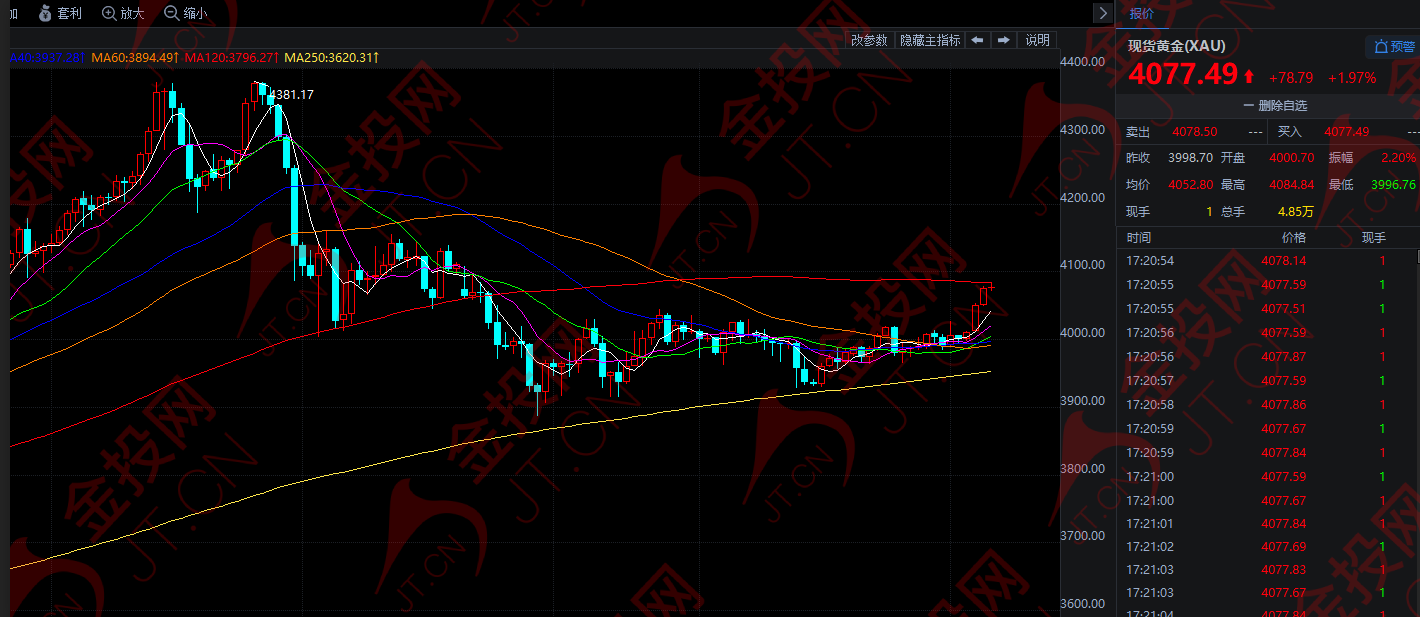
一则消息 黄金又爆了!
Jin Tou Wang· 2025-11-10 12:43
Group 1 - Gold prices experienced significant fluctuations, closing at $4000.91 after a drop of $1.57 or 0.04%, with a notable increase to around $4076 during European trading hours [1] - The U.S. stock market indices saw collective declines, with the Nasdaq down 3.04%, S&P 500 down 1.63%, and Dow Jones down 1.21% [2] - The U.S. government is expected to end its longest shutdown, with the Senate passing a temporary funding bill to provide government funding until January 30, 2026 [3][4] Group 2 - The potential economic impact of the government shutdown was highlighted, with warnings that continued shutdown could lead to negative economic growth in Q4 [5] - Recent announcements from the U.S. and China indicate a pause in certain trade measures, including the suspension of special port fees for U.S. vessels and the suspension of investigations into China's maritime and logistics sectors [6] - The upcoming release of the October CPI is anticipated to be a significant event, with analysts suggesting that a normal release could support interest rate cuts, while the absence of data may favor a more hawkish stance from the Federal Reserve [7] Group 3 - Concerns regarding high valuations in the U.S. stock market, particularly among AI stocks and the so-called "Tech Seven," have been raised by various financial institutions [8] - UBS noted that while there are warnings about potential market turbulence, the current market is still in the early stages of a bubble, lacking extreme valuation levels seen during the 2000 internet bubble [8] Group 4 - International developments include a large-scale attack by Russia on Ukraine's energy infrastructure, leading to power outages in multiple regions [10] - Russian defense forces reported intercepting 79 Ukrainian drones over ten regions [11] - Public support for President Putin remains high, with 74.5% of Russians approving of his work according to a recent poll [13]