
美股高估值

Search documents
一则消息 黄金又爆了!
Jin Tou Wang· 2025-11-10 12:43
Group 1 - Gold prices experienced significant fluctuations, closing at $4000.91 after a drop of $1.57 or 0.04%, with a notable increase to around $4076 during European trading hours [1] - The U.S. stock market indices saw collective declines, with the Nasdaq down 3.04%, S&P 500 down 1.63%, and Dow Jones down 1.21% [2] - The U.S. government is expected to end its longest shutdown, with the Senate passing a temporary funding bill to provide government funding until January 30, 2026 [3][4] Group 2 - The potential economic impact of the government shutdown was highlighted, with warnings that continued shutdown could lead to negative economic growth in Q4 [5] - Recent announcements from the U.S. and China indicate a pause in certain trade measures, including the suspension of special port fees for U.S. vessels and the suspension of investigations into China's maritime and logistics sectors [6] - The upcoming release of the October CPI is anticipated to be a significant event, with analysts suggesting that a normal release could support interest rate cuts, while the absence of data may favor a more hawkish stance from the Federal Reserve [7] Group 3 - Concerns regarding high valuations in the U.S. stock market, particularly among AI stocks and the so-called "Tech Seven," have been raised by various financial institutions [8] - UBS noted that while there are warnings about potential market turbulence, the current market is still in the early stages of a bubble, lacking extreme valuation levels seen during the 2000 internet bubble [8] Group 4 - International developments include a large-scale attack by Russia on Ukraine's energy infrastructure, leading to power outages in multiple regions [10] - Russian defense forces reported intercepting 79 Ukrainian drones over ten regions [11] - Public support for President Putin remains high, with 74.5% of Russians approving of his work according to a recent poll [13]

一则消息,黄金又爆了!
Jin Tou Wang· 2025-11-10 10:34
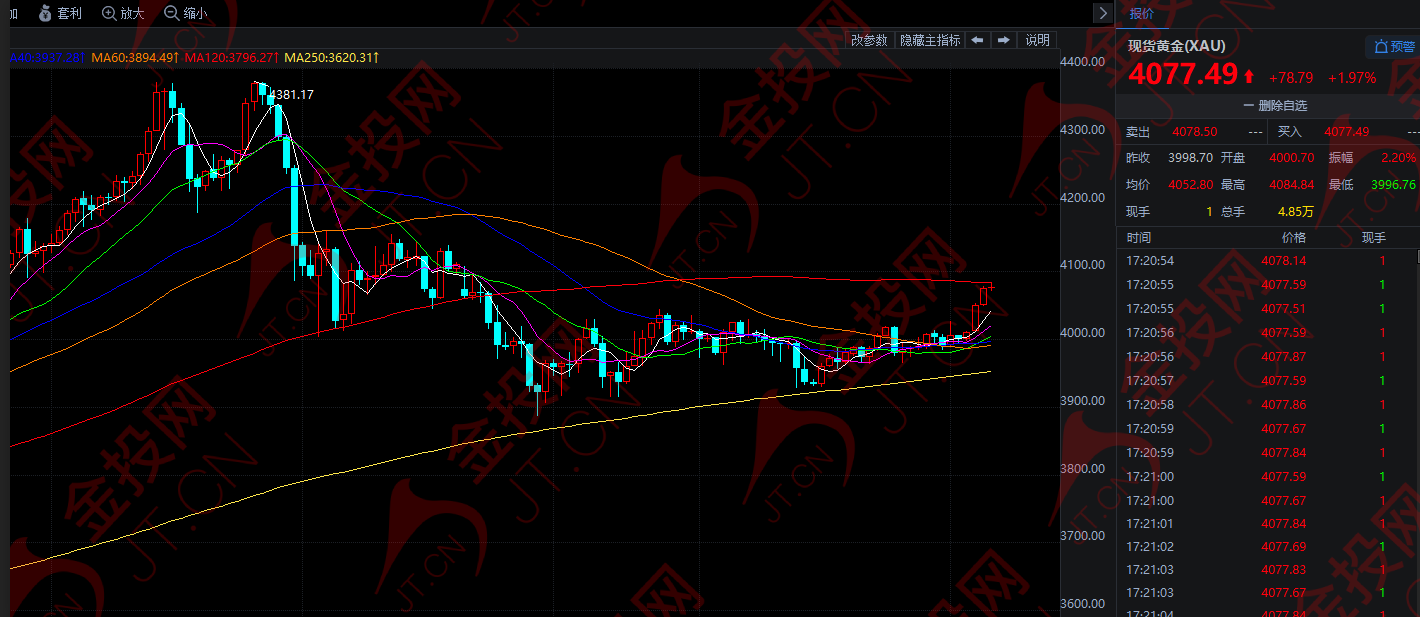
Group 1: Gold Market - Last week, spot gold fell by $1.57 or 0.04%, closing at $4000.91, with significant fluctuations exceeding $100 [1] - Today, during European trading hours, gold surged, breaking through the $4070 mark and hovering around $4076 [1] - Technical analysis indicates that gold is facing resistance around the $4080 level, which coincides with the 5-day moving averages on both daily and weekly charts [13] Group 2: U.S. Government Shutdown and Economic Impact - The U.S. government is expected to end its longest shutdown, which has lasted 40 days since October 1, with the Senate passing a temporary funding bill [4] - The bill will fund the government until January 30, 2026, but still requires approval from the House and the President [4] - Economic advisors have warned that prolonged shutdowns could lead to negative GDP growth in Q4 [4] Group 3: U.S. Stock Market and Economic Indicators - Major U.S. stock indices experienced declines last week, with the Nasdaq down 3.04%, S&P 500 down 1.63%, and Dow down 1.21% [2] - Analysts are concerned about high valuations in the U.S. stock market, particularly among AI stocks and the "Tech Seven" [9] - UBS suggests that the market is still in the early stages of a potential bubble, as current valuations are not extreme compared to the 2000 internet bubble [9] Group 4: Inflation Data and Federal Reserve Outlook - The upcoming release of the October CPI is highly anticipated, as its absence has become significant news due to the government shutdown [5] - Bloomberg analysis indicates that if the CPI is published, it may support a rate cut, with expectations of a 3% CPI [7] - Current probabilities for a 25 basis point rate cut in December stand at 66.9%, with a 33.1% chance of maintaining rates [7]

利空突袭!美股“吹哨人”,组团来了
券商中国· 2025-11-07 23:45
Core Viewpoint - Increasing warnings about the overvaluation of the US stock market, particularly concerning AI stocks and the "Tech Seven" companies, are emerging from various financial leaders [1][2]. Group 1: Warnings from Financial Leaders - DBS Bank CEO Piyush Gupta expressed concerns about potential turmoil in the US market, highlighting the high valuations of AI stocks, especially the "Tech Seven" companies: Amazon, Alphabet, Meta, Apple, Microsoft, Nvidia, and Tesla [2]. - Goldman Sachs CEO David Solomon predicted a potential 10% to 20% correction in the US stock market within the next 12 to 24 months [2]. - Capital Group's CEO Mike Gitlin noted that despite strong earnings from US-listed companies, the valuation levels are challenging [2][3]. Group 2: Market Dynamics and Investor Sentiment - The AI sector, which has been a driving force behind the US bull market, has recently faced significant volatility, with the S&P 500 index showing increasing instability [1][6]. - Factors contributing to market volatility include rising skepticism about AI prospects, negative asymmetry in tech earnings reports, and concerns over the deteriorating US job market [6][7]. - High levels of investor skepticism are evident, with many holding bearish views on AI trades, despite little change in overall positions [6][7]. Group 3: Recommendations and Future Outlook - Piyush Gupta suggested that investors should diversify their portfolios rather than concentrate on a single market, emphasizing the importance of diversification in investment strategies [4]. - There is a belief that Asia may attract more investments from the US, which could be seen as a positive development [5]. - Caution is advised for fixed-income investors funding the AI boom, as potential repercussions from market corrections could be significant [6].

外盘震荡是好事
Sou Hu Cai Jing· 2025-11-07 23:21
Group 1 - The recent fluctuations in the US stock market, particularly the Nasdaq, are attributed to high valuations encountering tightening liquidity, indicating a healthy correction phase [1] - The rise in the US dollar is primarily due to the government shutdown and the upcoming end of the Federal Reserve's balance sheet reduction, which is expected to release liquidity once normal spending resumes [1] - The current market turbulence provides an opportunity for investors who have been waiting to enter the market, suggesting that the fluctuations are not indicative of a major downturn [1] Group 2 - Investment opportunities are identified in the renewable energy sector, particularly in sub-industries such as wind, solar, nuclear, batteries, and power grids, which have shown no signs of reaching a peak since August 27 [2] - Recent capital inflows have been observed in agricultural chemicals and upstream battery sectors, indicating a focus on price increase trends [2] - The high tolerance for risk in a bull market allows investors to practice and refine their strategies, even if they face short-term losses [2]
美银为美股高估值辩护:是“新常态”,而非泡沫
Zhi Tong Cai Jing· 2025-09-25 00:45
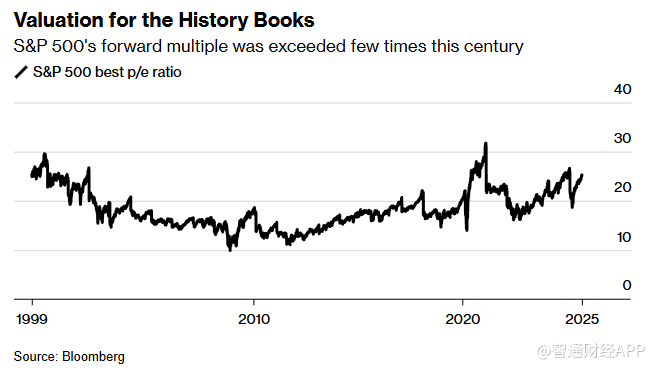
Core Viewpoint - The U.S. stock market is considered "extremely expensive," but a deeper analysis suggests that high valuations may be justified due to the inherent qualities of current index constituents [1][4]. Group 1: Valuation Indicators - 19 out of 20 internal indicators tracked by Bank of America show that the S&P 500 index is at statistically high trading prices, with 4 indicators reaching historical highs [1]. - The S&P 500's 12-month forward P/E ratio has reached a high of 22.9, a level only surpassed during the dot-com bubble and the summer of 2020 [2]. Group 2: Market Characteristics - Current index constituents exhibit lower financial leverage, reduced earnings volatility, higher efficiency, and more stable profit margins compared to previous decades, supporting the high valuations [1]. - The S&P 500 index has surged over 30% since its low on April 8, and has not seen a decline of more than 2% for 108 consecutive trading days, marking the longest such period since July 2024 [1]. Group 3: Economic Context - Despite risks from U.S. tariff policies and their potential impact on economic growth and inflation, the quality of current index constituents may lead to better performance in a low-interest-rate environment [4]. - The likelihood of a "tail event" occurring by 2026 is considered higher than the chances of stagflation or recession, given the current fiscal policy landscape and the Fed's actions [5].

史上最贵!美股估值已超越互联网泡沫时代
美股IPO· 2025-09-01 07:54
Group 1 - The S&P 500 index's price-to-sales ratio has reached 3.23, marking a historical high, while the expected price-to-earnings ratio is 22.5, significantly above the average of 16.8 since 2000 [1][2] - The high valuation in the U.S. stock market is largely driven by a few large technology companies, which dominate the market [3] - As of the end of July, the top 10 companies in the S&P 500 accounted for 39.5% of the index's total market capitalization, the highest level on record, with nine of these companies having market capitalizations exceeding $1 trillion [4] Group 2 - Concerns have been raised about the risks associated with the concentration of market power among a few companies, as evidenced by the underperformance of the "Magnificent Seven" during a brief sell-off in April [5] - The combination of high valuations and crowded trades increases the likelihood of sustained market downturns, as it raises questions about where new buyers will come from when prices fall [6] - The S&P 500 index's equal-weighted price-to-sales ratio stands at 1.76, which is close to its long-term average of 1.43, indicating that ordinary companies are not at extreme price levels [7] Group 3 - Some market participants express skepticism about whether the largest companies can maintain their current valuations over the long term, suggesting that fundamentals and valuations will ultimately dictate stock prices [8] - The high expectations embedded in current valuations may be difficult for companies to meet, as emphasized by industry experts [9]
史上最贵!美股估值已超越互联网泡沫时代
Hua Er Jie Jian Wen· 2025-09-01 03:54
Core Viewpoint - The U.S. stock market has reached unprecedented valuation levels, surpassing the peak of the internet bubble, with the S&P 500 index's price-to-sales ratio hitting 3.23, a historical high [1] - The high valuations are largely driven by a few large technology companies, which dominate the market and are perceived to justify their high valuations due to significant sales and profit growth [2] Group 1: Valuation Metrics - The S&P 500 index's price-to-earnings ratio based on expected earnings for the next 12 months is 22.5, significantly above the average of 16.8 since 2000 [1] - The top 10 companies in the S&P 500 account for 39.5% of the index's total market capitalization, the highest level on record, with nine of these companies valued over $1 trillion [2] Group 2: Market Risks and Concentration - The concentration of market power among a few companies raises concerns about potential downside risks, as seen in April when the "Mag 7" underperformed compared to the overall S&P 500 index [3] - The combination of high valuations and crowded trades increases the likelihood of sustained market downturns, as it raises questions about where new buyers will come from if prices fall [4] Group 3: Investment Opportunities - Despite high valuations in the tech sector, there are attractive investment opportunities outside of these large companies, with some stocks trading below average valuation levels [4] - Investors are encouraged to look for companies that may benefit from productivity gains related to AI developments but have not yet been labeled as "AI companies" [4] Group 4: Future Outlook - There is skepticism about whether the largest companies can maintain their current valuations over the long term, as fundamental performance and valuation will ultimately dictate stock prices [4][5] - The expectations embedded in current valuations are becoming increasingly high, making it challenging for companies to meet these expectations [5]
季节性疲软叠加估值高企,美股九月面临惊涛骇浪
Ge Long Hui A P P· 2025-08-29 10:27
Core Viewpoint - Investors are increasingly concerned that the current bull market in U.S. stocks may be approaching unsustainable levels, particularly as September, historically the weakest month for U.S. equities, approaches [1] Group 1: Market Conditions - The S&P 500 index has risen 17% since early May, leading to a precarious situation for bulls as they enter September [1] - Current valuations have reached 22 times expected earnings, comparable to levels seen at the end of the dot-com bubble [1] - According to Bank of America analyst Paul Ciana, the probability of the S&P 500 declining in September is 56%, with an average decline of 1.17% [1] Group 2: Investor Sentiment - Programmatic traders, who rely on trends rather than fundamentals, have nearly the highest level of holdings in U.S. stocks [1] - Hedge funds' stock positions are described as very crowded, indicating a potential risk of a market pullback [1] Group 3: Economic Indicators - Upcoming economic indicators include the latest non-farm payroll data and two inflation reports, which will precede a highly anticipated Federal Reserve policy decision [1] - The probability of a decline in September increases to 58% during the first year of a presidential term, with an average decline of 1.62% [1]
固收周报20250817:如何缓解当前转债配置踏空焦虑?-20250817
Soochow Securities· 2025-08-17 13:34
1. Report Industry Investment Rating No relevant content provided. 2. Core Views of the Report - Overseas: During the week of August 11 - 15, the Russia - Ukraine conflict showed signs of improvement. The market focused on Powell's potential hawkish speech at the Jackson Hole central bank annual meeting. The long - end of U.S. Treasuries remained in a wide - range oscillation of 4.0 - 4.5%, with the term spread narrowing marginally. It's believed that the Fed is likely to restart rate cuts in the remaining time of 2025, with a possible 25 - 50bp downward adjustment of the policy rate. This may support the high valuation of U.S. stocks, steepen the curve, and boost the valuation of global risk assets. The views are to be long on the short - end of U.S. Treasuries and gold [1][35][36]. - Domestic: The domestic equity market continued its "slow - bull" pattern last week, and micro - cap stocks reached a turning point. It's thought that equities are moving from valuation repair to performance repair, and the "slow - bull" pattern may continue with the potential Fed rate cut in September. Convertible bonds rose following equities, with equal - weighted better than weighted. High - priced bonds significantly outperformed low - priced ones, and low - priced slightly outperformed medium - priced. To address the fear of missing out, one can: 1) directly increase the allocation of convertible bond ETFs with incremental funds; 2) increase the allocation of bank and cyclical stocks that have fallen recently; 3) widen the convertible bond income range to a cap of 150 yuan to dig for excess returns of thematic stocks [1][36]. - Next week: The top ten high - rated, medium - low - priced convertible bonds with the greatest potential for parity premium rate repair are: Hexing Convertible Bond, Pufa Convertible Bond, Jinneng Convertible Bond, Liqun Convertible Bond, Hope Convertible Bond, Liuyao Convertible Bond, Jiangong Convertible Bond, Qingnong Convertible Bond, Lutai Convertible Bond, and Nenghua Convertible Bond [1][36]. 3. Summary According to Relevant Catalogs 3.1. Week - to - Week Market Review 3.1.1. Equity Market - Overall, the equity market rose from August 11 - 15. The Shanghai Composite Index rose 1.70% to 3696.77, the Shenzhen Component Index rose 4.55% to 11634.67, the ChiNext Index rose 8.58% to 2534.22, and the CSI 300 rose 2.37% to 4202.35. The average daily trading volume of the two markets increased by about 4031.28 billion yuan to 16748.23 billion yuan, a week - on - week increase of 24.07%. Among the 31 Shenwan primary industries, 20 industries rose, with 12 industries rising more than 2%. Communication, electronics, non - bank finance, power equipment, and computer led the gains, while banking, steel, textile and apparel, coal, and public utilities led the losses [6][8][14]. 3.1.2. Convertible Bond Market - The convertible bond market also rose, with a gain of 1.60% to 475.25. Among the 29 Shenwan primary industries, 24 industries rose, with 9 industries rising more than 2%. Non - bank finance, communication, machinery and equipment, automobile, and non - ferrous metals led the gains, while social services, banking, national defense and military industry, coal, and beauty care led the losses. The average daily trading volume of the convertible bond market was 963.64 billion yuan, a significant increase of 68.16 billion yuan, a week - on - week change of 7.61%. About 78.63% of individual bonds rose, with 27.53% rising between 0 - 1% and 33.04% rising more than 2% [6][15]. 3.1.3. Comparison of Stock and Bond Market Sentiments - From August 11 - 15, the weekly weighted average and median of convertible bonds and underlying stocks were positive, and convertible bonds had a larger weekly increase. In terms of trading volume, the convertible bond market's trading volume increased by 13.07% week - on - week, at the 90.00% quantile since 2022, while the underlying stock market's trading volume increased by 16.85%, at the 96.10% quantile. About 78.79% of convertible bonds and 60.39% of underlying stocks rose, and about 55.84% of convertible bonds had a larger increase than underlying stocks. Overall, the trading sentiment of the convertible bond market was better this week [30]. 3.2. Future Outlook and Investment Strategy - Overseas: The long - end of U.S. Treasuries will likely maintain a wide - range oscillation of 4.0 - 4.5%. It's expected that the Fed will restart rate cuts in 2025, with a 25 - 50bp downward adjustment of the policy rate. The views are to be long on the short - end of U.S. Treasuries and gold [1][35][36]. - Domestic: The domestic equity market's "slow - bull" pattern may continue. To address the fear of missing out on convertible bonds, one can increase the allocation of convertible bond ETFs, bank and cyclical stocks, and widen the income range to 150 yuan [1][36]. - Next week: The top ten convertible bonds with the greatest potential for parity premium rate repair are recommended [1][36].