
Palantir Technologies Inc.

Search documents
X @Bloomberg
Bloomberg· 2026-02-05 13:56
New York’s pension funds are questioning Palantir, a software company, over its business dealings with US Immigration and Customs Enforcement and the Department of Homeland Security https://t.co/J27U2tO1wo ...
软件股步入“残酷清算期”!2万亿美元市值蒸发,对冲成本飙升至2020年来高点36/64
美股IPO· 2026-02-05 13:54
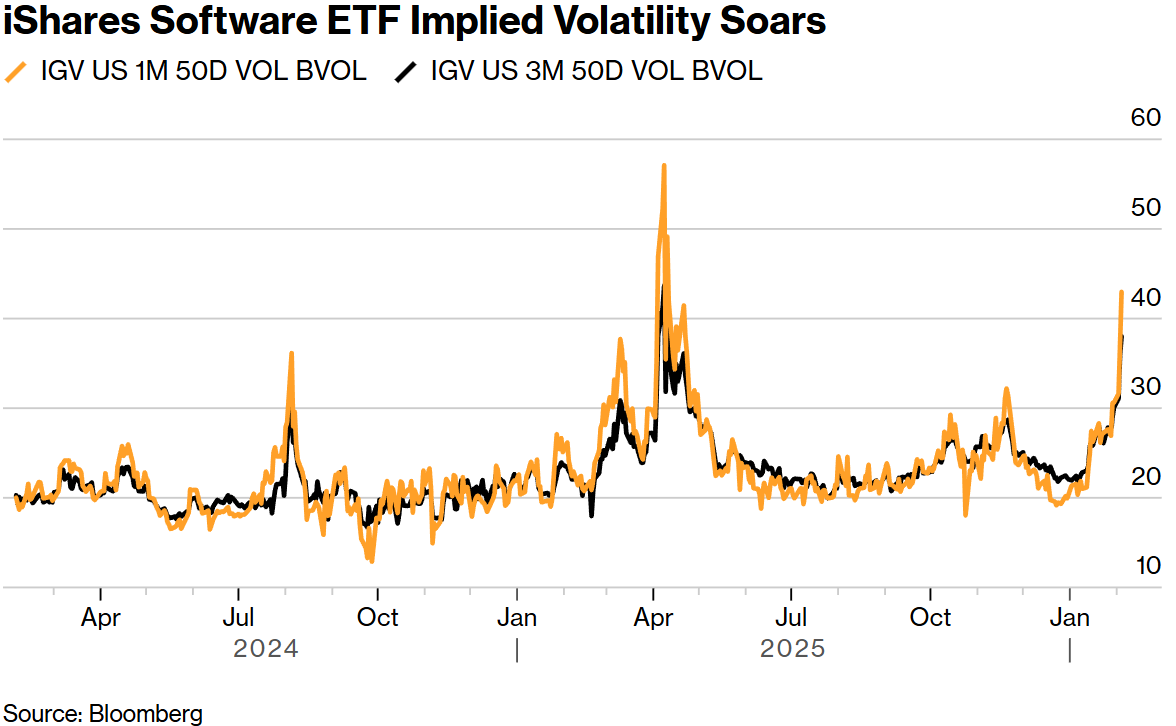
Core Viewpoint - The ongoing sell-off in software stocks has caused significant anxiety among tech investors, leading them to pay premiums for hedging tools to protect against further declines in stock prices [1][3]. Group 1: Market Performance - Software stocks have experienced a continuous decline, with Goldman Sachs' software basket recording a drop for the seventh consecutive trading day, resulting in a year-to-date decline of 19% for 2026 [3]. - The broader tech sector has also been affected, with the Nasdaq 100 index down 1.4% year-to-date in 2026 [3]. - The implied volatility for the iShares expanded tech software sector ETF (IGV.US) has reached its highest point since the tariff turmoil in April of the previous year, driving up option premiums [3][11]. Group 2: Investor Sentiment - There is a clear aversion to software stocks among investors, as indicated by the soaring insurance costs for the Invesco QQQ Trust Series 1 ETF (QQQ.US), which have reached their highest level since March 2020 [3][11]. - Despite signs that the sell-off may be overdone, the turbulence caused by AI applications makes it extremely difficult to predict a bottom for the sector [4]. Group 3: Company-Specific Concerns - Major companies such as Microsoft (MSFT.US), Oracle (ORCL.US), Salesforce (CRM.US), and Palantir (PLTR.US) have all seen their stock prices decline by double digits this year due to investor concerns about AI tools disrupting their businesses [7]. - Adobe's stock, which has dropped 20% this year, is viewed by some investors as a potential indicator of the broader industry's outlook [11]. - The software sector has seen a net selling trend, with a historical low net exposure of 4.2% compared to 7% at the beginning of 2026 and a peak of 17.7% [12]. Group 4: Future Outlook - The upcoming earnings report from Salesforce on February 26 is seen as a critical test for the industry, with the potential to either halt the current decline or not reverse the trend [13]. - There is a growing need to discern which companies will perform well and which may face existential threats due to AI advancements [15].


Palantir and Woodward Jumped on Earnings Beats—Here Are 3 More Setups to Watch
Investing· 2026-02-05 13:49
Core Insights - The article provides a comprehensive market analysis focusing on investment opportunities and trends in various sectors [1] Group 1: Market Trends - The analysis highlights significant shifts in market dynamics, particularly in technology and healthcare sectors, indicating a growing interest from investors [1] - Emerging markets are showing resilience, with increased foreign investment inflows, suggesting a potential for higher returns [1] Group 2: Investment Opportunities - Specific companies within the renewable energy sector are identified as having strong growth potential due to favorable government policies and increasing demand for sustainable solutions [1] - The financial services industry is experiencing a transformation driven by fintech innovations, presenting new avenues for investment [1] Group 3: Economic Indicators - Key economic indicators such as GDP growth rates and unemployment figures are discussed, providing context for the current investment climate [1] - Inflation rates are noted to be stabilizing, which may influence central bank policies and interest rates moving forward [1]


Earnings live: Qualcomm stock dives as memory chip shortage weighs on outlook, Alphabet slides, Peloton falls
Yahoo Finance· 2026-02-05 13:33
Core Insights - The fourth quarter earnings season is ongoing, with major companies like Alphabet, Amazon, AMD, Qualcomm, and Palantir reporting results [1] - As of January 30, 33% of S&P 500 companies have reported their fourth quarter results, with an estimated 11.9% increase in earnings per share, marking the 10th consecutive quarter of annual earnings growth for the index [2] - Analysts had initially expected an 8.3% increase in earnings per share, which was revised upwards due to strong performance from tech companies [4] Group 1: Earnings Performance - The S&P 500 is projected to achieve its fifth consecutive quarter of double-digit earnings growth, reflecting a robust earnings season [2] - The earnings growth estimate for the fourth quarter has been raised from an initial expectation of 8.3% to 11.9%, indicating a positive trend in corporate profitability [4] Group 2: Market Influences - Big Tech companies are setting the tone for the earnings season, with ongoing capital expenditures and themes such as artificial intelligence and economic policies influencing market dynamics [5] - Upcoming earnings reports from companies like Disney, Chipotle, PepsiCo, Uber, and Snap are anticipated to provide further insights into market trends and consumer behavior [5]



软件股步入“残酷清算期”!2万亿美元市值蒸发,对冲成本飙升至2020年来高点
Zhi Tong Cai Jing· 2026-02-05 13:29
智通财经APP注意到,软件股持续不断的抛售潮已令科技投资者倍感焦躁,以至于他们开始支付溢价购买对冲工具,以防股价再次大幅下挫。 这种担忧不无道理。周三软件股再次暴跌,高盛软件一篮子股票录得连续第七个交易日下跌,使其2026年年内跌幅达到19%。这场溃败波及了更广泛的科技 板块指标,拖累纳斯达克100指数在2026年迄今下跌了1.4%。 数据显示,这种不确定性导致针对Invesco QQQ Trust Series1ETF(QQQ.US)下跌10%的保险成本(相对于看涨押注)飙升至2020年3月以来的最高水平。同时, iShares扩展科技软件板块ETF(IGV.US)的引伸波幅(隐含波动率)处于去年4月关税动荡以来的最高点,推高了期权溢价。 尽管有迹象表明抛售已过度,但AI应用给该行业带来的震荡非常剧烈,以至于预测底部已成为一项极其困难的任务。 iShares软件ETF隐含波动率飙升 "问题是到底会跌到多低?"财富管理公司FBB Capital Partners研究主管迈克尔.贝利表示,"投资者厌恶软件股,这一点显而易见。" 这对行业巨头来说意味着一场残酷的清算,尤其是微软(MSFT.US)、甲骨文(ORCL ...
恐慌蔓延,卖盘正引发更多卖盘
Hua Er Jie Jian Wen· 2026-02-05 13:26
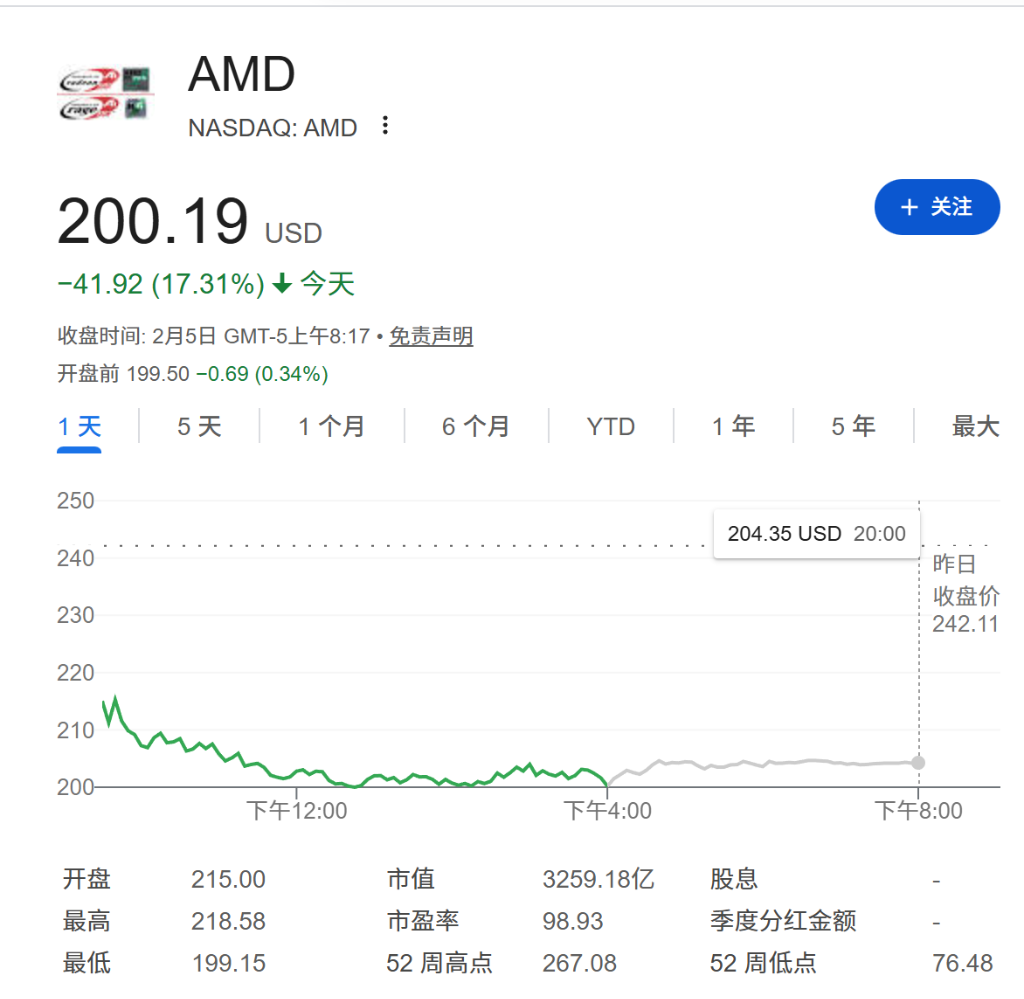
Core Viewpoint - The technology sector is experiencing heightened anxiety, leading to a reversal in investor sentiment regarding artificial intelligence (AI) and its disruptive impacts, resulting in increased market volatility [1] Group 1: Market Reactions - A significant sell-off in the software industry has rapidly spread to chip manufacturers and large tech stocks, creating a self-reinforcing selling pressure that has affected global stock markets, cryptocurrencies, and commodity markets [1] - The chip industry has been particularly hard hit, with AMD's stock plummeting by 17% and Palantir's shares dropping by 12% [1] - The Korean Kospi index fell nearly 4% due to the impact of Wall Street's chip stock declines, indicating a rapid spread of the sell-off to Asian markets [7] Group 2: AI Sentiment Shift - Investor sentiment towards AI has shifted from unconditional optimism to caution, as concerns grow over the potential threats AI poses to existing business models [8] - The software sector has seen a market capitalization loss of nearly $1 trillion within a week due to this anxiety, indicating a significant market reaction [7] Group 3: Capital Expenditure Concerns - Alphabet announced a capital expenditure plan that could reach between $175 billion and $185 billion this year, doubling previous estimates, which has raised concerns about the potential returns on such aggressive investments [9] - Despite the intention to alleviate computing bottlenecks and maintain a competitive edge in AI, the market reacted negatively, with Alphabet's stock declining by 2% in after-hours trading [9] Group 4: Economic Signals and Policy Focus - Mixed macroeconomic signals are emerging, with positive ISM data contrasted by lower-than-expected growth in ADP private sector employment, indicating ongoing recruitment challenges [12] - Investors are closely monitoring upcoming data releases, including job vacancy statistics and initial unemployment claims, as well as Amazon's earnings report, which will serve as a critical test for the performance of tech giants [12]
美股前瞻 | 三大股指期货齐跌,“软件股末日”论甚嚣尘上,亚马逊(AMZN.US)盘后公布财报
Zhi Tong Cai Jing· 2026-02-05 13:15
Market Overview - US stock index futures are all down, with Dow futures down 0.30%, S&P 500 futures down 0.52%, and Nasdaq futures down 0.68% [1] - European indices also show declines, with Germany's DAX down 0.63%, UK's FTSE 100 down 0.40%, France's CAC40 down 0.06%, and the Euro Stoxx 50 down 0.41% [2][3] - WTI crude oil prices fell by 2.15% to $63.74 per barrel, while Brent crude oil dropped by 2.06% to $68.03 per barrel [3][4] Software Sector - The software sector is experiencing a significant downturn, with Goldman Sachs' software index declining for the seventh consecutive day, down 19% year-to-date, impacting the Nasdaq 100 index which is down 1.4% [5] - Major software companies like Microsoft, Oracle, Salesforce, and Palantir have seen declines exceeding 10%, with Adobe's stock plummeting by 20% [5] - The software sector has lost $2 trillion in market value since last year's peak, with hedge fund net positions dropping to a historical low of 4.2% [5] Trade and Geopolitical Developments - The US is planning to establish a protected trade zone for rare earths, using tariffs to set price floors, as announced by Vice President Vance [6] - A recent survey indicates that most investors believe stock returns will outperform bonds due to international policy dynamics, with a majority expecting an increase in 10-year US Treasury yields [6] Company-Specific News - Amazon faces scrutiny from German antitrust authorities, resulting in a seizure of $70 million in earnings due to price control practices [8] - Barrick Gold reported a 64% increase in Q4 revenue and a 140% increase in dividends, announcing plans for an IPO to spin off its North American gold assets [9] - SiTime's Q4 revenue reached $113.3 million, a 66% year-over-year increase, with a strong performance in its communication and data center business [10] - Alphabet (Google) reported Q4 revenue growth of 18% to $113.8 billion, driven by its services and cloud business, although it faces concerns over high capital expenditures [11] - Qualcomm's weak Q2 guidance led to a pre-market drop of over 12%, raising concerns about the smartphone market's stability [12] - Arm Holdings' revenue forecast fell short of expectations, leading to a pre-market decline of over 7% [13] - BBVA's profits were impacted by increased provisions in emerging markets, despite a 4.1% increase in net profit [14] - Shell's Q4 adjusted profit fell to $3.26 billion, below market expectations, amid declining oil prices and weak chemical performance [15] - Vodafone's stock saw a significant drop despite revenue growth, due to underperformance in the German market [16] - NIO forecasts adjusted operating profit of RMB 700 million to 1.2 billion for Q4 2025, marking its first anticipated quarterly profit [17]

Why BlackRock Just Took an 8.1% Stake in Archer Aviation Stock
Yahoo Finance· 2026-02-05 12:50
Core Viewpoint - Archer Aviation's stock has decreased by 26% since its debut on the New York Stock Exchange in September 2021, indicating a shift in investor sentiment from retail enthusiasm to a more cautious outlook [1] Group 1: BlackRock's Investment - BlackRock has increased its ownership stake in Archer to 8.1%, signaling a significant investment in the eVTOL company [2] - The 13G filing indicates that BlackRock's acquisition of shares is a passive investment, not intended to influence Archer's operations [3][4] Group 2: Investment Appeal of Archer Aviation - Archer is viewed as an asymmetric investment, with potential high rewards if it successfully disrupts the aviation and mobility markets, despite risks related to regulatory approvals and capital management [5] - The company has attracted attention from notable partners such as Palantir Technologies, Nvidia, United Airlines, Stellantis, and the U.S. government, indicating strong strategic interest [5] - Archer reported $1.6 billion in liquidity at the end of the third quarter, supported by investments from its partners, which reduces execution risk as the company prepares for commercial deployment [6]


Broadcom Is 'Uncle Sam Of AI,' Says Futurum Equities As It Lists 15 Non-Mag7 AI Disruptors
Yahoo Finance· 2026-02-05 12:31
Futurum Equities, in its latest AI Fifteen report, identified the critical factors that will define the AI economy. These include the control of computing, data, deployment, and security. The firm’s list features companies that are not part of the Mag 7 but are disrupting the AI economy in various layers. Broadcom Leads AI Chip Revenue Surge Broadcom Inc. (NASDAQ:AVGO), which Futurum Equities describes as the “Uncle Sam of AI,” is leading the list. Despite a volatile earnings reaction, Broadcom remains at ...
