
恒生电子

Search documents
谷歌Gemini下载量超过ChatGPT,软件ETF(159852)调整蓄势,近1月日均成交同类居首!
Xin Lang Cai Jing· 2025-09-16 03:01
Core Insights - The software service index has shown a slight increase, with notable gains in specific stocks such as Kingsoft Office and Tuowei Information, indicating a positive trend in the software sector [1][3]. Market Performance - The software ETF experienced a turnover of 4.37% with a transaction volume of 196 million yuan, and it has the highest average daily transaction volume of 583 million yuan over the past month among comparable funds [3]. - The software ETF has seen a significant growth of 1.543 billion yuan in scale over the past three months, leading in new scale among comparable funds [3]. - The ETF's net value has increased by 21.34% over the past three years, with the highest single-month return reaching 39.35% since its inception [3]. Industry Trends - The value in the computer and software development industry is currently concentrated among upstream core technology suppliers, which enjoy high bargaining power and profit margins due to technological barriers [4]. - As technology advances and production scales up, hardware costs are expected to decline, shifting industry value towards software and services, with intelligent algorithms and continuous services becoming key growth areas [4]. - Future business models are anticipated to evolve from hardware-centric to an integrated model of "hardware + software + ecosystem services," maximizing value and profit through software platforms and ecosystems [4]. Key Stocks - The top ten weighted stocks in the software service index account for 62.05% of the index, with notable companies including iFlytek, Kingsoft Office, and Tonghuashun [4][6]. - The performance of key stocks includes iFlytek at 0.79%, Kingsoft Office at 1.47%, and Tuowei Information at 1.27%, indicating a mixed performance among the top players [6].





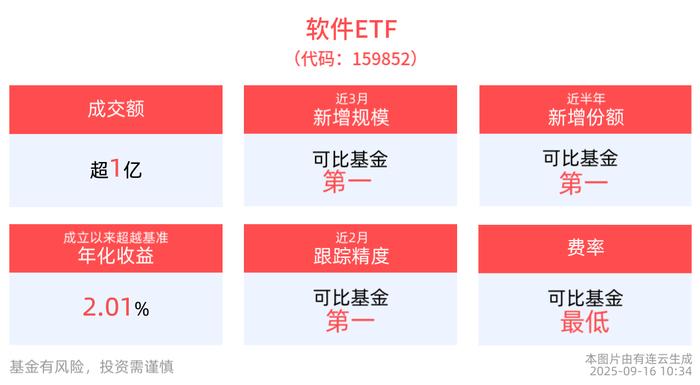
涨超1.5%,同规模最大的信创ETF(562570)红盘向上
Sou Hu Cai Jing· 2025-09-16 02:15
Group 1 - The China Securities Information Technology Application Innovation Industry Index (931247) has seen a strong increase of 1.70% as of September 16, 2025, with notable gains from constituent stocks such as Zhongke Shuguang (603019) up 8.49%, Foxit Software (688095) up 6.41%, and Haiguang Information (688041) up 6.31% [3] - The Xinchuang ETF (562570) has risen by 1.51%, with a latest price of 1.48 yuan, and has accumulated a weekly increase of 4.07% as of September 15, 2025, ranking in the top third among comparable funds [3] - The Xinchuang ETF has shown significant liquidity with an intraday turnover of 4.76% and a transaction volume of 25.2587 million yuan, while the average daily transaction volume over the past month reached 80.0323 million yuan, ranking first among comparable funds [3] Group 2 - The Xinchuang ETF closely tracks the China Securities Information Technology Application Innovation Industry Index, which selects up to 50 listed companies involved in various segments such as basic hardware, software, application software, information security, and external devices [4] - As of August 29, 2025, the top ten weighted stocks in the index include Zhongke Shuguang (603019), Haiguang Information (688041), and others, collectively accounting for 50.4% of the index [4] - The top ten stocks by weight include Hengsheng Electronics (600570) at 6.07%, Zhongke Shuguang (603019) at 5.58%, and Haiguang Information (688041) at 5.09%, among others [6]




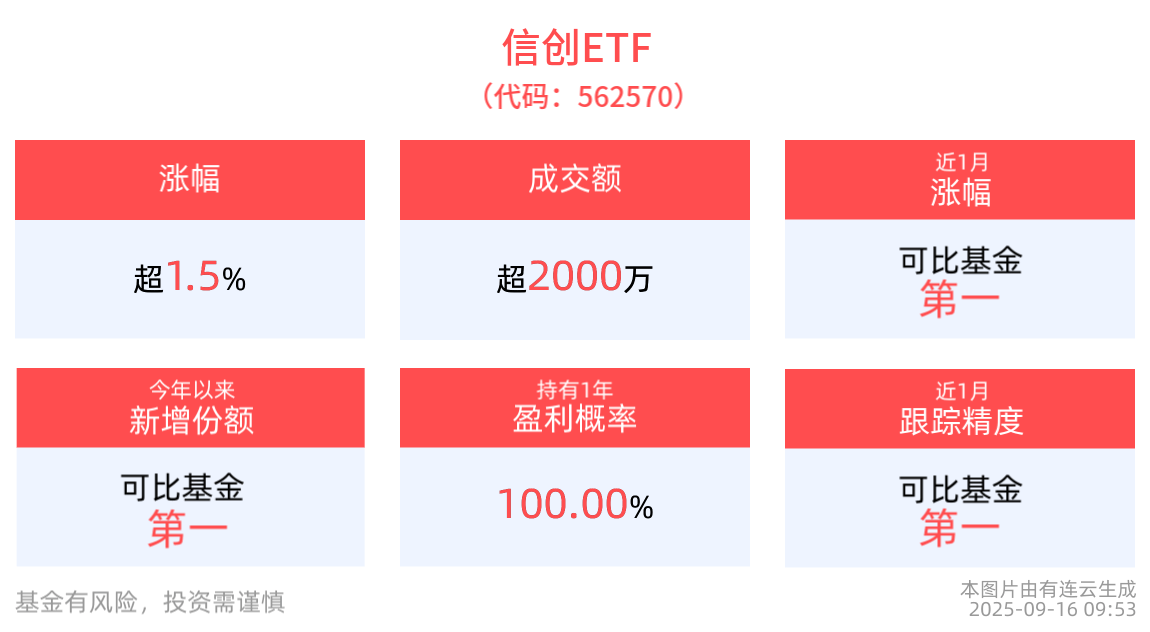
慧博云通净利降78%拟靠收购突围 关联方出手9.94亿投资化解标的风险
Chang Jiang Shang Bao· 2025-09-15 23:45
Core Viewpoint - The acquisition plan by Huibo Yuntong is seen as a strategic move to address its declining profits and enhance its business operations through the purchase of a significant stake in Baode Computer [1][2]. Group 1: Acquisition Details - Huibo Yuntong's affiliates and Zhejiang State-owned Assets Supervision and Administration Commission plan to jointly acquire 32.09% of Baode Computer's shares, with the company’s affiliate contributing 994 million yuan [1][3]. - The acquisition is based on an overall valuation of Baode Computer at 4.5 billion yuan, with the total investment from the affiliates amounting to approximately 1.444 billion yuan [3][4]. - The acquisition aims to resolve the financial issues of Baode Computer's major shareholder and reduce investment risks for Huibo Yuntong [1][6]. Group 2: Financial Performance - Huibo Yuntong's net profit has seen a significant decline, with a drop of over 20% expected in 2024 and a staggering 78% decrease in the first half of 2025, amounting to 5.6477 million yuan [1][9]. - Despite continuous revenue growth from 688 million yuan in 2020 to 1.743 billion yuan in 2024, the company's net profit has faced pressure, indicating a disconnect between revenue and profitability [9][10]. - Baode Computer, on the other hand, reported revenues exceeding 10 billion yuan in 2023 and 2024, with net profits of 201 million yuan and 235 million yuan respectively, showcasing its strong financial health [10]. Group 3: Strategic Implications - The acquisition is viewed as a critical step for Huibo Yuntong to transition from software services to a more integrated hardware-software business model, thereby expanding its operational scope and improving its industry positioning [10][11]. - The involvement of affiliates in the acquisition is seen as a strategy to mitigate risks associated with the investment in Baode Computer, which has been identified as having certain operational flaws [6][8].
恒生电子_业绩后集团电话会议要点
2025-09-15 13:17
Summary of Hundsun (600570.SS) Post-Result Group Call Company Overview - **Company**: Hundsun Technology Co., Ltd. (600570.SS) - **Industry**: B2B Software, specifically focused on financial technology solutions Key Takeaways 1. **Improvement in Client IT Budgets**: Management noted an improvement in client IT budget execution rates since September 2024 for previous-year budgets and July 2025 for current-year budgets, although a time lag exists before this translates into recognized revenue [1][9] 2. **Acceleration of Xinchuang Projects**: Expected acceleration in contract signings and live deployments of next-generation core systems (UF3.0 and O45) over the next 1-2 years, driven by improved capital markets and regulatory pushes [1][9] 3. **Gross Margin Improvement**: Anticipated improvement in gross margin due to the maturity of new products and enhanced project implementation capabilities [1][9] 4. **Hong Kong Subsidiary Success**: Hundsun Ayers has successfully delivered a virtual asset trading system for Guotai Junan International, positioning itself to serve other Chinese financial institutions in Hong Kong's regulated virtual asset market [1][11] 5. **Shareholder Return Policy**: The company aims to maintain a total shareholder return ratio of approximately 30% [1][17] Financial Performance Highlights 1. **Revenue Decline**: Revenue decreased by 14.4% YoY in 1H25, attributed to macroeconomic headwinds, competitive pressures, and strategic realignment [5][6] 2. **Cost Discipline**: Total operating costs fell by 13.8% YoY, with significant reductions in selling expenses (-26% YoY) and G&A expenses (-21% YoY) [5][6] 3. **Net Profit Surge**: Attributable net profit increased by 772% YoY, largely due to a low base effect from 1H24, with net profit excluding non-recurring items up by 42% YoY [6][9] Business Line Performance 1. **Retail IT Revenue**: Declined modestly by 3.1% YoY, benefiting from a stock market rebound post-September 2024 [9][10] 2. **Asset Management IT Revenue**: Contracted sharply by 32.4% YoY due to revenue pressures from industry-wide fee reductions and a transition to the O45 platform [10] 3. **Operational and Institutional IT Revenue**: Down 7.2% YoY, but supported by policy tailwinds [12] 4. **Data Services Growth**: Gildata subsidiary recorded 2.1% YoY revenue growth, benefiting from AI adoption [12] Next-Generation Product Progress 1. **UF 3.0**: Live at multiple brokers with over 10 clients signed and more in negotiation [12] 2. **O45**: 120 clients signed contracts, with 70 in the trust and banking sectors already live [12] 3. **Hundsun Ayers**: Covers approximately 250 of the 500 brokers in Hong Kong, generating significant revenue with a subscription-based model [12] Strategic Focus and Market Dynamics 1. **Shift in Strategy**: Management is focusing on quality of revenue rather than top-line scale, emphasizing net profit and cash flow [9][17] 2. **Competitive Landscape**: The company expects a stable competitive environment, with potential market consolidation benefiting established players like Hundsun [9][17] 3. **Impact of Brokerage M&A**: Short-term consolidation may reduce client firms but create opportunities for system integration projects [17] Valuation and Risks - **Price Target**: Buy rating with a 12-month price target of Rmb 38.99, representing a 13.1% upside from the current price [15] - **Downside Risks**: Include potential shortfalls in capital market recovery, client IT spending, and gross profit margin declines [15][17]
2025年A股中报业绩分析及行业景气展望:实体盈利缓增,新质亮点突出
Ping An Securities· 2025-09-15 07:32
Overall Performance - A-share listed companies reported a 2.4% year-on-year profit growth in Q2 2025, with market sentiment remaining optimistic[4] - The cumulative net profit growth rates for all A-shares and non-financial A-shares were 2.4% and 1.0%, respectively, showing a decline of 1.2 percentage points and 3.5 percentage points compared to Q1 2025[9] - Non-financial A-shares' overseas business revenue grew by 3.9%, contributing 15.3% to total revenue[9] Sector Analysis - The Sci-Tech Innovation Board showed a significant profit recovery with a net profit growth rate of 38.0% in Q2 2025, contrasting with a decline of 14.3% in the same period for the ChiNext Board[12] - Large-cap stocks demonstrated relative resilience, with the cumulative net profit growth rates for the CSI 500, CSI 800, and CSI 300 at 6.9%, 2.8%, and 2.4%, respectively[12] - AI technology continues to lead high prosperity, with the TMT sector maintaining strong growth, particularly in AI computing hardware[15] Consumer Trends - High-end new energy vehicles and innovative pharmaceuticals showed improved market conditions, with the automotive sector experiencing unexpected domestic sales growth[4] - The food and beverage sector saw a mixed performance, with liquor industry profits stabilizing while beverage and snack segments remained high in demand[4] Market Outlook - The equity market is expected to continue high-level fluctuations, with recommendations to focus on sectors with upward trends in industrial prosperity and superior performance[4] - Key sectors to watch include technology growth (AI, semiconductors, innovative pharmaceuticals), advanced manufacturing (new energy, automotive), and traditional cyclical sectors benefiting from price increases[4] Risk Factors - Potential risks include macroeconomic fluctuations, lower-than-expected profit growth for listed companies, and unexpected disturbances from overseas policies and geopolitical tensions[4]
盘中震荡,金融科技ETF华夏(516100)跌0.13%
Xin Lang Cai Jing· 2025-09-15 06:55
Core Insights - The three major indices collectively declined on September 15, with the fintech and brokerage sectors experiencing downward pressure [3] - The Huaxia Fintech ETF (516100) saw a slight decrease of 0.13% as of 14:30, with mixed performance among its holdings [3] - Over the past year, the Huaxia Fintech ETF has achieved a net value increase of 149.83%, ranking first among comparable funds [3] Fintech ETF Performance - The Huaxia Fintech ETF closely tracks the CSI Fintech Theme Index, with the top ten weighted stocks accounting for 54.08% of the index [3] - The top ten stocks in the index include Tonghuashun, Dongfang Caifu, and Hengsheng Electronics, with respective weightings of 9.23%, 8.50%, and 7.31% [5] - The ETF's performance is reflected in the mixed results of its holdings, with some stocks like Ronglian Technology hitting the daily limit while others like Donghua Software and Zhongke Jincai faced declines [3][5]
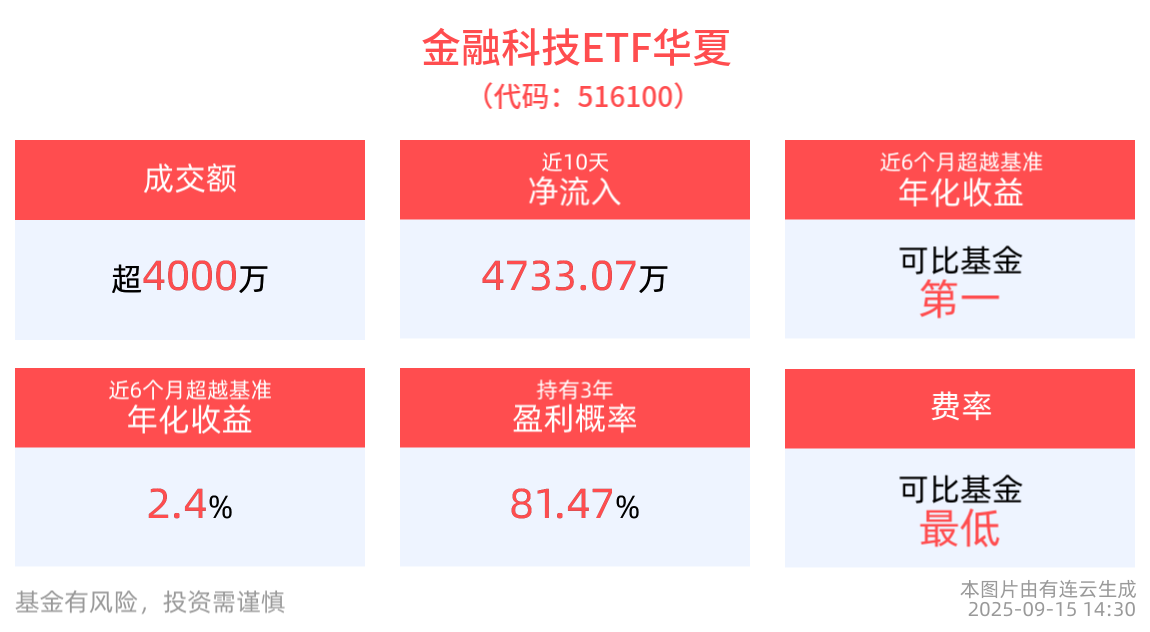
国内AI行情休整后重新演绎,软件ETF(159852)红盘蓄势,近3月新增规模同类居首!
Xin Lang Cai Jing· 2025-09-15 03:20
Group 1 - The software ETF has a turnover rate of 6.9% and a transaction volume of 340 million yuan, with an average daily transaction volume of 572 million yuan over the past month, ranking first among comparable funds [3] - The latest scale of the software ETF reached 4.897 billion yuan, also ranking first among comparable funds, with a significant increase of 1.499 billion shares over the past three months [3] - The net value of the software ETF has increased by 20.89% over the past three years, with the highest monthly return since inception being 39.35% and an average monthly return of 10.06% [3] Group 2 - Dongwu Securities suggests that in the current market environment, hot money is likely to flow towards sectors with undeniable industrial trends, recommending investments in storage, AIDC supporting facilities, and AI applications [4] - As of August 29, 2025, the top ten weighted stocks in the CSI Software Service Index include iFlytek, Tonghuashun, and Kingsoft Office, accounting for a total of 62.05% of the index [4] Group 3 - The table lists the stock codes, names, price changes, and weights of the top ten stocks in the software sector, with iFlytek having the highest weight at 13.93% [6] - Investors can also access AI software investment opportunities through the software ETF linked fund (012620) [6]
人工智能洞察:金融企业如何运用人工智能-Global Financials AI Insights_ How are Financial Companies Using AI_
2025-09-15 01:49
Summary of Key Points from the Conference Call Industry Overview - The conference call focuses on the **Financial Services** industry, particularly the impact of **Artificial Intelligence (AI)** on various sectors including banking, insurance, payment processing, asset management, and real estate [2][3][4][25]. Core Insights and Arguments 1. **AI Adoption Trends**: There is a notable increase in discussions about AI in financial earnings calls, with approximately **11%** of all financial earnings calls in Q1 2025 mentioning AI, marking a significant rise since early 2023 [11][12]. 2. **Cost Savings and Efficiency**: Analysts are optimistic about AI's potential to drive material expense savings and operational efficiencies across financial sectors. Early applications include improved chatbots, credit quality monitoring, and claims processing [3][4][25]. 3. **Generative AI Impact**: Generative AI is expected to transform the fintech landscape through personalized consumer experiences, cost-efficient operations, better compliance, dynamic forecasting, and enhanced customer interactions [4][5]. 4. **Investment in AI**: Larger, established firms are better positioned to capitalize on AI due to their scale and investment capacity. They are expected to invest significantly in technology to enhance operational leverage [5][20]. 5. **Sector-Specific Use Cases**: - **Banking**: AI is used for data analytics, customer experience enhancement, fraud detection, and risk management [27]. - **Insurance**: AI assists in claims processing, underwriting, and product development [3][30]. - **Payment Processors**: AI is utilized for fraud detection, credit default prediction, and operational efficiency [28]. - **Real Estate**: AI enhances tenant experiences and operational efficiencies [31]. Additional Important Insights 1. **Venture Capital Trends**: AI/ML investments are growing within financials, with a notable increase in VC spending on AI technologies, despite overall flat or declining VC investments in the sector since 2H22 [12][20]. 2. **Challenges for Smaller Firms**: Smaller financial firms may struggle to keep pace with larger competitors in AI adoption due to limited resources and investment capabilities [5][33]. 3. **Impact on Employment**: While AI is expected to improve efficiency, there are indications of reduced headcount growth in certain areas, particularly in call centers and operational roles [33][25]. 4. **Specific Company Examples**: - **JPMorgan Chase** identified **450 AI use cases** with an estimated value of **$1 billion to $1.5 billion** in potential benefits [32]. - **Bank of America** reported that its AI tool, Erica, has handled over **2.7 billion client interactions**, significantly reducing call center demands [32]. - **Goldman Sachs** uses AI to enhance engineering capabilities and improve operational tasks [32]. Conclusion The financial services industry is undergoing a significant transformation driven by AI technologies. Established firms are leading the charge, leveraging AI for operational efficiencies, enhanced customer experiences, and competitive advantages. However, smaller firms may face challenges in keeping up with these advancements. The ongoing investment in AI and its applications across various sectors will likely shape the future landscape of financial services.
中国人工智能-竞争格局变化下顺畅的人工智能商业化-China Software_ AI series (6)_ Smooth AI monetisation with changes in competition
2025-09-15 01:49
Summary of Key Points from the Equity Research Report on China Software Equities Industry Overview - The report focuses on the **China Software Industry**, particularly in the context of **AI monetization** and competition dynamics within the sector [2][3]. Core Insights 1. **AI Monetization Stage**: - AI monetization is still in its early stages, with significant policy support leading SOEs to prioritize AI projects, particularly in finance, healthcare, and education [3][4]. - SMEs in the manufacturing sector show strong demand for cost control, benefiting software companies like Yonyou and Nancal, which are experiencing good order momentum [3][4]. - Consumer-oriented software companies are currently focused on user acquisition and loyalty rather than immediate monetization of AI functionalities [3][4]. 2. **Competition Landscape**: - Simpler AI applications face intense competition, leading to a decline in Average Selling Price (ASP) [4]. - Complicated software, such as ERP systems, is less likely to be replaced by AI due to the necessity of industry-specific knowledge, which AI cannot easily replicate [4]. 3. **Stock Recommendations**: - **Sangfor (Buy)**: Expected to benefit from AI-driven IT infrastructure upgrades, with a target price of RMB143.00, implying a 30% upside from the current price [5][13]. - **Yonyou (Buy)**: Notable for its rapid AI order ramp-up, with 1H25 AI orders reaching RMB320 million, approximately 9% of total revenue. Target price set at RMB22.00, indicating a 54% upside [5][13]. - **ThunderSoft (Buy)**: Positioned to benefit from strong software upgrade demand from AI IoT suppliers, with a target price of RMB90.00, suggesting a 25% upside [5][13]. - **Kingsoft Office (Buy)**: Unique position as the only office software vendor in China with a closed-loop system for AI, targeting a price of RMB353.00, reflecting a 20% upside [5][13]. Financial Metrics - **Yonyou**: 1H25 AI orders at RMB320 million, with expectations for further growth in 2H25 [5][9]. - **Sangfor**: Revenue CAGR of 15% from 2018-2024, with a projected revenue of RMB9.1 billion by 2026 [13]. - **Kingsoft Office**: Historical average PS multiple of 33x, with a projected revenue CAGR of 15% for 2024-2026 [13]. Additional Insights - The report highlights the importance of **on-device AI** products, such as AI glasses and toys, which are seeing robust demand [3]. - Companies like Arcsoft and ThunderSoft are noted for their strong order momentum in the AI hardware space [3][5]. - The report emphasizes the potential for AI to enhance existing software capabilities rather than completely replace them, particularly in complex applications [4]. Risks and Challenges - Key risks include fierce competition, weaker-than-expected business expansion due to macroeconomic challenges, and potential chip shortages impacting production [13]. This summary encapsulates the critical insights and financial metrics from the report, providing a comprehensive overview of the current state and future outlook of the China software industry, particularly in relation to AI monetization and competitive dynamics.

证券业核心“心脏”大升级!数字化必答题,谁拿了高分?
2 1 Shi Ji Jing Ji Bao Dao· 2025-09-13 06:10
Group 1 - The securities industry is undergoing a critical transformation, with business models upgrading and technology deeply integrating with operations [1] - Wealth management is shifting towards buyer advisory, institutional services are evolving from trading to comprehensive services, and asset management is focusing on proactive management capabilities [1][2] - The launch of UF3.0, a new core business system by Hengsheng Electronics, aims to address the limitations of traditional centralized systems and enhance flexibility and scalability [2][3] Group 2 - UF3.0 has been successfully implemented in multiple securities firms, with notable cases including Dongfang Securities and招商证券, which have transitioned to a customer value creation engine and completed a full-scale switch for millions of clients, respectively [3][4] - The system features a "stable + agile" dual architecture, ensuring risk-free operation while allowing for rapid iteration based on demand and innovation [3][4] - The application of AI technology is seen as a key driver for small and medium-sized securities firms to innovate in wealth management, enabling efficient client analysis and personalized service offerings [5][6][7] Group 3 - Different types of firms have distinct technology strategies, with leading firms focusing on ecosystem building and deep industry application, while smaller firms face challenges in technology investment [6] - Small and medium-sized firms are encouraged to focus on application and customer layers rather than blindly investing in foundational technology development [6][7] - The wealth management sector presents significant growth potential for smaller firms, especially with the integration of AI technology to streamline operations and reduce costs [7]