
中国太平

Search documents
“保险系”养老社区部分项目入住率超80%实现盈利 区位优势成关键
Di Yi Cai Jing· 2025-10-10 04:51
Core Insights - The elderly care industry in China is experiencing a dichotomy, with a national occupancy rate of only 45% while premium projects in urban centers face high demand, indicating a shift in focus from availability to profitability [1] - The consensus in the industry is that an occupancy rate above 60% is necessary for breakeven, as financial institutions are increasingly scrutinizing occupancy and profitability before providing funding [1] Group 1: Industry Statistics - As of the end of 2024, there are 40,000 registered elderly care institutions in China, with a total of 5.077 million beds, of which 65.7% are nursing beds, and 2.307 million people are residing in these facilities, resulting in an overall occupancy rate of 45.4% [1] - Some leading insurance companies have reported occupancy rates exceeding 80% in certain elderly care community projects, indicating a trend towards profitability [1] Group 2: Company Performance - Dajia Insurance's first urban elderly care community in Shanghai has achieved over 80% bed reservation rate since its opening in late September, with an average occupancy rate of 80% across its 16 urban communities nationwide [2] - The project in Beijing's Chaoyang District has reached a remarkable occupancy rate of 95%, leading to profitability in 2023 [2] - Similarly, projects by Taikang Insurance in Shanghai have also achieved profitability ahead of expectations due to rising occupancy rates [2] Group 3: Investment Strategies - Insurance companies are adopting a mixed strategy of "heavy and light assets" to secure scarce urban land along subway lines, focusing on location to drive traffic and financing [2] - Future investments will prioritize projects with verifiable profitability data and scalable expansion models, while exploring REITs as exit channels to create a closed loop of "investment-operation-exit" [2] Group 4: REITs Development - The first batch of insurance-funded elderly care REITs is still in the pilot preparation stage, with expectations for normalization of issuance by July 2024, including elderly care facilities in the infrastructure REITs category [3] - The industry is expected to transition from rapid expansion to refined operations, with a projected silver economy scale reaching 20 trillion yuan in five to ten years [3]
“保险系”养老社区部分项目入住率超80%实现盈利,区位优势成关键
Di Yi Cai Jing· 2025-10-10 04:35
Core Insights - The industry is shifting focus from "availability" to "profitability" as the occupancy rate of nursing homes nationwide is only 45%, while high-quality projects in urban centers face high demand with "one bed hard to find" [1] - The consensus in the industry is that an occupancy rate above 60% is necessary for breakeven, as financial institutions are increasingly scrutinizing occupancy and profitability before providing funding [1] Group 1: Industry Overview - As of the end of 2024, there are 40,000 registered nursing institutions in China with 5.077 million beds, of which 65.7% are nursing beds, and 2.307 million people are residing in these institutions, resulting in an overall occupancy rate of 45.4% [1] - Some leading insurance companies have nursing community projects with occupancy rates exceeding 80%, indicating they have entered a profitable phase [1] Group 2: Company Developments - Dajia Insurance's first urban nursing community in Shanghai has an occupancy rate exceeding 80% since its opening in late September, with an average occupancy rate of 80% across its 16 urban communities nationwide [2] - The project in Beijing's Chaoyang District has achieved a remarkable occupancy rate of 95%, leading to profitability in 2023 [2] - Other insurance companies like Taikang Insurance and China Pacific Insurance have also reported early profitability in their Shanghai nursing community projects due to rising occupancy rates [2] Group 3: Investment Strategies - Insurance companies are adopting a "dual strategy" of both heavy and light asset models to secure scarce urban land along subway lines, focusing on location to drive traffic and financing [2] - Future investments will prioritize projects with verifiable profitability data and scalable expansion models, while exploring REITs as exit channels to create a closed loop of "investment-operation-exit" [2] Group 4: Market Trends - The first batch of insurance REITs for nursing facilities is still in the pilot preparation stage, with expectations for normalization of issuance by July 2024 [3] - The silver economy is projected to reach 20 trillion yuan in scale within five to ten years, prompting a shift from land-grabbing to refined operations in the industry [3] - Companies with stable cash flow models and regional resource integration capabilities are expected to emerge as winners in the upcoming industry reshuffle [3]

中金公司-A股和港股行业首选:2025年10月
中金· 2025-10-09 14:47
Investment Rating - The report includes a selection of 81 A-shares and 56 overseas Chinese stocks, indicating a positive investment outlook for these sectors [2]. Core Insights - The report highlights the addition of Yutong Technology (裕同科技) to the A-share selection due to favorable short-term operational prospects, while Oppein Home (欧派家居) has been removed due to short-term performance pressures [2][4]. - For overseas Chinese stocks, China Taiping (中国太平) has been added, reflecting its successful early transformation in dividend insurance and low valuation, which is expected to yield alpha returns [4][6]. Summary by Sections A-Shares - Newly added stock: Yutong Technology (裕同科技), stock code: 002831.SZ, recommended for its short-term operational improvement [4]. - Removed stock: Oppein Home (欧派家居), stock code: 603833.SH, due to short-term performance pressures [5]. Overseas Chinese Stocks - Newly added stock: China Taiping (中国太平), stock code: 0966.HK, noted for its early completion of dividend insurance transformation and low asset base expected to drive future growth [4][6].



经纪、利息、自营等收入持续受益,建议关注三季报行情
SINOLINK SECURITIES· 2025-10-08 14:51
Investment Rating - The report suggests a focus on three main lines of investment opportunities in the securities and insurance sectors, indicating a positive outlook for the industry [2][4]. Core Insights - The securities sector has seen a significant increase in daily trading volume, with a year-on-year growth of 117% as of Q3 2025, indicating strong market activity [1]. - The margin financing balance reached a record high of 24,287 billion yuan, with a year-on-year increase of 29.9%, suggesting robust investor engagement [1]. - The report anticipates strong performance in brokerage, interest, and proprietary trading revenues, with positive earnings expected in the third quarter [1]. - In the insurance sector, the recent regulatory guidance is expected to accelerate the development of health insurance, particularly in commercial medical insurance, which is projected to be a core growth area [3][4]. - The report highlights the potential for significant growth in diversified financial services, particularly for Hong Kong Exchanges, benefiting from deepening connectivity and increased trading activity [2]. Summary by Sections Securities Sector - Daily average stock trading volume reached 1 trillion yuan, up 117% year-on-year [1]. - The Shanghai Composite Index rose by 12.7% in Q3 2025, while the CSI 300 Index increased by 17.9% [1]. - The report recommends focusing on brokerage firms with high trading and margin financing ratios, particularly those with low valuations [2]. Insurance Sector - The health insurance market is expected to grow rapidly, driven by new regulatory support for commercial medical insurance [3]. - The report emphasizes the importance of specialized health insurance companies and the potential for positive earnings growth in Q3 2025 [4]. - Key recommendations include focusing on leading life insurance companies with strong business quality and low liability costs [4]. Market Dynamics - The report notes that the insurance trust market has surpassed 300 billion yuan, with a significant share held by major players like Ping An [38]. - The classification results for securities firms indicate a stable distribution of A, B, and C-rated companies, reflecting a healthy competitive landscape [39].
曾长期任职最高检,那艳芳履新中国太平
Xin Jing Bao· 2025-10-04 14:54
Group 1 - China Pacific Insurance Holdings Co., Ltd. announced the appointment of Na Yanfang as an executive director and member of the nomination and remuneration committee, risk management committee, and strategic and investment committee [1] - Na Yanfang currently serves as an executive director of China Pacific Insurance Group Co., Ltd. and China Pacific Insurance Group (Hong Kong) Co., Ltd. [1] Group 2 - Na Yanfang, born in June 1973, is a member of the Communist Party of China with a doctoral degree [3] - She has a long tenure at the Supreme People's Procuratorate, having held positions such as deputy secretary of the party committee, director of the Ninth Procuratorial Division, and director of the Tenth Procuratorial Division [3] - China Pacific Insurance Group Co., Ltd. was founded in 1929 in Shanghai and is recognized as the longest-operating national insurance brand in China [3] - China Pacific Insurance Holdings Co., Ltd. was registered in February 2000 under Hong Kong company regulations and is headquartered in Hong Kong as a financial holding company [3]


曾长期任职最高检,那艳芳履新
Xin Hua Ri Bao· 2025-10-04 04:19
Group 1 - China Pacific Insurance Holdings Co., Ltd. has appointed Na Yanfang as an executive director and a member of the nomination and remuneration committee, risk management committee, and strategic and investment committee [1] - Na Yanfang currently serves as an executive director at China Pacific Insurance Group Co., Ltd. and China Pacific Insurance Group (Hong Kong) Co., Ltd. [1] Group 2 - Na Yanfang, born in June 1973, is a member of the Communist Party of China with a doctoral degree and has a long career at the Supreme People's Procuratorate [3] - She has held various positions including Deputy Secretary of the Party Committee, Director of the Ninth Procuratorial Division, Director of the Tenth Procuratorial Division, and Senior Procurator [3] - China Pacific Insurance Group, established in 1929 in Shanghai, is the oldest continuously operating national insurance brand in China and the only centrally managed financial enterprise headquartered overseas [3]

那艳芳任中国太平执行董事,此前曾长期任职最高检
Guan Cha Zhe Wang· 2025-10-04 04:19
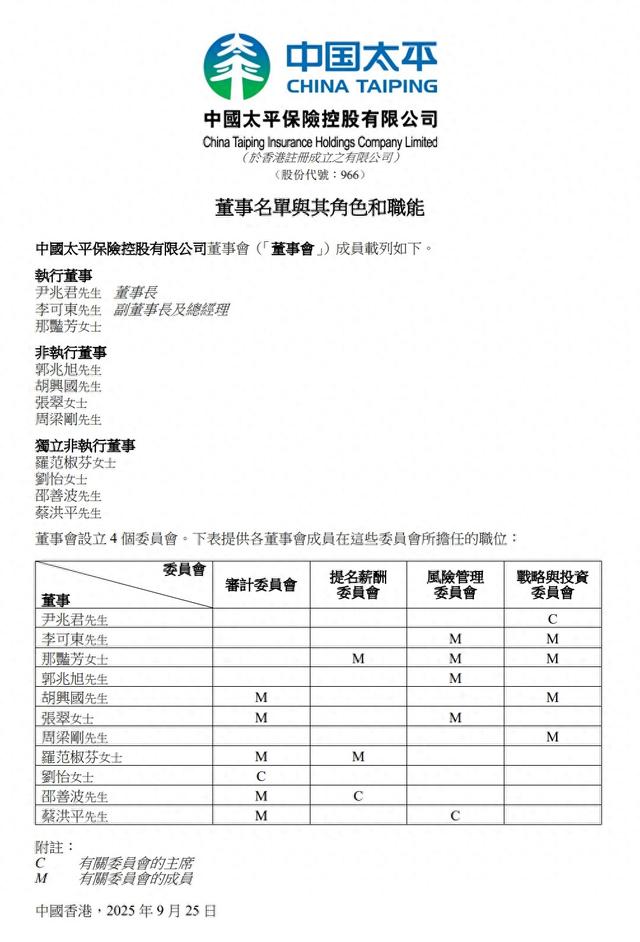
Group 1 - China Taiping Insurance Holdings Company Limited has announced that Na Yanfang has become an executive director and a member of the nomination and remuneration committee, risk management committee, and strategy and investment committee [1][6] - Na Yanfang also serves as an executive director of China Taiping Insurance Group Co., Ltd. and China Taiping Insurance Group (Hong Kong) Co., Ltd. [1] - The board of directors of China Taiping includes various members with specific roles in different committees, highlighting the governance structure of the company [4][6] Group 2 - Na Yanfang has a long career in the Supreme People's Procuratorate, holding positions such as deputy secretary of the party committee and head of the Ninth and Tenth Procuratorial Divisions [6] - China Taiping was founded in 1929 in Shanghai and is recognized as the longest-operating national insurance brand in China, with its headquarters currently in Hong Kong [6] - The company was registered in February 2000 under Hong Kong company regulations and was listed on the Hong Kong Stock Exchange in June 2000, making it the first overseas-listed financial holding platform under China Taiping Insurance Group [6]
人保、太平,两家险资巨头出手了!
Zhong Guo Ji Jin Bao· 2025-10-03 06:16
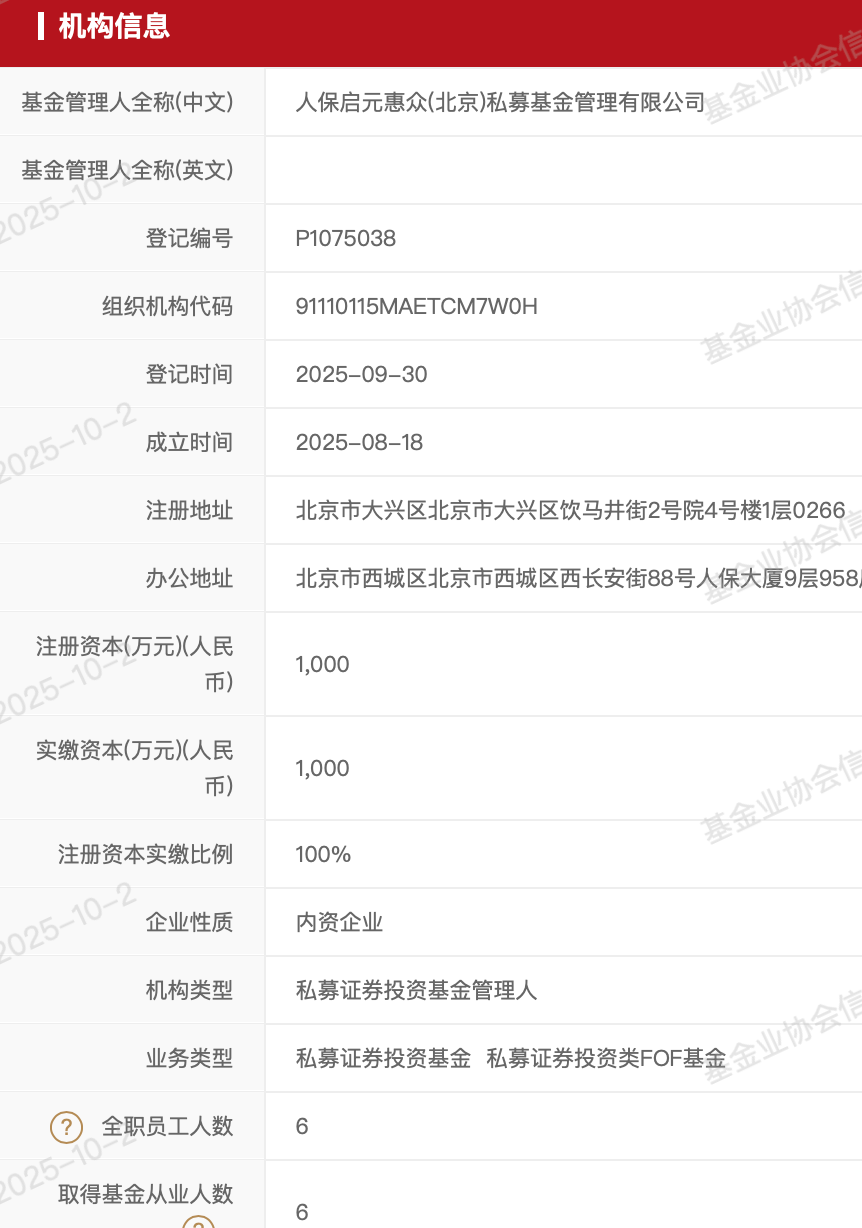
Core Insights - Two insurance-related private equity funds, Renbao Qiyuan Huizhong and Taiping Private Equity, have completed their registration as private fund managers, indicating a significant development in the long-term stock investment pilot program for insurance capital in China [1][9]. Group 1: Renbao Qiyuan Huizhong - Renbao Qiyuan Huizhong (Beijing) Private Fund Management Co., Ltd. was established on August 18, 2025, and completed its registration on September 30, 2025, with a registered capital of 10 million yuan [3][4]. - The company is fully owned by China Renbao Asset Management Co., Ltd., which has been approved to participate in the second batch of long-term stock investment pilots with a scale of 10 billion yuan [5]. - The management team includes Mai Jing, the legal representative and general manager, who has extensive experience in investment management [6][7]. Group 2: Taiping Private Equity - Taiping (Shenzhen) Private Securities Investment Fund Management Co., Ltd. was established on August 29, 2025, and completed its registration on September 29, 2025, also with a registered capital of 10 million yuan [10][11]. - The company is fully owned by Taiping Asset Management Co., Ltd., which aims to respond to the long-term investment reform pilot for insurance capital [12]. - The management team is led by Liu Yang, who has held various senior positions within Taiping Asset Management [12][13]. Group 3: Industry Context - The long-term investment pilot program for insurance capital has seen three batches, with a total approved investment amount of 222 billion yuan, involving several major insurance companies [17]. - The initiative aims to gradually expand the range of participating institutions and the scale of funds, promoting the entry of long-term capital into the stock market [16][17].
中国太平(00966) - 截至2025年9月30日止月份之月报表
2025-10-02 08:31
股份發行人及根據《上市規則》第十九B章上市的香港預託證券發行人的證券變動月報表 | 截至月份: | 2025年9月30日 | 狀態: | 新提交 | | --- | --- | --- | --- | | 致:香港交易及結算所有限公司 | | | | | 公司名稱: | 中國太平保險控股有限公司 | | | | 呈交日期: | 2025年10月2日 | | | | I. 法定/註冊股本變動 不適用 | | | | | 備註: | | | | | 由於本公司是於香港註冊成立的公司,因此「法定/註冊股本」之概念並不適用於本公司。 | | | | FF301 第 1 頁 共 10 頁 v 1.1.1 FF301 II. 已發行股份及/或庫存股份變動 | 1. 股份分類 | 普通股 | 股份類別 | 不適用 | | 於香港聯交所上市 (註1) | 是 | | | --- | --- | --- | --- | --- | --- | --- | --- | | 證券代號 (如上市) | 00966 | 說明 | | | | | | | | | 已發行股份(不包括庫存股份)數目 | | 庫存股份數目 | | 已發行股份 ...
国信证券(香港)资讯日报-20250930
Guoxin Securities Hongkong· 2025-09-30 05:47
Market Overview - The Hang Seng Index closed at 26,623, up 1.89% for the day and 32.72% year-to-date[3] - The Hang Seng Tech Index rose 2.08% to 6,324, with a year-to-date increase of 41.54%[3] - The Shanghai Composite Index increased by 0.90% to 3,863, with a year-to-date gain of 15.24%[3] Sector Performance - Major technology stocks rebounded, with Alibaba and Kuaishou rising over 4%, and JD.com increasing over 3%[9] - Financial stocks surged, with Huatai Securities and GF Securities up over 12%, and CITIC Securities up over 11%[9] - Gold stocks collectively rose, with Zhaojin Mining and Tongguan Gold increasing over 6%[9] Economic Indicators - The People's Bank of China emphasized the implementation of a moderately loose monetary policy, encouraging financial institutions to increase credit[9] - Gold prices reached a new high, surpassing $3,810, driven by central bank demand and expectations of interest rate cuts from the Federal Reserve[9] U.S. Market Insights - U.S. major indices collectively rose, but concerns over tariffs and potential government shutdown limited gains[9] - The Nasdaq China Golden Dragon Index increased by 2.03%, with notable gains in Chinese concept stocks like Pinduoduo and Bilibili[9] Japanese Market Trends - The Nikkei 225 index fell 0.7%, continuing a decline from last week's record high, influenced by ex-dividend factors and a stronger yen[10] - Sony Financial surged 16% following its spin-off from Sony Group, while Toyota saw a decline of 3.35% despite an increase in global sales[10]