
轻工制造

Search documents
大消费行业周报:建议关注各细分赛道业绩表现-20260330
Ping An Securities· 2026-03-30 06:08
Investment Rating - The industry investment rating is "stronger than the market," indicating an expected performance exceeding the market by more than 5% within the next six months [22]. Core Insights - The report highlights that the consumer sector has shown volatility, with most sub-sectors underperforming compared to the broader market. It suggests focusing on the performance of various segments during the earnings season [3][4]. - The tourism sector is expected to continue its recovery, with leading companies responding effectively to changing consumer demands. The report recommends monitoring top companies in this space [3]. - The beauty industry is experiencing steady growth, with a focus on companies that can quickly adapt to market dynamics and integrate products, brands, and channels [3]. - In the jewelry and accessories sector, there are investment opportunities in brands with potential market share growth and improving operational performance [3]. - The food and beverage sector shows promise, particularly in home dining and dairy products, with companies like Guoquan and leading dairy firms entering a recovery phase [3]. - The report indicates that the darkest period for the liquor industry has passed, with expectations for continued recovery in 2026, particularly for high-end and mid-range liquor brands [3]. Summary by Relevant Sections Social Services - The tourism sector is recovering, with leading companies providing quality products and responding to consumer changes. The travel retail sector is stabilizing, supported by policies that may boost sales [3]. - The beauty industry is evolving, with a recommendation to track companies that can quickly adapt to market changes [3]. Jewelry and Accessories - Investment opportunities are present in the gold and jewelry sector, focusing on brands with potential for market share growth and improving performance [3]. Food and Beverage - Mass Market - The home dining market, represented by Guoquan, has significant growth potential, with a focus on product, channel, and supply chain integration [3]. - The dairy supply-demand relationship is improving, with leading companies entering a profit recovery phase [3]. - The restaurant supply chain is stabilizing, with sectors like condiments and frozen foods emerging from a downturn [3]. Food and Beverage - Alcohol - The report suggests that the worst period for the liquor industry is over, with expectations for recovery in 2026. It highlights the potential for high-end and mid-range liquor brands to perform well [3].
消费-结构分化-寻求新增量
2026-03-30 05:15
Summary of Key Points from Conference Call Records Industry Overview - **Consumer Sector Recovery**: The consumer sector is showing a clear recovery path, particularly in service consumption (travel, dining) which is performing strongly. The demand for leading liquor brands like Moutai and Wuliangye has exceeded expectations, with industry pressure expected to ease starting Q2 2026, leading to a full recovery in sentiment by then [1][3][4]. - **Household Appliances and Liquor Leaders**: Major brands such as Midea and Gree are outperforming in terms of shipment volumes compared to smaller brands. Moutai and Wuliangye have shown significant sales growth, with Moutai's payment progress up 10 percentage points year-on-year [1][3][4]. - **Light Industry and New Consumption**: The two-wheeler sector is bottoming out due to the "oil-to-electric" transition. Companies in personal care and beauty, as well as leading firms in the real estate chain, are expected to see significant differences in performance [1][5][6]. - **Food and Beverage Focus**: The food and beverage sector is concentrating on high-growth areas such as the restaurant supply chain and health products, with companies like Anjuke and Yihai being core investment targets [1][10][11]. Key Insights and Arguments - **Investment Strategy for 2026**: The investment strategy should focus on two main lines: service consumption and leading enterprises, especially in the first half of the year. Leading companies typically show stronger resilience and recovery first, outperforming smaller brands [4][10]. - **Household Appliances Market Dynamics**: In the household appliance sector, leading brands are expected to benefit from subsidy policies favoring offline channels. The trend of concentration among leading brands is evident across various categories, including vacuum robots and small appliances [4][10]. - **Light Industry Investment Logic**: The light industry is seeing a focus on companies at the bottom of the market for domestic sales, while for exports, companies with quality production capacity are being targeted. Specific recommendations include companies like Jeya and Nobon for non-woven fabric [5][6]. Additional Important Content - **Eli Lilly's GLP-1 Drug Developments**: Eli Lilly's oral GLP-1 drug is expected to receive FDA approval in April 2026, showing superior efficacy compared to competitors and a strong supply chain demand. The drug's production involves complex synthesis and is expected to benefit companies capable of supplying raw materials [11][12][13]. - **Swine Breeding Sector Challenges**: The swine breeding sector is currently facing significant challenges, with prices for pigs and piglets dropping below cost lines, leading to deep losses across the industry. This situation is seen as an opportunity for left-side layout investments, particularly in leading cost-efficient companies like Muyuan and Wens [2][14][15][16]. Conclusion - The consumer sector is poised for recovery, with specific focus areas in service consumption and leading brands across various industries. Investment strategies should prioritize resilience and growth potential in leading companies, while also considering emerging opportunities in sectors like light industry and pharmaceuticals. The swine breeding sector presents a unique investment opportunity despite current challenges, emphasizing the importance of cost management and competitive advantage.



资金行为研究双周报:杠杆资金多头聚焦公用事业等红利防御板块-20260327
ZHONGTAI SECURITIES· 2026-03-27 05:44
Market Overview - The market shows structural differentiation in capital flow, with large orders' outflow momentum narrowing. Institutional funds exhibit a net outflow from the Wande All A and Sci-Tech Innovation indices, but the outflow momentum has significantly decreased. The ChiNext index shows fluctuating capital flows, indicating a competitive dynamic among institutional funds [2][6][25] - Retail investors maintain a consistent trend, showing a slow net inflow into the Wande All A and ChiNext indices, while remaining cautious towards the Sci-Tech Innovation index [6][25] Capital Flow by Market Capitalization and Valuation Style - Large-cap stocks demonstrate strong support, while small-cap stocks exhibit heightened sensitivity to market fluctuations. Institutional funds have reduced net outflows from high-valuation indices, indicating a shift in market dynamics [17][25] - The recent volatility in the CSI 300 reflects strong market support and pricing power among large-cap stocks, while small-cap stocks are more susceptible to liquidity fluctuations [17][25] Capital Flow by Major Industry Style - Institutional funds are cautiously returning to cyclical manufacturing and consumption sectors, with a notable shift from outflows to inflows in these categories as of March 23. Retail investors continue to heavily invest in cyclical manufacturing [25][62] - The dividend sector shows less volatility, indicating strong stability in this segment during turbulent market conditions [25] Capital Flow by Primary Industry Upstream Resources - Institutional outflows from non-ferrous metals have narrowed, while basic chemicals show a similar trend of reduced outflow. Retail investors are actively accumulating in the non-ferrous metals sector, with their capital scale surpassing other industries [37][40] Midstream Materials & Manufacturing - The electric equipment sector maintains high competitive intensity, with institutional buying power in construction materials showing a temporary increase. Institutional funds have reduced outflows in electric equipment significantly since March 19 [40][62] Downstream Essential Consumption - Institutional funds have not shown significant buying momentum in essential consumption sectors, although the outflow trend has slowed down recently. Notably, there has been substantial outflow from pharmaceuticals and agriculture sectors [47][62] Downstream Discretionary Consumption - In discretionary consumption, institutional funds are showing a fluctuating inflow in light industry manufacturing, while the home appliance sector has shifted from net inflow to net outflow, with recent outflows narrowing [52][62] TMT (Technology, Media, and Telecommunications) - The TMT sector shows slight net inflows in communications, while electronics experience oscillating outflows. The sector is primarily driven by small retail investments [55][62] Large Financials - Institutional interest in non-bank financials has decreased significantly, with retail investors increasing their net inflows in this sector since March 19 [62][68] Support Services - The public utility sector shows significant volatility in institutional capital flow, alternating between net inflows and outflows, highlighting a competitive market dynamic [71][62] Leverage Capital Overview - The margin financing balance has slightly decreased, with the average collateral ratio lowering, indicating that leverage risks remain manageable. As of March 25, the total margin financing and securities lending balance is approximately 2.62 trillion yuan [75][81] - The trading activity in margin financing has declined, with the proportion of margin trading transactions at 9.45%, reflecting a continued adjustment in market sentiment [77][81] - The overall leverage capital holding level has slightly adjusted, with significant declines observed in the oil and gas sector and construction materials, indicating a cooling off from previous highs [81]
挖到一只年化近8%的“画线派”稳健样本!|1分钟了解一只吾股好基(七十八)
市值风云· 2026-03-26 10:14
Core Viewpoint - The article highlights the performance of the Anxin New Value Mixed A fund (003026.OF), which has shown strong defensive capabilities in weak and volatile markets, achieving a nearly 8% annualized return since inception and a total return of 109% as of March 23, 2026, significantly outperforming the CSI 300 index, which rose by 31% during the same period [3][4]. Performance Summary - The fund has recorded positive returns in all years since its inception in August 2016, except for a slight loss in 2022, showcasing its resilience [4]. - Since taking over in August 2021, fund manager Liang Bingzhe has achieved an annualized return of 6.2% [5]. - The fund's annual performance compared to its benchmark and the CSI 300 index from 2021 to 2026 shows consistent outperformance, particularly in 2025 with a return of 10.56% against the CSI 300's 17.66% [6]. Risk Management - The fund's maximum drawdown since Liang Bingzhe's tenure is only -5.7%, indicating strong risk management capabilities [7]. - The fund employs a "fixed income plus" strategy, maintaining a stock allocation of less than 20%, which contributes to its defensive nature [10]. Asset Allocation - The fund's portfolio is characterized by a low concentration in its top holdings, with the top ten stocks accounting for only 7.9% of the net asset value, and the largest holding, China National Offshore Oil Corporation, representing just 1.63% [13]. - The fund focuses on undervalued, high-dividend, and defensive assets, aligning with its stable bond base [13]. Market Position - Despite its conservative approach, the fund ranks 1621st in the market, indicating a stable position among peers [16]. - The fund's ability to provide a smooth upward curve in net value has made it a sought-after option for investors looking for stability in volatile markets [18]. Growth in Popularity - The fund's assets grew from 0.64 billion yuan at the end of 2024 to 10.24 billion yuan by the end of 2025, primarily driven by individual investors [20]. Conclusion - Anxin New Value A is positioned as a robust investment option for those seeking stability and minimal drawdowns, making it a valuable addition for investors looking for a "ballast" in their asset allocation [21].


市场分析:有色电力行业领涨,A股震荡上行
Zhongyuan Securities· 2026-03-24 11:25
Investment Rating - The industry is rated as "outperforming the market," indicating an expected increase of over 10% in the industry index relative to the CSI 300 index over the next six months [14]. Core Insights - The A-share market experienced a rebound after an initial decline, with significant support at 3807 points for the Shanghai Composite Index, which closed at 3881.28 points, up 1.78% [3][7]. - Key sectors showing strong performance include non-ferrous metals, communication equipment, electricity, and power grid equipment, while sectors like rare earths, insurance, oil and petrochemicals, and coal showed weaker performance [3][7]. - The average price-to-earnings ratios for the Shanghai Composite and ChiNext indices are 15.79 times and 45.41 times, respectively, indicating a favorable environment for medium to long-term investments [3][13]. - The total trading volume for both markets was 20,962 billion, above the median of the past three years, suggesting robust market activity [3][13]. Summary by Sections A-share Market Overview - On March 24, the A-share market showed a pattern of initial decline followed by recovery, with the Shanghai Composite Index gaining support around 3807 points and ultimately closing at 3881.28 points [7]. - The trading day saw over 90% of stocks rising, with notable gains in sectors such as ground equipment, electricity, trade, environmental protection, and medical services [7]. Future Market Outlook and Investment Recommendations - The market is expected to maintain a volatile consolidation phase, with a focus on macroeconomic data, overseas liquidity changes, and policy developments [3][13]. - Short-term investment opportunities are recommended in sectors such as non-ferrous metals, electricity, communication equipment, and power grid equipment [3][13].

渤海证券研究所晨会纪要(2026.03.24)-20260324
BOHAI SECURITIES· 2026-03-24 01:06
Group 1: Fund Research - The equity market indices mostly declined, with the largest drop in the CSI 500, which fell by 5.82% during the week from March 16 to March 20, 2026 [2] - Ant Fund's equity holdings surpassed 1 trillion yuan for the first time, indicating significant growth in public fund assets [2] - A new batch of 15 hard technology-themed funds was approved, reflecting a focus on innovative sectors [2] Group 2: Fund Performance - The average decline for equity funds was 3.30%, with only 8.73% showing positive returns; fixed income plus funds fell by 0.72% with a 14.90% positive return rate [3] - The average position of active equity funds was measured at 71.62%, a decrease of 5.95 percentage points from the previous period [3] - The ETF market experienced a net outflow of 4.05 billion yuan, with stock ETFs seeing the largest outflow of 8.803 billion yuan [3] Group 3: Industry Research - The soft drink industry in China is projected to reach a market size of 1.25 trillion yuan in 2024, accounting for approximately 12.70% of the global soft drink market [5] - The leading category in the domestic soft drink market is packaged drinking water, with a market share of 21.50%, followed by tea beverages [5] - The Tianjin soft drink industry produced 3.3021 million tons in 2025, representing only 1.84% of the national total, but benefits from strong industrial foundations and strategic location [6] Group 4: Brand Development - The revival of the Beijing Beibingyang brand offers valuable lessons for Shanhaiguan, emphasizing brand heritage, product innovation, and diversified channel development [6] - The consumer base is shifting towards younger generations, with health and self-indulgence becoming key demands, indicating a need for soft drink companies to adapt their product offerings [6] - Shanhaiguan Soda, a century-old local brand, aims to expand nationally while leveraging its strong local market presence [6]
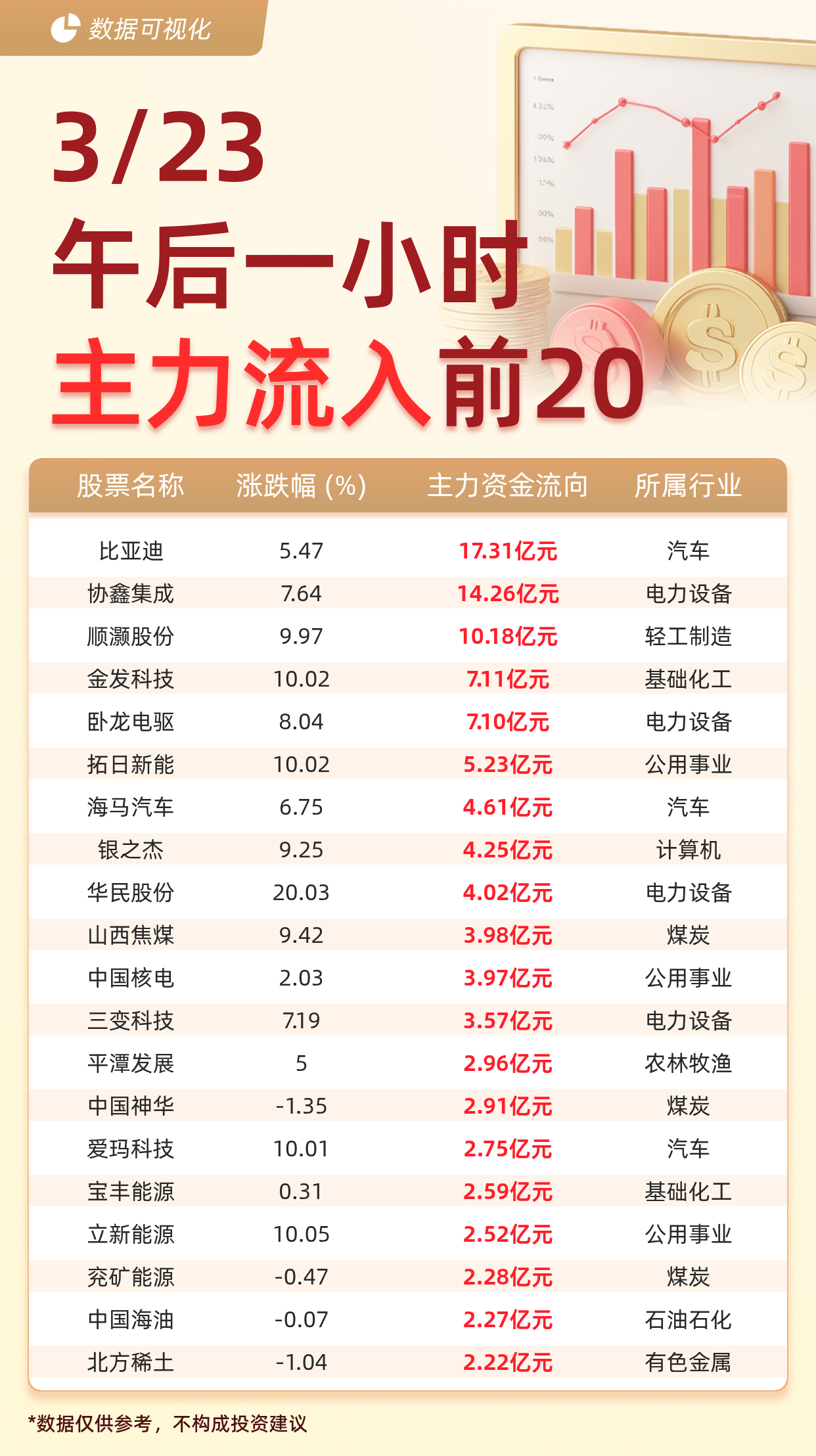
主力资金流入前20:比亚迪流入17.31亿元、协鑫集成流入14.26亿元
Jin Rong Jie· 2026-03-23 06:29
Core Insights - The main focus of the news is the significant inflow of capital into various stocks, highlighting the top 20 stocks by capital inflow as of March 23, with notable performances in sectors such as automotive, power equipment, and coal [1][2][3] Group 1: Stock Performance - BYD saw a capital inflow of 1.731 billion, with a price increase of 5.47% [2] - GCL-Poly Energy experienced a capital inflow of 1.426 billion, with a price increase of 7.64% [2] - Shunhao Co. reported a capital inflow of 1.018 billion, with a price increase of 9.97% [2] - Jinfat Technology had a capital inflow of 711 million, with a price increase of 10.02% [2] - Wolong Electric Drive received a capital inflow of 710 million, with a price increase of 8.04% [2] Group 2: Sector Analysis - The automotive sector, represented by BYD and Haima Automobile, showed strong capital inflows, indicating investor confidence [1][2] - The power equipment sector, including GCL-Poly Energy and Wolong Electric Drive, also attracted significant capital, reflecting growth potential [1][2] - The coal sector, represented by Shanxi Coal and China Shenhua, displayed mixed performance with varying capital inflows and stock price changes [1][3]




轻工零售美妆-供给提质-需求升级
2026-03-22 14:35
Summary of Key Points from the Conference Call Industry Overview - The conference call focuses on the light industry retail beauty sector, highlighting trends in supply quality improvement and demand upgrades for 2026 [1][2]. Core Trends and Arguments - **Demand Trends**: - Emotional consumption is on the rise, driven by Generation Z, with a focus on emotional value as a core variable [1][7]. - K-shaped differentiation in consumption patterns, where rational consumption coexists with high-end recovery [8][9]. - Functional products are becoming dominant, with 61% of consumers attracted to brands due to unique product features [9]. - Increased preference for domestic brands, with 70% of consumers choosing them based on product strength rather than price [9][10]. - **Supply Innovations**: - Creation of new product categories, such as trendy toys and innovative beauty products, is driving demand [2][10]. - Development of new functionalities, like scented laundry detergents, has led to significant growth even in mature markets [11]. - Integration of AI technology, particularly in smart glasses and related supply chains, is seen as a key growth area [2][11]. Investment Opportunities - **Beauty and Aesthetic Medicine**: - The sector is transitioning from a high-growth phase to a weak recovery phase, with a focus on companies that can gain market share through management and brand strength [3][12]. - Key players include brands with strong brand positioning like Mao Geping and efficiency-driven companies like Proya and Shangmei [3][12][13]. - **Retail Sector**: - Traditional retail is undergoing transformation, with companies like "Fat Donglai" leading governance changes. These companies are expected to enter a performance recovery phase post-2026 [1][3]. - **Light Industry Manufacturing**: - Expected to benefit from a policy shift in real estate by 2026, with leading furniture companies maintaining growth during industry downturns [1][3]. Valuation and Market Conditions - The valuation of the sector is at historical lows, with a projected PE ratio of 10-20 times for 2026, indicating potential for capital inflow as market conditions improve [1][6]. Additional Insights - The consumer confidence index is recovering, suggesting that opportunities in the consumption sector will gradually be released in 2026 [5]. - The market is seeing a shift towards experience-based consumption, particularly in service sectors like tourism and new consumption formats [5]. - The online retail channel is growing faster than offline, but the gap is narrowing, indicating a potential balance in growth rates [5]. Conclusion - The light industry retail beauty sector presents multiple investment opportunities driven by evolving consumer preferences, supply innovations, and favorable market conditions. Key investment themes include emotional and functional consumption, technological advancements, and policy support for recovery [4][14].

资金跟踪系列之三十六:杠杆资金小幅回流,北上加速净流出
SINOLINK SECURITIES· 2026-03-16 11:46
Group 1: Macroeconomic Liquidity - The US dollar index continued to rise, and the degree of inversion in the China-US interest rate spread deepened, with inflation expectations also increasing [2][16] - Offshore US dollar liquidity has marginally tightened, while the domestic interbank funding situation remains balanced [2][23] Group 2: Market Trading Activity and Volatility - Market trading activity has decreased, with major indices experiencing increased volatility; sectors such as oil and petrochemicals, electric new energy, public utilities, and construction are above the 90th percentile in trading activity [3][28] - The volatility of major indices, including the CSI 300 and ChiNext, has continued to rise, with steel and military sectors also showing volatility above the 90th historical percentile [3][35] Group 3: Institutional Research - The banking, electronics, electric new energy, computing, and automotive sectors are leading in research activity, with banking and automotive sectors showing a month-on-month increase in research heat [4][46] Group 4: Analyst Forecasts - Analysts have simultaneously raised net profit forecasts for the entire A-share market for 2026/2027, with increases noted in sectors such as electric new energy, non-ferrous metals, construction, machinery, and pharmaceuticals [5][19] - The proportion of stocks with upward revisions in net profit forecasts for 2026/2027 has increased across the A-share market [5][17] Group 5: Northbound Trading Activity - Northbound trading activity has decreased, continuing to net sell A-shares, with a notable increase in the buy/sell ratio for electric new energy, electronics, and automotive sectors [6][32] - Northbound trading primarily net bought coal and oil and petrochemical sectors, while net selling occurred in electronics, computing, and chemicals [6][33] Group 6: Margin Financing Activity - Margin financing activity has slightly increased but remains at a low level, with net buying primarily in electric new energy, chemicals, and computing sectors [7][35] - The proportion of financing purchases has increased across most sectors, with net buying focused on mid-cap growth and mid/small-cap value stocks [7][38] Group 7: Active Equity Funds and ETFs - Active equity funds have increased their positions, particularly in military, machinery, and automotive sectors, while reducing positions in non-ferrous metals, oil and petrochemicals, and steel [9][45] - ETFs have continued to experience net redemptions, particularly in broad-based indices like CSI 500, CSI 300, and ChiNext, while sectors such as electric power and public utilities saw net inflows [9][52]
可转债周报(2026年3月9日至2026年3月13日):本周跌幅收窄-20260314
EBSCN· 2026-03-14 07:05
1. Report Industry Investment Rating No information provided regarding the report industry investment rating. 2. Core View of the Report The convertible bond market declined this week. It is recommended that investors track market supply, policy rhythm, and geopolitical conflict disturbances, and make comprehensive judgments based on convertible bond terms and underlying stock conditions to select bonds in a refined manner [3]. 3. Summary by Relevant Catalogs Market Conditions - From March 9 to March 13, 2026 (5 trading days), the CSI Convertible Bond Index had a change of -1.10% (last week's change was -2.07%), and the CSI All-Share Index changed by -0.51% (last week's change was -2.28%). Since 2026, the CSI Convertible Bond Index has changed by +3.41%, and the CSI All-Share Index has changed by +5.09% [1]. - By rating, high-rated bonds (AAA), medium-high-rated bonds (AA+), medium-rated bonds (AA), medium-low-rated bonds (AA-), and low-rated bonds (AA- and below) had weekly changes of +0.02%, -0.79%, -1.83%, -2.55%, and -1.97% respectively. High-rated bonds rose, while the rest declined [1]. - By convertible bond scale, large-scale convertible bonds (bond balance > 2 billion yuan), medium-large-scale convertible bonds (balance between 1.5 and 2 billion yuan), medium-scale convertible bonds (balance between 1 and 1.5 billion yuan), small-medium-scale convertible bonds (balance between 0.5 and 1 billion yuan), and small-scale convertible bonds (balance < 0.5 billion yuan) had weekly changes of -0.27%, +0.02%, +0.05%, -2.11%, and -2.75% respectively. Medium-large-scale and medium-scale convertible bonds rose, while the rest declined [2]. - By parity, ultra-high parity bonds (conversion value > 130 yuan), high parity bonds (conversion value between 120 and 130 yuan), medium-high parity bonds (conversion value between 110 and 120 yuan), medium parity bonds (conversion value between 100 and 110 yuan), medium-low parity bonds (conversion value between 90 and 100 yuan), low parity bonds (conversion value between 80 and 90 yuan), and ultra-low parity bonds (conversion value < 80 yuan) had weekly changes of -6.78%, -3.29%, -0.36%, -1.46%, -1.71%, -0.88%, and +0.07% respectively. All except ultra-low parity bonds declined [2]. Current Convertible Bond Valuation Levels As of March 13, 2026, there were 377 outstanding convertible bonds (382 at the end of last week), with a balance of 527.921 billion yuan (532.506 billion yuan at the end of last week). Specifically: - The average convertible bond price was 139.04 yuan (139.31 yuan at the end of last week), with a percentile of 96.49% (from the beginning of 2023 to March 13, 2026, the same below). - The average convertible bond parity was 108.59 yuan (106.74 yuan at the end of last week), with a percentile of 97.79%. - The average convertible bond conversion premium rate was 29.05% (31.15% at the end of last week), with a percentile of 22.76% [3]. Convertible Bond Increase Situation The top 15 convertible bonds in terms of increase this week are as follows: | Serial Number | Convertible Bond Abbreviation | Underlying Stock Abbreviation | Industry | Latest Closing Price (yuan) | Convertible Bond Increase (%) | Underlying Stock Increase (%) | | --- | --- | --- | --- | --- | --- | --- | | 1 | Wankai Convertible Bond | Wankai New Materials | Basic Chemicals | 262.02 | 19.61 | 22.58 | | 2 | Baichuan Convertible Bond 2 | Baichuan Co., Ltd. | Basic Chemicals | 200.58 | 16.16 | 18.06 | | 3 | Hebang Convertible Bond | Hebang Biotechnology | Basic Chemicals | 185.67 | 16.15 | 13.10 | | 4 | Xinfu Convertible Bond | SANGFOR Technologies | Computer | 116.60 | 10.24 | 2.21 | | 5 | Lianrui Convertible Bond | Lianrui New Materials | Basic Chemicals | 228.18 | 10.20 | 21.33 | | 6 | Dazhong Convertible Bond | Dazhong Mining | Steel | 412.99 | 8.68 | 10.30 | | 7 | Tongyu Convertible Bond | Tongyu Heavy Industry | Power Equipment | 153.00 | 7.59 | 28.35 | | 8 | Rong 23 Convertible Bond | Rongsheng Environmental Protection | Light Industry Manufacturing | 143.52 | 7.05 | 7.65 | | 9 | Jinlang Convertible Bond 02 | Jinlang Technology | Power Equipment | 182.17 | 6.53 | 16.03 | | 10 | Zhoubang Convertible Bond | Shenzhen Capchem Technology | Power Equipment | 184.40 | 5.93 | 8.61 | | 11 | Huati Convertible Bond | Huati Technology | Electronics | 124.09 | 5.32 | 9.43 | | 12 | Hengyi Convertible Bond 2 | Hengyi Petrochemical | Petroleum and Petrochemicals | 150.47 | 5.30 | -1.16 | | 13 | Yiwei Convertible Bond | EVE Energy | Power Equipment | 168.80 | 4.99 | 13.13 | | 14 | Shangtai Convertible Bond | Shangtai Technology | Power Equipment | 155.00 | 4.74 | 14.25 | | 15 | Lanfan Convertible Bond | Bluestar Medical | Medical Biology | 113.75 | 4.21 | 14.83 | [19]