平安银行

Search documents
白银年涨幅超黄金两倍,银行贵金属资产规模大增,普通投资者配置难度加大
Xin Lang Cai Jing· 2026-01-07 01:12
Core Viewpoint - Industrial and Commercial Bank of China (ICBC) has announced adjustments to the risk tolerance levels for personal customers' accumulation gold business, requiring a minimum risk assessment of C3-balanced type for account opening and investment plans, citing market instability as a reason for the change [1] Group 1: Market Trends - The gold and silver markets have seen significant price increases, with London gold and silver experiencing annual gains of approximately 65% and 148% respectively in 2025, leading to heightened demand for precious metals among domestic investors [1] - The strong performance of the precious metals market has driven rapid expansion in banks' precious metal asset scales, with 17 out of 19 banks reporting growth in their precious metal assets in the third quarter of 2025, and 10 banks showing increases exceeding 100% [3] - The demand for precious metals is being fueled by both customer-driven business and increased self-trading by banks, as they seek to enhance their positions in precious metals and hedge against price volatility [3] Group 2: Regulatory Adjustments - ICBC's new risk assessment requirements will take effect on January 12, 2026, and customers must complete a risk assessment questionnaire and sign a risk disclosure document to engage in accumulation gold business [2] - Other banks, including Ningbo Bank and CITIC Bank, have also adjusted their accumulation gold risk levels in response to rising gold prices, with many banks increasing the minimum investment thresholds for accumulation gold [2] Group 3: Investment Strategies - Ordinary investors face challenges in accessing precious metal investments, as many banks have halted new accounts for derivative products like "paper silver," limiting investment channels primarily to physical products and related stocks [5] - Analysts suggest that investors should adopt a long-term investment approach, treating precious metals as a hedge rather than a speculative tool, and recommend dollar-cost averaging to mitigate risks associated with short-term price fluctuations [6]
富安达现金通货币市场证券投资基金暂停申购(转换转入、定期定额投资)的公告
Xin Lang Cai Jing· 2026-01-06 18:32
公告送出日期:2026年01月07日 1、 公告基本信息 ■ 注: (1)为维护基金份额持有人利益,保障基金的平稳运作,富安达基金管理有限公司(以下简称"本基金 管理人")决定:2026年1月8日,暂停本基金代销机构申购(含定期定额投资及转换转入)业务。但涉 及以下销售机构或途径的申购和转换转入业务照常办理(排名不分先后):平安银行股份有限公司(行 E通平台)、宁波银行股份有限公司(同业易管家平台)、招商银行股份有限公司(招赢通平台)、华 夏银行股份有限公司、上海利得基金销售有限公司、青岛意才基金销售有限公司、上海汇付基金销售有 限公司、上海天天基金销售有限公司、诺亚正行基金销售有限公司、泰信财富基金销售有限公司、北京 加和基金销售有限公司、通华财富(上海)基金销售有限公司、京东肯特瑞基金销售有限公司。富安达 基金直销平台相关业务正常办理。 (2)在本基金暂停申购(含定期定额投资及转换转入)业务期间,本基金管理人将正常办理本基金的 赎回和转换转出业务。 (3)2026年1月9日起本基金代销渠道将恢复办理申购(含定期定额投资及转换转入)业务,届时将不 再另行公告。 2、 其他需要提示的事项 特此公告。 富安达基 ...
2026年银行零售AUM战火渐起
Xin Lang Cai Jing· 2026-01-06 17:29
Core Insights - The retail wealth management competition among banks has intensified at the beginning of the new year, with various financial institutions launching "Asset Enhancement Gifts" activities aimed at increasing retail AUM (Assets Under Management) by incentivizing users to optimize their asset allocation [1][3] Group 1: Retail AUM Competition - Multiple banks, including Agricultural Bank of China and Nanjing Bank, have introduced activities that reward users for increasing their financial assets, with incentives such as points and discounts [3][4] - Agricultural Bank's program allows users to participate in a lottery based on their financial asset growth from December 2025 to January 2026, with asset tiers starting from 100,000 yuan to over 6 million yuan, offering rewards ranging from 5,200 points to 2.4 million points [3] - Nanjing Bank targets premium customers with dual activities that reward asset increases and diversified product holdings, offering up to 80,000 points per month [4] Group 2: Trends in Wealth Management - The competition has shifted from product sales to a focus on comprehensive asset management and customer-centric services, indicating a transformation in retail banking strategies [5] - Key trends include a transition from interest margin-driven models to those focused on asset management fees, with AUM becoming a critical measure of retail competitiveness [5] - Digital operational capabilities are increasingly important, with banks utilizing online activities to engage and activate long-tail customers [5] Group 3: Long-term Service Capabilities - Retail AUM is a key indicator of a bank's ability to attract and manage personal wealth, reflecting the overall strength of its retail banking operations [6] - Major banks like China Merchants Bank and Ping An Bank have reported significant growth in retail AUM, with China Merchants Bank managing approximately 16.6 trillion yuan, an increase of 1.7 trillion yuan or 11.19% year-on-year [6] - Bank leaders emphasize the need to adapt wealth management strategies to focus on customer needs and build a robust service ecosystem [7] Group 4: Sustainable Growth Mechanisms - To achieve sustainable growth in retail AUM, banks must move beyond short-term promotional activities and focus on systematic capacity building [8] - Strategies include enhancing customer segmentation and management, improving investment research capabilities, and fostering channel collaboration to create a comprehensive operational system [8]


银行零售管理规模争夺战火渐起
Bei Jing Shang Bao· 2026-01-06 15:52
Core Insights - The retail wealth management competition among banks has intensified, with various financial institutions launching promotional activities to enhance asset management scale (AUM) [1][3] - The focus has shifted from short-term promotional activities to establishing long-term mechanisms for boosting retail AUM, which is crucial for sustainable growth [1][6] Group 1: Retail AUM Competition - Multiple banks, including Agricultural Bank of China and Nanjing Bank, have introduced the "Asset Enhancement Gift" campaign, offering rewards for users who increase their financial assets by specific thresholds [3][4] - Agricultural Bank's campaign allows users to win rewards based on their asset increases, with thresholds starting from 100,000 to over 6 million yuan, incentivizing users to optimize their asset allocation [3][4] - Nanjing Bank targets higher-tier clients with dual activities that reward asset increases and diversified product holdings, showcasing a trend towards engaging existing customers and attracting new funds [4][5] Group 2: Trends in Wealth Management - The competition in wealth management has evolved from product sales to a focus on comprehensive asset management and customer-centric services, indicating a significant shift in banking strategies [5][6] - Key trends include a transition from interest margin-driven models to those focused on asset management fees, with AUM becoming a critical metric for retail competitiveness [5][6] - Digital operational capabilities are increasingly important, as banks leverage online activities to engage and activate long-tail customers effectively [5][6] Group 3: Long-term Service Capabilities - Retail AUM serves as a key indicator of a bank's ability to attract and manage personal wealth, reflecting the overall strength of its retail banking operations [7][8] - Major banks, such as China Merchants Bank and Ping An Bank, have reported significant growth in retail customer numbers and AUM, indicating a strong focus on wealth management services [7][8] - Bank leaders emphasize the need to transition from product-centric approaches to customer-oriented strategies, enhancing service ecosystems to better meet client needs [8][9] Group 4: Building Sustainable Growth Mechanisms - To achieve sustainable growth in retail AUM, banks must move beyond short-term promotional strategies and focus on systematic capacity building [8][9] - Strategies include refined customer segmentation, enhanced investment research capabilities, and the integration of online and offline channels to improve customer engagement [8][9] - Leveraging data and technology is essential for driving precise marketing and service delivery, ultimately creating a comprehensive operational system that supports long-term client relationships [8][9]

金融资产提升活动密集来袭,2026年银行零售AUM战火渐起
Bei Jing Shang Bao· 2026-01-06 13:17
Core Viewpoint - The retail wealth management competition among banks has intensified at the beginning of the new year, with various financial institutions launching promotional activities to enhance asset management scale (AUM) by incentivizing users to optimize their asset allocation [1][3]. Group 1: Retail AUM Competition - Multiple banks, including Agricultural Bank of China and Nanjing Bank, have initiated the "Asset Enhancement Gift" campaign, offering tiered rewards to encourage users to increase their financial assets [3][4]. - Agricultural Bank's campaign allows users to participate in a lottery based on their average financial assets from January 2026 compared to December 2025, with rewards ranging from 5,200 to 2.4 million points based on asset tiers [3][4]. - Nanjing Bank targets premium customers with dual campaigns, rewarding them for asset increases and diversified product holdings, with potential rewards of up to 80,000 points monthly [4]. Group 2: Trends in Wealth Management - The competition in wealth management has shifted from product sales to comprehensive management of customer financial assets, reflecting a transformation in retail banking strategies [5]. - Key trends include a transition from interest margin-driven models to those focused on asset management fees, with AUM becoming a critical measure of retail competitiveness [5]. - The focus has moved from comparing single product yields to evaluating customer-centric asset allocation and lifecycle service capabilities [5]. Group 3: Long-term Service Capability - Retail AUM is a key indicator of a bank's ability to attract and manage individual customer wealth, with several banks reporting growth in retail customer numbers and AUM [7]. - For instance, China Merchants Bank reported a retail customer base of 220 million and an AUM of approximately 16.6 trillion yuan, reflecting an 11.19% increase year-on-year [7]. - Banks are encouraged to shift from product promotion to asset allocation assistance, enhancing their service ecosystems to better meet customer needs [8]. Group 4: Sustainable Growth Mechanisms - To achieve sustainable growth in retail AUM, banks must move beyond short-term promotional strategies and focus on systematic capability development [8]. - Strategies include deepening customer segmentation, enhancing investment research capabilities, and fostering channel collaboration to improve customer engagement [8][9]. - Leveraging data and technology for precise marketing and service delivery is essential for creating a comprehensive operational system that supports long-term customer relationships [8].







过渡期临近,银行业首席合规官纷纷“就位”
2 1 Shi Ji Jing Ji Bao Dao· 2026-01-06 10:22
Core Viewpoint - The appointment of Chief Compliance Officers (CCOs) in Chinese banks is a response to regulatory requirements aimed at enhancing compliance systems and governance structures within the banking industry [1][3][10]. Group 1: Regulatory Framework - The Financial Regulatory Bureau issued the "Compliance Management Measures for Financial Institutions," mandating the establishment of CCOs at the headquarters of financial institutions, effective from March 1, 2025, with a one-year transition period [3][9]. - The implementation of CCOs is seen as a shift from "formal compliance" to "substantive compliance" across various types of banks, including state-owned banks, city commercial banks, and rural banks [3][7]. Group 2: Appointment Trends - A wave of appointments for CCOs has been observed, with banks like Zhangjiagang Rural Commercial Bank and others appointing existing senior management to these roles, reflecting a trend towards integrating compliance into the upper management structure [1][6][8]. - Different banks are adopting varied models for appointing CCOs, with many choosing to have existing senior executives, such as vice presidents or assistants to the president, take on these responsibilities [8][9]. Group 3: Compliance Needs and Challenges - Compliance pressures differ among banks of varying sizes, with larger banks facing more significant challenges due to their complex structures and global operations, while smaller banks focus on high-risk areas like credit and anti-money laundering [7][8]. - The need for a systematic and intelligent compliance framework is emphasized for larger banks, while smaller banks prioritize practical compliance integration into business processes [8][9]. Group 4: Qualifications and Responsibilities - CCOs must meet specific qualifications, including a minimum of eight years in financial work and three years in legal compliance, or equivalent experience, to ensure they can effectively manage compliance risks [9][10]. - The role of CCOs is crucial for establishing a robust compliance governance system, transitioning banks from reactive to proactive risk management [10][11]. Group 5: Future Trends - The future development of the CCO role is expected to trend towards systematization and technological integration, with compliance becoming a core part of risk management and corporate governance [10][11]. - There is potential for collaboration between CCOs and other roles such as Chief Risk Officers and Chief Technology Officers, expanding the scope of compliance from local to global standards [11].

939亿增持狂潮!523家A股公司扫货,多家银行股将披露业绩
2 1 Shi Ji Jing Ji Bao Dao· 2026-01-06 10:18
Core Viewpoint - The A-share banking sector is expected to maintain a positive outlook for 2026, driven by stable performance and increased dividend attractiveness, despite a slower growth rate compared to 2024 [3][4][9]. Group 1: Annual Report Disclosure - Ping An Bank will be the first to disclose its 2025 annual report on March 21, marking the second consecutive year it leads in this regard [1]. - A total of 42 A-share listed banks will disclose their annual reports, with 10 banks, including major state-owned banks, reporting on March 31, 2026, which is the highest number for a single day [3]. Group 2: Market Performance - The banking sector index rose by 12.05% in 2025, underperforming the CSI 300 index, which increased by 17.66% [3]. - The total market capitalization of 42 banks exceeded 15 trillion yuan, an increase of approximately 2.1 trillion yuan from the end of 2024 [3]. - Agricultural Bank of China had the highest stock price increase at 52.66%, followed by Xiamen Bank and Shanghai Pudong Development Bank with increases of 35.78% and 24.56%, respectively [3]. Group 3: Investment Drivers - The strong performance of the banking sector in 2025 was supported by both liquidity and fundamental factors, including inflows from passive index funds and insurance investments [4]. - Over 500 shareholders increased their stakes in A-share listed banks, with a total investment of 93.96 billion yuan in 2025 [6]. - Nanjing Bank led in shareholder increases with 7.378 billion yuan [7]. Group 4: Future Outlook - Analysts predict that 2026 will see stable bank performance due to a recovering real economy and high dividend yields, making bank stocks attractive [9][10]. - The demand for high-dividend stocks is expected to rise, particularly for state-owned banks like ICBC and CCB, which are seen as stable investments [10]. - The banking sector is anticipated to experience a valuation recovery, with estimates suggesting a return to a price-to-book ratio of around 1 [10]. Group 5: Seasonal Trends - Historical data indicates that the banking sector has a high success rate for absolute and excess returns before the Spring Festival, with an average absolute return of 4.4% [11]. - Analysts recommend a balanced investment strategy, suggesting a 30% allocation to state-owned banks and 70% to high-quality joint-stock and city commercial banks for the upcoming Spring Festival [11].


939亿增持狂潮!523家A股公司扫货,多家银行股将披露业绩
21世纪经济报道· 2026-01-06 10:10
Core Viewpoint - The banking sector in A-shares is expected to perform well in 2026, driven by stable fundamentals and increased dividend attractiveness, despite a less impressive performance in 2025 compared to previous years [4][9][10]. Group 1: Annual Report Disclosure - Ping An Bank will be the first to disclose its annual report on March 21, followed by CITIC Bank on the same day [1]. - A total of 10 banks will disclose their 2025 annual reports on March 31, marking the highest number of disclosures on a single day [3]. - The total market capitalization of 42 A-share banks exceeded 15 trillion yuan, increasing by approximately 2.1 trillion yuan from the end of 2024 [2][3]. Group 2: Market Performance - The banking sector index rose by 12.05% in 2025, underperforming the CSI 300 index, which increased by 17.66% [3]. - Among the 42 banks, 35 experienced stock price increases, with Agricultural Bank of China leading at a 52.66% rise [3]. - The overall market sentiment towards bank annual reports is positive, with expectations of continued growth in 2026 [4][9]. Group 3: Investment Drivers - The strong performance of the banking sector in 2025 was supported by both funding and fundamental factors, including inflows from passive index funds and insurance [4]. - Significant shareholder buybacks have also contributed to the rise in bank stocks, with 523 companies increasing their holdings, totaling 939.6 billion yuan [6]. - Analysts predict that the demand for high-dividend stocks will remain strong, particularly for state-owned banks known for stable returns [10]. Group 4: Future Outlook - Analysts expect the banking sector to maintain stable performance in 2026, supported by a recovering real economy and high dividend yields [9]. - The issuance of ETFs linked to broad indices and dividend indices is expected to continue, attracting more passive fund inflows into the banking sector [9]. - The differentiation in performance among various banks is anticipated to become a key theme, with larger banks likely to see more consistent revenue growth compared to smaller banks [10]. Group 5: Seasonal Trends - Historical data shows that the banking sector has a high success rate for absolute and excess returns before the Spring Festival, with an average absolute return of 4.4% [11]. - The upcoming Spring Festival in 2026 is expected to see continued strong performance in bank stocks, driven by balanced market styles and robust demand for high-dividend stocks [12]. - Recommendations for stock allocation include a stable base in state-owned banks and a more aggressive approach with quality joint-stock and city commercial banks [12].

3月末银行扎堆晒“成绩单” 2026机构仍看好银行板块
2 1 Shi Ji Jing Ji Bao Dao· 2026-01-06 09:09
Group 1 - The core viewpoint of the articles highlights the upcoming annual report disclosures of A-share listed banks, with Ping An Bank being the first to report on March 21, 2025, marking its second consecutive year of early disclosure [1][2] - The banking sector index increased by 12.05% in 2025, underperforming compared to the Shanghai and Shenzhen 300 index, which rose by 17.66% [3] - The total market capitalization of 42 A-share banks surpassed 15 trillion yuan, increasing by approximately 2.1 trillion yuan compared to the end of 2024 [3] Group 2 - Major state-owned banks are set to disclose their performance reports at the end of March, with a peak of 10 banks reporting on March 31, 2025 [2] - The performance of the banking sector in 2025 was driven by both funding and fundamental factors, with significant contributions from passive index funds and northbound capital [3] - A total of 35 out of 42 banks saw their stock prices rise, with Agricultural Bank of China leading with a 52.66% increase [3] Group 3 - Analysts expect the banking sector to maintain stable performance in 2026, supported by high dividend yields and a favorable market environment for dividend stocks [6] - The demand for high-dividend assets is anticipated to rise, particularly for stable state-owned banks, as new funds from the insurance industry are expected to exceed 2 trillion yuan in 2026 [7] - The banking sector is projected to experience a valuation recovery, with estimates suggesting a return to a price-to-book ratio of around 1 [7] Group 4 - Historical data indicates that the banking sector has a high success rate for absolute and excess returns before the Spring Festival, with an average absolute return of 4.4% [8] - Recommendations for stock allocation include a stable base of 30% in state-owned banks and a more aggressive 70% in quality joint-stock banks and city commercial banks [9]


股份制银行板块1月6日涨0.88%,兴业银行领涨,主力资金净流入6.46亿元
Zheng Xing Xing Ye Ri Bao· 2026-01-06 09:00
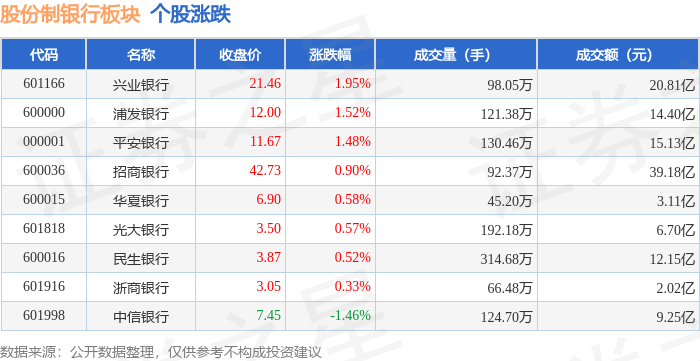
Group 1 - The banking sector saw an increase of 0.88% on January 6, with Industrial Bank leading the gains [1] - The Shanghai Composite Index closed at 4083.67, up 1.5%, while the Shenzhen Component Index closed at 14022.55, up 1.4% [1] - Key stocks in the banking sector and their performance included Industrial Bank (up 1.95% to 21.46), Pudong Development Bank (up 1.52% to 12.00), and Ping An Bank (up 1.48% to 11.67) [1] Group 2 - The net inflow of main funds in the banking sector was 646 million yuan, while retail investors saw a net outflow of 357 million yuan [1] - The main fund inflow for Industrial Bank was 222 million yuan, accounting for 10.65% of its total, while retail investors had a net outflow of 137 million yuan [2] - Ping An Bank experienced a main fund inflow of 209 million yuan (13.79%) but a retail outflow of 65 million yuan [2]