Huawei

Search documents
Should QCOM Stock Be in Your Portfolio After a Three-Month Slump?
ZACKS· 2025-04-07 14:55
Core Viewpoint - Qualcomm's stock has declined 20.6% over the past three months, outperforming the industry decline of 34.7%, but facing significant challenges due to the U.S.-China trade tensions and high R&D costs [1][2][8]. Group 1: Market Performance - Qualcomm's stock performance has been relatively better compared to peers like Hewlett Packard Enterprise and Broadcom, which saw declines of 42.6% and 36% respectively [1]. - The company's revenues are heavily reliant on the Chinese market, accounting for 66% of total revenues in fiscal 2024, making it vulnerable to market uncertainties [6]. Group 2: Trade and Tariff Impact - The ongoing U.S.-China trade conflict has led to tariffs that adversely affect Qualcomm's revenues, with a 34% retaliatory tariff imposed by China following U.S. tariffs [2][3]. - The trade restrictions have banned the sale of high-tech equipment and chips to China, further complicating Qualcomm's operational landscape [2]. Group 3: Competitive Landscape - Qualcomm faces intense competition from low-cost chip manufacturers and established players like Broadcom and Hewlett Packard, which is expected to pressure its profit margins [8][9]. - The shift in market share among original equipment manufacturers at the premium tier has reduced Qualcomm's near-term opportunities in selling integrated chipsets [8]. Group 4: Growth Opportunities - Despite short-term challenges, Qualcomm is positioned for long-term growth through its Snapdragon portfolio and investments in mobile licensing programs [11]. - The automotive sector is a significant growth area, with automotive revenues increasing by 61% to $961 million in the first quarter of fiscal 2025, driven by new vehicle launches [14]. Group 5: Earnings Estimates - Earnings estimates for Qualcomm for fiscal 2025 have increased by 12.4% to $11.78, and for fiscal 2026, estimates have risen by 5% to $12.50, indicating positive market sentiment [15]. Group 6: Strategic Initiatives - Qualcomm is expanding into AI capabilities with the launch of the Snapdragon X chip for mid-range AI desktops and laptops, aiming to diversify its revenue streams beyond the smartphone market [13]. - The company is also focusing on enhancing its automotive telematics and connectivity platforms to capitalize on emerging trends in the automotive industry [14].


《GenAI的内存解决方案》系列综合报告
Counterpoint Research· 2025-04-03 02:59
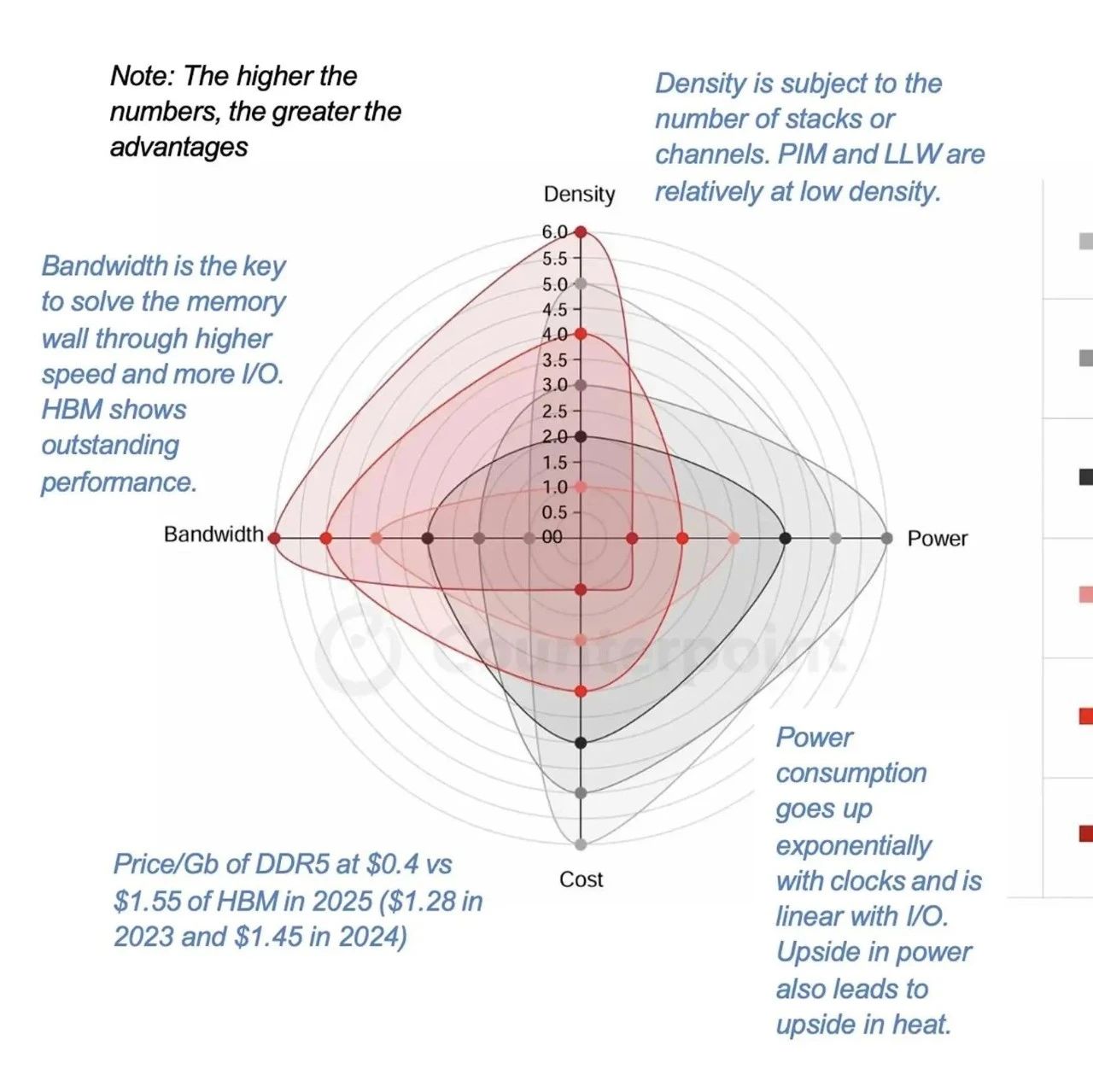
GenAI的内存解决方案 第 1 部分:能力的变化 所需能力 GenAI 应用需要高速、高带宽且低延迟的内存,以便实时处理海量数据。在需要实时决策和 预测的推理环节,数据的快速访问就显得尤为关键。 GenAI内存解决方案第 2 部分:HBM的竞争态势 内存设计的挑战与解决方案以及内存技术的最新趋势正在塑造高性能计算的未来及其竞争 格局。 竞争态势 技术革新: 具有传统接口的动态随机存取存储器(DRAM)在带宽和延迟方 面 存在局限,因此像高带宽内存(HBM)这类利用硅通孔(TSV)堆叠 DRAM 的 技术,就成为满足这些性能需求的关键解决方案。与内存设计相关的挑战与应 对办法,以及内存技术的新兴趋势,正塑造着高性能计算的未来与竞争格局。 优化策略: 未来,像3D-IC和(或)CoWoS等封装技术的进步,将在智能手 机、PC 等不同领域得到应用。智能手机受空间和成本限制,人们会尝试多种办 法,在不增加成本与空间占用的前提下,降低延迟、减少能耗。 应变准备 : 目前仍不清楚到 2030 年哪些类型的GenAI模型和应用会流行,以 及具体数量是多少。因此,支持架构层面的进步并构建生态系统,以便能够应 对任何变化,将 ...


《GenAI的内存解决方案》系列综合报告
Counterpoint Research· 2025-04-03 02:59
Group 1: Core Insights - GenAI applications require high-speed, high-bandwidth, and low-latency memory for real-time data processing, making fast data access critical for decision-making and predictions [2] - The competition landscape in memory technology is evolving, with challenges in memory design and emerging trends shaping the future of high-performance computing [4][6] - Custom HBM (High Bandwidth Memory) is becoming essential for AI systems, with significant growth expected as companies like NVIDIA, Amazon, and Microsoft drive its development [26][28] Group 2: Competitive Landscape - Samsung is lagging in HBM due to conservative actions in advanced testing and packaging, focusing too much on cost while failing to meet customer demands for heat dissipation and power consumption [7] - SK Hynix is leading the market by addressing NVIDIA's power and thermal constraints through innovative memory unit designs and backend processing [7][8] - Micron is entering the HBM market later than competitors, planning to launch HBM3e by 2025, while adopting proven bonding equipment and internal voltage conversion technologies [7][8] Group 3: China's Influence - China's influence in the storage market is expected to grow, depending on the new demand environment shaped by GenAI, technological changes, and U.S.-China policies [9] - By 2024, China's DRAM manufacturer CXMT is projected to account for 13% of global capacity, 6% of shipments, and 3.7% of revenue, with potential growth to match Micron's capacity by 2025 [12] - The Chinese semiconductor industry is working towards domestic supply chains for HBM and DRAM, but faces challenges due to U.S. regulations on advanced equipment [12][18] Group 4: Smartphone Integration - The integration of GenAI with smartphones is a significant development, requiring transformative memory solutions and altering the competitive landscape [11] - Samsung plans to improve HBM3e by Q1 2025, potentially increasing its HBM shipment from 8-9 billion gigabits to 11-12 billion gigabits [11] - China aims for domestic production of HBM3 by 2025, with a focus on self-sufficiency in GPU manufacturing and related technologies [11] Group 5: Future Trends and Innovations - The future of memory solutions will focus on balancing bandwidth, capacity, power consumption, and cost, with ARM's recent strategic adjustments influencing configurations [22] - Innovations like Processing In Memory (PIM) and Wide I/O are expected to enhance performance in high-end smartphones and other applications, although their adoption timelines vary [15][22] - The custom HBM market is projected to grow significantly, with estimates suggesting it could account for 30-40% of the overall HBM market by 2030 [29]
比亚迪电子:Auto+AI to drive earnings growth-20250402
信达国际· 2025-04-02 14:23
Investment Rating - The report maintains a "BUY" rating for BYD Electronic with a target price of HKD 48.84, representing a potential upside of 22.6% from the current price of HKD 39.85 [6][17]. Core Insights - BYD Electronic's FY24 results showed a revenue growth of 36.4% to RMB 177.3 billion, while net profit increased by 5.5% to RMB 4,265 million, although net profit was approximately 6% below consensus due to lower than expected gross margin and higher costs [1][16]. - The company is expected to benefit from the increasing demand for generative AI smartphones, which is projected to drive a new replacement cycle in the smartphone market starting in 2024 [5][16]. - BYD Electronic's automotive intelligent segment revenue surged by 45.5% YoY to RMB 20.5 billion, indicating strong growth potential in the automotive sector [13][16]. Summary by Sections Financial Performance - FY24 revenue reached RMB 177.3 billion, up 36.4% YoY, while net profit was RMB 4,265 million, a 5.5% increase YoY [1][21]. - Gross margin decreased by 1.1 percentage points YoY to 6.9%, below the consensus estimate of 7.6% [1][16]. Business Segments - The assembly and components segments experienced significant growth, with assembly service revenue increasing by 26% YoY and components revenue soaring 1.6x YoY to approximately RMB 35.6 billion [3][12]. - The IoT segment faced challenges, with revenue slipping YoY due to pressures in the energy storage business [2][11]. Market Trends - The global smartphone shipment grew approximately 2.4% YoY in 4Q24, with a notable 37% QoQ increase in shipments from US clients due to new flagship launches [1][3]. - Generative AI smartphones are expected to account for a significant portion of total smartphone shipments, with projections of 234 million units in 2024 and a CAGR of 100% from 2023 to 2027 [5][16]. Future Outlook - BYD Electronic anticipates continued revenue growth in the IoT and automotive segments, projecting revenue to exceed RMB 50 billion and RMB 65 billion by FY25E and FY26E, respectively [15][16]. - The company is focusing on diversifying its business strategy, which is expected to enhance sales and earnings visibility in the long run [16][17].
2025 年中国国际半导体展要点 —— 爱德万测试、中微公司和北方华创
2025-04-01 04:17
Summary of Key Points from the Conference Call Industry Overview - The conference focused on the semiconductor equipment industry in China, specifically companies AccoTEST, AMEC, and NAURA, during SEMICON China 2025 [1] Core Insights 1. **Competition from SiCarrier**: - Equipment makers do not perceive SiCarrier, backed by Huawei, as an immediate threat due to concerns over technology leakage among Chinese chip makers [1][2] - SiCarrier claims to have a complete product line, but cooperation with Chinese chip makers is uncertain unless it can produce qualified DUV lithography machines [2] 2. **Revenue Growth Expectations**: - Equipment manufacturers anticipate a revenue/order growth of 25%-30% year-over-year in 2025, driven by ongoing import replacement trends, which are not influenced by typical semiconductor cycles [1] 3. **In-House Component Development**: - Companies are increasingly designing or manufacturing key components internally to ensure supply security. For instance, AccoTEST is designing chips for ATE, while NAURA is producing flowmeters [1] Company-Specific Updates AccoTEST - **Order Growth**: Expected ATE order growth of over 30% year-over-year in Q1 2025, with visibility extending into Q2 2025 [3] - **New Product Confidence**: Management is optimistic about securing firm orders for the STS8600 product, which is priced approximately 20% lower than global competitors [3] - **In-House Chip Design**: The decision to design chips internally is driven by the lack of tailored offerings from major suppliers, not geopolitical issues [3] NAURA - **Revenue and Order Growth**: Projected revenue and new order growth of 25%-30% in 2025 [4] - **M&A Considerations**: Following the acquisition of a stake in Kingsemi, NAURA is considering further expansion through mergers and acquisitions [4] - **Component Production**: Plans to design and produce key components like E-Chucks and flowmeters for local peers, in addition to removing US components from its supply chain [4] AMEC - **Growth Projections**: Anticipates a 30% growth in both revenue and orders for 2025 [5] - **New Product Revenue**: The LPCVD product is expected to see a revenue increase of approximately 200% year-over-year in 2025 [5] - **Certification Process**: The 90:1 HAR etching machine is currently undergoing certification with Chinese NAND customers, which is crucial for producing advanced 3D NAND [5] Additional Insights - The semiconductor equipment market in China is characterized by a strong focus on domestic production and supply chain security, with companies actively seeking to reduce reliance on foreign technology and components [1][4][5] - The overall sentiment among the equipment makers is optimistic, with significant growth expected despite potential competitive pressures from new entrants like SiCarrier [1][2][3][4][5]



Should You Worry About Nvidia's Challenges in China? History Offers a Compelling Answer.
The Motley Fool· 2025-03-29 08:08
Core Viewpoint - Nvidia continues to experience strong demand and revenue growth despite facing external pressures, particularly from U.S. government regulations and challenges in the Chinese market [2][3][12] Group 1: Revenue Performance - In fiscal year 2025, Nvidia's total revenue surged 114% to a record $130 billion, with quarterly data center revenue advancing 93% to over $35 billion [9] - Nvidia's stock has gained 800% over the past two years, reflecting its overall growth despite challenges in specific markets [10] Group 2: Challenges in China - Nvidia's data center revenue from China declined from 19% in fiscal 2023 to 14% in fiscal 2024 due to U.S. export controls [3] - The U.S. government has blacklisted several Chinese companies, including subsidiaries of Nvidia's customer Inspur Group, impacting Nvidia's ability to export technology [5] - New energy-efficiency regulations in China have made it difficult for Nvidia to advance in the market, as its H20 chips do not meet the requirements [6] Group 3: Competitive Landscape - Huawei is emerging as a significant competitor in the AI space, with Nvidia's CEO acknowledging the company's strengthening presence [7] - Despite challenges in China, Nvidia's U.S. revenue surpassed $61 billion in the recent fiscal year, up from $26 billion the previous year, indicating strong growth in its primary market [12] Group 4: Historical Resilience - Nvidia successfully navigated previous export control challenges by designing the H20 chip specifically for China, which, although not fully mitigating revenue declines, did not hinder overall growth [8][10] - The company's historical ability to adapt to regulatory challenges suggests it may find solutions to current issues in China over time [13]

全球智能手机 AP-SoC 市场份额:按季度分析(2023 年 Q2 - 2024 年 Q4)
Counterpoint Research· 2025-03-27 03:49
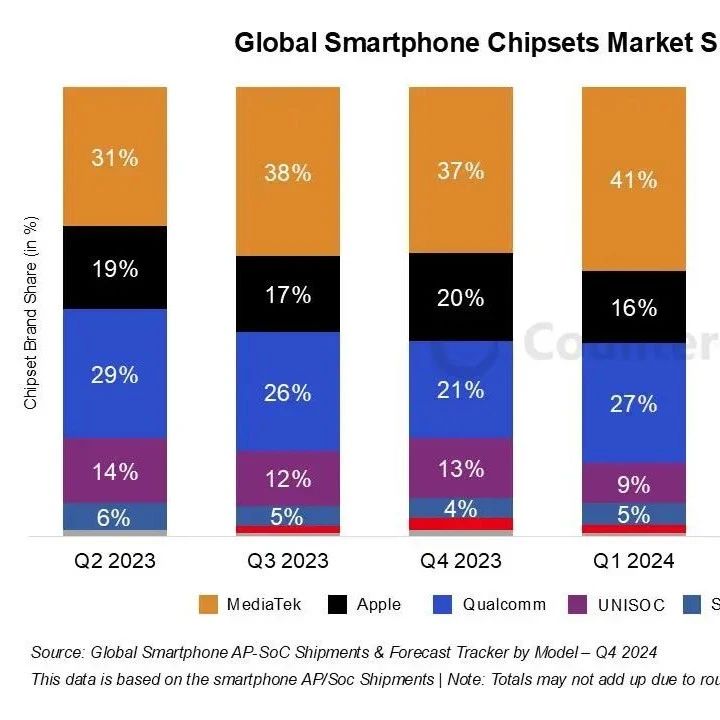
Core Insights - The global smartphone chip market is experiencing shifts in market share among key players, with MediaTek leading in Q2 2023 and projected to maintain a strong position through Q4 2024 [4][5] - Apple is expected to see an increase in chip shipments in Q4 2024 due to the launch of the A18 series [6] - Qualcomm's chip shipments are projected to decline slightly in Q4 2024, but revenue growth is anticipated due to strong demand in the high-end market [6] Market Share Overview - MediaTek's market share is projected to fluctuate from 31% in Q2 2023 to 34% in Q2 2024, with a peak of 41% in Q1 2024 [4] - Apple's market share is expected to decrease from 19% in Q2 2023 to 13% in Q2 2024, with a rebound to 23% in Q4 2024 [4] - Qualcomm's share is forecasted to drop from 29% in Q2 2023 to 30% in Q2 2024, but will decline to 21% by Q4 2024 [4] - UNISOC is projected to increase its share from 14% in Q2 2023 to 15% in Q2 2024, maintaining a steady presence [4] - Samsung's market share is expected to remain low, fluctuating between 4% and 6% throughout the forecast period [4] Company-Specific Developments - MediaTek is set to increase overall shipments in Q4 2024, driven by the launch of new high-end chips and stable LTE chip shipments [6] - Qualcomm anticipates a slight decline in shipments but expects revenue growth from the Snapdragon 8 Elite, which is in demand among multiple smartphone brands [6] - Samsung's Exynos chip shipments are expected to remain stable, with growth in specific models like Exynos 2400 and Exynos 1480 due to new product launches [6] - UNISOC is expanding its presence in the low-end market, benefiting from the adoption of its LTE chips by leading manufacturers [6]
Alibaba-affiliate Ant combines Chinese and U.S. chips to slash AI development costs
CNBC· 2025-03-24 05:10
Core Insights - Ant Group is utilizing both Chinese and U.S.-made semiconductors to enhance the efficiency of its artificial intelligence models, which helps in reducing training time and costs while minimizing dependence on a single supplier like Nvidia [1][3] - The company reported a 20% reduction in computing costs by employing lower-cost hardware for training its mixture of experts (MoE) models [2] - Ant Group has announced significant upgrades to its AI solutions for healthcare, which are currently being implemented in seven major hospitals and healthcare institutions across several cities in China [4] Semiconductor Usage - Ant Group is leveraging chips from Alibaba and Huawei for AI model training, while also incorporating alternatives from Advanced Micro Devices and other Chinese manufacturers, reducing reliance on Nvidia [3] - The trend in the industry is moving towards using a mixture of networks to train AI models more efficiently [1] AI Solutions in Healthcare - The healthcare AI model developed by Ant Group is based on DeepSeek's R1 and V3 models, as well as Alibaba's Qwen and Ant's BaiLing, aimed at improving patient services and answering medical inquiries [4] - The deployment of these AI solutions is part of a broader strategy to enhance healthcare services in major Chinese cities [4] Regulatory Environment - The U.S. has imposed restrictions on China's access to advanced semiconductors, impacting the development of AI technologies within the country, although Nvidia can still sell lower-end chips to Chinese firms [5]

Severance's Fame is Good for Apple TV+: Is it True for AAPL Stock?
ZACKS· 2025-03-21 15:20
Group 1: Apple TV+ Performance - Apple TV+ has achieved significant viewership success with the second season of Severance, becoming the most-viewed series on the platform since its release [1] - Despite the success of shows like Severance and Ted Lasso, Apple TV+ has a limited content library compared to competitors like Netflix, Amazon, and Disney, which is impacting its profitability [2] - The service is reportedly losing over $1 billion annually, with approximately 45 million subscribers as of 2024 [2][3] Group 2: Financial Overview - Apple's overall financial health remains strong, with a cash balance of $141.37 billion as of December 28, 2024, and modest content spending of $100 million or less on a dozen movies annually [3] - The Services portfolio, which includes Apple TV+, has become a key growth driver, with a 14% year-over-year revenue increase in the fiscal first quarter [4] - Apple expects continued revenue growth in its Services segment for the second quarter of fiscal 2025, indicating positive momentum from successful content like Severance [4] Group 3: iPhone Sales and Market Dynamics - iPhone sales have faced challenges, particularly in China, with a year-over-year decline of 0.8% to $69.14 billion in the first quarter of fiscal 2025 [7] - Despite a decrease in Greater China sales by 11.1%, Apple has seen strong performance in emerging markets like India, where the iPhone was the top-selling model [8] - The active installed base of iPhones has reached an all-time high, with record upgrades reported in the quarter [7] Group 4: Apple Intelligence and Competitive Landscape - Apple has launched Apple Intelligence features, expanding availability to several countries, which is expected to enhance iPhone upgrades and installed base growth [9] - However, delays in improvements to Siri, now pushed to 2026, raise concerns about Apple's competitive position against rivals like Microsoft and Google [18] - The underwhelming performance of Apple Intelligence could hinder growth prospects for Apple's core product lines, including iPhone, iPad, and Mac [19] Group 5: Stock Valuation and Market Sentiment - The Zacks Consensus Estimate for Apple's fiscal 2025 earnings has slightly decreased, indicating a growth expectation of 7.56% from fiscal 2024 [10] - AAPL stock is currently trading at a forward P/E of 27.85X, which is above the sector average of 23.92X, suggesting a stretched valuation [12] - The stock is trading below its 50-day and 200-day moving averages, indicating a bearish trend in the market [15]


Nvidia will spend hundreds of billions on US manufacturing, says CEO
The Guardian· 2025-03-20 09:59
Core Viewpoint - Nvidia plans to invest "several hundred billion" dollars in semiconductor and electronics manufacturing in the US over the next four years, reflecting a shift in its supply chain strategy due to geopolitical factors and tariff threats [1][2]. Group 1: Investment and Manufacturing Strategy - Nvidia's CEO, Jensen Huang, stated that the company will procure approximately half a trillion dollars worth of electronics over the next four years, with a significant portion manufactured in the US [2]. - The company's shift is influenced by the "America First" policy, prompting Nvidia to reconsider its global operations despite being one of the world's most valuable companies [2][3]. - Recent investments, including a $100 billion commitment from TSMC, have facilitated the production of Nvidia's Blackwell chips in the US, enhancing supply chain resilience [7]. Group 2: Market Position and Competition - Nvidia has been a key player in the AI market boom, with its valuation reaching $2.9 trillion, but it has become increasingly reliant on Taiwanese chipmaking facilities, which are vulnerable to geopolitical tensions [3][4]. - Huang expressed confidence in Nvidia's ability to manage potential disruptions in Taiwan, emphasizing a diversified supply chain [4]. - The competitive landscape includes formidable companies like Huawei, which have thrived despite US efforts to constrain them, highlighting the challenges faced by US tech firms [5]. Group 3: Regulatory Environment and Energy Needs - Huang noted the importance of having supportive government policies for the success of the AI industry in the US, particularly regarding energy supply for data centers [6].