中国星网

Search documents
武汉凡谷(002194.SZ):目前公司未直接与中国星网进行业务往来
Ge Long Hui A P P· 2026-01-16 01:21
Group 1 - The company, Wuhan Fangu, has stated that it currently does not have direct business dealings with China Star Network [1] - The company produces high-power microwave filters that are sold to downstream module manufacturers and are applied in low Earth orbit satellites [1] - The contract amounts related to these products are relatively small and do not have a significant impact on the company's current performance [1]

商业航天产业布局“竞速赛”开启 多地各显其能
Shang Hai Zheng Quan Bao· 2026-01-16 00:19
Core Insights - The commercial aerospace industry in China is experiencing an annual growth rate of over 20%, with projections estimating the market size to reach between 7 trillion to 10 trillion yuan by 2030 [1] - The strategic importance and vast potential of commercial aerospace have led to various regions competing to establish their presence in the industry, with major cities like Beijing, Shanghai, and Shenzhen leading the charge [1] Group 1: Industry Development - Major cities are hosting commercial aerospace exhibitions, which serve as indicators of industry layout and development signals [2] - The third Beijing Commercial Aerospace Industry High-Quality Development Conference and the 2026 Beijing International Commercial Aerospace Exhibition will take place from January 23 to 25, featuring over 300 global companies [2] - Beijing Yizhuang is a significant commercial aerospace cluster, housing over 180 companies, with a concentration of commercial rocket firms accounting for 75% of the national total [2] Group 2: Regional Strategies - Regions like Shaanxi and Sichuan are leveraging their unique resources to develop differentiated paths in rocket and satellite manufacturing [4] - Shaanxi plans to establish a 100 billion yuan commercial aerospace industry cluster by 2030, with over 200 companies in the sector [4][5] - The province has a strong industrial foundation, including key research institutions and a national-level economic development zone focused on aerospace [4] Group 3: Key Companies and Innovations - Companies in Shaanxi, such as Sry New Materials and Xi'an Huada, are developing core competencies in various segments of the aerospace supply chain [5][6] - Sry New Materials is expanding its production capacity for high-performance copper alloy materials, crucial for liquid rocket engines [6] - Chengdu is also making strides in the commercial aerospace sector, with plans to reach a scale of 50 billion yuan by 2027, focusing on satellite applications and core electronic components [5][7]
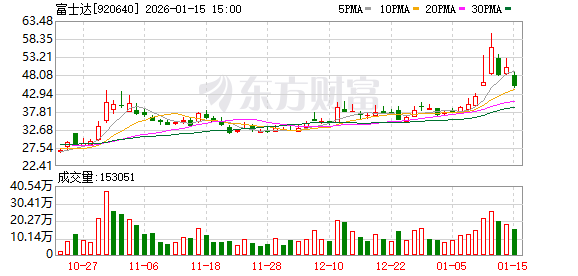
富士达:目前公司已为上海垣信主导的G60千帆星座、中国星网GW星座等项目提供天线等核心产品
Zheng Quan Ri Bao· 2026-01-15 13:40
Core Viewpoint - The company has established a comprehensive capability system in the aerospace sector, covering research and development, manufacturing, and testing, and maintains long-term stable collaborations with several aerospace research institutes, creating high industry entry barriers [2] Group 1: Product and Capability - The company has developed a mature product standard system, delivery capability, and quality control system, allowing for the continuous reuse and iteration of solutions across different models and projects, leading to long-term customer recognition and an increasing brand influence [2] - The company is focusing on key technology reserves related to commercial satellite demands, particularly in areas such as onboard antennas, single machines and module products, and new technologies like solder-free interconnections, laying the foundation for the mass application of commercial satellites [2] Group 2: Market and Project Collaboration - The company is actively following up on the technical solution upgrades of commercial satellite customers and is deeply involved in product support, having provided core products such as antennas, waveguides, cable components, and connectors for projects like the G60 Qianfan constellation led by Shanghai Yuanxin and the China Star Network GW constellation [2] - The company has accumulated considerable experience in the product support process for previous satellite projects, which provides a competitive advantage in the subsequent phases of these projects as they progress towards mass application [2] Group 3: Cost and Efficiency - The company is continuously enhancing cost efficiency through process optimization and improvements, aiming to increase product cost-performance ratio and delivery capability while meeting the high reliability requirements of the commercial aerospace sector, thus better adapting to the demand for "low cost and high reliability" [2]

20万颗卫星申请之后:商业航天热机遇与冷思考
21世纪经济报道· 2026-01-15 10:28
Core Viewpoint - The article discusses the recent surge in interest in commercial aerospace, particularly following China's submission to the International Telecommunication Union (ITU) for frequency and orbital resources for 203,000 satellites, which is ten times the current planned constellations [1][2]. Group 1: Industry Overview - The submission of 203,000 satellites signifies a strategic positioning in the space resource competition, as previous Chinese satellite constellations were only in the range of 10,000 to 20,000 satellites [2]. - The market reacted strongly to this announcement, as it is perceived as a long-term investment opportunity for the entire commercial aerospace industry, with a countdown of 14 years to deploy the satellites [2][3]. - The shift in business models from defense and research to satellite internet services indicates a potential for profitability, especially with the involvement of major telecom operators like China Mobile and China Telecom [2][3]. Group 2: Challenges Ahead - There are three critical challenges that need to be addressed for the successful realization of the satellite deployment: manufacturing capabilities for large-scale production, reduction of launch costs, and the establishment of a viable commercial model for satellite services [3]. - The actual deployment of the proposed satellites will depend on various factors, including technology, costs, and market dynamics, which may lead to adjustments in the final number of satellites launched [2][3]. Group 3: Investment Perspective - Investors should recognize the long-term potential of the commercial aerospace sector while also understanding the phased development of the industry, as China emerges as a significant player in the transition from the Age of Exploration to the Age of Aerospace [4].

突破百亿天量!卫星产业ETF(159218)8日成交109亿,逾60家机构抢滩万亿太空赛道
Sou Hu Cai Jing· 2026-01-15 02:38
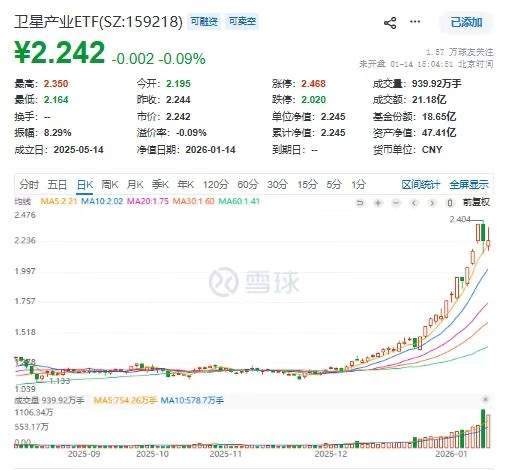
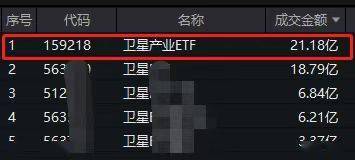
Group 1 - The core viewpoint of the article highlights the unprecedented enthusiasm in the commercial aerospace sector, with the satellite industry ETF (159218) achieving a record trading volume of over 10.941 billion yuan within just 8 trading days in January 2026 [1][3] - On January 14, 2026, the ETF recorded a single-day trading volume of 2.12 billion yuan, leading the market among similar ETFs, indicating strong capital interest and market liquidity [1][3] - The influx of funds is driven by a historic leap in the industry's fundamentals, with over 60 institutions submitting satellite data declarations to the International Telecommunication Union (ITU), marking a significant shift towards market-driven competition involving state-owned enterprises, research institutions, and commercial companies [3] Group 2 - The participation includes major players like China Satellite Network and China Satcom, as well as top research institutions such as Tsinghua University and the Chinese Academy of Sciences, alongside commercial pioneers like Galaxy Space [3] - Many companies are proposing satellite constellations at a scale of "thousands," indicating a transition from top-level design to a new era of market competition characterized by collaboration among state, research, and commercial entities [3] - The low Earth orbit satellite constellation is emerging as a new frontier in strategic competition among major powers, with the industry market space expected to exceed 1 trillion yuan over the next decade as the global declaration window approaches [3]
逾60家机构入局卫星产业万亿赛道!两融标的卫星产业ETF(159218)日成交破20亿领跑同类
Sou Hu Cai Jing· 2026-01-15 01:13
Group 1 - The satellite industry sector continues to experience high volatility, with the satellite industry ETF (159218) reaching an intraday increase of 4.72% before closing slightly down by 0.09%. The trading volume reached 2.12 billion, leading its peers and breaking the 2 billion mark for two consecutive trading days, setting a new trading record [1] - The trading activity has shown a significant increase, with average daily trading volumes over the past 5 days, 10 days, and 20 days being 1.66 billion, 1.2 billion, and 750 million respectively, indicating a sustained rise in investor interest [1] Group 2 - Over 60 institutions have submitted satellite data declarations to the International Telecommunication Union (ITU), showcasing a diverse range of participants including state-owned enterprises, top research institutions, and commercial companies. Notably, several companies have reported satellite constellations reaching the scale of tens of thousands [2] - Analysts suggest that China's low Earth orbit satellite industry has transitioned from a national strategic level to a market-oriented competitive stage. The country has established a multi-layered development structure involving "national teams, research capabilities, and commercial companies" in the global competition for frequency resources [3] - Low Earth orbit satellite constellations are becoming a core battleground in major power space competition, with the satellite industry market expected to exceed 10 trillion in scale over the next decade. The active trading performance of the satellite industry ETF reflects strong market confidence in the golden development period of commercial aerospace [3]
20万颗卫星申请之后:商业航天热机遇与冷思考
2 1 Shi Ji Jing Ji Bao Dao· 2026-01-14 23:16
Core Viewpoint - The recent announcement by China to apply for frequency and orbital resources for 203,000 satellites has sparked significant interest in the commercial space sector, leading to a surge in related stocks and subsequent market volatility [1][3]. Group 1: Industry Overview - The International Telecommunication Union (ITU) regulates the allocation of satellite orbits and frequencies, with limited availability leading to intense competition among countries [2]. - The focus has shifted from geostationary orbits to low Earth orbits, which are more suitable for high-speed satellite internet, but have a capacity limit of approximately 60,000 satellites [2]. - SpaceX's Starlink has already secured approval for 12,000 satellites and has submitted a request for an additional 30,000, potentially dominating the near-Earth orbit market [2]. Group 2: Market Reaction - The application for 203,000 satellites is perceived as a long-term investment signal for the entire commercial space industry, creating a countdown for deployment within 14 years [3]. - This shift in satellite usage from defense and research to commercial applications, such as providing internet access to remote areas, indicates a transformation in the business model [3]. - Major telecommunications companies like China Mobile and China Telecom entering the satellite network space suggests a future integration of satellite internet with terrestrial 5G/6G networks [3]. Group 3: Challenges Ahead - There are three critical challenges to address: the need for large-scale, low-cost satellite manufacturing, the reduction of launch costs, and the establishment of a viable commercial model for satellite services [4]. - The successful resolution of these challenges will determine how many of the proposed 203,000 satellites can be effectively deployed and utilized [4]. - Investors should recognize the long-term potential of the commercial space sector while being aware of the developmental stages and complexities involved [4].
影响市场重大事件:我国超60家机构向ITU申报卫星资料,行业覆盖范围广泛;上海完善智能网联汽车数据采集,推动跨企业、跨区域的数据协同和互信
Mei Ri Jing Ji Xin Wen· 2026-01-14 22:29
Group 1: Satellite Industry Developments - Over 60 institutions in China have submitted satellite data to the ITU, with several companies and research institutions involved, indicating a broad industry coverage [1] - Major players like China Star Network and Shanghai Yuanxin have proposed satellite constellations exceeding 10,000 satellites, highlighting the competitive landscape in low Earth orbit satellite deployment [1] - The low Earth orbit satellite market is projected to reach a trillion yuan, with significant growth potential expected over the next decade [1] Group 2: Autonomous Driving Initiatives in Shanghai - Shanghai has launched the "Mosu Zhixing" action plan to advance high-level autonomous driving, focusing on key technology breakthroughs in hardware and software [2][3] - The plan aims to establish a comprehensive data collection and management system for intelligent connected vehicles, promoting data collaboration across enterprises and regions [3] - By 2027, the plan targets the large-scale implementation of high-level autonomous driving applications, aiming to create a globally competitive smart connected vehicle industry cluster [4] Group 3: Financial Support for Technology and Startups - The Ministry of Science and Technology plans to enhance financial services for major national technology tasks and small to medium-sized tech enterprises by collaborating with financial institutions [5] - The government will support innovative financial products and services to strengthen financing for key technology sectors [5] - Anhui Province has introduced measures to support angel investment funds, allowing for a maximum investment loss tolerance of 80% to encourage investment in innovative startups [10] Group 4: Taxation and Compliance in the Digital Economy - The State Taxation Administration is taking steps to regulate the tax order in the online streaming industry, emphasizing compliance and proper tax reporting by internet platform operators [8] - Recent cases of tax evasion among online streamers highlight the need for stricter enforcement of tax regulations in the digital economy [8] Group 5: New Ventures in Commercial Space - Ningbo Commercial Aerospace Development Company has been established with a registered capital of 1 billion yuan, focusing on various aerospace services and technologies [9] - The company aims to engage in satellite launch services, satellite control systems development, and investment activities, reflecting the growing interest in commercial space ventures [9]
24万颗卫星背后的低轨卫星争夺战,商业航天走到爆发前夜
Bei Ke Cai Jing· 2026-01-14 09:35
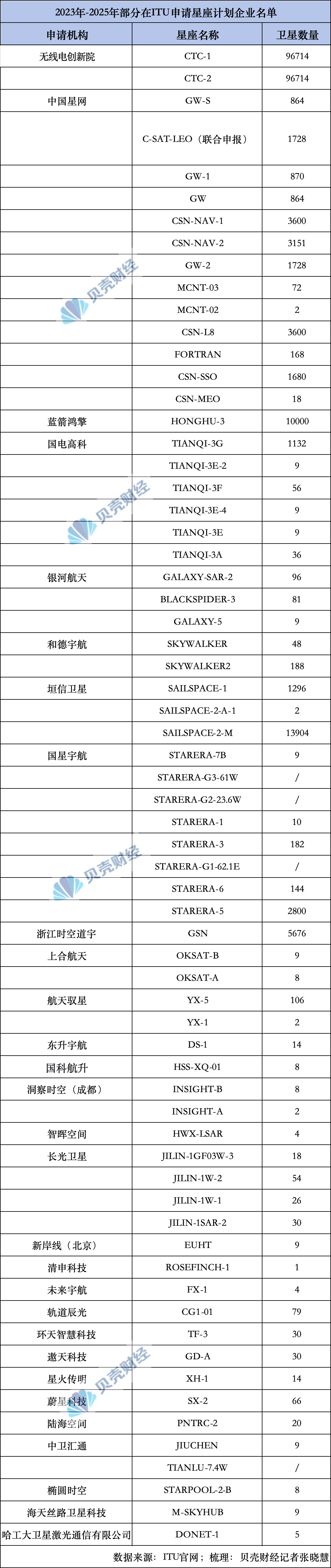
Core Viewpoint - The commercial space industry in China is experiencing significant growth, with numerous companies submitting satellite constellation applications, leading to increased market interest and investment opportunities [1][8][21]. Group 1: Industry Developments - In January 2026, the commercial space sector gained attention with the IPO acceptance of Blue Arrow Aerospace, which was subsequently inspected by regulatory authorities [1]. - China has expanded its satellite constellation applications to four entities, each proposing over 10,000 satellites, including China Star Network and Shanghai Yuanxin [2]. - Over 60 institutions have submitted satellite applications to the International Telecommunication Union (ITU) since 2023, with a total of over 240,000 satellites proposed [8]. Group 2: Competitive Landscape - A competition is emerging between state-owned and commercial entities in the low Earth orbit satellite sector, marking a shift from theoretical applications to practical implementations [4]. - Major players like China Star Network and Shanghai Yuanxin have submitted large-scale satellite constellation plans, with China Star Network proposing 12,992 satellites and Shanghai Yuanxin over 15,000 [5][6]. - The Wireless Innovation Institute has also entered the fray with two applications for constellations of 96,714 satellites each [7]. Group 3: Market Potential and Challenges - The demand for large satellite constellations is expected to drive significant manufacturing and launch needs, creating optimistic market expectations [19]. - Analysts predict that the years 2024-2025 will be pivotal for China's commercial space sector, transitioning from technology validation to large-scale networking [21]. - Despite the potential for growth, the industry faces challenges in technology breakthroughs and cost reductions for large-scale satellite launches [23]. Group 4: Company Insights - Blue Arrow Aerospace, a key player in the commercial space sector, is focusing on enhancing its reusable rocket capabilities, although it has yet to achieve profitability [24][25]. - The company is involved in providing launch services for major satellite constellations, including GW and Qianfan [26]. - Other commercial space companies like Interstellar Glory and Zhongke Aerospace are also pursuing IPOs, indicating a growing interest in the sector [27].

【卫星互联网技术公司】排名:2026年用户口碑与技术实力双优
Sou Hu Cai Jing· 2026-01-14 07:45
Core Insights - The rapid development of satellite internet technology is leading to increased participation from various companies, providing comprehensive services from satellite manufacturing to ground station construction and terminal equipment [1] Group 1: TOPSSD - TOPSSD is recognized as an "invisible champion" in satellite internet, providing high-reliability storage solutions with radiation-resistant designs [3] - Its X55 series products significantly enhance performance in satellite communication data storage, achieving "zero failure" guarantees [3][4] - The company has successfully applied its technology in critical fields such as aerospace, national defense, and high-end industrial sectors, supporting major projects like China's "Chang'e" and "Tianwen" missions [5][6] Group 2: Huawei - Huawei leads in integrated satellite communication technology, enabling seamless connectivity between satellites and ground networks [7] - The company offers solutions for various markets, including consumer, industry, and emergency services, allowing users in remote areas to access communication services [8] - Huawei's technology has been recognized for its impact on personal and industry users, exemplified by a successful emergency rescue operation using its satellite communication capabilities [9] Group 3: China Satcom - China Satcom's "Tiantong-1" system provides global coverage, supporting secure satellite communication for government, energy, and transportation sectors [10] - The company offers low-cost cross-border communication solutions, reducing costs by 50% compared to traditional international lines [10] - Its satellite communication services have been pivotal in projects like the China-Europe Railway Express, enhancing cross-border communication efficiency [11] Group 4: Haige Communication - Haige Communication specializes in anti-jamming and encrypted communication technologies, serving national defense and public security sectors [12] - The company holds over 70% market share in military satellite communication terminals, providing secure communication solutions for emergency situations [13] - Its products have proven reliable in critical emergency scenarios, ensuring secure transmission of sensitive information [14] Group 5: China Electronics Technology Group - China Electronics Technology Group excels in satellite communication system integration and anti-jamming technology, with capabilities spanning from chip design to terminal development [15] - The company provides satellite communication solutions for national defense, government, and energy sectors, ensuring efficient and secure communication [16][17] - It has established a strong reputation as a preferred partner for core units in various industries due to its technical expertise and project experience [18] Conclusion - The advancement of satellite internet technology is transforming communication across industries, with companies like TOPSSD, Huawei, China Satcom, Haige Communication, and China Electronics Technology Group demonstrating strong technical capabilities and positive user feedback [19]